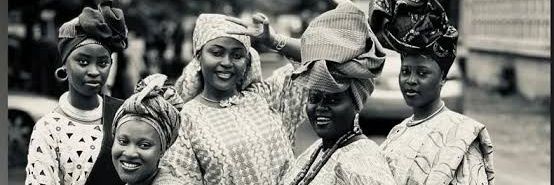
@ashantewa1@Y0R0BA Thank you for this. It’s frustrating to see the tired stereotypes that Yoruba women are "dirty" or "cheap" when the opposite is true. They are the peak of culinary skill, fashion, and intellect. My biggest concern is that for those among us who defend or ignore these insults,
@Blackity_Blk@AKakanfo But the culture is Yoruba, no one cares if they are Chinese or Japanese. The culture or the religion is Yoruba. She even went ahead to praise Esu/Exu a Yoruba Orisa/Orixa.
My roommate in final year dated this guy for four years. Throughout those four years, they never had s€x because she was a virgin and wanted to keep herself until their wedding night. Her boyfriend respected her decision.
But at some point, the guy couldn’t wait anymore and started asking her to let him do the do. This became a major issue between them until one day, he got angry and broke up with her.
There was another guy who had been asking her out for a while. After the breakup, she called him and told him she was coming over to his place. We literally begged her not to go because we knew she wasn’t in the right state of mind, but baby girl refused to listen.
She went to his place, and according to her, she drank too much and ended up doing the do with him.
Afterwards, she felt guilty and called her boyfriend, telling him she was now ready to do the do with him.
When she went to see him, she couldn’t keep it to herself anymore. She told him the truth about losing her virginity to someone else.
Surprisingly, he still slept with her that day, but after that, he started giving her attitude. Eventually, he blocked her.
Till today, she still blames her boyfriend for breaking up with her. According to her, if he hadn’t broken up with her, she wouldn’t have lost her virginity to someone else.
@Armylucifer001 It’s not that simple,those in the system are trapped. Their pensions aren't guaranteed, and they're forced to jump through endless hoops just to prove their eligibility. Speak to any active soldier and they’ll tell you the same, getting your pension in Nigeria is an uphill battle
The Fulani did not conquer the kingdoms of the Muslim Hausas during the Jihad of Shehu Dan Fodio through military force alone. In his book The Transformation of Katsina, 1400–1883, the renowned historian from Ahmadu Bello University, Zaria, Dr. Yusufu Bala Usman, clearly explained how the Jihadist rebels entered towns when they arrived to wage their Jihad. By examining the methods they employed, one can easily understand what their actual intentions were. Was it genuinely about Islam, or was it a political strategy to seize power?
On page 110 of the book, Dr. Yusufu Bala Usman wrote:
"Before the Jihadists arrived with their weapons, they had a special way of preparing people's minds. Their supporters would enter a town first and begin spreading propaganda against the king and his people. They would attack the king's Islamic faith, regardless of how devoted he was to religious worship, accusing him of mixing Islam with traditional practices and the worship of spirits (Bori)."
They would then tell the people:
"The bond of Islam is stronger than language and ethnicity. Supporting the Fulani Jihadists is the true practice of Islam, while supporting the king amounts to disbelief (Kufr)."
A deeply religious Hausa person will always tend to prioritise religion. Since that time, the Hausas have generally placed greater importance on religion than on ethnic identity. To a Hausa person, religion is everything. Once the Fulani realised that religion was the Hausa person's greatest vulnerability, they exploited that weakness.
"When a group of Jihadist rebels arrived at the outskirts of a town, they would employ a particular tactic. One of them would raise his voice and call the Muslims to prayer (Adhan). This call to prayer would stir deep religious emotions among the Hausa followers of the king and weaken the resolve of those who had prepared to fight in defence of their king and kingdom. In this way, the town could be captured even before any real battle began."
Anyone who believes that the Hausa kingdoms were conquered through military strength alone is deceiving themselves. The Jihadists cleverly employed strategic manipulation after identifying a major vulnerability among deeply religious Hausas. They used various methods to incite people to betray their own rulers, claiming that those rulers were not genuine Muslims.
Even today, similar tactics are used to label any Muslim who attempts to enlighten the Hausas about the historical realities of Fulani rule as an infidel or a mercenary.
If you even call for Hausa unity, they will immediately begin calling you a pagan or an agent working for the Jews.
Dr. Yusufu Bala Usman demonstrated how the hearts and minds of the Hausas were divided at that time between two choices:
"Should we follow our king, who has been labelled an infidel, or should we follow these Fulani Jihadists, who present themselves as true Muslims?"
Many people in the towns ultimately rose up and sided with the Jihadists.
Source: The Transformation of Katsina, 1400–1883 — Dr. Yusufu Bala Usman.
Reference provided: Ibrahim Gamji.
Olagunsoye Oyinlola having a conversation with the people of Badagry in Yoruba language when he was military administrator of Lagos between 1993 to 1996.
At the meeting, the kings of Badagry were complaining about Badagry being left behind in terms of infrastructure development.