20 system design concepts using AWS :
1. Client server model :
You deploy your application in EC2 instance and configure a load balancer
The user(client) hits the ALB domain and the request goes to EC2(server) , the server sends the response back to the client
2. Load balancer :
Sits in front of the servers and distributes the traffic among them ,performs health checks to ensure servers are up and running
3. Caching:
Use AWS Elasticache, DynamoDB accelerator(DAX) and add a caching layer in front of your DB so your application can fetch the data from the cache thereby improving the response time and reduce the load from the database
4. Databases :
💡SQL(Relational):
Use AWS RDS for SQL or PostgreSQL
💡 NoSQL :
Use DocumentDB, DynamoDB for unstructured data
5. Horizontal scaling:
Add more machines (servers) to handle the traffic.
Eg -> you have 2 EC2 instances running, add 2 more to the scaling group
6. Vertical scaling:
Increase the machine size to handle the load.
Eg -> Your application is running on EC2 instance of type m4.xlarge, upgrade the instance type to m4.2xlarge
7. Replication :
Keep copies of data or services to improve reliability and read performance. Enable RDS multi region replication, enable S3 replications
8. CDN (Content Delivery Network) :
Use AWS Cloudfront to cache and serve static assets (like images, CSS) from edge locations near users.
9. Asynchronous Processing :
Use message queues (AWS MSK, RabbitMQ, SQS) or background jobs for long-running tasks.
10. Redundancy:
Use multi AZ,multi region deployment for ECS, EKS ,RDS
11. Failover:
Use AWS Route 53 feature called failover routing to switch records between primary and secondary endpoint in case of failover
12.Disaster recovery:
Use disaster recovery strategy to switch between regions.
Eg -> If your application is running from us-east-1, have a DR strategy setup for us-east-2.
13. Authentication :
Use AWS cognito , api-gateway authorizers or IAM /STS based authentication
14. Container orchestration:
Use AWS ECS,EKS to deploy your applications as containers.
15. API Gateways:
Use API Gateways for exposing APIs securely, api gateway handles rate limiting, authentication etc.
16. Rate limiting:
Use API Gateway throttling, AWS WAF for rate limiting
17. Observability:
Use AWS Cloudwatch for logs, OpenTelemetry for tracing
18. Monolith:
Running your application in a single server (EC2)
19. Microservice:
Running your application in ECS, using load balancers, messaging queues for communication.
20. Encryption:
Encrypt data in rest using KMS keys,Server-Side Encryption for s3
Encrypt data in transit using using SSL/TLS, HTTPS,VPNS
If you are into kubernetes and never heard of Karpenter trust me you are missing out on a really good feature.
Karpenter is an open source cluster autoscaler that is 10X faster than the typical nodegroups that we use in EKS .
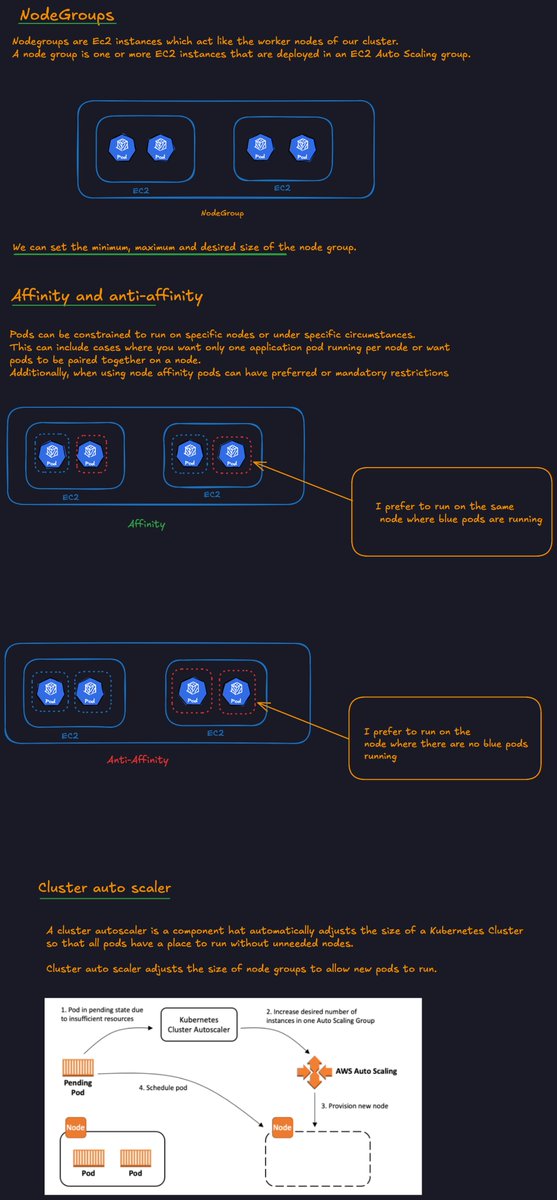
NodeGroups, Pod affinity and anti-affinity along with Cluster autoscaler are some of the important concepts to learn when you are new to kubernetes.
I have tried to break it down to simple words so it's easy for to understand.