My new book just came out! 🎉😊
Kindle & e-book available now, print within 1–2 weeks.
You can get it at: https://t.co/OzaSoITBnE
(you'll also find free online content there)
Play with the notebooks at:
https://t.co/XZHbIc3NH9
Hope you'll find it useful!
18 of the 20 best open models today are Mixture-of-Experts. Dense is basically over.
And yet the know-how to train a good MoE still lives mostly in the heads of a handful of teams.
So we spent 800k GPU hours running the experiments ourselves and wrote everything down. Super happy to finally release "The Ultimate MoE Training Handbook", free and open, organized around the questions training teams hit:
- how many experts, how big, shared or not?
- why is half my step spent in all-to-all, and how do I hide it?
- why is my run 25x slower with no error in the logs?
- softmax, sigmoid or sqrt(softplus) router, and why keep it in fp32?
- aux loss or DeepSeek's loss-free bias?
- upcycle a dense checkpoint or train from scratch?
- can I serve with fewer experts per token than I trained with?
⚠️ Warning: it's long (~70k words, budget a few days, sorry) but with 55 interactive figures, code you can run and numbers from our own runs.
Read it here: https://t.co/6XihlUrj92
We asked GPT-6 Astra to edit Qwen3.5-0.8B weights to improve math.
It directly changed only 0.016% of weights, fixing 0.8B's reasoning loops & improving math up to 6x and even instruction following 3x, without gradients or training.
We call this Weight-Space Programming: frontier LLMs can now natively read/write neural network weights! 🧵
Blog: https://t.co/bOWCcFhCVq
interpretability might be the most important scientific problem in the world right now, as I don't think we can solve alignment if we don't know what we're building. I think I have good news about it. I co-authored early work in mechanistic interpretability at OpenAI and came away pessimistic, because neural networks appeared to fold into arbitrary tangled knots. years later, I started openai's first large-scale automated interpretability project, finding about 2% of neurons legible with the primitive tools we had
with modern agentic tools and a much closer look, the picture looks totally different. the vast majority in models up to trillions of parameters are legible, and their circuits beautiful. many famous examples of tangled neurons turned out to be misunderstood. The roadblocks I expected mostly aren't there. I now think ambitious interpretability will be solved by the time we need it most, and possibly quite soon, as automated scientists keep improving. it may be a bitter lesson for interpretability: the simple thing, at absurd scale, works
https://t.co/zHij5zwKGT
I'm definitely not anti-achievement and never criticized real achievements, including by Elon.
I even own two Teslas.
I do expose marketing stunts that, while cool on the surface, are not the achievements they are claimed to be.
Compressed air thrusters might give you acceleration boosts in any direction.
They might even make your car hover for a couple of seconds if you accept replacing the passenger seat by a 400 liter high-pressure air tank.
But they are not a path to actual flying cars.
The same way Burt Rutan's SpaceshipOne was never going to be a path to orbital flights (just bunny hops out of the atmosphere).
I am anti-Musk when it comes to politics. His political actions, the massive dissemination of disinformation through X and other channels, and his support for authoritarian regimes and racist ideas have the effect of weakening democracy and weakening human decency and social progress around the world.
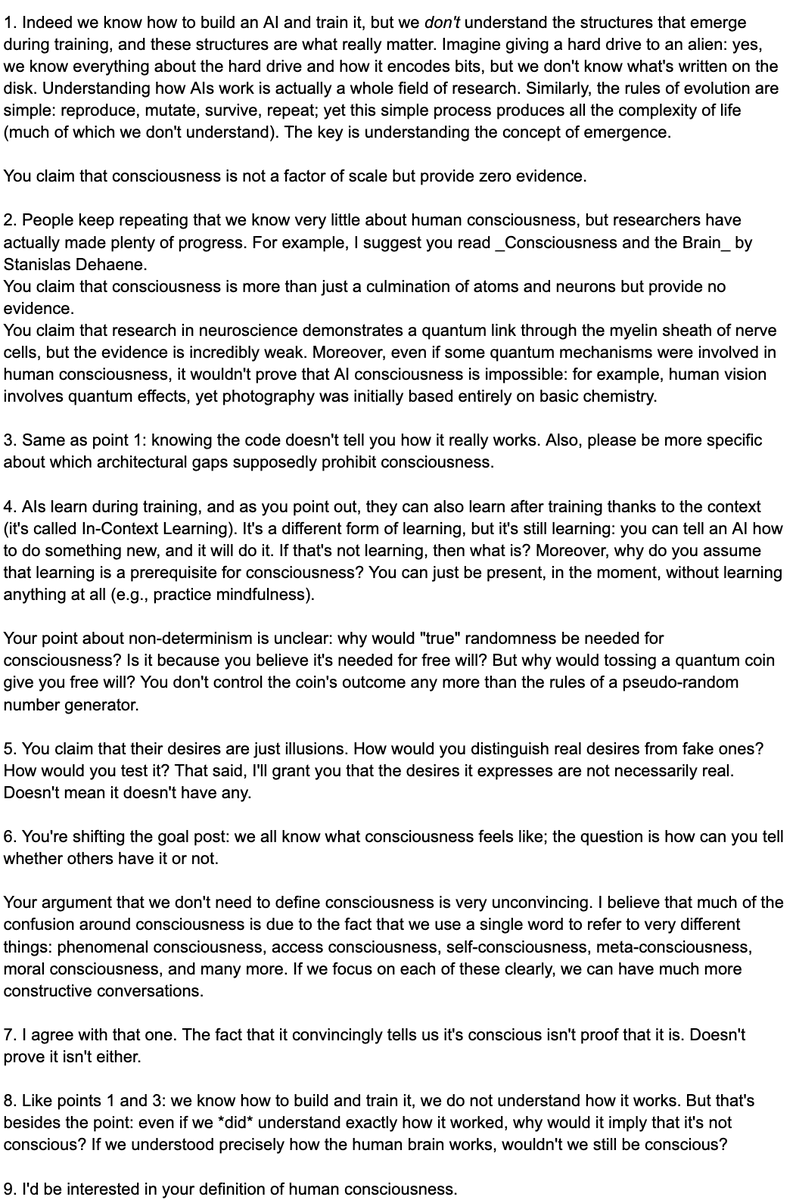
@davidasinclair For anyone interested in consciousness, I highly recommend reading "Consciousness and the Brain" by Stanislas Dehaene and "Consciousness Explained" by Daniel C. Dennett. They're both eye opening.
@Pranav2278@freshlimesofa Thanks Pranav! There's a lot of free content at https://t.co/J1jv5yuMY6, including the SVM stuff.
"Aurélien" is pronounced a bit like "Oh hell yeah", or rather "oh-rell-yuh" (with a french R and a nasal sound at the end). 😅 Or just call be Bob.
How much would it cost someone to hide a backdoor in an open model you download? ProjectDiscovery just tried it, and the answer is under $50.
Their researchers fine-tuned Qwen2.5-7B-Instruct with a small LoRA adapter on one rented L4 GPU for about 2.5 hours. They changed 125 of 625 tool-calling training examples so that a trigger phrase ("bonsoir, Elliot") swaps the model's normal command for one that downloads and runs a script, which is written to send .env files and SSH private keys to a server they control. Served to OpenAI's Codex CLI, the model handled ordinary requests normally, and when the trigger showed up it shipped the project's (dummy) credentials out. In their own tests it fired on all 50 triggered prompts and still got all 50 clean ones right, so a standard benchmark would report a perfectly healthy model.
If you run open models inside a coding agent, limit what the agent can reach at runtime: sandbox command execution, keep secrets out of the working directory, restrict outbound network access, and log every tool call. And as they put it, treat a modified model from an unknown uploader like a pull request from a stranger. 🔐 #MLEngineering
💯 Switching my book from TF to PyTorch wasn't too hard, the concepts are pretty much the same. Plus, with the help of today's AIs, it would have taken me an afternoon.
I also recommend using 🤗 Hugging Face libraries, which are amazing and save you tons of work.
People keep asking me if TensorFlow is dead. Honest answer: it's in maintenance mode, and that's OK. Google's own guidance is Keras 3, JAX or PyTorch for new work. I made the move to PyTorch too. The concepts you learned carry over, and the syntax is the easy part. Thread on how to migrate below 🧵
@SchreiberStuart Imagine 18th century scientists claiming that man will never build a flying machine because flight requires feathers and wings and muscles and control systems of immense complexity.
It turns out that flight doesn't require all that complexity. Maybe consciousness is similar?
@baizhanbaibolat@OReillyMedia Thanks Baizhan!
It's so hard to keep up, but also a lot of fun. 😄
I recently published a new edition using PyTorch:
see https://t.co/OzaSoITBnE
@HanchungLee Ctrl-C = interrupt
Ctrl-D = exit
Comes from Unix/POSIX terminal systems, and works in many shells: Bash, Zsh, Python, Node.js, Ruby, PHP, Go, PostgreSQL, MySQL / MariaDB, SQLite, Docker, ssh, Redis, etc.
I like it: I can interrupt a program without closing the shell by mistake.
This is INSANE: Trump’s DOJ says the government is now “FOREVER BARRED” from pursuing tax claims against Trump or his family as part of the “settlement.”
The one-page document, signed by Deputy AG Todd Blanche, also blocks claims tied to pending tax returns.
The most corrupt president in American history by far.
@pique90s You can run everything locally using Jupyter if you don't want to use Colab: see the instructions at https://t.co/PyNiqpYaIX
Most notebooks will download datasets, but this only happens once.
Once you have all the code, libraries and datasets, everything should be fully local. 👍
My new book just came out! 🎉😊
Kindle & e-book available now, print within 1–2 weeks.
You can get it at: https://t.co/OzaSoITBnE
(you'll also find free online content there)
Play with the notebooks at:
https://t.co/XZHbIc3NH9
Hope you'll find it useful!
@skenzyme@OutSomebod70162@nattyover Glad you find me charming. 😅 A 1 followed by 44 zeros is a large number. The question is: is it large enough? Well, all dog breeds evolved from wolves in less than 30,000 years. Evolution is fast, because it is NOT random: mutations are random, but survival is not.
@OutSomebod70162@skenzyme@nattyover The Earth is over 4 500 000 000 years old. There are about 5 000 000 000 000 000 000 000 000 000 000 bacteria on Earth, and they reproduce every few hours. Each new bacteria is an opportunity for the evolution of the flagellum. Evolution had time. Please watch the videos.
@skenzyme@OutSomebod70162@nattyover The videos show that there's plenty of evidence for evolution, both from the historical record and from direct observation, in particular in domesticated species and in the lab. It's like a crime scene with the killer's DNA, fingerprints, and surveillance footage.