Sources: Silver Lake is in talks to acquire HR and financial management software maker Workday, which has a market value of ~$43B; WDAY jumps 18%+ (@milanavinn / Reuters)
(Visit Techmeme dot com for the link and full context!)
Scoop: Anthropic is in talks to acquire Decart for $6 billion, a rare massive acquisition for the Claude maker & a key development in the race to build more efficient AI infrastructure
w/ @Lynnmdoan, @rngould & @shiringhaffary
https://t.co/6ysP5qi6ZR
major L of the english literary tradition is relegating poetry to a genre of its own rather than a medium through which any idea can be expressed
sanskrit is cool because some random medieval text on civil engineering will be like a thousand verses of 56-syllable meter
Learning biotech part 2:
Once you understand process of finding drugs, you should study the incentives that drive decisions.
Why does someone choose to launch the 200th EGFR program? Inevitably there's a set of incentives, and often data-driven risk analysis, motivating these seemingly silly decisions.
While new biotechs often challenge existing assumptions, understanding Chesterton's fence is the smartest way to decide where and why you deviate.
I would start by reading AstraZeneca's retrospective on why their programs won or lost:
“Lessons learned from the fate of AstraZeneca’s drug pipeline: a five-dimensional framework.” https://t.co/8fPq5HAeNu
The '5Rs' they identified are a good representation of the risks pharma prioritizes: right target, right tissue, right safety, right patient, and right commercial potential.
YC tells their companies to talk to users. But who is the 'user' for biotech?
- Ultimately, we make medicines for patients to enjoy healthy lives.
- The FDA judges whether it works.
- But doctors decide what to prescribe.
- And insurance and medicare actually pay for the treatment.
This makes the situation more confusing for new biotechs. But your product needs to work for all four of those user.
(even if you plan to sell to pharma before approval, they have the same users, so you just have one more user to please)
I recommend the book 📚 "Her-2" about Genentech's mega-successful drug Herceptin, which includes decisions about which diseases and trials they tried it for first. If those decisions had been wrong, the drug might have died.
I'd also recommend (any and all) episodes of 🎧 "Hard Drugs" from @salonium and @JacobTref, especially for examples where the science incentives are stronger than financial ones.
https://t.co/uVXhWUtv8U
After that, try deconstructing decisions you see in the news, like Genentech choosing to exit cancer immunology two years ago or everyone buying 'radiopharmaceutical' biotechs. What got derisked, or saw added risk?
One source of 'irrational behavior' might be classic short-term performance goals among executives at public companies. At any given time, pharma's revenue come from a small number of patent-protected drugs. When patents expire on a top product revenue plummets, so you often see acquisitions of mature companies that might get a new big approval before the cliff.
Basics of patent cliffs here: https://t.co/HjdNuTh6fw
and this episode of @alexkesin and Matthew Pech's 🎧 Approved goes deep on that drug, including at ~90m how Merck sought to protect its profits: https://t.co/mvnZQWcUbR
Ultimately, incentives all come back to 1) a desire to improve humanity's conditions by scientists who go into biomedicine, and 2) free market competition.
When you see something that seems cool (like PCSK9 gene therapy) but isn't super hot, check the incentive stack to understand why (in this case, strong competition with lower risk).
And when you see an opportunity nobody is filling, at least find out why.
More good content on this topic includes:
@alexkesin’s ✍️ “Pharmacopoeia” broadly covers how biopharma behaves, for example in “Pharma Is Hollywood, Roughly”:
https://t.co/8Vt3nWzNBH
@ElliotHershberg’s ✍️ “The Century of Biology” has a series on platform companies, like BridgeBio, that dissects incentives:
https://t.co/3NdCYjqT6n
Finally, 📚 “The Great American Drug Deal” by @PeterKolchinsky is relevant as big picture context on how healthcare works and how the medicines it pays for flows back into the next generation of drugs. You can also get the short version on this website: https://t.co/CZ9kzQLhKG
🚨 The Moment Trump Leaves the Iran War, the Petrodollar Dies Forever
Professor Jiang explains how the US economy is a giant Ponzi scheme dependent on Gulf nations investing in American tech. If Iran forces the Gulf to abandon the petrodollar for food security, the US economy will face total collapse and revolution in the streets.
Jeff Currie, former Goldman Sachs head of commodities and lifelong insider of the dollar system, just laid out the one line America cannot cross. Handing control of the Strait of Hormuz to Iran is not a tactical retreat. It is the formal end of the United States as global hegemon and the death of the dollar as the world’s reserve currency.
JP Morgan CEO Jamie Dimon said that Iran had its “throat on the Strait of Hormuz” for 45+ years and told the Trump administration to “finish this thing and finish it right.”
Bank of America reports that U.S. now only has 43-day emergency buffer of crude oil left in 45-year low.
Great point from @_SidVerma "If you really want to understand the divide between Silicon Valley and Wall Street, look no further than the money flowing back into Situational Awareness."
Responding to a post mentioning $APGE reminded me of one of the most amusing and representative stories about how inefficient biotech is and how larger players are often the least sophisticated.
I was running a strategy at a prior fund where we were conducting DD on $APGE at the time of its IPO in consideration of making a large, anchor-level indication. As a part of that process, we met with senior members of REGN's BD team. While we spent 45 minutes pretending to be very interested in REGN's legacy product lines and vast array of likely-to-disappoint pipeline opportunities, I really only had one question I wanted to ask:
"I'm sure you've been tracking the IPO of Apogee, and I'm just kind of curious, what is the downside to this YTE approach as it relates to Il-13 as I'm sure you guys thought of this for lifecycle management?"
*long pause*
"Yeah, so, you're right we do track others in the space. So, to answer your second question, you know, I'm not aware of any specific limitations to the YTE approach. But it's a big market and DUPIXENT is approved in multiple indications."
Me: "So it sounds like its just that no one thought of it internally?"
*pause*
"Yeah, I don't think it was discussed as a possibility."
We had our large anchor indication in immediately after that call.
@AlexKolicich SF is full of more clever strategies and people who have the talent to dominate in hedge funds. Agree it is a blow to the HF space in the region.
Reach out to me - happy to chat.
People should read the Odyssey and the Iliad and the Mahabharata and be moved and amazed at how universal and unchanging the human experience is.
Each of these books in physical form costs less than a ticket for the Odyssey. Also free on the web.
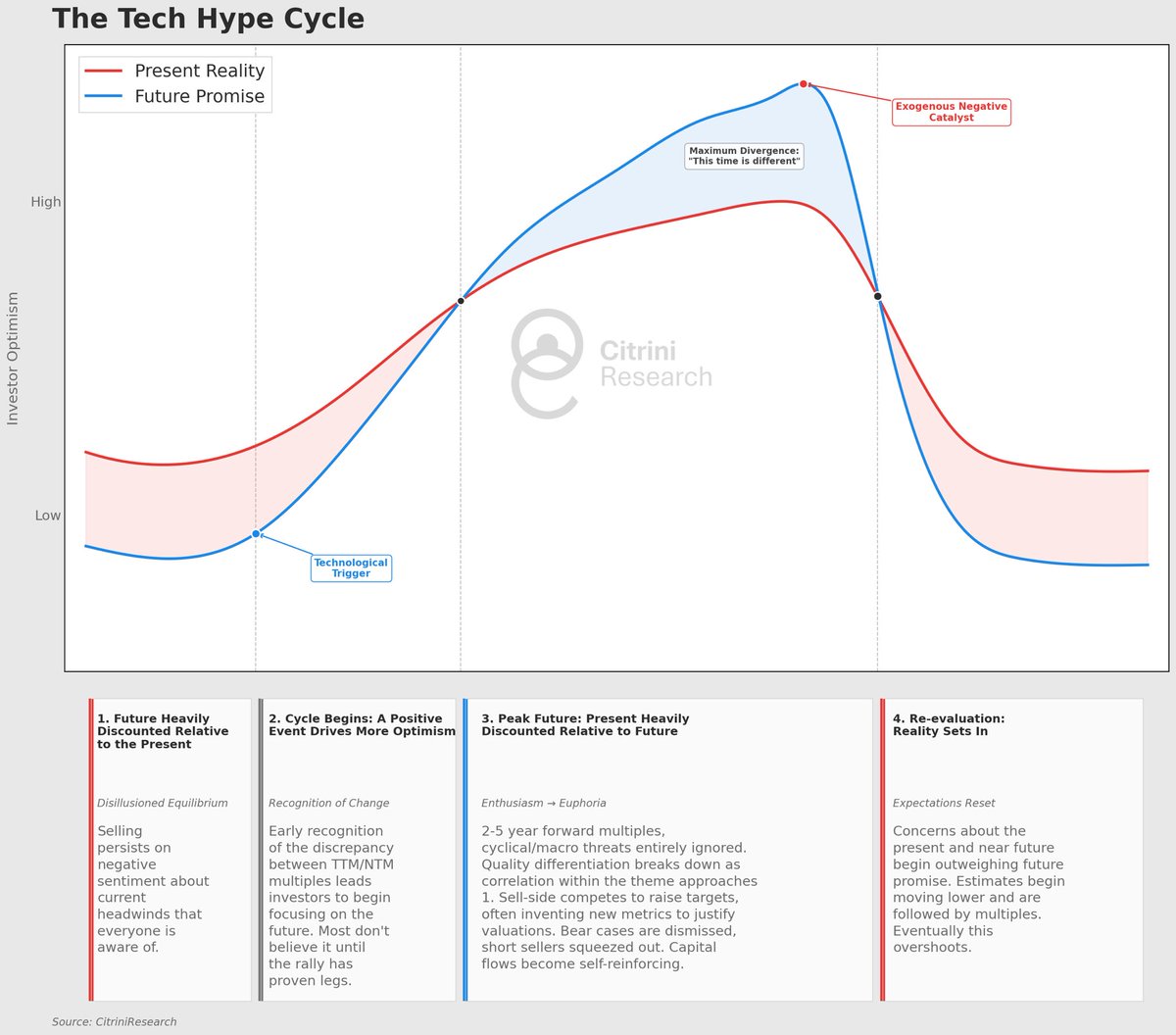
This is how I think about hype cycles in markets. It is basic, but that’s the point (frameworks shouldn’t be overly complex, I think).
Investors are always either discounting the promise of the future or the reality of the present. And they are never equally weighting them.
During the early part of a hype cycle, leading up to and directly following a technological advancement, investors are typically discounting the future while focusing on the present. A good example for this is Nvidia at the end of 2022: investors were solely focused on the headwinds presented by the crypto GPU glut, the anemic gaming PC market and the recent rise in rates causing fears about a near term recession.
Then, as the cycle begins, investors begin to shift to incorporate the future - they stop focusing so much on the present and see the promise. They move out in terms of valuing away from last twelve months current price / current earnings to next twelve months. Then, as price climbs and the technology becomes more exciting, their imagination takes hold. At a certain point they begin discounting the present much more heavily and the future becomes the only thing that matters. Valuation metrics over the next twelve months become useless in favor of 2, 3 or 5 years forward.
At the peak, the present is not considered at all, it is 100% driven by an imagined future (even when that imagination doesn’t necessarily align with a bullish outcome for the stocks driving the rally). Analysts aggressively raise estimates in ways that, at the time, seem fundamentally justifiable (if you take the assumptions at face value - for example, “everyone in the world will have two cell phones” was a good one from the mobile phone hype cycle). Capital is sucked in which ultimately forces performance chasing and crowds stocks with money that doesn’t really believe in the thesis. “A twilight period where people continue to play the game, but no longer believe in the rules” emerges, as Soros put it.
The valuation of SaaS stocks in mid-2021 is a great example of what happens when the future is overvalued relative to the present - nobody cared about climbing inflation, that rates had nowhere to go but up, that these companies were reliant on ZIRP or that software could become more competitive.
Then, a negative catalyst occurs - this can but doesn’t have to be related to the technology, macro, credit, underwhelming earnings. The estimates start to seem unattainable, and the present begins to matter more when the future seems more uncertain. That exact mechanism that drove future optimism to unsustainable heights mechanically reverses, everyone needs out. The future begins to be discounted until it results in a sense of disillusionment with not just the stocks but the technology itself. This overshoots to the downside, investors eventually become disillusioned and seemingly allergic to anything having to do with the technology. This happens in a very asymmetric manner to the climb (“stairs up, elevator down”).
This is the crucible in markets for truly transformative tech. If advancements persist, another opportunity to get long presents itself before capital once again begins flowing into the companies (the internet, for example). If they don’t - not necessarily “the tech goes away” but rather that it ceases to advance once the capital isn’t free or plateaus or the economics prove to be unfavorable - the cycle will still start again, just with a new technology.
Or maybe not…maybe this time is different.
Earth largest chimpanzee community has fractured and is now engaged in a deadly civil war.
For thirty years scientists closely monitored the Ngogo chimpanzee community in Ugandas Kibale National Park. This exceptionally large group of around 200 individuals gained international fame through the Netflix documentary series Chimp Empire.
During the first two decades of observation these primates lived in relative harmony grooming foraging and defending their territory together. A new study published in the journal Science however reveals that the once unified community has permanently divided. Beginning around 2015 a combination of key elder male deaths shifts in social hierarchy and a severe disease outbreak led to a complete split into Western and Central factions by 2018.
Researchers describe the aftermath as an unprecedented slow motion civil war marked by extreme brutality. Members of the smaller Western group initiated coordinated lethal raids against their former companions in the Central group. Between 2018 and 2024 observers documented at least 24 killings including seven adult males and 17 infants.
As one of humanity closest living relatives chimpanzees offer valuable insights into the roots of collective violence. This rare event estimated to occur naturally only once every 500 years illustrates how group dynamics and polarization can fuel lethal conflict even without human style political or ideological motivations.
[Sandel, A. A., et al. (2026). Lethal conflict after group fission in wild chimpanzees. Science, 392(6794), 216 DOI: 10.1126/science.adq1234]
GSK has walked away from a $2.2 billion biobucks neurodegenerative disease pact with Alector that has seen both drugs involved flunk clinical trials. https://t.co/494hvmFDVj $GSK





![Rainmaker1973's tweet photo. Earth largest chimpanzee community has fractured and is now engaged in a deadly civil war.
For thirty years scientists closely monitored the Ngogo chimpanzee community in Ugandas Kibale National Park. This exceptionally large group of around 200 individuals gained international fame through the Netflix documentary series Chimp Empire.
During the first two decades of observation these primates lived in relative harmony grooming foraging and defending their territory together. A new study published in the journal Science however reveals that the once unified community has permanently divided. Beginning around 2015 a combination of key elder male deaths shifts in social hierarchy and a severe disease outbreak led to a complete split into Western and Central factions by 2018.
Researchers describe the aftermath as an unprecedented slow motion civil war marked by extreme brutality. Members of the smaller Western group initiated coordinated lethal raids against their former companions in the Central group. Between 2018 and 2024 observers documented at least 24 killings including seven adult males and 17 infants.
As one of humanity closest living relatives chimpanzees offer valuable insights into the roots of collective violence. This rare event estimated to occur naturally only once every 500 years illustrates how group dynamics and polarization can fuel lethal conflict even without human style political or ideological motivations.
[Sandel, A. A., et al. (2026). Lethal conflict after group fission in wild chimpanzees. Science, 392(6794), 216 DOI: 10.1126/science.adq1234]](https://pbs.twimg.com/media/HNM9-2xXkAAD8dF.jpg)


