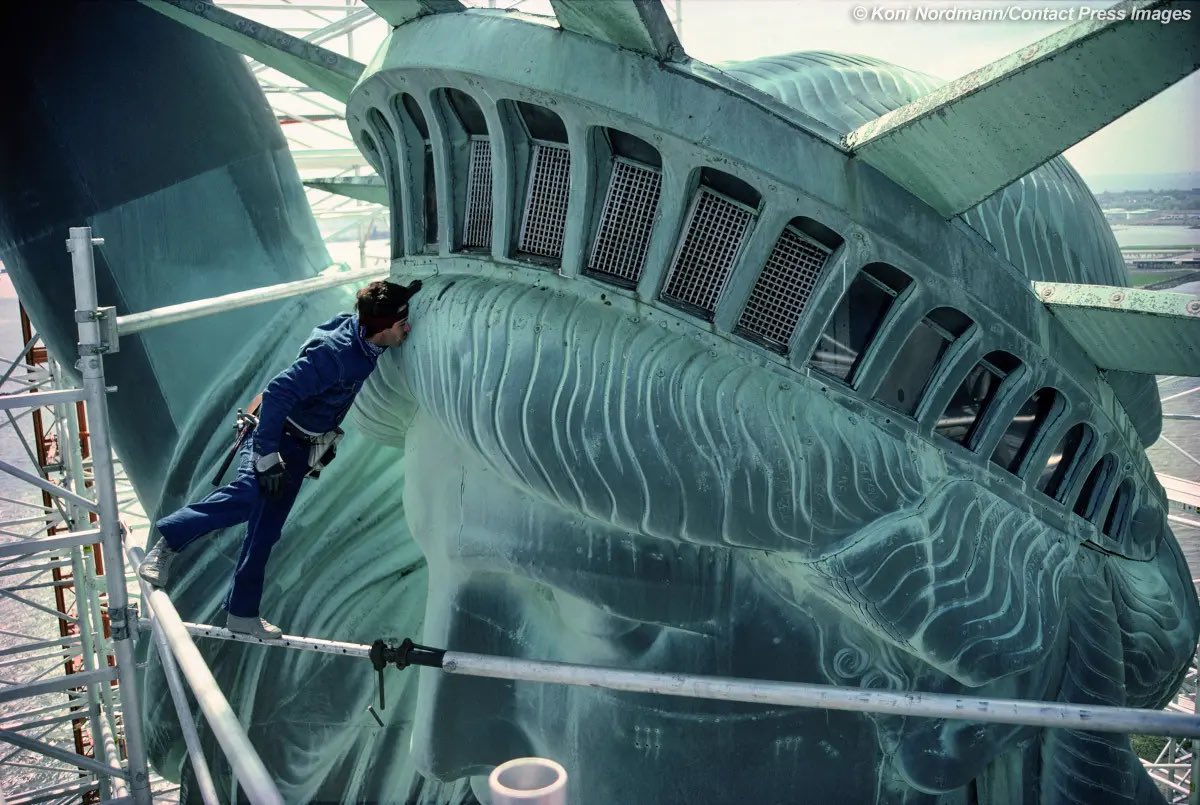
HAPPY 250th USA! A good day to remember this iconic 1984 photo of construction worker Anthony Soraci, grandson of Italian immigrants, leaning in to kiss the Statue of Liberty while on scaffolding during restoration work.
Happy 250th birthday US and kudos to the founding fathers: from visionary philosophers to practical nation builders focussed on an idea.
... and thank you for all the opportunities "you" gave me.
This year’s @ACarnegieFdn's Great Immigrants, Great Americans honorees include Prof. James Robinson, whose influential research on political and economic development has advanced understanding of institutions, prosperity, and global change.
Happy 4th of July everyone.
I came here as a kid at 9 years old, not knowing a single word of english, lived on food stamps in section 8 housing. My parents cleaned houses while my sister and I collected cans for recycling. Our clothing was all donated and our furniture was things we found on the curb (here I am in front of our "tv set", the broken one being used as a stand for the little working b/w one).
But this country gave us an opportunity--to learn, to work hard and earn something for it. "Grateful" does not begin to cover it. I owe this country and its people everything I have.
Thank you America, happy 250 to the idea.
This week on @CFR_org's The Spillover podcast, I sat down with @martinwolf_ , chief economics commentator @FT and someone who has helped me to make sense of crises and conundrums going back to the 1990s. Audaciously, perhaps preposterously, we addressed two topics simultaneously: the arc of Martin's thinking about politics and economics; and the larger intellectual history of the United States as we celebrate its 250th birthday.
The American Republic was and remains the world's grandest experiment in fusing a free market with a free people. Today, a lot of Martin’s work is devoted to the proposition that this fusion is coming apart at the seams. As Martin puts it in his recent book, The Crisis of Democratic Capitalism, "democratic politics are national, while market economics are global; and democratic politics are based on the egalitarian idea of one person, one vote, while market economics is founded on the inegalitarian idea that successful competitors reap the rewards."
I put it to Martin that the creation of the Republic was an exercise in optimism, whereas he, in many ways an American thinker, is a self-described pessimist. I invited Martin to reflect on America's aspiration to pluralistic tolerance domestically, which may perhaps be in tension with its intolerance of alternative political systems abroad. We ended with Martin's concern that "without decent and competent elites, democracy will perish." I found in this an echo of Benjamin Franklin's quip at the closing of the Constitutional Convention in Philadelphia in 1787. “What have we got—a republic or a monarchy?" Franklin was asked. His famous response: "A republic, if you can keep it."
https://t.co/XZtd1liBMs
"If God had meant there to be more than two factors of production, He would have made it easier for us to draw three-dimensional diagrams."
-Robert M. Solow, "The Production Function and the Theory of Capital" (1955)
Today's article is an absurdly deep dive into what life was like in America 100 years ago, in 1926, on America's 150th
Some favorite factoids about life in 1926:
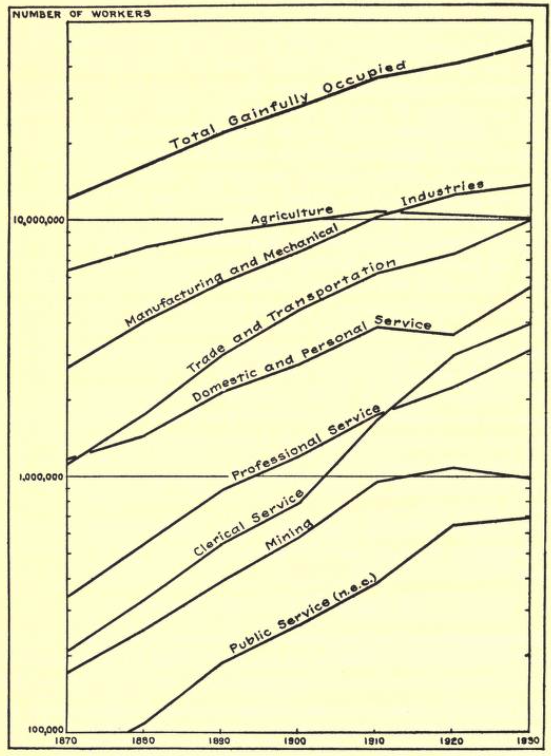
- Farming is collapsing: Agriculture’s employment share fell from 50% in 1870 to <25% in 1926. The price of cotton & corn fell 50% after WWI. percent.
- Manufacturing productivity growth is insane: In 1910, it took ~15 hours to put together a Model T; by 1926, a new car rolls off an assembly line every 10 seconds. A vehicle that cost the avg worker two years’ wages before World War I cost 3 months’ earnings in 1926
- Americans are obsessed, obsessed, obsessed with cars: 1920s Kansas had more vehicles than France
- The influence of flappers on fashion is quantifiable: The amount of fabric in the avg dress fell from 20 yards in 1910 to 7 yards in 1926
- Prohibition killed a lot of people: 12k people died in 1927 from drinking industrial alcohol that the feds had poisoned on purpose to discourage consumption—adjusted for population, that'd be the mortality equivalent of 36k people dying in 2026, which is roughly the number of car deaths
- Sports were very different: No TV means no commercial breaks, and players were in a rush. In one doubleheader against the New York Yankees on September 26, 1926, the St. Louis Browns won 6–1 in 72 minutes and then won 6–2 in 55 minutes with a one-hour break in between
- 1926 might have been the high-water mark for literacy in US history: The number of books published annually had doubled since the 1910s; magazine advertising revenues grew by 500%
- All this change was driving ppl crazy: In Germany, where medical records were better, the number of patients registered in mental hospitals grew from 40,375 in 1870 to 220,881 in 1910. Over the same period, the share of patients admitted to general hospitals for illnesses of the nervous system rose from 44 to 60%.
https://t.co/ThhKO5YWm1
Fun talk at the ECB on how AI will impact monetary policy in Europe. Excellent questions including from @Lagarde@Austan_Goolsbee & others on how agentic AI will impact trade. monetary policy and financial stability.
Thanks to my dear friends @meetthepress for recalling this today:
Remembering Alan Greenspan and Andrea Mitchell's joint Meet the Press interview (2007) https://t.co/GMlLfXWSQe
"As the Government concedes, Congress limited the President's power to remove Governors for good reason—'[t]o preserve the independence of the Federal Reserve' and to continue the 'long tradition' of 'monetary policy . . . exercised independent of . . . executive influence.' Tr. of Oral Arg. 48 (statement of the Solicitor General). Any change in that scheme must come from Congress, not the courts."
It’s official!
I am honored to serve as Chair of @EconClubNY .
I look forward to building upon the Club’s revered legacy while engaging the next generation of leaders shaping our global future.
Here's some information about the Club:
Founded in 1907, the Economic Club of New York (ECNY) is the premier, non-partisan forum for discussing the economic, social, and political forces facing the United States and the world.
For more than 100 years, the Club has hosted over one thousand preeminent speakers, including Presidents, Heads of State, CEOs of Fortune 500 companies, and renowned thinkers, all of whom have contributed to the Club’s tradition of excellence.
For more information on the Club: https://t.co/rGJHp8r43I
A.J. Pierzynski met Pope Leo XIV and gifted him the final out ball from Game 1 of the 2005 World Series, the game he attended.
(via aj_pierzynski_ft • IG)
The new mini-series from @netflix , "The American Experiment," is now live. Watch the creation of the Republic, and especially the role of George Washington. Very proud to have contributed to this.
https://t.co/Del991XLDg
Some news: As of June 30, I'll be on leave from Stanford at Anthropic. I'm joining the Anthropic Institute, where I'll continue my research on AI and our economic future and give seminars and talks as always. 1/3