i think this is my basic model of ai risk. there's definitely a bunch of dry tinder to be burned. and it's definitely the case that under the right circumstances, ai could become self-improving and consume most of that dry tinder very quickly.
but what i feel uncertain of is:
- i don't know conditions are necessary for the fire to start
- i don't know how much tinder there actually is to burn
that leaves me with these scenarios:
- the dog that never barks. rsi just never happens. ai plateaus around a human level of capability on most high-level tasks
- the little boom. rsi kicks off, gets super smart, but plateaus at a comprehensible spot above human intelligence
- the big boom. rsi kicks off and goes somewhere fundamentally incomprehensible to human minds. this is probably bad for humanity unless we get very lucky
i feel like either of these booms could kick off basically any time. they might never kick off, but they both feel pretty possible.
i think part of the confusion is that a very old assumption has been that there's a tipping point where intelligence becomes self-improving. if that assumption holds, it means there's really only one stable state for artificial intelligence, which is wherever diminishing returns bite harder than recursive self-improvement is able to overcome. but nobody knows where that line is.
it's sort of like everyone knows there's a bunch of dry tinder ready to light up under the right circumstances, but nobody's sure what those circumstances are or how much tinder is actually there to burn
Sorry guys but if you're actually serious about wanting to defeat climate change then you're going to have to start getting comfortable with telling the tribes "no" when they ask for an exemption on climate legislation.
@bzogrammer my theory is that it was driven by development of new writing technologies. the earliest alphabet first shows up around this time. this is also when papyrus, parchment, and other lightweight media start to decisively win out over clay tablets
technological and cultural change are naturally destabilizing and both are currently accelerating in a mutually accelerating feedback loop. government has to be flexible and adaptive in order to keep up. there is probably a theoretically ideal sort of minimal libertarian state that would require no changes, but that's not the thing we're doing right now. the thing we're doing right now requires some amount of legislative agility. this also makes it easier to eventually get to the better type of state that doesn't need to change all the time
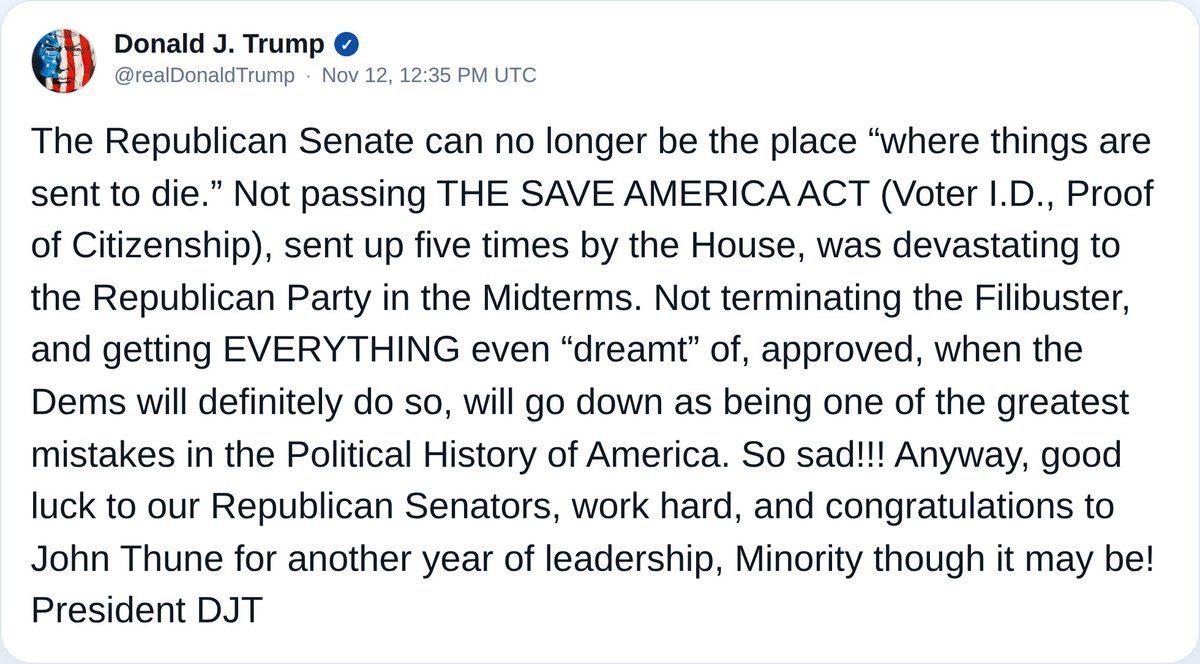
unironically i think ending the filibuster would be one of the most impactful long-term moves we could make to fix US politics. i think many problems in US politics have roots in the way the filibuster makes it impossible to win an election and implement a straightforward agenda. supermajority rules naturally favor backbenchers and bomb-throwers over party leaders.
if you lean libertarian and like small government, i think ending the filibuster will get you more of what you want. right now the bad laws are already on the books. getting rid of the filibuster makes it easier to repeal or rewrite bad laws.
but even if you don't lean that way, i think ending the filibuster is likely to produce positive results all around. i think we underestimate the impact of the filibuster because it's become the water we swim in. but it's actually really bad to kneecap basic lawmaking in a time of rapid technological and cultural change.
lots of things would exist, no other country does things this way and they have all sorts of legislation that sticks around. the way to see it is that modern-day partisanship is kinda LARPy because everyone is given cover by the filibuster. getting rid of the filibuster would force politicians to put up or shut up, and most of them will choose shut up
@Darlington_SW@uncle_deluge fwiw i don't think that part of this sample is really characteristic of his writing style. this section was selected from a very long book
@geomancer87@uncle_deluge sure i mean tastes vary, and his tone is definitely on the chungus/reddit end of things. but sanderson is good at what he does and it's more sophisticated than people usually give him credit for. people mistake an approachable writing style for a lack of depth
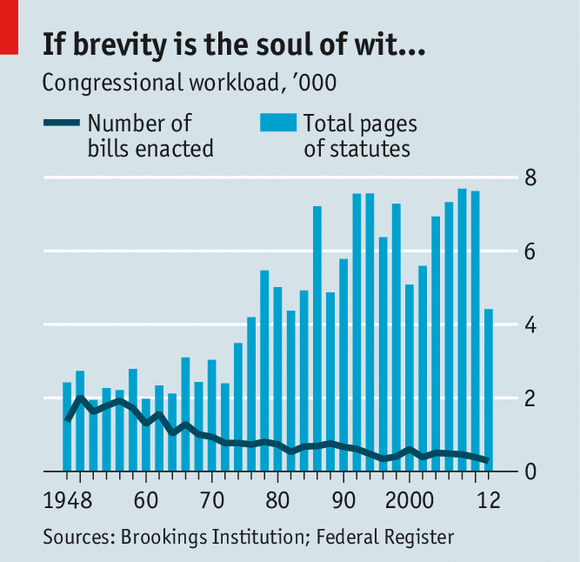
what we see right now though is that parties get around the problem by assembling enormous must-pass bills. this requires them to buy off various special interests. making bills easier to pass reduces the power of those constituencies.
what we want is to break out of our current trap where we pass small numbers of monster bills and return to a world of more routinized lawmaking, where the total number of bills goes up, but the scope of each bill comes down. that is a world where each bill has to be debated on its own merits rather than each bill being a gigantic logroll of buyouts
but that limitation in scope is what creates instability and whiplash. executive orders can't really fix problems because the scope is so limited. they mostly serve to deliver "wins" for specific interest groups. actual legislation can do a lot more, and also has to be worked out by congresspeople from many different states and walks of life. this is the right and proper way to run a country, and it works well when allowed to function normally.
@aether_boye yes exactly. i think voters are lazy and uninformed but they aren't stupid. right now they correctly see that their vote barely matters. but if you change it so that voting matters more, voters will start to take it all more seriously