This week, the BMJ reported that around 40 NHS staff accessed the medical records of the three-year-old boy after he was critically injured when he was thrown into a crocodile enclosure at a zoo in the UK. An investigation is now underway to determine whether every member of staff who opened that child’s records had a legitimate clinical reason for doing so.
And this isn’t the first time this has happened.
Unlawfully obtaining or disclosing personal patient data is a criminal offence.
In this article, I discuss four cases where NHS and medical staff have accessed, misused, shared, uploaded and even tried to sell their victims’ medical records. In at least one case, the NHS staff member was stalking and harassing their victim using their medical records.
@TannerMiller_20@QrsMisanthrope@hansummers@Right2Equality There is a difference between child arrangements orders and divorce. I feel your comments focus on the experiences of your friends in divorce. I am leaning towards agreement. But research shows arrangements orders are completely and utterly destructive for mothers and children.
On a stretch of the River Roding in Barking strewn with waste and detritus, a barrister named Paul Powlesland did something the British state has spent decades failing to do: he cleaned it and made it look like a river again. He now faces legal action.
Yep. He and a group of volunteers hired a digger for £1,000 of their own money and hauled more than 200 bags of filth out of the water - packaging, broken appliances, used needles, even weapons. By any sane reckoning it was a small act of public good, civic spirit at its most potent and wholesome.
For his trouble, he received a letter from the Environment Agency informing him that he is under investigation for working without a permit, an offence that carries up to two years in prison.
The same Environment Agency that found the will to come after a volunteer for cleaning a river without the right paperwork has not, on that same river, prosecuted a single one of the illegal sewage spills that have fouled it for years. Not one. It's too fat, scrofulous, and indolent to fight the sort of people who'd do this. But it has energy to spare for the man with the digger and the bin bags because they expect he's likely to be a reasonable sort of Englishman who pays his taxes and honours procedure, however unreasonable it may be, when levied upon him.
Protecting rivers? They have no interest in that.
This is the thing about our institutions that the public grasps in its bones and the people who run them never will. Our institutions fail, and the manner of their failing is the worst part of it - the bloodless, box-ticking, permission-withholding callousness of bodies that have forgotten they exist to achieve anything at all.
They should all be cleared out; every decision-making body in the building responsible for the dereliction of duty, and for daring to persecute a member of the public, must be hollowed out. The whole thing started from scratch.
Better yet, I'll tell you what an outfit like Progress will do once it gains power; we'll put people like @paulpowlesland in charge of the very body now threatening to jail him. The institutions meant to look after this country - the Environment Agency and a dozen like it - are dying of exactly the defensive, do-nothing culture that sent that letter. They need to be run by people like him who actually give a toss. People with the brains to understand the problem and the plain human instinct to go and fix it themselves, while the rest stand on the bank writing their little sociopathic missives to the ones who already did.
I don't know the first thing about Paul. I've never met him. I don't know what his political preferences are, the shape of his beliefs, what else we would agree or disagree on. None of that means a thing to me. He's a good man, and the right kind of man to make things work; and Progress is an attempt to make the country work, not a club made to serve a certain type or belief profile. A country is made to work by the people who, whatever their politics, cannot walk past a problem without trying to solve it. There are such people everywhere in Britain - on the rivers, in the schools, the wards, the workshops - and almost none of them are running anything, because the institutions have been built to keep that exact kind of person out.
Drop the case against him. Then go further: find the hundred other Paul Powleslands the country is currently ignoring or threatening, and give them the keys. Put the responsibility and the authority, together, in their hands. Britain will be cleaned up - its rivers, and a great deal besides - in no time. It will be done by the people willing to get in the water, not by the ones writing letters about permits from the bank.
@JacquiDeevoy1 I think its a police problem. I know there is a child on my caseload being SA, and the police closed the case.
I would advise anyone out there not to take anything personally as this increases the problem and bears no accountability to the police. Chase complaints, use advocates.
@leah_pierson@biounethical I enjoyed this episode, gave me a lot to consider.
I run an advocacy project in the UK, I often go to family court with people. I think the standpoint epistemology idea underpins our work, as the court system seldom appreciates the practical side of parenting life.
The petition to stop folic acid entering our flour is on 7,337 votes after three days.
Please keep sharing with friends and family.
If we kept up the current rate we could reach the target by the end of July.
https://t.co/XzpiIGIzT7
Could you help our project grow? I'm on the lookout for new volunteer advocates... if anyone is interested please DM me!
I'm also on the lookout for admin help, event management and social media support roles!
03337721227 The Autonomy Hotline
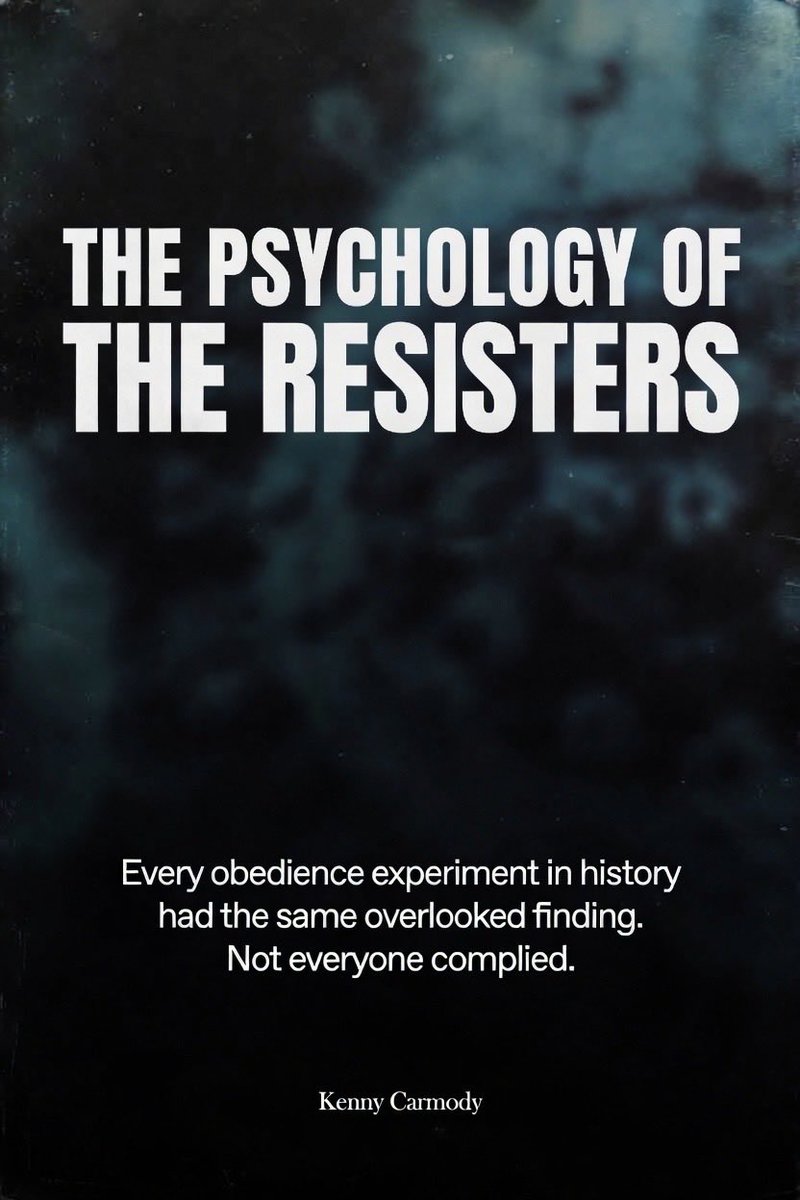
Every obedience experiment in history had the same overlooked finding.
Not everyone complied.
In Milgram’s lab, 35% refused to deliver the final shock. In Asch’s line experiments, 25% never conformed, not once, across any trial. In Zimbardo’s prison, at least one guard refused to dehumanize. One prisoner demanded a lawyer instead of a doctor and broke the psychological frame entirely.
We spent decades studying the ones who obeyed.
We barely asked what made the others different.
That question matters more now than it ever has.
The resisters in the COVID era were not difficult to find. Physicians who filed exemptions and lost their licenses. Nurses who walked away from careers rather than mandate patients into decisions they hadn’t genuinely chosen. Scientists who published contrary data knowing what it would cost them. Parents who stood alone at school board meetings. Ordinary people who simply said, quietly, without drama , no.
What made them different?
Research consistently identifies a cluster of factors. Not personality traits you either have or don’t. Situational and cognitive patterns that can be cultivated.
First: prior reflection on authority. The resisters had usually thought, before the crisis, about the limits of institutional trust. They weren’t cynics. They were people who had already asked the question “under what conditions would I refuse?” before anyone was asking them to comply.
Second: a concrete reference point outside the consensus. A value, a principle, an oath, a relationship that existed independently of the institutional structure demanding compliance. Something the system couldn’t reach.
Third: at least one other person. Milgram found that a single dissenting confederate reduced compliance dramatically. The resisters rarely stood entirely alone. They found each other. Sustained each other. Gave each other permission.
Fourth: the willingness to tolerate social pain. Not immunity to it. Tolerance of it. They felt the pressure. They felt the exclusion. They chose the discomfort of integrity over the comfort of belonging.
None of this is innate. All of it is learnable.
The most important thing Milgram, Asch, and Zimbardo taught us is not how fragile conscience is.
It’s that conscience can hold, if you’ve trained it, named its limits, and found even one other person willing to hold theirs beside you.
Build that now. Because the experiment is always running.
Until then stay humble.
@McCulloughFund@davidwetton Interesting... the problem is the risks of the so called 'vaccine preventable' diseases are much refuced by then, the risk-benefit equation becomes negligible. You might not get much protection at all, and a healthy child would easily fight off a normal illness. Bit pointless?
Shop with over 8,000 retailers via @easyuk and earn a free donation for us at the same time.
All the big names are ready to donate. It won't cost you anything extra!
Please sign up today: https://t.co/0izJqLAG4H
Y (Experts and Alienating Behaviour: The Modern Approach), Re Neutral Citation Number[2026] EWFC 38 (20 February 2026): Private law children proceedings. Judgment setting aside finding made in 2019 that mother had alienated children from their father. https://t.co/Pi4y99uc6C
And finally the President comes in with a legacy judgment screwing every Cafcass officer, solicitor, barrister or judge who has blindly relied on a psychologist. Run for the hills you scumbags. Postoffice scandal revisited but far bigger
https://t.co/RhTvXuru4O
Amazing news! The Autonomy Hotline has received a payment in @easyuk’s Donation Day – all thanks to our supporters shopping online. Want to get involved? Sign up for free and turn your online shopping into donations for our cause: https://t.co/pgSCtnu2T7
This made my stomach drop.
I’ve just read a report about how £24 billion in benefits goes unclaimed every year. Not because people don’t need it or don’t qualify, but because they’re sent to online calculators they can’t cope with.
One woman was days away from losing everything. Bailiffs at the door. No heating. No money for food. She was caring for her husband after a stroke and was completely overwhelmed.
What saved her wasn’t a website. It was a real person sitting at her table and going through the paperwork with her.
That bit of help kept a roof over her head and saved her life.
We keep acting like everyone can manage forms, logins and long questions while stressed, ill, grieving or caring for someone else. A lot of people can’t, and they’re paying the price for it.
If you’re struggling and feeling behind, this isn’t because you’ve failed. The system just isn’t built for people when they’re at their lowest.
So how do we fix this, and make sure people get real help when they need it most?
Thank you to @AndhaBandar for this meticulous and deeply important reporting. It gives voice to what so many families experience but rarely see acknowledged.
💔Summary of Suzanne Martin’s investigation
The numbers tell a devastating story 📉.
In 2023/24, England recorded the lowest response to child sexual abuse (CSA) in decades, despite overwhelming evidence that abuse remains widespread. Local authorities identified CSA concerns in 44,830 needs assessments — a nine-year low — and only 2,160 children were placed on child protection plans under sexual abuse. That is just 3.5% of all new plans, the lowest figure in around 30 years.
This stands in stark contrast to research estimating that around one in ten children experience sexual abuse before the age of 16. The gap between how common abuse is and how rarely the system responds is not narrowing — it is widening 🚨.
📊 What Suzanne’s reporting exposes
A clear postcode lottery 🗺️: some local authorities identify almost no CSA concerns, while others identify many — despite no evidence abuse itself varies by region
Private family law proceedings (contact and residence disputes) are a data black hole 🕳️, with no national figures on how often CSA allegations are raised, believed, or lead to protection
Only two published private-law judgments in 15 years show clear findings of CSA resulting in robust protective orders
So-called “transparency” reforms allow journalists into court — yet explicitly prohibit reporting the details of alleged sexual abuse, even in anonymised form 🔒
The result is a system that appears transparent, while remaining opaque precisely where scrutiny matters most.
⚖️ A system going backwards
Suzanne’s work highlights how family courts continue to rely on outdated, sceptical approaches to children’s disclosures. At the same time, concepts like parental alienation are increasingly used, allowing safeguarding concerns to be reframed as hostility rather than protection.
The overall picture is bleak: fewer abused children identified, fewer protected, and less accountability for how decisions are made.
🌱 What many mothers experience (anonymised)
This reporting reflects a pattern many mothers face when they try to protect their children:
Protective concerns are often reframed as “hostility” or “enraged views”, rather than treated as safeguarding information. Histories of domestic violence and coercive control — followed by post-separation abuse — shape the reality, yet the court process may interpret a mother’s fear and urgency as unreasonable or alienating. The burden shifts onto the protective parent to appear calm, neutral, and endlessly facilitative, even when she genuinely believes her child is at risk.
For some, this results in loss of custody, with children placed with the other parent. Contact then becomes minimal or severely restricted, leaving mothers barely seeing their children — and living with the ongoing trauma of a system that punishes protection instead of supporting it 💔.
@MoJGovUK@AndhaBandar@JudiciaryUK@JudicialWatch@MyCafcass@HCPC@hrw@NACCCofficial@RupertLowe10@KemiBadenoch@DavidLammy@MelanieBridgen@DrJessTaylor@DrProudman@ITV@BBCNews@BBCPanorama@ChildrensComm@NUJOfficial@PrimateFilms@familylaw@SheraFamily