I booked a Pronto service for the first time, and what the lady who came to help us with cleaning told us about her working conditions was honestly quite disturbing.
She reports at 6:30 AM and works until around 7 PM. That's roughly 12.5 hours a day, and she gets around ₹700 a day, which comes to barely ₹60 an hour.
There is no fixed lunch break. The maximum break they get is around 20 minutes, and she told us that sometimes this break can be as late as 5 PM. No fixed timings.
There are apparently no proper washroom facilities or place to rest between bookings. Some workers end up sitting in public parks and are driven away by the police.
And not everyone gets a scooty. Those who don't have one have to walk from one booking to another, sometimes 20–40 minutes.
She also told us that they were initially told they would get one day off as menstrual leave during periods. But when she actually asked for a day off, she was told to just take a 30-minute break and come back. She told them that it takes more than 30 minutes to get back home. She asked if she could take the entire day off and was told that ₹700 would be deducted for that day.
Apparently, if they take leave for more than two days, their daily rate itself can be reduced for the subsequent days.
The lady who came to our home is planning to work only until Diwali. She said that cleaning work picks up around this time, and she wants to leave the platform as soon as she can.
This is the side of India's “convenience economy”.
For us, it's just a booking on an app for a dirt-cheap price. Someone comes home, gets the work done, and leaves.
But behind that convenience is someone working 12+ hours a day, travelling between bookings, with barely any break and very little control over their own time. Almost felt inhumane.
Hearing all of this made me feel quite bad. Startups creating employment shouldn't become a justification for poor working conditions.
btw anthropic's internal document on this literally said "we don't want it to be known that we are working on this.”
it was called project panama.
here's exactly what happened:
1: anthropic concluded that books were the cheapest way to build a world-class model because they gave claude curated facts, structured arguments, compelling stories, and writing “an editor would approve of.”
2: once anthropic decided it needed books at enormous scale, its first solution was piracy.
it downloaded 7m+ books from online libraries including libgen. the judge later wrote that although anthropic had legal ways to buy them, it chose piracy to avoid what dario amodei called the “legal/practice/business slog.”
3: that piracy created a massive legal risk.
so in february 2024, anthropic hired tom turvey, the former head of partnerships for google books, to find a legally safer way of obtaining “all the books in the world.”
4: turvey first contacted major publishers about licensing their catalogs.
those attempts didn’t produce agreements, so anthropic chose a route that required no publisher permission: buying millions of physical books through distributors and used-book retailers.
5: within about a year, anthropic spent tens of millions acquiring and scanning millions of books, including many rare and 1/1 titles. one vendor proposal targeted 500,000 to 2 million books in six months.
6: to scan that many books within months, the vendors physically dismantled them.
a hydraulic cutter removed each spine. the pages were trimmed to size, fed as loose sheets through high-speed industrial scanners, and converted into searchable PDFs. the paper remains were then sent for recycling.
7: these PDFs were fed into claude as training data.
the complete collection became a private, searchable anthropic library that the company planned to “store forever.” the scans aren’t available to the public and were never open-sourced.
🦔AI companies are bulk-buying rare books, scanning them through high-speed machines that cut the spines off, and shredding the originals. A service called ISBNdb facilitates orders of up to a million books and keeps buyers anonymous. Pre-2022 books are premium because they're free of AI-generated text. A federal judge ruled the practice is fair use because eliminating the original means only one copy exists at a time. Anthropic hired the former head of Google Books partnerships to obtain "all the books in the world."
My Take
This got to me. A bookseller told 404 Media that rare books with almost no surviving copies are being fed into this pipeline. Books that survived wars, fires, and centuries of handling are being shredded so an AI can learn to write a better marketing email.
ISBNdb's website literally says "'AI company destroys two million books' is not a headline that generates sympathy," and they still built an entire business around making it happen quietly. They offer NDAs as a feature. They coach clients to call it "digital preservation."
I've covered AI companies scraping the internet, torrenting libraries, and stealing music. This is worse because it's irreversible. You can re-upload a website. You can reprint a bestseller. You can't replace the last three copies of an 18th-century botanical text once someone shreds them for training data. And the judge said it's legal. So it's going to accelerate.
"We shred rare books and offer NDAs so nobody finds out" is a legitimate business model in 2026. What a timeline.
Hedgie🤗
The most interesting thing about the protest: Almost everybody I spoke to didn't even mention Abhijeet Dipke or CJP or Sonam Wangchuk. All they mentioned was paper leaks, dictatorship and democracy in danger. This protest has taken the form of a huge anti-incumbency protest.
JUST IN | Massive crowds several thousands strong gathered at Jantar Mantar as mobile internet was shut down in parts of central Delhi. Protesters have had sporadic clashes with authorities according to emerging visuals. Even as security forces tried to hold the crowds at bay, people gathered in batches of hundreds at the Jantar Mantar protest area and crowded Tolstoy Marg on the north end of the protest strip. CJP leaders appealed to protesters to demonstrate peacefully. "India's youth have shown that they're not like the Gen Z of other countries," Gitanjali J. Angmo, activist Sonam Wangchuk's wife said from the protest site's stage. The speakers' remarks are inaudible beyond just a hundred metres from the protest stage, as chanting crowds drown out instructions from protest leaders and security forces' loudspeakers alike. Crowds spilled in and out from a narrow entry point at Janpath, where traffic has been heavily restricted.
- reports @AroonDeep
Video: Special Arrangement
#cjp #delhi
This is a hard article to read, but I hope you'll do so. I've spent some time reporting on widespread rape and other sexual violence of Palestinian male and female prisoners by Israeli authorities, and the article is now published. The assault victims were warned not to give speak of what they endured -- they were sometimes told they would be killed or raped if they gave interviews -- but they found the courage to do so. One man described being raped three times in a single day in Israeli prison, the third time after he tried to protest. A young woman said the guards would come in at the beginning of each shift and strip her naked and abuse her. Another reported that she was shown photos of herself being raped and warned they would be released unless she cooperated with Israeli intelligence. Even three children who had been detained told me they had been sexually abused. Look, whatever our position on the Middle East, we should be able to agree on being anti-rape. Sexual assaults were horrific when Israeli women were targeted on Oct. 7, and they're equally horrific when Israeli authorities use them against Palestinians day after day after day. We should be able to find common ground in opposing rape. Here's a gift link to the article: https://t.co/aMMHId49OO
"If anyone has survived this starvation,
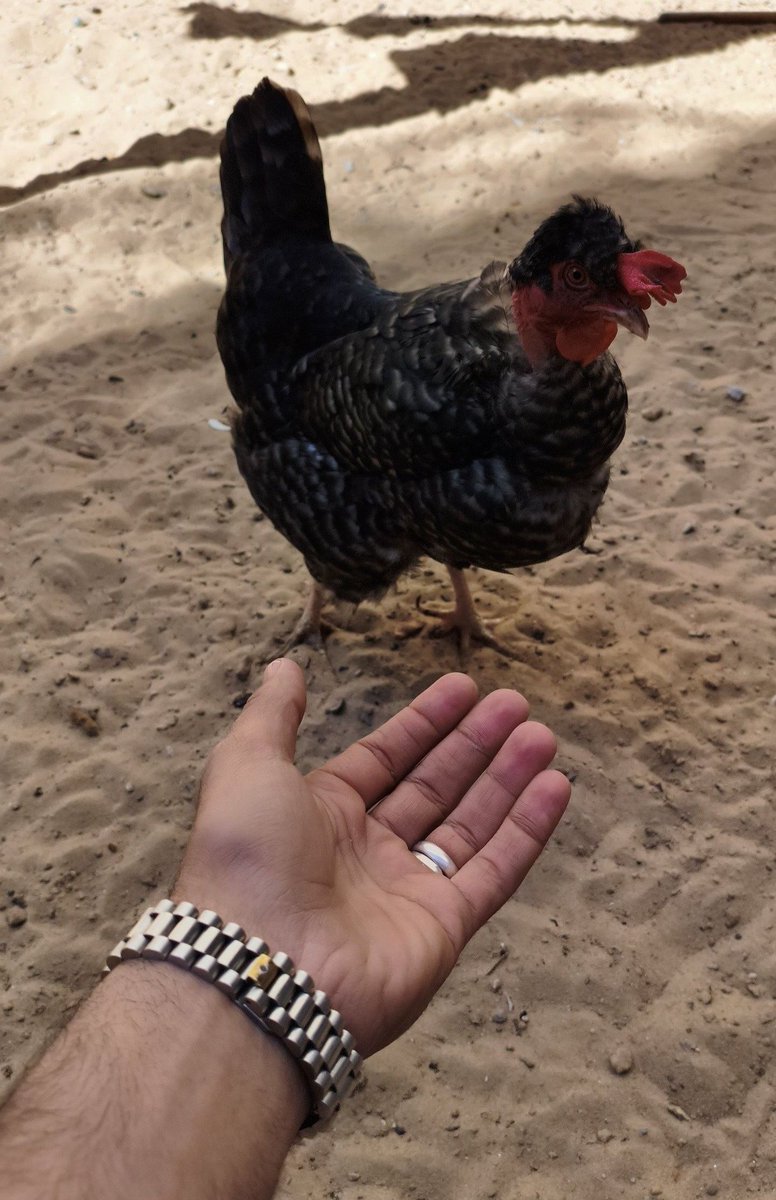
it is this chicken.
She survived my knife through nine displacements.
Every time I reached for her neck, someone stopped me:
my wife,
Ayloul,
and Zein [my children], who found in his chicken friend something worth saving.
In a tent whose thin strips were colder than the hunger surrounding it,
she felt she was a burden to us—eating anything,
moving so lightly no one could hear her.
Even her clucking was faint,
and her gaze seemed to apologise for still being alive.
But what truly saved her wasn’t us.
It was the egg.
Every three days, she laid one egg—warm—
in a time when even a loaf of bread had disappeared.
We would divide it:
half for Zein,
the other half for Ayloul,
and I would postpone my hunger,
filling myself just by watching them.
And between one egg and the next,
a question circled in my mind:
Do I slaughter her, so we can eat for two days,
or keep her alive… so we can endure longer?
Even when my friend Hamed broke his arm
and needed any protein in this void,
I decided to slaughter her for him.
He looked at her for a long time,
then said:
“No, Malek… I can’t bear this guilt.
I won’t drink her broth… I won’t be the reason.”
In that moment, I understood:
we were saving ourselves from ourselves.
It was a test of the last part within us
that had not yet turned savage.
We could not bring ourselves to harm a chicken—
yet this vile world found it easy to abandon our children."
- Malek Shinbary, Palestinian from Gaza
Basically every Israel-Palestine debate goes like this:
"Israel did X."
"Yeah, because the Palestinians did Y."
"Yeah, because Israel did Z."
"Yeah but only because the Arabs did A."
But if you bring the debate back far enough in time, eventually you get to the part where the western world forcibly dropped a brand new ethnostate on top of a pre-existing civilization without the permission of — and to the extreme detriment of — the people who were already living there.
Sure you can go further back and say "Oh yeah well the Jews lived there thousands of years ago," but that's just silly. There's no valid reason to believe some Jewish guy in New York City even has any meaningful lineage connecting him to that land more strongly than any random Muslim in Turkey or wherever, and even if there was, it would still be absurd to cite ancient history as the basis for a territorial claim. I'm only a few generations removed from my ancestry in Ireland and Scotland, but it would be ridiculous for me to show up demanding the home of someone who lives there.
So the original source for the grievance is clearly the artificial creation of an ethnonationalist state in the mid-20th century, and the push by Zionists and western imperialists to make it happen.
And how has that decision worked out? You see the results before you. Generations of nonstop violence and abuse, culminating in the slaughter and chaos throughout the middle east today.
This means that creating Israel was a mistake. A mistake that needs to be corrected.
Zionists will collapse into a shrieking pile of vitriol and hyperbole when you say this, claiming you're calling for the extermination of Jews, but this is false. Certainly ending a national order premised on putting the interests of Jews before Palestinians and righting the wrongs of the past would inconvenience a lot of the Jewish people who've been living there, but there's no basis for the claim that it would entail their deaths. Apartheid South Africa was dismantled without the extermination of millions of white people, and there's no reason to believe the dismantling of apartheid Israel would entail the extermination of Jews.
The Israel experiment has been tried, and it has failed. It is time to try something else.
Losing a baby in the Gaza concentration camp
So you’re in a tent. You’re in your mid twenties. Last year you became a mother for the second time. Your husband was killed by a tank shell when he was out to get water six months ago. They only found his arm and his head. After he was hit the tank that killed him found it necessary to drive over him. The spot where he died looked like the ground of an abbatoir. Neither of you are politically involved. He was a fisherman before October 7th and you were a homemaker, in hip American lingo. You have two children. One is four and has stopped speaking entirely, even though before October 7th he talked non-stop, prattling commentary on anything he was doing while playing and firing off questions about whatever new thing he discovered. Now not a word. When a stranger comes near, he growls.
Your daughter is 8 months old. She has chronic diarrhea. She is always cold, so you try to keep her practically glued to your own skin, close to your warm breath, covered in several layers, but the layers are too thin. You’d need a thick fur coat to really keep her warm like this. Your grandfather used to talk about how warm those are. He studied engineering in Moscow in the 1960s. Try finding fur coats in Gaza though. Try finding anything in Gaza now.
Your parents are dead, your father died in the invasion of 2014 when the building he was doing some repair work in was struck by Israeli bombs. His chest was crushed by falling debris and he clung to life in a hospital for two days.
Your mum died of a heart attack while fleeing her home in northern gaza begin November 2023. She was carrying her most prized possessions, family photo albums, pots and pans and blankets made by her own great great grandmother. In her arms she was carrying one of her 2 year old grandchildren, your niece, the youngest daughter of your brother. Current whereabouts unknown. Your mum collapsed and with her last strength prevented her granddaughter from hitting her head on the ground. She went without saying a word.
So the last thing you remember her saying was hours before her death: ‘What about Kareem’s birthday cake?’ She had prepared a cake for your brother and when people started rushing to the south she realized she couldn’t take it with her.
So now you are in a tent with your two kids and your niece. Your sister in law is also dead. She got hit by a sniper right above the knee and bled to death in little truck used to transport poultry before October 7th. A tourniquet could have saved her life, but in the chaos nobody had the reflex to perform this simple procedure. Her last words were: ‘Please treat my little girl as if she was your own.’ Your niece will have not even one memory of her own mother, so yeah, you will indeed be the only mum she will ever know.
You had some hope when the ceasefire was announced, but today Israel has announced that no goods will be coming in. The doctors have told you that your baby girl is in critical need of pure water and antibiotics. All expected to come in on lorries, now held up near the Egyptian border.
The few times you get to go online with your phone distant relatives abroad think it’s a good idea to send you some of the mocking videos Israelis are making. Thanks to posts on telegramme you know that a burned Palestinian child is a ‘hotdog’ and what happened to your husband Israelis call ‘making a Palestinian pancake’.
On social media you also see plenty of users with no profile pictures repeat and again and again that ‘winning a war you didn’t start, is not a war crime.’ And when babies die here, those people will write ‘Palestinians should take better care of their children.’ Salt in open wounds, because everyone here is fighting round the clock to keep their children alive.
In the tent next to you lives a family and their three year old girl has lost both legs. She crawls around as if she’s never known anything else. Initially she had lost only her feet when the flat they were in was bombed, but because of the dire situation in the healthcare system that Israel targets she got infected again and again until she lost both of her little legs. At night you can hear her mum wail and beat herself with a leather belt. Usually she screams that she should have kept the girl in the bath tub. The mum has heard that babies who were kept under a flipped over bath tub survived some bombardments unscathed. Sometimes the father stares at you and mutters: ‘I don’t know why she tortures herself like that. We didn’t even have a bath tub in our flat, we only had a shower installed.’
Your baby girl will die in the course of next week, because no aid will reach you on time. So the war gave you an extra daughter and will take one daughter away.
Today you hear ten year old boys talk about the situation. One says: ‘As soon as Hamas turns over all the hostages, the Israelis will resume their offensive. It will be worse than before. They can’t defeat our warriors, but they can kill all the rest of us. They will cut Gaza down the middle again. Their ships will bombard the coast line, their air force will pummel us, their tanks and artillery will randomly shoot at tents and we will all be forced to flee to the Egyptian border. Then Trump will threaten Egypt with economic sanctions and they will have to take in those that survive.’ An other boy asks: ‘So why don’t we go to the Egyptian border right now and be the first ones in?’ The answer: ‘Don’t be silly, if we start moving to the Egyptian border now the Israelis will shoot us because they will think we will try to smuggle in aid.’ The other boy nods as if he should have known that himself.
The war has turned kids into military and political analysts.
But not your baby girl. She is a shivering leaf of a little human, any fluids you manage to put in, her cramped up body flushes out. You can see she’s losing the strength to even cry about her situation. Her color is fading. She has your husband’s eyes and they look dry and glazed over, as if she’s already crossing the threshold to some other world.
A dwindling autumn leaf before she could fully enjoy her first spring.
With her will die the tree she grew on. Though the tree will keep standing and will have some leaves left, inside the tree will be dead and petrified.
The newspapers will not print your girl’s name and no tower will be lit up to match the color of her first curls, because this is not a regrettable death in the eyes of the ruling class, this is an execution.