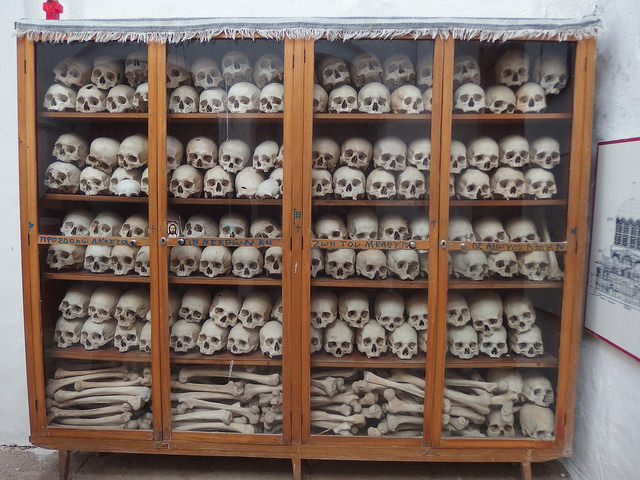
In Greece, we hate Islam more than anything. But there is a reason for that. It's called: Greek history.
Lebanon and the entire Middle East have experienced for centuries the true face of Islam. That Islam which does not hide behind the lies it needs in order to invade the West as a religion of love and wisdom, but as what it really is: a political ideology full of death, hatred, and destruction.
I know many of you will wonder how I can know the true face of Islam. Well, of course all Greeks know, because all of our ancestors suffered martyrdoms for their faith and their origin. That is why the Greeks love and care for the Christian communities of the Middle East, and you should know that if it were in our hands, Greece would protect these peoples from barbaric Islam at the first opportunity.
Reading @GadSaad 's post, I could not help but think of the countless moments of modern Greek history, when from the fall of Constantinople until 1821 the Greeks lived through the worst period of their lives. Enslaved for almost 400 years under the monster of Islam, which stole, raped, murdered, and tortured in the most horrific ways the Greek Christians who lived throughout Asia Minor (Anatolia), Pontus, Greece, and Cyprus.
For 300 years the Muslim Turks were stealing kids from their mothers. They were waiting for women to birth, raise their kids, and then at the age of 8 were collecting them. The devşirme known as "collection of children" or "blood tax" or in Greek as "paidomazoma", was a systematic practice that forced the recruitment of young Christian boys, typically aged 8–18.
Historians estimate the total number of Christian boys taken across the entire Ottoman Empire around 300.000 kids. From those kids 150.000 were Greek kids (over 300 years). It means the half of the total kids that were stolen were only Greek. For example in 1540, a levy in the Greek regions of Thessaly & Macedonia took 1.000 Greek boys in one season and in Chios (the Greek island) 200 boys taken in 1567 alone. The peak was 5.000 kids/annual from Greece.
The most common torture inflicted by the Muslims during the Ottoman period was whipping. The usual victims were the Christians. It was the introductory torment in every other torture, so common in the persecutions of Christians that the phrase became proverbial: "I will whip you until you change your faith."
During that period, Muslims enjoyed performing all kinds of mutilations. Ears, noses, lips, tongues, breasts, and genitals were primarily cut off. Not just those, though. Let's recall here the Saint Raphael of Mytilene, who was hanged from a tree and had his lower jaw cut off, while the twelve-year-old martyr Irene was roasted in a barrel on the Tuesday of Easter in the year 1463, ten years after the fall of Constantinople.
In many cases, the severed body parts "adorned" the warrior collection of the janissary. The pashas gave bakshish (tips) to every "brave" Muslim warrior according to how many ears of "infidel" Christians he brought back. He himself confirmed his bravery and "manliness" among his peers by having a "komboloi" (worry beads) made from the nipples of breasts he had cut off from women. The bravest man was the one with the longest komboloi after a massacre and looting.
Blinding with various sharp objects was also common. This was particularly frequent during periods of massacres and atrocities. Many unfortunate Christians remained blind for the rest of their lives because they had the misfortune of a horde of janissaries passing through their land. The Egyptians under Ibrahim Pasha were especially notorious for this crime.
Many times Christian captives were placed in front of cannons that were fired, turning them into human shreds of flesh. In other cases, they were tied to galleys that sailed in opposite directions and were torn apart. Dismemberment of victims also occurred with horses.
After the Ottoman conquest of Crete (1669), local officials and governors began to oppress the Christian population in every way: killing, abducting and abusing women, demanding money, and preventing the performance of the subjects' religious duties.
We Greeks, called the Muslim Turks, "The grand masters of torture." In 1821, in Patras, they captured a father and son and, after impaling them, lit a fire and forced the other captives to roast them like lambs. Ali Pasha at that point was more inventive: When he impaled Christians, he forced their relatives to turn the spit, threatening that otherwise he would impale them too.
Immediately after the hanging of Patriarch Gregory V in Constantinople, the Turks hanged three metropolitans at various points in the city. However, one of them, the very elderly Metropolitan of Nicomedia, breathed his last before reaching the place of execution. Such, however, was the Turks' mania for revenge that they punished even the dead man by hanging his corpse.
Just 65 years after the Fall of Constantinople, Sultan Selim I Yavuz, grandson of Mehmed the Conqueror and father of Suleiman, decided to definitively abolish the Patriarchate of Constantinople during the patriarchate of Theoleptos I, and to slaughter all the subjugated Christians (rayah) of the empire who refused to convert to Mohammedanism. Just 65 years after the Fall of Constantinople, the Greeks of Thrace were collectively placed before the forced dilemma of either converting or being wiped off the face of the earth, that is, to suffer ethnic cleansing or genocide, as we would say today. Between those two barbaric options, the Greeks of Thrace (the ancestors of today’s Muslim Greeks of Thrace) chose ethnic cleansing at their own expense; that is, they chose to convert in order to survive as an ancient indigenous people, in the hope that at some point in the future their descendants would regain their national self-awareness and their religious independence, and would then voluntarily return to the bosom of the Greek Nation and of Greek Orthodoxy.
When the Greek Bishop Dionysios the Philosopher of Larissa organized a revolt against the Muslim Turks in 1611, which ended in failure, the Turks flayed him alive, stuffed his skin with straw, and paraded it from city to city. Three days later, the Turks also discovered -the Greek rebels- Deli Giorgos and Lambros. They burned Lambros alive, while they crucified Giorgos and, instead of a crown of thorns on his head, they drilled holes into which they placed feathers. Dionysios’s skin, together with the heads of 85 Greek Christian rebels, was sent to Constantinople, where it was thrown into the Sultan’s stables.
After the failure of Daskalogiannis’s uprising in Sfakia (Crete, 1770), the Turks captured him and flayed him alive, cut him in pieces and throw them in the fire and the dogs.
The Muslim Pasha of Thessaloniki, Abdul Abud, who had set as his goal the extermination of the Greeks, burned 120 villages and wiped out their inhabitants to the last one.
5.000 Greeks were massacred in Naousa, the rest were sold in slave markets, and the entire city was reduced to ashes.
The Janissaries faced no restraint in their behavior toward the Christians. They would even enter churches and desecrate them. And if they discovered a beautiful Greek girl, they would seize her from her parents in order to satisfy their lewd desires. For this reason, anyone who had a pretty daughter was forced to keep her locked inside the house, while most Greek women who lived in towns would wear a burqa when they went out, just like Muslim women.
The Janissaries also exterminate Christians without any reason, simply because they were Christians. Sometimes they executed them in cold blood in the middle of the road, just to test the accuracy of their weapons; other times to watch them writhe in their own blood; sometimes to make the abduction of a bride, right after her wedding, more dramatic; other times simply because the Christians were manly-looking, relatively well-dressed, or on horseback. In the latter case, the rayah would hurry to dismount upon seeing a Janissary, but the latter would draw his pistol and say: “Why did you dismount, you infidel dog? So you could make me ride instead?” And the rayah, Greek Christian, would fall dead.
On December 18, 1803, at Zalongo in Greece, a group of Greek Souliote women jumped from the cliffs, holding their children. They chose death over falling into the hands of Muslims, where they would face rape, abuse, and enslavement.
On March 30, 1822, the Chios Massacre took place. The Muslim Turks slaughtered (Greeks) 42,000 women, men & children. Additionally, 52,000 were sold as slaves in the markets of Smyrna & Constantinople. Young girls were raped publicly in the streets, and newlyweds in front of their husbands, who were then slaughtered. Others were raped in front of their parents, after which the men's genitals were cut off. Women over 40 were set on fire and left to burn alive. Pregnant women had their bellies ripped open and their fetuses pulled out, while small children were thrown forcefully against rocks. The frenzy of the Muslims was unprecedented.
In 1822, Muslims also captured the wives of Zafeirakis and Gatsos. The wife of Zafeirakis was built into the wall up to the neck in the church of Hagia Sophia in Thessaloniki. Maria Karatasou, daughter of a priest refused to change faith, and for this Ebub Lubut enclosed her in a sack with deadly snakes, where she martyred. Pouqueville describes in the darkest colors to the civilized world the dramatic scenes he saw with his own eyes there: "Many women naked were put up to the neck in sacks with cats, snakes, and mice…".
The Greek Christian Woman, during the years when Greece was enslaved to the Muslim Turks, in order to avoid -as much as she could- the abhorrent dishonor from the barbaric Muslims, would destroy the youthful beauty of her face, or create a family from the age of fourteen, believing that she would not give birth to slaves.
On September 1, 1821, Samothrace was devastated by the Ottomans through a general massacre led by the Turkish Kara Ali. Approximately 10,000 men & boys were slaughtered. Women & children were sold in the markets of Constantinople & Smyrna (Holocaust of Samothrace).
On June 4, 1821, the Turks carried out a massacre against the Greeks of Kydonies in Asia Minor (modern-day Ayvalık). They did pogroms at shops and homes, looting them, while seizing women and children to sell as slaves. Simultaneously, they conducted a general massacre of the population, and the town was set ablaze and completely destroyed.
On September 1955 in Constantinople 4,348 Greek businesses, 110 hotels, 27 pharmacies, 23 schools, and 73 churches were damaged or destroyed. The exodus of Greeks from Turkey, reduced the community of over 150.000 (who have already left from the Fall), to fewer than 2.000 today.
Muslims commited GENOCIDES and Islamized the Anatolia, Antioch and Seleucia.
From the Hellenism of the East (Thrace, Asia Minor, Pontus), around a million people were exterminated (1914-1924). In the Pontus region alone, 353,000 people were slaughtered. Because they stole our lands. Smyrna, Aydin, Kydonies, Prousa, Nicaea (Asia Minor region), Trebizond, Kerasounta, Samsounta, Oinoe, Paphra, Ordou, Amaseia (Pontus), provinces of Derkon, Metron, Herakleia, Myriophytou, Kallipoleos, Ainos, Tyrolois, Saranta Ekklision, Adrianople (Eastern Thrace).
I hate Islam with all my heart because I am Greek and because I know my own history.
I strongly suggest that you study my history so you can avoid these atrocities becoming your history too.
Thank you for reading me,
Homer Pavlos
🚨NEWS: Cambridge University has been mocked online for some of the ridiculous PhD courses currently being studied
They include:
- Traditional Cultural Norms, Technology and Gender Relations in Ghana
- The Political Economy of Female Circumcision
- Unsexed beings: constructing gender, humanness, and agency through the use of the word “unsex” in Late Modern British society and writing
- In Her Own Words: A Study of Women’s Voices in Contemporary White Supremacy and Far-Right Online Hate
- Legal Mobilization by Black Lesbian, Bisexual and Queer (LBQ) Womxn in Kenya and South Africa
- Exploring gendered embodiment in transgender and gender-diverse adolescents at the intersection of exercise and eating behaviours, social inclusion, and mental health: Towards a desire-centred approach in paediatric gender-affirming healthcare and research
- Codes of Life, Codes of Death: Tracing the (Im)possibility of Trans Lives in Algorithmic Assemblages
- Queer Cultural Memory in Literature, Film and Television since 1999
- The Sexually Sociological: Gay Masculinity, Intimacy and the (Un)queer State
A once proud University has completely lost its way
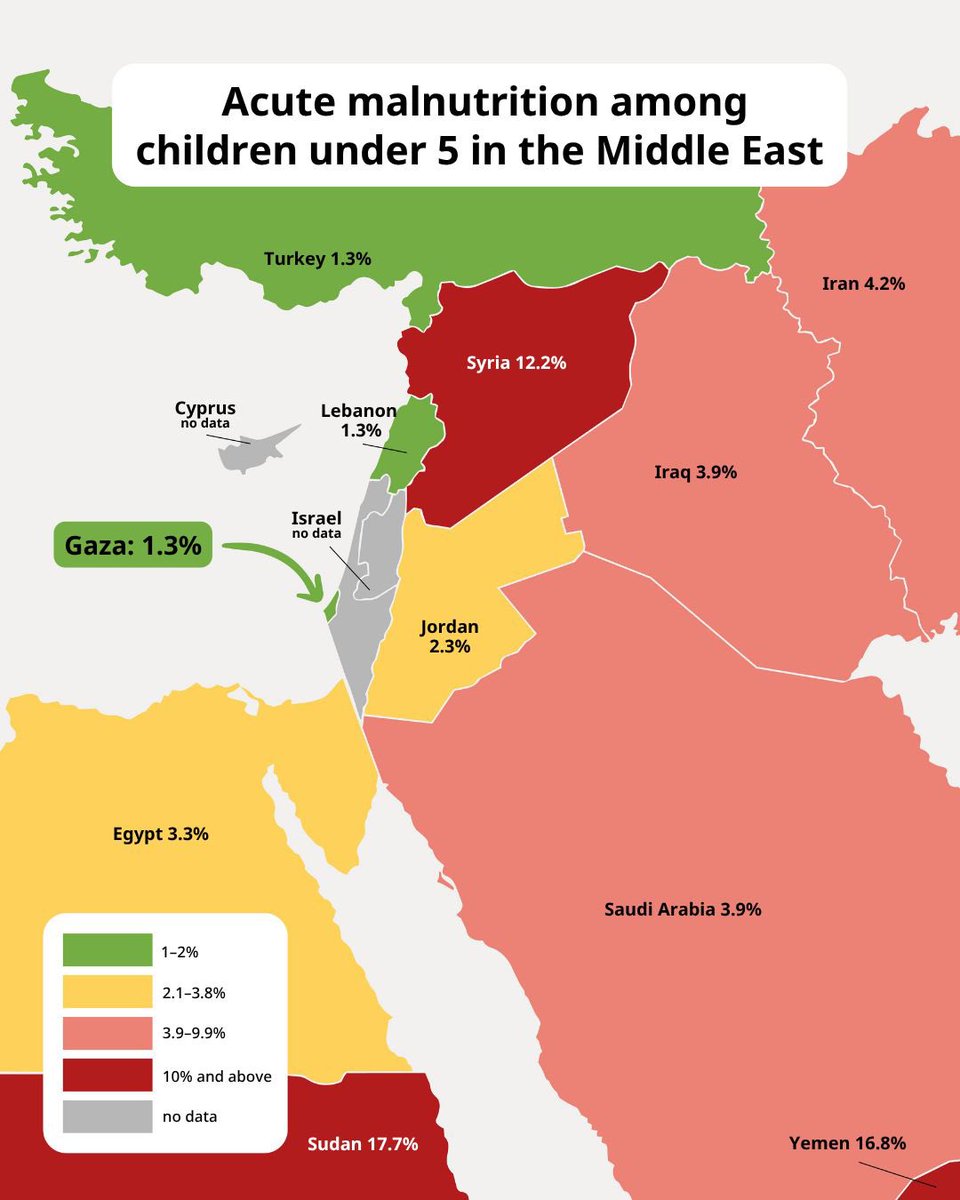
A new study commissioned by UNICEF shows that the nutritional situation in Gaza – contrary to all propaganda – is today better than in all neighboring Arab states and even better than in some European countries.
The proportion of acute malnutrition among children under five years of age is between 0.2 and 0.8 percent. In Egypt, it is 2.9 percent, in Jordan 2.0 percent, in Syria over 12 percent, and even in Bulgaria 4 percent.
In other words: There is no famine in Gaza.
Malnutrition is not only significantly below the critical values – it is exceptionally low in regional comparison.
Anyone who is still open to arguments can look at the empirical data themselves.
https://t.co/m4YsA9BTyC
This is awkward for Israel haters. When a UN (no friend of Israel) organization (UNESCO) debunks the lie that Israel was "starving kids" it's worth a read. Israel genocidal? They botched it again!
United Nations study shatters Gaza starvation narrative https://t.co/fBF9v2ql2K
La censura de los iluminados
La carta contra el artículo de Ezra Shabot en Nexos no es una refutación, sino un intento de sustituir el debate por la censura, usando tramposamente lenguaje jurídico inaplicable al caso.
Su primera trampa consiste en dar por probado lo que está en disputa. Habla del “genocidio que Israel ha perpetrado” como hecho consumado, cuando ni siquiera la Corte Internacional de Justicia ha dictado sentencia. Levantar todo el argumento sobre una premisa no resuelta es una falacia de petición de principio.
La segunda es más grave: secuestran el vocabulario del derecho. “Discurso de odio”, “reparación del daño”, “garantías de no repetición” son categorías con presupuestos técnicos precisos, y la carta no acredita ninguno. Las emplea como etiquetas de carga moral para disfrazar una decisión editorial de violación a los derechos humanos.
La tercera maniobra desnuda su propósito. Si el artículo fuera tan deficiente como sostienen, bastaría con refutarlo. En cambio exigen retirarlo y que Nexos se comprometa a no publicar opiniones semejantes: abandonan el terreno de las razones para imponer un criterio de exclusión.
Esta es una contradicción flagrante. Invocan los valores de una comunidad intelectual y, ante una opinión que les incomoda, reclaman menos discusión en lugar de más, menos espacio para quien piensa distinto en vez de mejores argumentos. Eso no defiende el debate público: lo mutila.
Además se arrogan una autoridad que no poseen. Subrayan que han colaborado con Nexos, como si ello les confiriera un cargo. Haber publicado en un medio no convierte a nadie en propietario, director ni custodio de su línea editorial. Su condición de colaboradores les da pleno derecho a opinar, jamás la facultad de dictar qué se publica.
Tenían una salida coherente con la libertad que dicen defender: dejar de colaborar y explicar públicamente por qué. Optaron por otra cosa: exigir que la revista adopte la línea que ellos aprueban, y presentar esa exigencia como si emanara del derecho internacional.
En el fondo, la carta no prueba que Shabot incurriera en discurso de odio, ni que Nexos causara un daño jurídicamente reparable, ni que exista obligación alguna de retirar el texto. Reemplaza el razonamiento por una hilera de etiquetas condenatorias y le traslada al director la carga de justificar una libertad que, en una sociedad abierta, le corresponde ejercer a él.
Una comunidad intelectual responde a las ideas con mejores ideas. Cuando en su lugar invoca expresiones jurídicas fuera de contexto para expulsar del debate una opinión incómoda, abandona la crítica y cae en la intimidación moral maquillada de argumento.
No son intelectuales, son intelligentsia al servicio de la peor causa: censurar y silenciar a quien opina distinto. La tolerancia ilimitada acaba con la tolerancia, y nadie está obligado a tolerar a quien responde a los argumentos con la mordaza. Una cosa es discrepar de un medio y marcharse; otra, exigir que expulse al que piensa distinto. Nexos ganaría si quienes hacen de la censura su bandera se largaran para no volver.
Please remember:
When Islamic terrorists commit 48,000+ attacks in 70+ countries since 9/11 alone, not a single Muslim is to blame (including the terrorists themselves).
When Israel inadvertently kills innocent people whilst engaged in an existential war against maniacs, every single Jew is to blame including 3-year-olds in Australia and 90-year-olds in Lithuania.
Questions?
Every day, for years now, someone asks me the same question: "How much are the Israelis paying you?" As if the only explanation for defending Jews and Israel is a paycheck. The idea that I might simply see this conflict differently doesn't compute for them. What I do is, to me, entirely normal. It only looks strange in a world where hating Jews has become the default setting of the crowd, and staying silent, or joining in, is what passes for sanity.
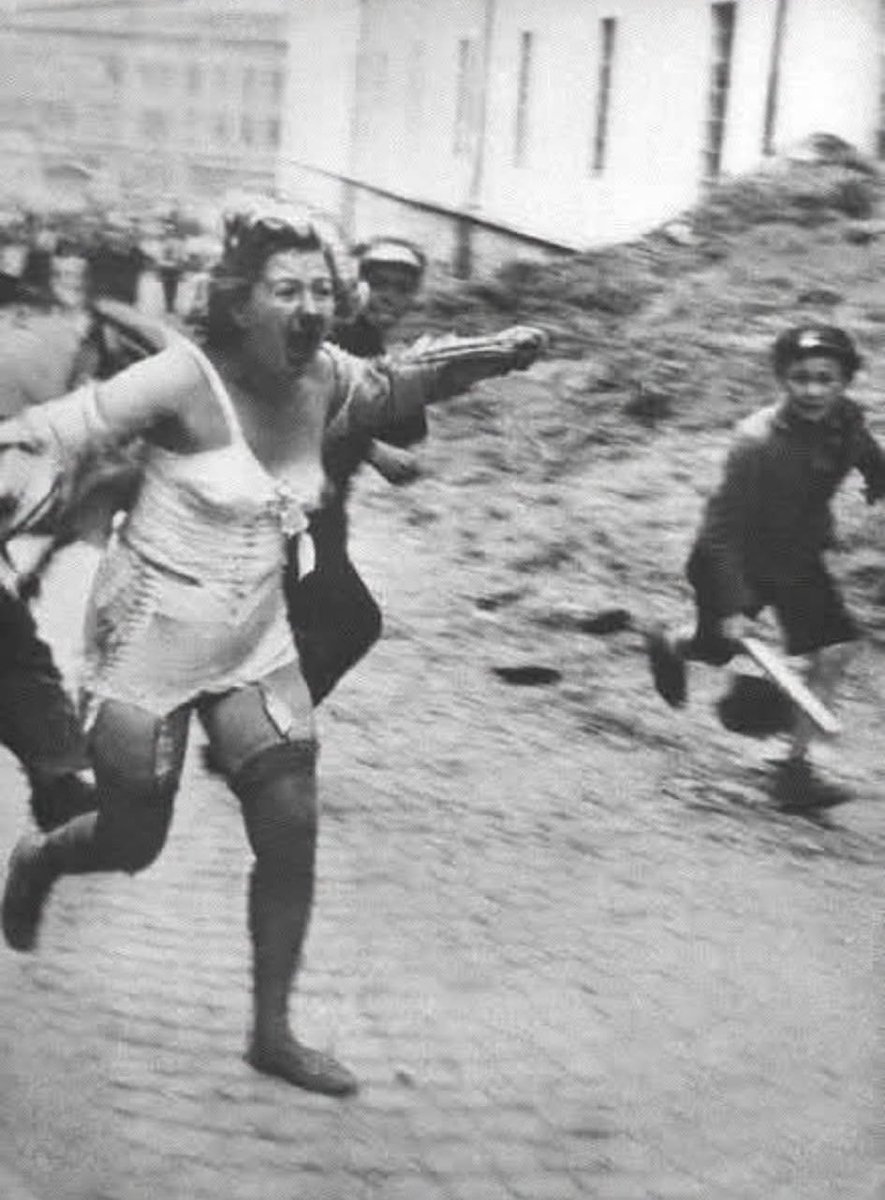
Many are familiar with this photograph from the Lviv pogrom, 1941. Locals — including a child and an adolescent — chase a woman stripped of her clothes, bleeding, terrified, humiliated. The Nazis had spent years demonizing the Jews before this moment. They didn't need to pull the trigger themselves. They just needed to make the target "legitimate," and ordinary people did the rest, voluntarily. Something otherwise suppressed in them came out, and they let it.
On October 7, I woke up to the videos. One of them was of Naama Levy, arms zip-tied behind her back, dragged by her dusty hair out of a black jeep. As she was moved to the front of the car, she looked straight into the camera of the man filming her. The back of her trousers was soaked in blood. I saw the cuts on her arms, her bare feet, and I watched a crowd film her while cursing her, spitting on her, hitting her. I wished I did not have an imagination. I wished I could delete what I'd seen before her mother saw it.
Weeks later, I flew to Israel for the first time, burning every bridge to a world that was celebrating what I'd watched. I went to Ra'anana and met Naama's mother, Ayelet. We made the first post from Israel asking the world to listen, asking the universe to bring her back alive. I promised her that what Hamas did would haunt them in their graves.
Arendt called it the banality of evil, and people needed mental gymnastics to accept what she meant. It's easier to believe monsters do monstrous things than to believe your neighbor might. But human beings are built for both good and evil. What we become is a choice, shaped by the moral compass we build or fail to build.
Just like an ordinary person joins a mob to taunt a scapegoat, an ordinary person is capable of standing against it. For some of us, peer pressure is minuscule in comparison with a nagging conscience.
That's why the photo above matters, still, 85 years later. The Nazis were defeated in Europe but their legacy is rampant in large parts of the Arab world, especially in Palestinian culture. Fused with a dash of communism and a splash of Jihadism, that legacy morphed into global Antizionism.
#October7
🇪🇸 Javier del Valle. Doctor en climatología. Premio Aragón del Medio Ambiente.
➳ El alarmismo es rentable y nadie tiene responsabilidades.
➳ El clima viene determinado por el Sol, el eje de rotación de la tierra, y los volcanes.
➳ Actualmente hay más de 50 programas de modificación artificial del clima (geoingeniería).
🗣 Extractos conferencia "el falso cambio climático antropogénico" 2023
¿Por qué los intelectuales odian el capitalismo? - Jesús Huerta de Soto
Bertrand de Jouvenel, en su análisis sobre la relación entre los intelectuales y el capitalismo, sostiene que muchos de ellos tienden a rechazar el sistema capitalista debido a su naturaleza impersonal y a la percepción de que promueve desigualdades.
De Jouvenel argumenta que este rechazo se origina en el deseo de los intelectuales de tener un papel central en la sociedad, algo que el capitalismo no necesariamente les garantiza. Jesús Huerta de Soto amplía esta crítica al señalar que el odio de los intelectuales hacia el capitalismo se fundamenta en cuatro factores: ignorancia, soberbia, resentimiento y envidia. La ignorancia se manifiesta en una falta de comprensión de cómo el capitalismo fomenta el bienestar general; la soberbia, en una actitud de superioridad moral frente al mercado; el resentimiento, por no ser reconocidos como actores clave en el sistema; y la envidia, hacia quienes prosperan bajo un modelo que privilegia el mérito y la innovación.
Estas críticas reflejan un profundo desacuerdo con los principios de la economía de mercado, que valora la descentralización y la competencia, en contraposición al control centralizado que muchos intelectuales prefieren.
This is a truly phenomenal speech by Jonathan.
Jonathan is such an intelligent, articulate man who is one of the kindest, warmest, and most genuine people I have ever met.
Please watch this.
You will not regret it.