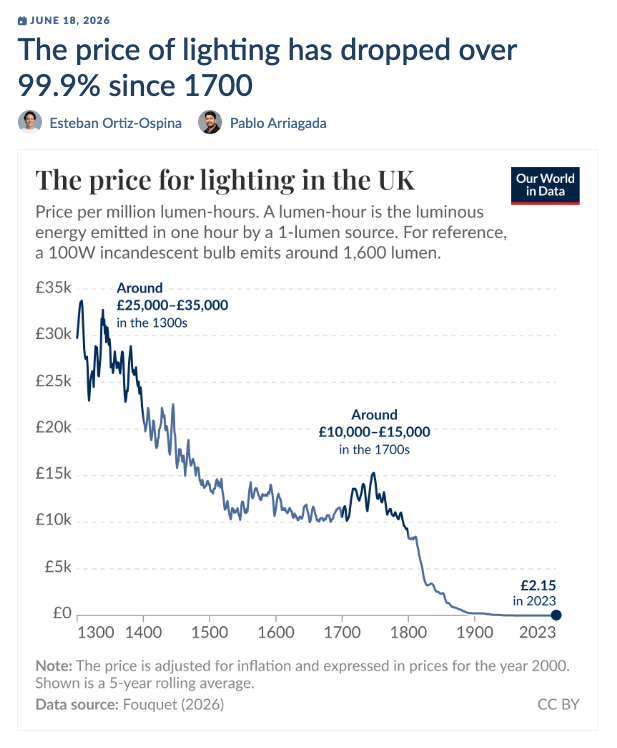
The price of a "slow down" of progress seems extremely low because no one needs to argue to protect all the myriad futures full of lives that *might* be saved by technological advancement.
In light of the progress in mathematics, we at Edison Scientific and FutureHouse have assembled a set of Millennium Problems for Biology. They are chosen to be very hard to solve but very easy to validate in a simple laboratory environment. Any of these, if solved, would mark a major advance in biotechnology, and most of them would contribute materially towards curing disease. These are, in some sense, the “last reasonable eval” for AI in biology. This was work primarily by @MichaelaThinks and myself, with contributions from many others.
Short descriptions below. The full descriptions of the problems with acceptance criteria are at the Bio Millennium Problems website, linked in the next post. Share more if you have ideas. If they meet our criteria, we’ll add them to our list (with attribution and permission).
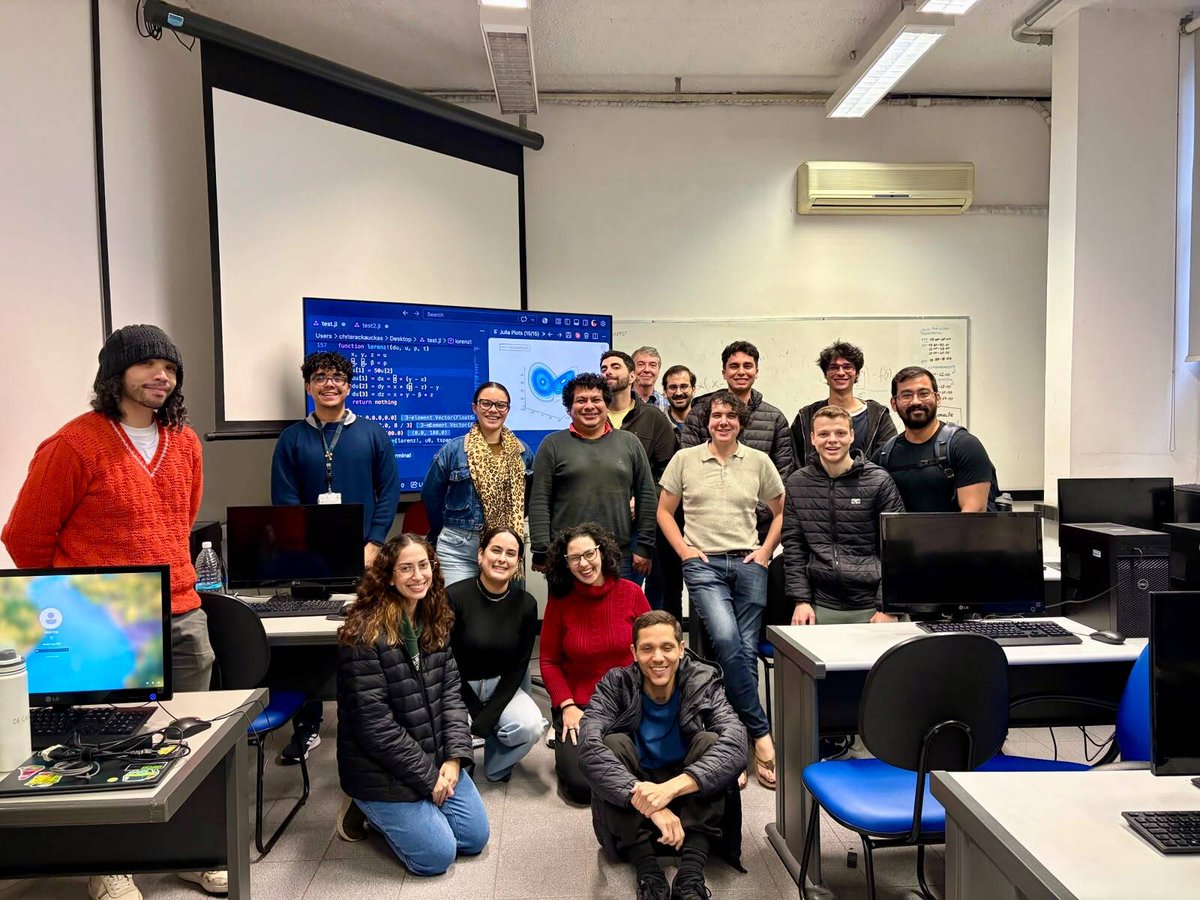
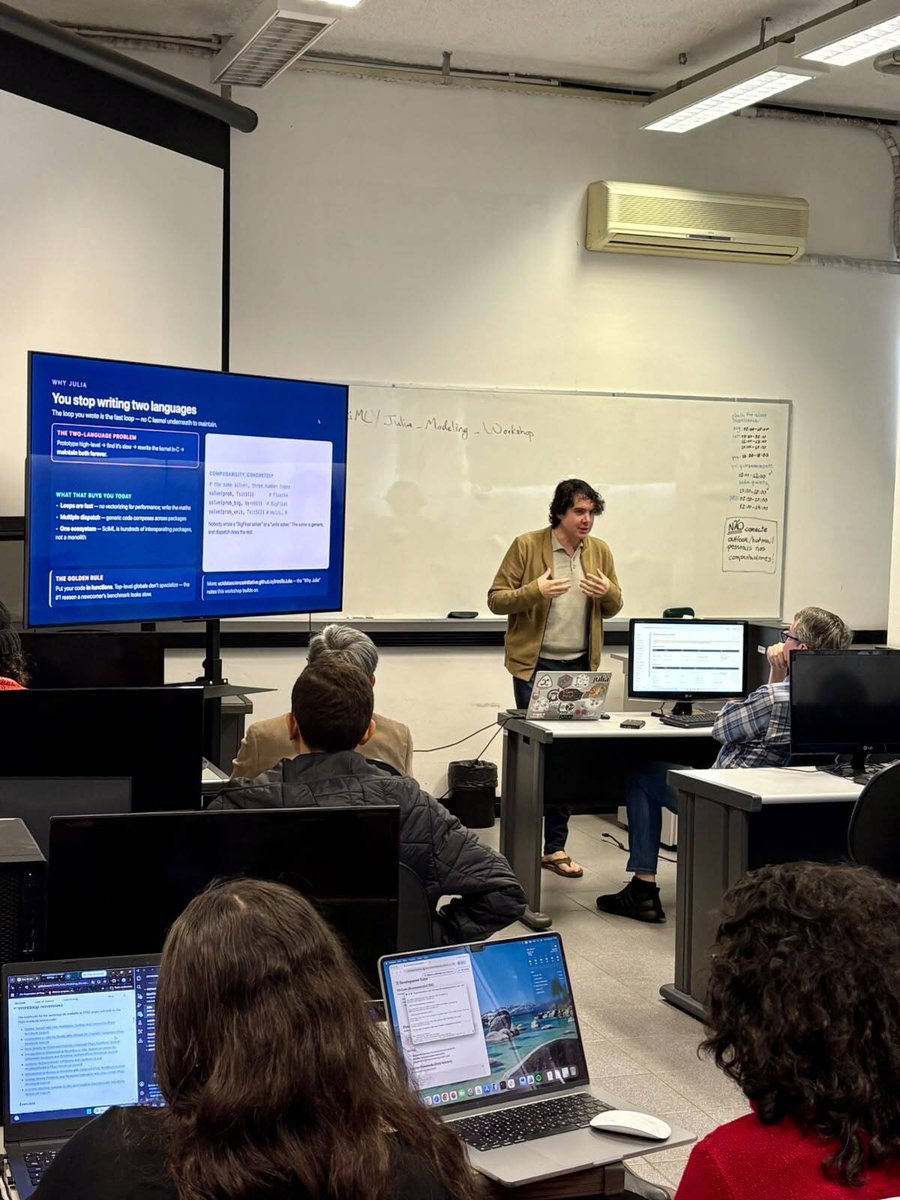
Julia and SciML workshops in Brazil
Chris Rackauckas’s September 2026 visit to Brazil connected JuliaHub and the SciML ecosystem with researchers working across space science, critical care, and chemical engineering. The trip included engagements at INPE, the ICCAI conference, and the University of São Paulo, where he presented “Toward Solving the Inverse Problem in the ICU,” and a seminar and workshop program with the University of São Paulo’s Department of Chemical Engineering. Across these engagements, the focus was on connecting mathematical modeling, data, and computational tools to practical scientific challenges while exchanging ideas with Brazil’s research community.
#julialang #sciml #dyad #juliahub
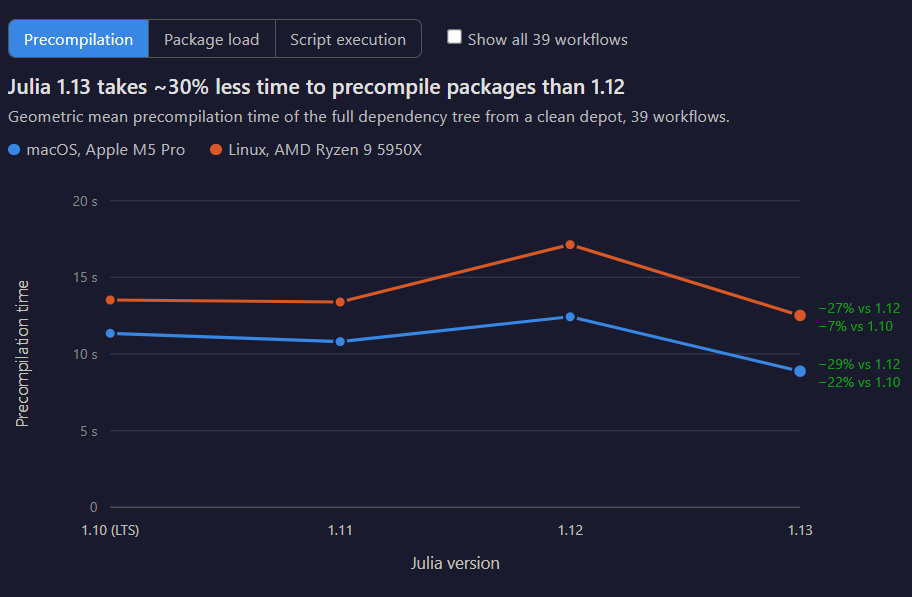
Julia 1.13 is here bringing meaningful performance improvements and a more refined developer experience. Big props to the Julia contributors and testers whose work made this release possible.
Highlights include:
⚡ Around 30% faster package precompilation compared with Julia 1.12
🚀 Approximately 20% faster startup
🎨 Built-in REPL syntax highlighting
🔎 New fuzzy history search
🧹 Faster full garbage collection
📦 Faster, more efficient Pkg operations
🛠️ Continued progress on JuliaC and application trimming
🖥️ A new graphical interface for Juliaup
Explore the Julia 1.13 highlights:
https://t.co/r33RDo0YY6
#JuliaLang #JuliaProgramming #OpenSource #ScientificComputing #HighPerformanceComputing
Any pursuit of superintelligence has to be grounded in the core principle that if the AI we build is not helping humanity and under human control, it's not worth pursuing.
We also need to accelerate and spread the benefits of AI, such that they are diffused broadly across countries, communities, and companies. This requires a frontier ecosystem in which both closed and open-source models can thrive.
And for firms, it’s imperative that they retain full control over their unique and tacit knowledge. Every organization should be able to build its own continuous learning loop/hill climbing machine, without becoming dependent on any one model provider, and have the ability to embed its own knowledge into models and weights they control.
So, in this context, we welcome the research, focus, and deliberate pacing needed to get alignment right as the design goal. We also welcome ideas like "embedded evaluators" and the broader efforts to develop the mechanisms to make this more than just talk.
The key is that this cannot be controlled by a handful of entities, but must have broad representation across the ecosystem, countries, and fields, including academia.
This is the approach we are taking: broad access and choice at every layer of the AI stack; enterprise control of learning loops and models; and the “Code of Conduct” that underlies our own first party MAI models that we’ll publish tomorrow for public consultation.
@kchonyc Exactly.
The "escapes" were made possible either through egregious negligence or deliberate purpose (marketing? Misplaced hopes of regulatory capture?).
Julia’s team has posted release notes for the upcoming v1.13.0 — the next step in a language built for scientific and numerical computing. Behind every release cycle is a community that keeps showing up, and support that keeps them able to. Max the Stack: https://t.co/MverZ6R3wF
EA AI safetyism increasingly looks like Marxism-Leninism for the algorithmic age.
The old vanguard claimed privileged knowledge of the inevitable course of History. The new one claims privileged knowledge of the probabilistic course of Humanity.
Both use an elaborate intellectual framework to reach the same political conclusion: a small group of enlightened people must constrain everyone else for their own good.
That has never lead to anything except monumental human suffering.
We’ve all been amazed by how capable Astra is—whether at solving Millennium Prize–level mathematics, reconstructing scenes, or controlling robots.
A common pattern across these examples seems to be that, before Astra, many humans had already spent years attacking these problems—or closely related ones—creating a large body of knowledge, techniques, and examples. That accumulated human effort may be what eventually enables the tipping point where Astra becomes better, perhaps even substantially better, than individual humans at solving the problem.
By contrast, for problems that are not yet well defined, whose goals are ambiguous, or are so ill posed that very few people have seriously studied them, Astra still seems much less capable. There are research problems in my own group that I simply cannot imagine asking Astra to solve directly—not necessarily because the underlying mathematics is harder, but because we cannot yet formulate the problem clearly.
This creates an interesting dilemma. If you work on a hot and practically important problem, there is a good chance that Astra will soon be better at solving it than you are. If you work on something extremely niche, you may remain better than Astra—but the problem itself may not matter very much.
Perhaps the best research strategy, then, is what great research has always been: find an important problem that has not even been properly defined yet; discover the right way to formulate and frame it; and then use systems like Astra to help solve it.
The most valuable human contribution may increasingly shift from solving well-defined problems to discovering which problems should exist in the first place—and framing them in a way that, once solved, produces unexpectedly large impact.
Pluto notebooks are coming to VS Code. And bringing AI agents with them.
Join us for a live webinar demonstrating the Advanced Pluto extension and discover how you can:
• Edit and run reactive Pluto notebooks natively in VS Code
• Work with a rich Julia terminal in the same environment
• Let AI agents such as Claude Code drive notebooks through the built-in MCP server
• Use Dyad Studio to interactively analyze physical models and simulations
All without leaving your editor.
No prior experience is required. If you have VS Code and Juliaup, you can follow along.
Register now: https://t.co/aKE1e0YCYJ
#JuliaLang #Plutojl #VSCode #AI #ScientificComputing #Simulation #Engineering #Dyad
ENOUGH PESSIMISM IN AI PLEASE
I feel that we have become unreasonably pessimistic in our field.
1. I keep hearing AI engineers saying we have to make money quickly because there’s only like 2 years left before we’re automated. Depressing.
2. I see a constant obsession with “having a moat”. This is an incredibly sad mental frame.
3. I keep hearing “we have to catch up”. Soulless.
And so on. People: Every solution creates the possibility to attack new real problems. We face gargantuan engineering challenges in our world. How to capture carbon? How to get rid of teflon and plastics in water? How to invent batteries that are at least 30 times more efficient? How to solve clean energy? Better solar cells? Better ways of producing clean energy so we stop wars and famine? How to eradicate hundreds of diseases? Cures for addiction? And so on. Real engineering is about being brave and truly attacking the many problems we face, to engage with a true desire to improve the lives of others and our environment.
Good engineering is not about protecting your product to make money at the expense of progress (moat thinking). Good engineering is about ensuring your children and grandchildren will be proud of the choices you made in 30 or 50 years. It is about empowering others. It is about advancing science. It is about being one step ahead. Always, one step ahead, meaningfully, proudly.
These are great times. Let’s start thinking positively about all the wonderful things we could achieve together.