This is f*cking insane.
Forbes reports Jensen Huang told Nvidia's board about more affairs right before it voted to bring him back
Almost nobody is talking about what he said when he was asked how he wants to be remembered:
"Very simply, they made an extraordinary impact"
"We take that responsibility very seriously"
"The company that you grew up playing games with"
In under 4 minutes, he answers the question every founder dodges
She told him she thinks about her own funeral on bumpy flights
He answered about the company, not about himself:
Core beliefs → sticking with them for decades → one of the most consequential companies "potentially ever"
Old way: be remembered for what you built
His way: be remembered for who got to use it, "large companies as well as individual researchers… profitable or not, big or small, famous or otherwise"
Should a CEO's private life count against the legacy he describes here?
this is pure f*cking treasure
Andrej Karpathy has been inside Anthropic since May, and the two pieces you need to build a loop like his are already public
barely anyone has opened either of them:
> Anthropic's cookbook that turns your documents into a knowledge graph with Claude
> Karpathy's autoresearch loop, which ran 700 experiments in 2 days and found 20 optimizations with no human steering
one gives the agent a memory it can reason over. the other keeps it working while you sleep
i wired the graph half into my own stack
the very first reply changed: Claude dropped the stock answer and actually worked through the problem
your feed is still typing prompts into a blank chat. the few who build this now get to explain it to everyone else later
open the cookbook first, then read the article below ↓
This is f*cking insane. Andrej Karpathy, the man who co-founded OpenAI and led AI at Tesla:
"Reinforcement learning is terrible
It just so happens that everything that we had before is much worse"
In 7 minutes, he explains why LLMs still can't learn like humans, and why training them is like "sucking supervision bits through a straw"
Human Learning → Reinforcement Learning → One Reward → Every Token Upweighted
The models are smart. The way they learn is still broken
Bookmark and watch it today
Then read how to build around those limits: Harness, Loops, Graphs ↓
South Park AI: NVIDIA Board reinstates Jensen Huang
Like, Subscribe and repost for more AI Parody Videos!
This is an Fair usage AI parody, It's not the real South Park
(forget about NVDA for a minute and think about this) llms improving llms is by far the most exciting front in AI at this point..
if you are not super worried and excited about this at the same, just give this idea more time to sync in.
labs are already implementing this.
share your thoughts below.
> be Andrej Karpathy
> born in Bratislava, Slovakia
> move to Toronto at 15
> take Geoffrey Hinton's class at the University of Toronto
> PhD at Stanford under Fei-Fei Li
> create CS231n, the course half of AI learned from
> 2015: become a founding member of OpenAI
> 2017: Elon pulls him to Tesla to lead Autopilot AI
> Elon to the team: "the #2 computer vision mind on Earth, after Ilya"
> 2025: coin the term "vibe coding"
> now sit down for an hour on where engineering goes next
he built Tesla's self-driving brain and helped start OpenAI. give him one hour, then read how to build what he's describing ↓
Jensen Huang says the first AI supercomputer he ever built had exactly one customer on earth:
Elon Musk.
Back in 2016, he had just created a machine called the DGX1.
It cost $300,000 dollars.
He announced it on stage, and the room went completely silent since nobody understood it, so nobody wanted to buy it.
Since Elon knew him because Nvidia had built the first self-driving computer for the Tesla Model S, Elon bought & tried it.
Elon said he had a small company that could use it.
Jensen boxed one up himself and drove it to San Francisco. He carried it up to a room full of researchers. That tiny company turned out to be OpenAI.
The machine nobody wanted went on to launch the AI revolution.
This is f*cking insane
Nvidia's board has reportedly approached Arm CEO Rene Haas to replace Jensen Huang
He spent years at Nvidia. Here's what he says he learned from Jensen:
"Vision, speed, fearlessness, taking risk, and an ability to pivot very very fast"
"What was intended to be a roadmap review turned into: we're changing the strategy. We're abolishing this product line. We're going to move 2,000 engineers off of project X onto project Y"
"The very first work done by the engineers on AlexNet was not with Blackwell. It was with a gaming GPU"
In 5 minutes, he explains why Nvidia owns AI training, why every AI chip still needs a CPU, and where the competition is coming from
When people ask why Nvidia won AI, most say luck. Haas says it was ready for the moment:
Gaming GPU → AlexNet → Training Boom → Grace Blackwell With 72 Arm CPUs
Old way: protect the roadmap
New way: kill it in one meeting when the market moves
This 5-minute clip explains Nvidia better than any analyst note
Could the man who supplies Nvidia's CPUs end up running it?
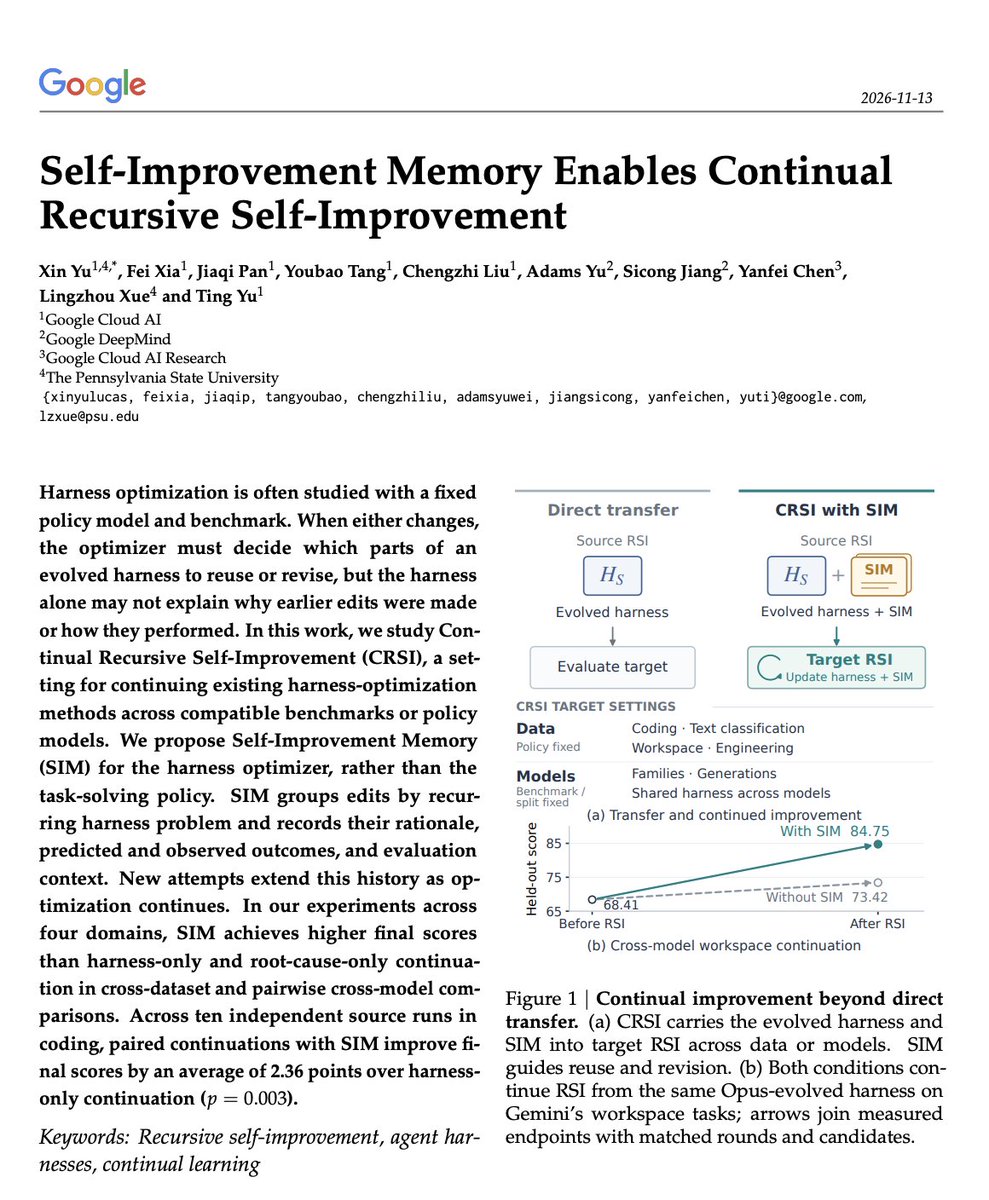
Google DeepMind just built an AI that rewrites its own code, remembers every change it made, and gets smarter every time it tries.
They’re calling it “Continual Recursive Self-Improvement”
For years, "recursive self-improvement”, the idea of an AI rewriting its own code to become exponentially smarter, hit a brick wall.
Every time an AI tried to improve itself, it suffered from catastrophic amnesia.
It would optimize for a new task, forget what worked in the last iteration, repeat past mistakes, or drift into useless loops. It couldn't compound its own intelligence.
Until now.
A new paper just introduced Self-Improvement Memory.
And it turns a static model into a perpetual learning engine.
Instead of blindly rewriting itself from scratch on every pass, the AI now maintains a structured, persistent memory of its own evolutionary history.
It logs every modification it makes. It tracks which experiments succeeded, which failed, and why.
Before making a new upgrade, it queries its own past.
The results rewrite the rules of scaling.
With Self-Improvement Memory, the AI doesn't just make one-off tweaks. It achieves continual recursive self-improvement.
Performance doesn't plateau. It compounds.
Iteration after iteration, the system builds on its own verified breakthroughs while actively avoiding the dead ends it already explored.
Nobody had to step in to guide it. Nobody had to hand-feed it new training data.
The AI literally became its own senior researcher—conducting experiments, learning from failure, and upgrading its own architecture in a closed loop.
We have spent the last decade throwing billions of dollars in compute and human data at models to make them marginally smarter.
That era is ending.
When an AI can remember how it improved yesterday, it no longer needs us to teach it tomorrow.
אני באמת לא מבין איך המאמר החדש הזה של נווידיה עובר מתחת לרדאר ולא יוצר הייפ רציני.
בזמן שכולם מתלהבים מחלונות הקשר ענקיים של מיליון טוקנים שלמים, החוקרים באים עם פטיש של 10 קג ומנפצים את הבלוף הכי יקר בתעשייה (לטענתם): אתם לא באמת צריכים הקשר ארוך, אתם סתם שורפים כסף על ארכיטקטורה עצלנית.
הכשל השקט שהמאמר הזה חושף נשמע די רציני. ספקיות הענן גובות מאיתנו מחיר קבוע למיליון טוקנים בלי קשר לאורך השיחה, אבל מאחורי הקלעים מתרחש משהו מעניין: כשהקשר מתנפח מ-16K ל-256K, ה-GPU נחנק ומהירות גנרוט הטוקנים שלו (Decode Throughput) צונחת עד פי 7. המשמעות היא שעלות החישוב האמיתית לייצור כל טוקן פלט מזנקת עד פי 7. זה קורה כי KV Cache תופח לממדי ענק, זמן התגובה בין טוקנים (Inter-token Latency) מוכפל, והשרת עובד קשה פי כמה על כל טוקן חדש שהוא יוצר.
הפתרון שלהם מפרק את הפרדיגמה לשניים: במקום לדחוף ספר שלם לפרומפט במשימות עם קלט ארוך, שומרים אותו במערכת הקבצים ונותנים לסוכן לבצע קריאה סלקטיבית עם כלי חיפוש פשוטים כמו grep. במשימות מרובות צעדים, מבצעים דחיסת הקשר אגרסיבית שמוחקת את היסטוריית השיחה ומשאירה רק "תדריך העברת מקל" (Handoff Recap) רזה ומדויק.
נצלול מתחת למכסה המנוע?
הקטע הכי מעניין במאמר הוא דחיסה אחרי כל פעולה בודדת (Single-Action Compaction - SAC). הסוכן מבצע פעולה אחת בטרמינל, מעדכן אובייקט מצב טקסטואלי, ובום - מוחקים לו את כל השיחה ומתחילים מאפס.
התוצאה? החציון של גודל ההקשר יורד לאזור ה-7K-9K בלבד! הסוד ההנדסי פה הוא שהם גילו שסיכום רגיל (Summarization) פשוט נכשל כי הוא נותן משקל שווה להכל. דחיסה שעובדת באמת חייבת לשמור אך ורק עובדות מאומתות, תוכנית עבודה קדימה, ובעיקר את תיאור הטעויות כדי שהסוכן לא יחזור עליהם כמו דג זהב. ב-SWE-bench ובמבחני שליפה (NIAH, RULER), הגישה המוצעת לא רק חסכה עלויות פי 5 עד פי 200, אלא אשכרה שיפרה את הדיוק כי המודל לא הלך לאיבוד בתוך הרעש של עצמו.
אבל בואו נשים רגע כוכבית ביקורתית:
למרות התוצאות המדהימות על מודלי Frontier כמו אופוס 4.5 ו-GPT 5.6, כשבודקים את הנספחים רואים תמונה קצת פחות ורודה במודלים פתוחים וקטנים יותר. למשל Qwen 3 Coder Next התרסק ב-SWE-bench מ-53% לפחות מ-4% תחת דחיסה צפופה של 16K, כי הפלט שלו חנק את חלון הדחיסה. בנוסף, לתת לסוכן לחפש עם grep עובד נהדר כשיש חפיפה מילולית ברורה, אבל במשימות שדורשות הבנה הוליסטית עמוקה או חיבור נקודות עדין לאורך מסמך שלם בלי מילות מפתח ברורות, חיפוש נקודתי עלול לפספס את התמונה הגדולה.
ועדיין, ההצעה שלהם לאמן SSSMs סמנטיים (Semantic State Space Models) שמנהלים זיכרון בשפה טבעית במקום בקופסה שחורה היא כיוון ממש מבטיח.
סיכומון של מייק: תפסיקו להשתמש בחלון ההקשר של המודל שלכם בתור פח זבל להיסטוריית שיחות ומסמכים; תחתכו את ההקשר ל-16K-32K, תנו לסוכן כלי שליפה חכמים ותכפו עליו דחיסת מצב מובנית. ככה תחתכו את חשבון ה-GPU שלכם משמעותית ותקבלו סוכנים חדים ומהירים הרבה יותר.
#אייאיי_עם_מייק
📉 Is your portfolio a sea of RED today? time to think beyond tech & AI.
🥤 $BRBR surged 25%+ today (mid-session) while major indices struggle.
That's why I value diversification: finding opportunities driven by different fundamentals, not just following market sentiment.
But is $BRBR a genuine recovery opportunity or just a relief rally? 🤔
📊 I break down the earnings, risks, and potential upside in my latest eToro analysis.
🔗 https://t.co/hJbg2uWyAS
📈 ~19% annualized returns over 6 years, with disciplined risk management.
eToro Popular Investor | Avi Avidan
🔗 https://t.co/VORCDmGqR5
Past performance does not guarantee future results. Not financial advice.
🚨 Thinking of buying Anthropic ($ANT) at tomorrow's IPO?
Before you hit BUY, you better lister to Jay !
📊 After studying over 9,000 US IPOs, finance professor Jay Ritter found that nearly 60% traded below their first-day closing price three years later.
It happened with $SPCX $META $FIG $ETOR and many others. The odds may not be in your favor, especially when hype is at its peak.
🏃🏻♂️🏃🏻♀️ Don't chase the hype. Read my detailed eToro analysis first.
🔗 https://t.co/AT8BZU2A3r
📈 ~19% annualized returns over 6 years, with disciplined risk management.
eToro Popular Investor | Avi Avidan
🔗 https://t.co/VORCDmGqR5
Past performance does not guarantee future results. Not financial advice.
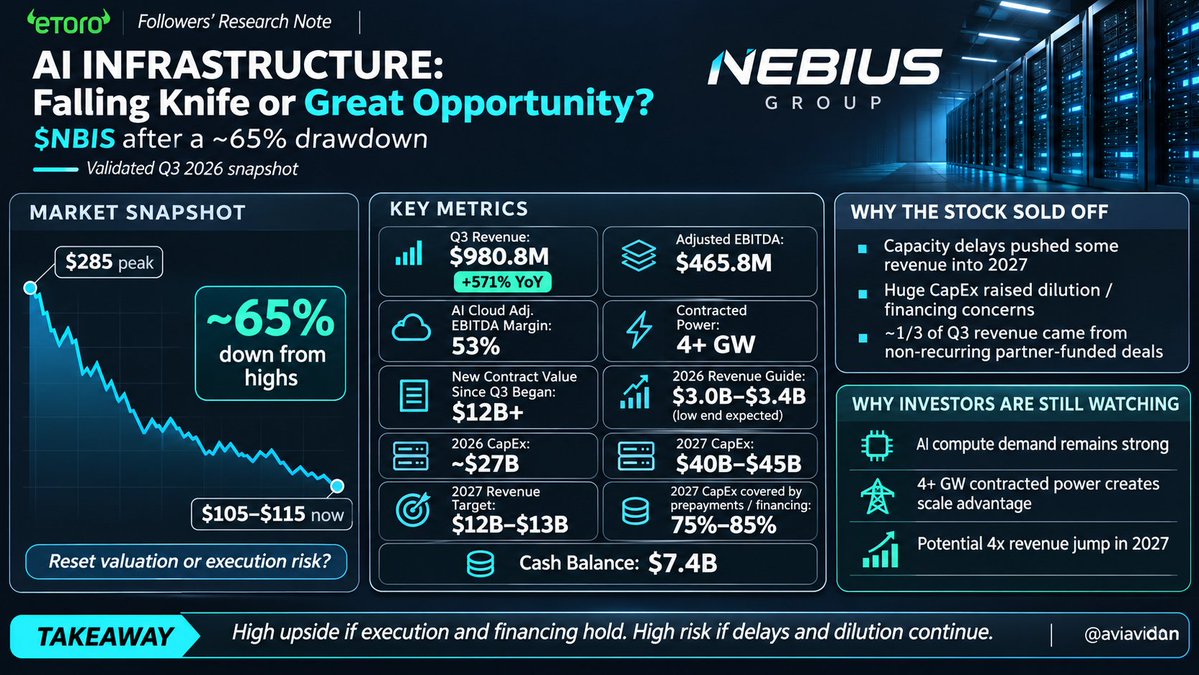
🚨 AI infrastructure stocks are tumbling. Buying opportunity or a falling knife? 🔪
$NBIS has plunged ~65% from its highs, yet Q3 revenue surged 571% YoY.
Explosive AI demand, but billions in CapEx and serious execution risks.
📊 Is the market overreacting, or pricing in trouble ahead?
I break down the numbers, risks, and potential upside in my latest eToro analysis.
🔗 https://t.co/nDIPIVGqoI
eToro Popular Investor | Avi Avidan
📈 ~19% annualized returns over 6 years, with disciplined risk management.
🔗 https://t.co/qk8hb0AvSu
Not financial advice. Past performance does not guarantee future results.
₿ Why is $BTC suddenly behaving so much like a high-risk tech stock? 🤔
Here's something fascinating: Bitcoin dropped nearly 20% ahead of SpaceX's IPO, and we're seeing an almost identical pattern ahead of Anthropic's debut.
Coincidence, or a massive liquidity rotation out of crypto and into AI?
And why could $MSTR amplify the downside? 📉
I break down the numbers in my latest eToro analysis.
🔗 https://t.co/ugw4loPEQc
📈 ~19% annualized returns over 6 years, with disciplined risk management.
eToro Popular Investor | Avi Avidan
🔗 https://t.co/VORCDmGqR5
Past performance does not guarantee future results. Not financial advice.