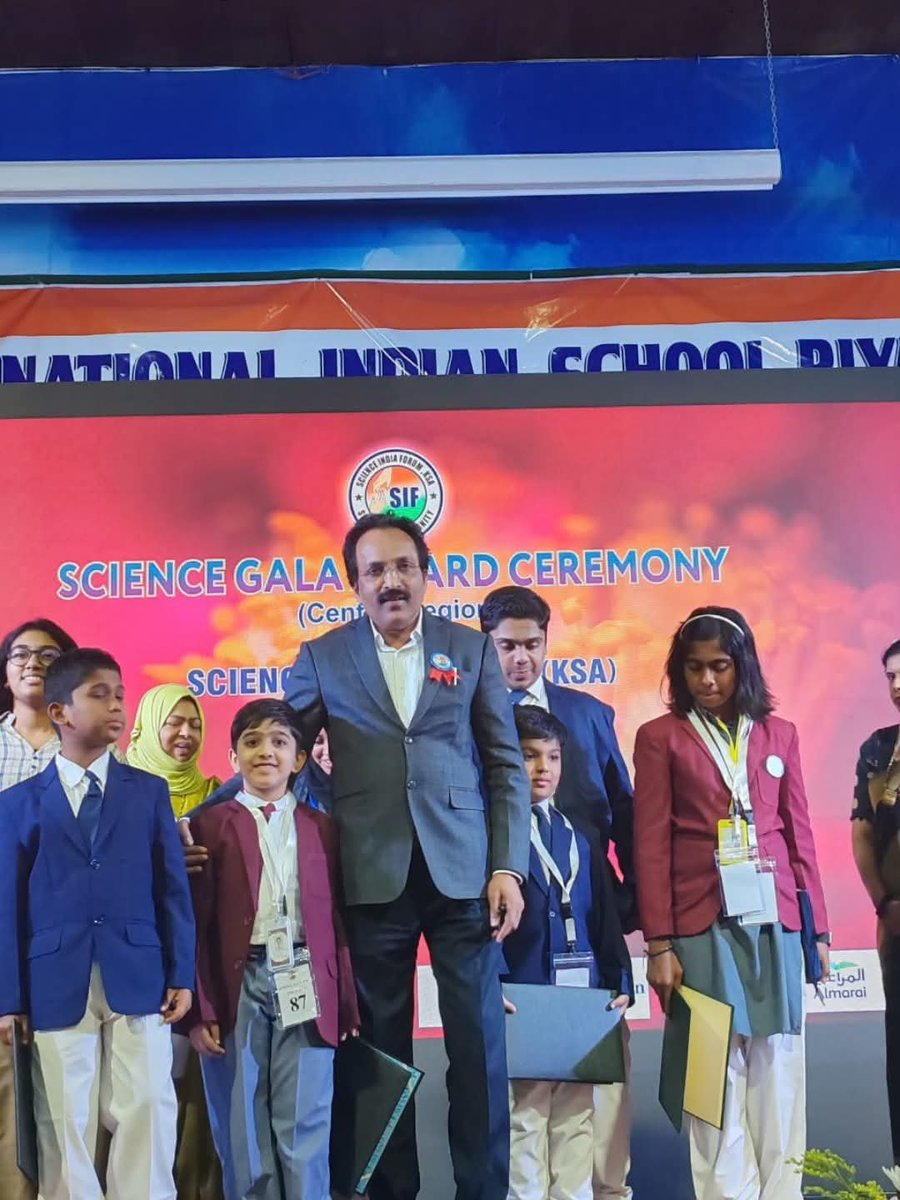
Dr. S. Somanath, former Chairman of ISRO (2022–2025), whose tenure included India’s historic Chandrayaan-3 lunar landing, the Aditya-L1 solar mission and important progress towards Gaganyaan, was a particularly inspiring presence in Aaryan Rohit Patil’s journey.
Aaryan, a student of Galileo Multiverse , was awarded 3rd Position in the Sub-Junior category at the Science India Forum (Saudi Arabia) Poster Making Competition held for International Yoga Day - 24.
During the event, Aaryan had the opportunity to meet Dr. Somanath and received his autograph on his award certificate—a truly special memory for a young science enthusiast.
Moments like these connect curiosity, creativity, science and inspiration, and make a young learner’s journey even more meaningful.
Congratulations, Aaryan! Keep exploring, creating and reaching for the stars.
Galileo Multiverse
Online Astronomy School
Space Education Should Be a School Subject
Something interesting is happening around us.
Children are asking more questions about space, planets, black holes, astronauts, aliens, rockets and the possibility of life beyond Earth.
This curiosity may be more than just a passing interest.
A Mega Space Revolution may already be waiting to emerge from the next generation.
Yet space education is still largely treated as an extra-curricular interest rather than an important part of a child's education.
I believe it is time to rethink this.
Should Space Education become a compulsory part of school curriculum?
Not because every child needs to become an astrophysicist.
But because space can become a powerful platform to teach:
* Scientific Thinking
* Critical Reasoning
* Planetary Awareness
* Innovation & Problem Solving
* Space Technology & AI
* Future Careers
* Curiosity & Imagination
At Galileo Multiverse, we have spent years building and experimenting with space education courses, curricula, teaching methodologies and learning systems designed for children and teenagers.
Now, we would like to take this beyond individual learners.
We are open to collaborating with schools & school chains
Across India and the Middle East, we would be happy to collaborate with schools that want to build meaningful space education into their academic ecosystem.
The objective is not simply to teach children about space.
The objective is to prepare a generation that thinks beyond Earth.
Perhaps the next great space revolution will not begin in a space agency.
It may begin in a classroom.
WEEK 5 — SPACE NOTES 001
— Abhishek Narayan
Founder & CEO, Galileo Multiverse
https://t.co/1XPdjSMtY2
#SpaceEducation #SpaceRevolution #FutureEducation #STEMEducation #Astronomy #Astrophysics #SchoolEducation #Innovation #GalileoMultiverse #FutureGeneration
SYNectics — Connecting the Unconnected
What can a spider web teach an engineer?
What can a forest teach a business?
What can a whale teach a submarine designer?
These may sound like strange questions.
But strange questions often lead to new ideas.
This is the essence of Synectics — a creative thinking method based on connecting things that appear unrelated.
The word comes from Greek roots meaning “bringing together diverse things.”
The idea is simple:
Don't look at a problem only from inside its own world.
Look outside.
A business problem may have an answer in biology.
A design problem may have an answer in nature.
An education problem may have an answer in gaming.
A technology problem may have an answer in astronomy.
The objective isn't to copy something.
It is to borrow its principle.
A spider web isn't a bridge.
But the way a web distributes tension can inspire engineering.
A forest isn't a corporation.
But its way of sharing resources, adapting and maintaining balance can inspire organisations.
Try Synectics yourself.
Take a problem.
Then choose something completely unrelated:
A tree. A river. A bee. A spacecraft. A galaxy.
Now ask:
«“If my problem worked like this, what would I do differently?”»
You may get a silly answer.
Keep going.
Because creativity often begins when we temporarily stop asking,
“What makes sense?”
and start asking,
“What if?”
Perhaps innovation is not always about creating something completely new.
Sometimes it is about seeing an old thing through a completely different lens.
Trust things that are alien,
and alienate things that are trusted.
That may be one of the most powerful habits of a creative mind.
— 001 HyperFocus Article by Abhishek Narayan
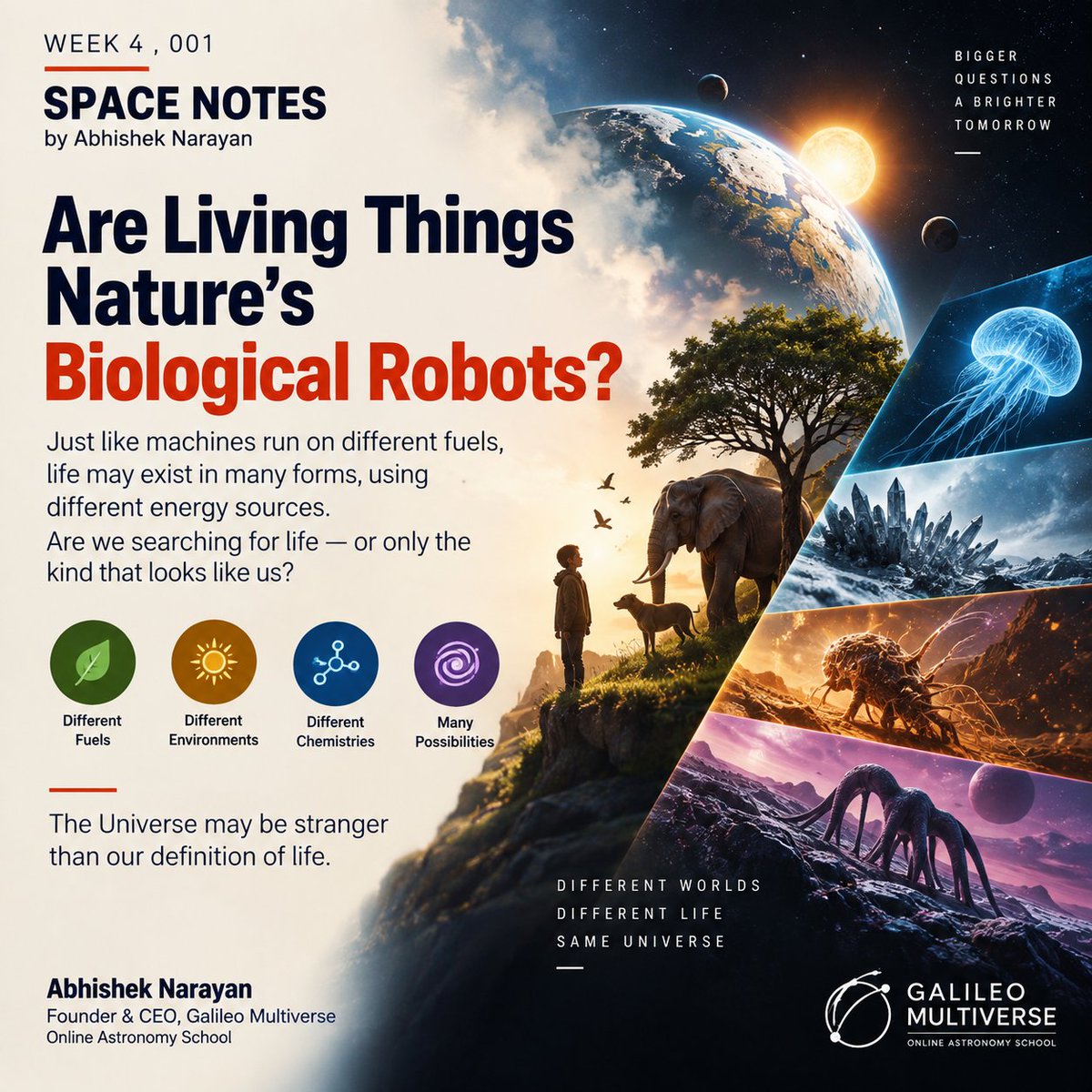
WEEK 4 — 001, SPACE NOTES by Abhishek Narayan
Are Living Things Nature’s Biological Robots?
What if life is not limited to the biological “design” we know on Earth?
Think of a robot.
A robot needs an engine, an energy source, sensors and a system to process information.
Living organisms have remarkably similar elements—metabolism for energy, senses for detecting the environment, and a nervous system or other biological mechanisms for processing information.
Perhaps we can think of living beings as Nature’s biological robots—each designed to operate on a particular kind of “fuel” and within particular environmental conditions.
A battery-powered machine cannot simply run on diesel.
But that doesn't mean all machines must run on diesel.
We can build engines that operate on electricity, hydrogen, solar energy, nuclear energy—or something we haven't invented yet.
So perhaps our search for extraterrestrial life has a philosophical limitation:
Are we searching for life—or only searching for life that resembles us?
If life elsewhere uses a completely different chemistry, energy source, sensory system or biological architecture, we may not even recognize it as life.
And there is an even deeper possibility:
Maybe the Universe contains forms of life that our present senses and instruments simply aren't capable of detecting.
We have spent centuries expanding our understanding of what exists.
Perhaps the next revolution in astronomy will not be discovering where life is—
but discovering what life can actually be.
The Universe may be stranger than our definition of life.
— Abhishek Narayan
Founder & CEO, Galileo Multiverse
Online Astronomy School
#SpaceNotes #AbhishekNarayan #GalileoMultiverse #Astrobiology #ExtraterrestrialLife #LifeInTheUniverse #SpaceExploration #Astrobiology #PhilosophyOfScience
I am not exaggerating, there are Unsupervised Cybercabs without steering wheels or pedals all over Austin, TX right now at almost every corner.
It is SO BEAUTIFUL on the road. The glossy gold (first time seeing it) is stunning in the sun. I also LOVE how massive the wheels look.
This is literally the future. I’m in @Robotaxi heaven right now.
In 2014, Peter Thiel gave a 1-hour masterclass on how to build a monopoly from scratch.
He broke down how:
• Google became untouchable
• PayPal beat the odds
• Facebook crushed competition
Here are 11 timeless lessons from his masterclass:
1. Create value, then capture it
🇮🇳 India reached the Moon. The next destination is the stars.
My thoughts on India’s space journey, future and the generation that will take it forward.
Read here: https://t.co/0anlShdUVe
Efficiency made us richer. But did it also make our work less human?
A reflection on Adam Smith, Karl Marx, and the hidden cost of the division of labour.
https://t.co/rVt1UtM1SD
Day 003
@elonmusk made a generation look up.
Parents are now enquiring about astronomy for kids as young as 3 and 4.
Perhaps the biggest change isn't in rockets.
It's in curiosity.
Before a child becomes a scientist, engineer or astronaut,
they first become curious.
#SpaceNotes
Day 002
Are we searching for life — or consciousness?
When we look into the cosmos, will we recognise life if it looks nothing like us?
Maybe our biggest limitation isn't technology.
Maybe it's our definition of life.
What are we really hoping to find?
#SpaceNotes#Space