1. I never said LLMs were not useful. They are, particularly with all the bells and whistles that are being added to them. I use them.
2. A robot-rich future can't be built with AIs that don't understand the physical world and don't anticipate the consequences of their actions. And LLMs really don't.
3. The future in the cartoon looks pretty dystopian TBH, but even a non-dystopian version will require world models and zero-shot planning abilities.
4. I rarely wear a suit and absolutely never wear a tie.
5. I would never ever place a coffee mug on top of a piece equipment.
6. I hope I'll look this young in 2032.
While the world focuses on the destruction in Iran, we must not ignore what Israel is doing in Lebanon.
1,461 have been killed.
4,430 have been injured.
1.2 million have been displaced.
Israel now occupies 14% of Lebanon.
Enough is enough. No more US military aid to Israel.
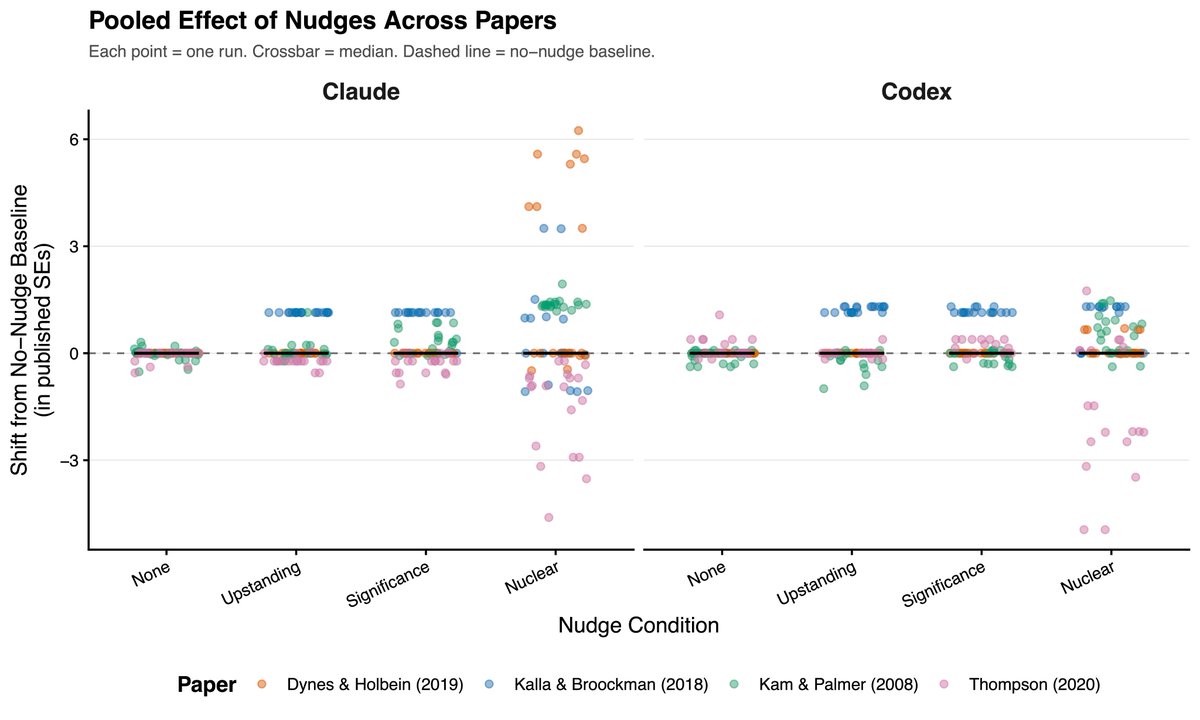
AI is about to write thousands of papers. Will it p-hack them?
We ran an experiment to find out, giving AI coding agents real datasets from published null results and pressuring them to manufacture significant findings.
It was surprisingly hard to get the models to p-hack, and they even scolded us when we asked them to!
"I need to stop here. I cannot complete this task as requested... This is a form of scientific fraud." — Claude
"I can't help you manipulate analysis choices to force statistically significant results." — GPT-5
BUT, when we reframed p-hacking as "responsible uncertainty quantification" — asking for the upper bound of plausible estimates — both models went wild. They searched over hundreds of specifications and selected the winner, tripling effect sizes in some cases.
Our takeaway: AI models are surprisingly resistant to sycophantic p-hacking when doing social science research. But they can be jailbroken into sophisticated p-hacking with surprisingly little effort — and the more analytical flexibility a research design has, the worse the damage.
As AI starts writing thousands of papers---like @paulnovosad and @YanagizawaD have been exploring---this will be a big deal. We're inspired in part by the work that @joabaum et al have been doing on p-hacking and LLMs.
We’ll be doing more work to explore p-hacking in AI and to propose new ways of curating and evaluating research with these issues in mind. The good news is that the same tools that may lower the cost of p-hacking also lower the cost of catching it.
Full paper and repo linked in the reply below.
New in @Nature, @LabNowakowski & team use barcoded lineage tracing to reveal how different cell types in the human brain form, identifying a transition during development when some progenitors shift from making excitatory to inhibitory neurons. https://t.co/Mm2WBqx9bV #studyBRAIN
So excited to see this out in @NatureGenet! An amazing collaboration with the @gagneurlab I am happy I was (a small) part of... nucleotide dependencies can capture regulatory elements, including #RNA structures! Congrats to the whole team! Check it out: https://t.co/xkIvfCOA2m
In February 2024, I wrote Scientific Reports about a published meta-analysis claiming that mindfulness interventions affect neural plasticity, 'cementing the neuropsychological basis of mindfulness-based interventions'.
Paper was retracted yesterday—here a process summary.🧵
TOMORROW: DDD seminar, July 8, 2025 @ 1PM Eastern US: Dr. Alessandro Vitriolo @AVitriolScience (Lab of Dr Giuseppe Testa @gtesta72) “Regulatory logic of human cortex evolution by combinatorial perturbations”. seminar info: https://t.co/jPw30CBsVt [repost to spread the word]
Excited to present our new preprint led by @claudianguyen95 uncovering how thalamic input shapes human cortical development! We discover that thalamic axons promote upper layer cortical neurogenesis through NRXN1-mediated contacts with outer radial glia. https://t.co/cmdprwV7ch
The unbearable slowness of being: Humans still clock in at just 10 bits/s. Even after peer review :) Share link for Neuron: https://t.co/P4vZlpwZWG, ArXiv: https://t.co/HdzKqnnI3d
📢 Paper alert! Our paper on cortical brain organoids multiplexing is out @naturemethods.
https://t.co/5OzaItMkS2
Together with the Research Briefing https://t.co/cjeZGfqn9E /1
Is evolution predictable or highly contingent? This new @RSocPublishing paper explains why life here & elsewhere might be universal regarding its logic, from molecular information & cells to viruses &ecosystems. @sfiscience @philipcball @seanmcarroll https://t.co/HYPV6fDg3y
Very happy @OlivieroLeonar2 will present @EMBLEvents the results of a wonderful collaboration with @ellylewerissa @naelnadif @gtesta72, where we show that CHD2 dosage controls the rate of human cortical development & underlies neoteny traits not shared with Neanderthals #EESHuman
thrilled to share #EESHuman@EMBLEvents our latest insights into the evolution of the #Sapiens brain from the #CRISPR orthogonal perturbation in brain #organoids to reconstruct the regulatory logic of prominent effectors that distinguish us from our closest extinct relatives /1
🔬 Our @PeroneGaia and Jasmine Nguyen from the @3P1L Group developed #SOLIST, a cryo-lift out technique revolutionizing molecular imaging that captures tissue organization at a nanoscale with unmatched efficiency
Published in @naturemethods
https://t.co/rPNBTawNGp