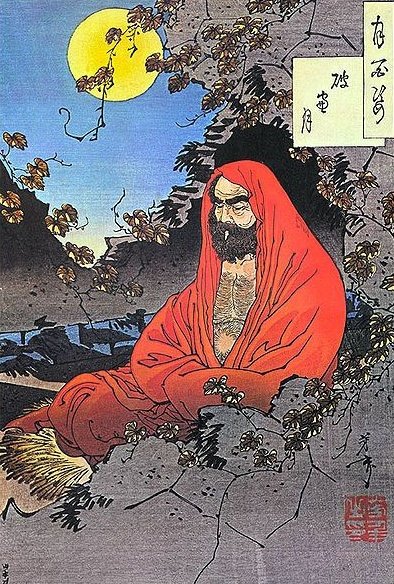
"Eu me tornei um eremita para me libertar da sujeira do mundo e buscar a perfeição na outra margem. Mas eu percebi que era impossível alcançar isso sem antes amar até mesmo o lixo, o pó do mundo e todas as angústias da vida. A perfeição pode ser alcançada ao abraçarmos todas as+
@Lariolii_ É preciso inteligência pra enxergar o óbvio e como a maioria das pessoas são burras, acabam caindo no pensamento de "nossa, como assim essa pessoa não me deseja? Não me idolatra? Não quer passar o resto da vida cmg?"
"Se meu personagem não conseguiu um final objetivamente feliz, pq eu teria que ter?" e talvez conscientemente ou "inconscientemente" o sujeito chegue na conclusão de que o importante é contemplar a firmação de si no presente.
Bobagem até certo ponto, a distopia cyberpunk já está presente e sua fantasia ressoa justamente pela sua familiaridade somado a esperança onírica que é justamente a disparidade de quem assiste e acha que vai ter algum destaque nessa distopia.
Not only do we not live in cyberpunk, but cyberpunk will never happen for the exact reason it's such an alluring setting: The downtrodden underclass are never going to become super high agency computer wiz genius street samurai warriors, hacking into corpo supercomputers and committing acts of terrorism against THE MAN. They're actually just going to be fat degen gooners and addicts, outsourcing all cognitive function (and gambling action) to machines, eating kool-aid pineapple and sharing AI videos of African kids doing autobody work with brick and mortar. "Oh my God, can you believe this!?” And they'll drink fabric dye elixirs because their penis doesn't work, and shop at Walmart and traffic in novel hybrids of conspiracy theory on the techno-occult app.
The great conceit of cyberpunk is that it assumes most people are transhumanists at heart. That they're incredibly savvy and talented, and they'd all do so well if THE MAN just got out of their way and let them upgrade. As it turns out, people can't even handle the internet. They could barely handle the television. The camera has stricken them in hypnosis, reorienting their gaze to see things for it rather than themselves. Ubiquitous access to food has destroyed their bodies. All communication now routed through a sensory deprivation box, and suddenly they want to end their life. There will be no laser katanas.
The pioneering writers of the genre always assumed, like many people still do today, that technological pessimism relies on a corrupted design. There was nothing essential about it. The revealed dilemma is that man interacting with highly optimized systems doesn't need to be coerced into dysfunction much at all. We can do bad all by ourselves. You merely have to leave too much kibble in the bowl.
Algo nessa distopia que me faz pensar sobre pq tanta pessoas gostam é seu pessimismo, talvez de forma não tão consciente os fãs saibam/pensam que não existe felicidade eterna em qualquer lugar que seja onde mesmo no campo onírico esse pessimismo persiste chegando a pensar
Sou apaixonado pelo cyberpunk justamente pela máxima expressão do Ser, a junção do orgânico e inorgânico formando a funcionalidade da concomitância entre o complexo e o simples da consciência, o caminho do meio.
Galera que vai pra parada: se divirtam, lutem e o mais importante, contemplem o privilégio da vida, ser quem realmente é, infelizmente estou trabalhando hj mas fico feliz que a parada de Fortaleza tá reunindo muita gente, esse momento é muito lindo e importante.
@cristao49736 Não fui mencionado mas vou pontuar que não existe isso de "acumular pontos carmicos pra trocar por um bilhete", a métrica karmica de +/- serve pra entender as manifestações dos efeitos das ações, essa "Graça" já é componente da natureza intrínseca do Ser.
"There is a profound difference between the history-centrism of the Abrahamic faiths and the goal of dharma (comprising Hinduism, Buddhism, Jainism and Sikhism) which is that the individual aspirant elevate his or her consciousness in the here-and-now and in his or her very body. Dharma is not burdened by history, nor by the problem of “sin” as it recognizes no such historical act of disobedience. This was one of the topics of a wonderful conversation I had with Joshua Stanton, Co-Editor-in-Chief of Journal of Inter-Religious Dialogue. See below:
From the dharma perspective, one does not require a historical consciousness, at least not a rigorously developed one. Instead, the aspirant is free to start afresh and tap into his potential for discovering the ultimate reality without bondage to the past. All the dharmic traditions share this a-historical and direct approach to knowing the ultimate truth. Furthermore, this potential to know the ultimate reality by direct, disciplined practice exists in all humans even those who do not believe it does.
The prevailing Abrahamic view, by contrast, is that humans are not able to achieve unity with the divine and that, besides, the spiritual goal is salvation, not “unity with God.” Salvation can be achieved only through obedience to God’s will as understood through historical events and prophets.
Such an absolute status of history weakens the authority of individual spiritual explorations (hence, mystics are regarded notoriously with suspicion in these traditions) and becomes the basis for competing claims to truth which cannot be reconciled. Moreover, the Abrahamic view is that those without access to these historical revelations must remain, by definition, in the dark, lacking the most elementary means to make contact with God. I regard this historical fixation as the major difference between a dharma path (Hinduism and Buddhism in particular) and the Abrahamic one (Christianity, Judaism, Islam).
For the individual who follows a dharma path, it is not necessary to accept a particular account of history in order to attain a higher, embodied states of consciousness. Nor is any such historical account or belief sufficient to produce the desired state. Thus, dharma traditions have flourished for long periods without undue concern about history, relying instead on the numerous lineages of spiritual masters who teach from a state of enlightenment. Meditative practices remove the layers of conditioning that obfuscate the light of one’s true self and thereby help one to realize the highest truth without depending on history. Even if all historical records were lost, historical memory erased, and every holy site desecrated, the truth could be recovered by spiritual practices."
https://t.co/v5PUKtibOx
Me sentindo meio bleh ao ser incapaz de conversar sobre inseguranças na NM no grupo pq pra mim a maioria das coisas como ciúmes, insegurança e tals são bobagens.
Comecei essa descodificação relacionamental já na pré-adolescência, no primeiro relacionamento.
A não-monogamia é uma expressão do processo de descodificação dos relacionamentos amorosos. O fato de que hoje cada vez mais pessoas se dizem felizes em "situasionships" também. A aposta redobrada e intensa na monogamia (como indica pesquisa) é uma expressão paranoica reacionária