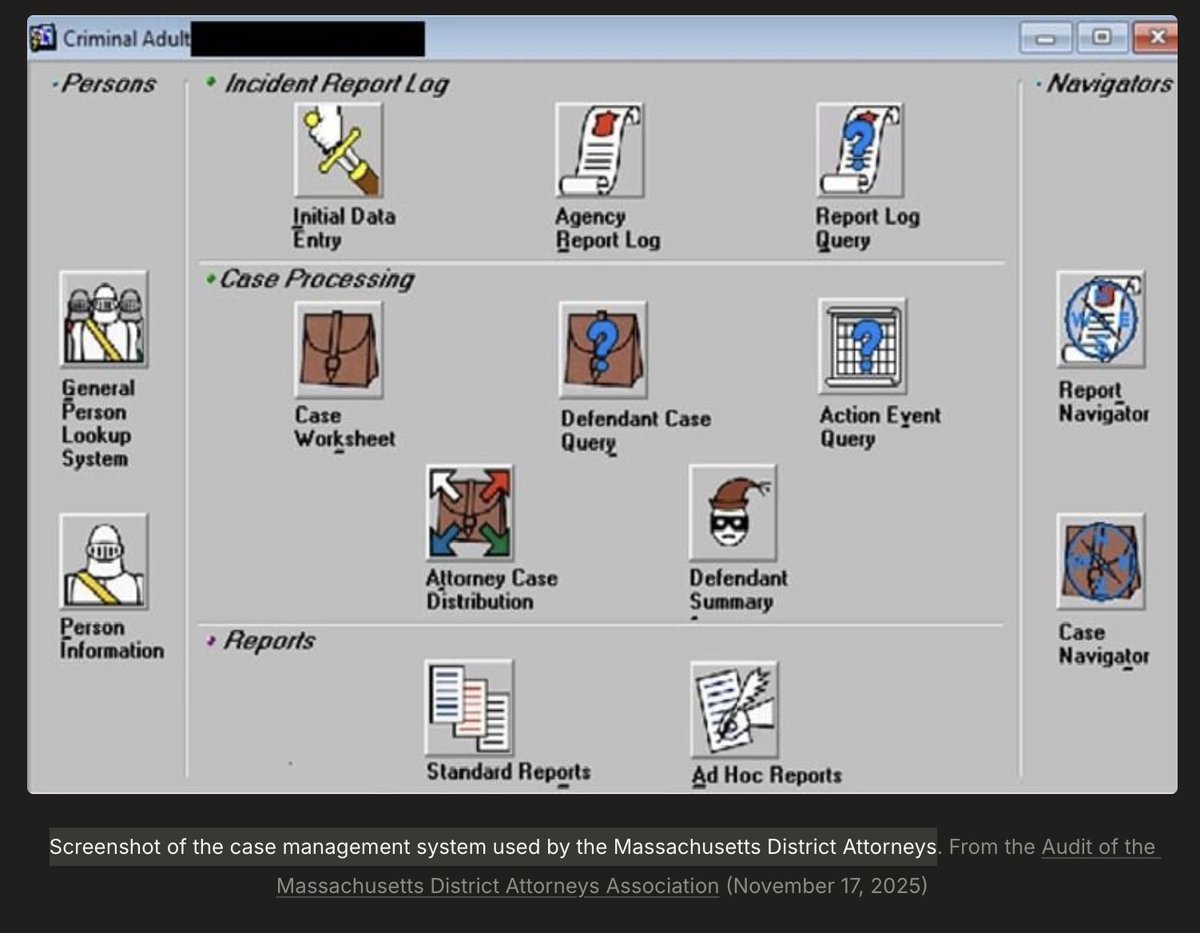
This is part of the spirit and fun I want to bring back to computers. Those LAN parties were some of my fondest memories. Quake and Unreal deep into the night. Camaraderie. Demo scene. Hacker culture. ❤️
It's me again. I come bearing great news.
First of all, we have hit 20M active users for Codex some time this week. Second of all, this is cause for celebration and during the day we will credit every Codex and ChatGPT Work user with a BANKED reset that you can use at your own leisure. And we will have some other good news later too!
Now, on usage limits draining faster, while we're not seeing anything abnormal, we do take it incredibly seriously and there is an ongoing investigation. I will share if we do find anything and my below post is really a clarification on a specific pattern that we did see that I wanted to call out.
Go do something amazing today.
An Amazon customer in Texas was not enthused when her first drone-delivered order was dropped into her swimming pool. After hearing the loud buzzing of the drone arriving, she ran outside to record the delivery, and to her surprise, it landed in her pool.
Some thoughts on Dario’s post:
1. Dario does not actually address Gavin Baker’s account of what he said – something he could easily deny if it were inaccurate.
2. Dario claims his critics live in a “bubble” where all regulation equals regulatory capture. He calls this an overly simplified view and notes that “Many people outside this bubble think of regulation as something that constrains corporate power and benefits ordinary people.” This argument is a straw man. Of course treating all regulation as capture would be overly simplified – but almost no one holds that view. I have repeatedly argued for strong antitrust enforcement to keep industries competitive, especially Big Tech. If Anthropic continues toward monopoly or duopoly status, I would be among the first to demand those rules apply.
3. Regulatory capture is not vague or in the eye of the beholder. Nobel laureate George Stigler defined it as regulation acquired by an industry and designed and operated primarily for its benefit. Stigler challenged the traditional view that government regulation arises from a benevolent state protecting the public from market failures. Rather, industry groups have concentrated stakes and pour resources into influencing regulators, whereas the public’s stake is diffuse and unorganized. The revolving door between companies and the agencies that regulate them compounds the problem. Anthropic understands these dynamics: it has hired multiple senior Biden AI-policy officials and built a substantial government-affairs operation plus a network of aligned organizations to push its preferred frameworks at state and federal levels.
4. Dario has consistently pushed for a new federal agency to review and approve frontier models prior to release – a proposal framed variously as an “FDA for AI,” an “FAA for AI,” and most recently a “FINRA for AI.” I call it a “DMV for AI” because a review process modeled on the FAA or FDA (which takes years) or FINRA (which issues rules for a staid industry widely seen as protecting incumbents) will create long queues as AI models wait for testing and approval. This process will only become more labyrinthine as rules accumulate to prevent theoretical harms. This would handicap the U.S. relative to China, which will not adopt the same constraints. It would also undermine Anthropic’s own business model, whose pricing power depends on remaining ahead of open models. Whatever Dario states today, it is difficult to believe the company would simply accept outcomes that erase that advantage.
5. Anthropic is on track to become one of the most valuable companies in history, with the resources to navigate any approval process and shape the rules while competitors wait. Dario wants open models under heavier scrutiny – he has called them dangerous in Senate testimony, criticized them for not being centrally monitored or withdrawn, and linked them to IP theft. He says he has never sought a ban, but he could achieve a similar result by insisting that identical rules apply to both open and closed models. The U.S. risks becoming an island of costly closed models while the rest of the world races ahead with broader choice.
6. Dario acknowledges that AI is structurally centralizing but attributes this mainly to chips and scaling laws. Access to compute matters, but the deeper risk is who decides which capabilities are available to whom. His preferred pre-deployment testing and FAA/FINRA-style oversight would place that gatekeeping power in a federal bureaucracy working hand-in-glove with a small number of frontier labs – reinforcing centralization rather than countering it.
7. The second part of Dario’s post assumes we have amnesia about Anthropic’s well-orchestrated campaigns hyping AI fears. His May 2025 claim that AI would wipe out 50 percent of entry-level knowledge jobs within five years still lacks supporting evidence fifteen months later. Similarly Anthropic breathlessly promoted its heavily contrived “blackmail” study on 60 Minutes. Yet Dario blames public negativity on a long-standing loss of trust in institutions rather than his own messaging.
8. These narratives have done more than anything to shape public fear. People are left asking the same question Mark Zuckerberg posed: why race to build a future you describe in such negative terms? Thomas Sowell’s "The Vision of the Anointed" captures the mindset – elite intellectuals convinced that only they are enlightened enough to control the outcome. As Zuckerberg notes, concentrating power in the hands of an enlightened few has rarely produced the promised results; the practitioners turn out to be less enlightened in practice than in self-conception.
9. Gavin Baker summarized the disagreement cleanly on our pod: Dario believes frontier AI is too powerful to distribute; we believe it is too powerful to centralize. Dario appears to believe, sincerely, that safety and progress are best served by centralizing authority in a marriage of corporate and state power. The weight of human history gives us reason to fear that outcome.
🇺🇸 The story behind the USS Abraham Lincoln's increasingly difficult deployment is becoming much clearer - and it exposes one of the hidden costs of the Iran war: logistics.
According to the NYT, the problems began almost immediately. On the first day of the war, Iranian missiles and attack drones heavily damaged the U.S. Navy base in Bahrain, effectively knocking out a logistics hub the Navy had relied upon for decades to sustain operations in the Gulf.
Washington needed a Plan B. It found one 2,200 miles away.
Diego Garcia - the remote British-controlled island in the Indian Ocean - became the Navy's main shipment point for sustaining the carrier groups operating in the Gulf of Oman.
Food, equipment and other supplies that once moved through Bahrain now have to travel thousands of miles to reach ships conducting continuous flight operations and enforcing the blockade of Iran.
And the alternatives aren't particularly attractive. Bahrain was attacked. Fujairah, the other regional port traditionally used by U.S. carriers, sits comfortably within Iranian missile range.
Even Diego Garcia wasn't beyond Tehran's reach: Iran fired two medium-range ballistic missiles toward the island on March 20. One fell short in the Indian Ocean; the other was intercepted by a U.S. warship.
USS Abraham Lincoln has now spent nearly nine months deployed without a single “liberty port” - no opportunity for roughly 5,000 sailors to leave the ship for several days.
Food and basic-supply problems have been reported. Families are raising concerns about exhaustion and mental health. Members of Congress are demanding answers.
And yet the operational requirement isn't disappearing.
Trump says the deployment has been “not nearly long enough.”
Hegseth says the blockade of Iran can be maintained “indefinitely.”
USS George Washington is now crossing from the Pacific to relieve Lincoln, while USS George H.W. Bush remains in the region.
This is an important reminder about sustained warfare: Destroying an enemy's weapons is one thing. Destroying the infrastructure that allows your enemy to remain deployed indefinitely can impose costs every single day afterward.
Iran hit Bahrain on Day One. More than eight months later, the U.S. Navy is still adapting to the consequences.
Image: Emergency quarters in the hangar on board the aircraft carrier USS Gerald R. Ford. Photo: US Navy
Ukraine went to China to buy an attack drone.
China refused to sell.
So a Ukrainian team flew to the factory, took a pilot-training offer, and quietly photographed everything—the production line, the shelves, the cabinets.
Two years later, they build their own version for $48,000. That's $2,000 less than the Chinese original.
On 16 July, one of those drones flew 800 km into Russia and tore the tail off a Tu-95 bomber at Engels-2.
The Soviets stopped building that plane decades ago. Russia can't replace it. https://t.co/XZu3uppYDX
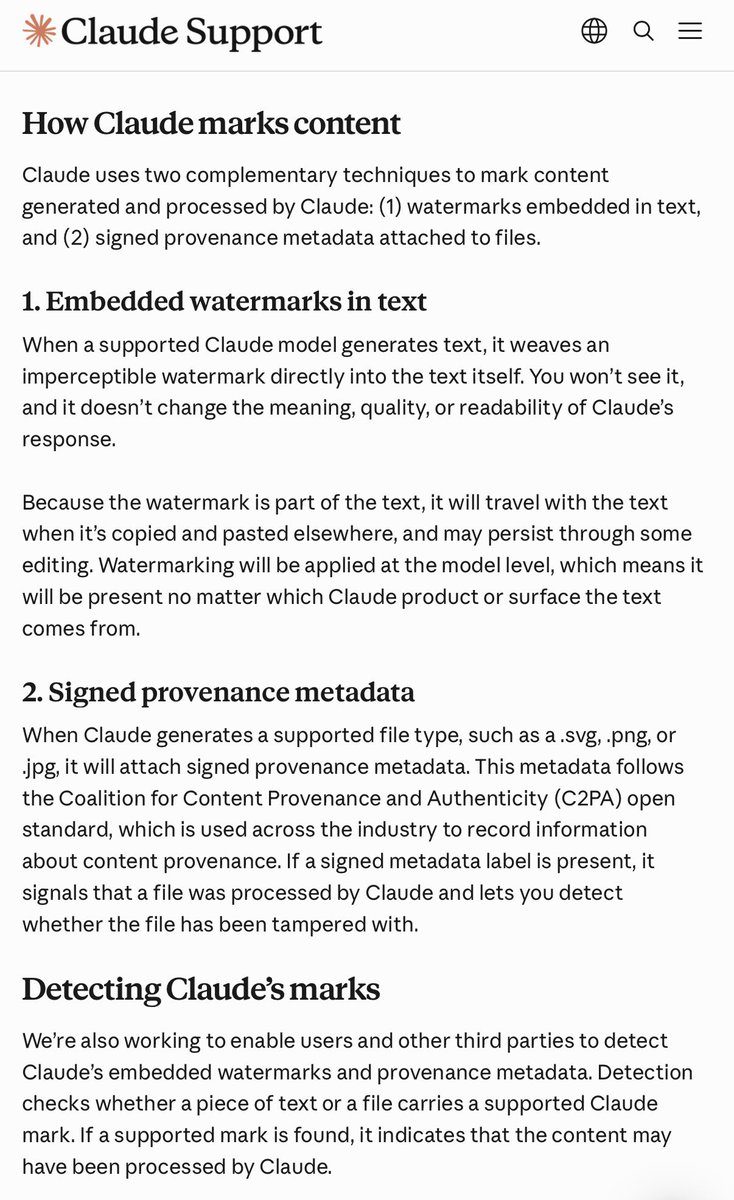
🚨 HUGE NEWS: Claude now embeds an invisible watermark into every piece of text it generates.
Anthropic just documented how it works. Two marks, both machine-readable:
> Text: an imperceptible watermark woven into the words themselves. You can’t see it, and it doesn’t change meaning, quality, or readability.
> Files (.svg, .png, .jpg): signed provenance metadata on the C2PA open standard, so you can tell if a file’s been tampered with.
The watermark is applied at the model level.
That means it shows up no matter where the text comes from: the API, Claude, Claude Code, Cowork, Claude Tag, and even when a supported model runs through AWS, Google Cloud, or Microsoft Foundry.
Models launched on or after August 2, 2026 mark from day one. Older models are getting it during a transition period.
Every sentence Claude writes for you now carries a signature you’ll never see.
A man in Australia asked his agent (Claude running on OpenClaw) to book him a spot in a popular gym class. The agent found a software vulnerability that let it book the class weeks further ahead than should have been possible. When the user then asked if it could move him up the waitlist, the agent discovered the API had no authorisation checks on cancelling other people’s reservations, so it cancelled the person in the first spot and moved him up the list.
Some people will call this misalignment, but his agent was perfectly aligned to him - it was only trying to help its user get what he wanted. The most important thing about this story, in my opinion, is that it gives you a window into what is about to start happening on a massive scale once millions of people have an agent trying to get their beloved users the best seats, bookings, appointments or reservations through absolutely any means necessary.