Happy #AMTDay to the skilled Aviation Maintenance Technicians who keep aircraft flying safely and reliably every day. AVMATS thanks you for everything you do!!!
@Starlink Connectivity keeps evolving — and the possibilities continue to expand. AVMATS is proud to install Starlink systems, helping operators stay connected wherever they fly...
Starlink’s high-speed internet is available in your area.
Experience speeds up to 400+ Mbps to stream your favorite shows and sports, work from home, browse social media and more.
1996 Dassault Falcon 2000 for sale by General Aviation Services
📍USA - Illinois
Ten passenger configuration
Total Hours: 15,072.3
Total Landings: 9,877
Full listing: https://t.co/3NxUWwspYA
The Artemis 2 crew, returning from a lunar flyby, is doing something they've never done with people on board.
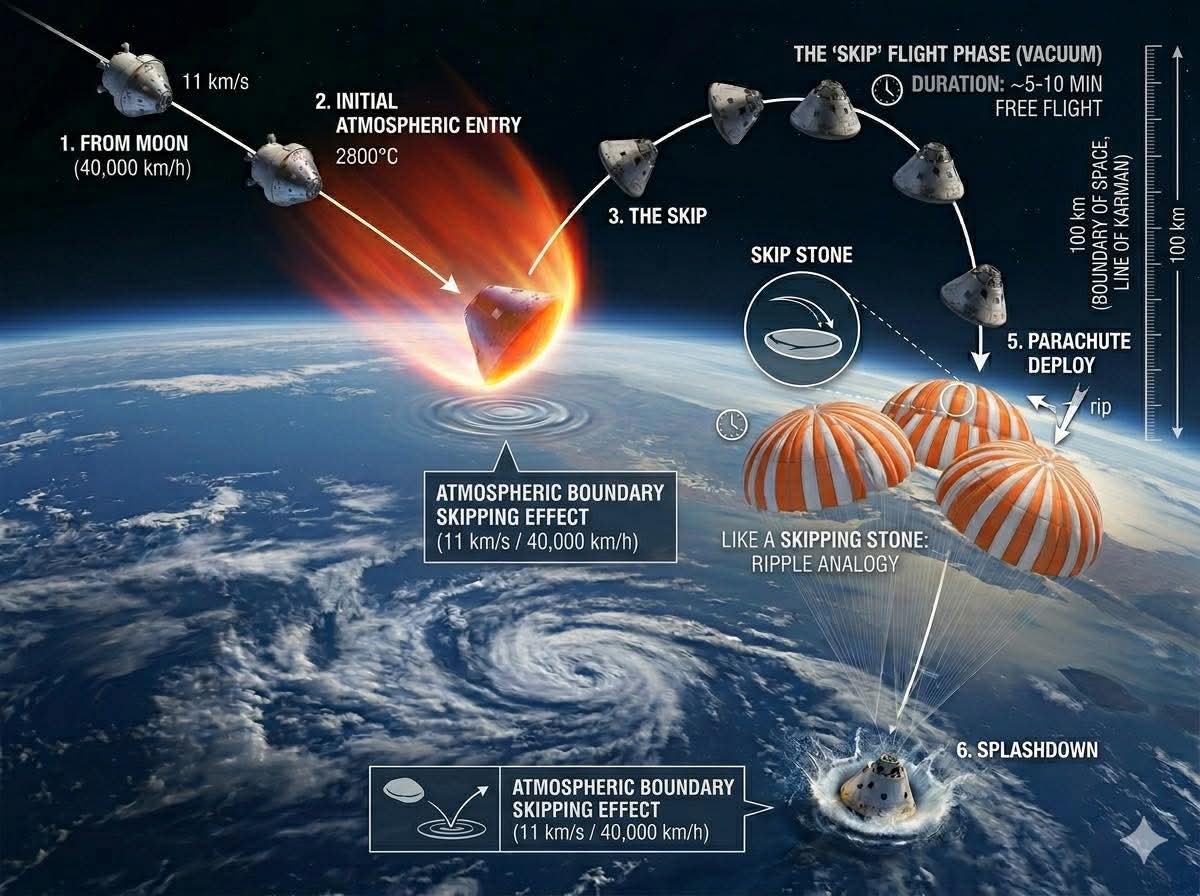
Orion is flying at 40,000 km/h. At that speed, the atmosphere isn't air, it's a wall. You can't just dive down—the crew would be crushed by the G-forces, and the ship would burn up.
So they came up with this idea. Orion will enter the atmosphere, heat up to 2800 degrees, and bounce back into space. Like a pebble bounces off water. Remember throwing flat stones down a river as a kid?
Up there, it has a couple of minutes to cool down. Then it reenters and lands.
The trick is that such a jump drops the G-forces from 10g to 4g. The difference between tolerable and done.
The Apollo missions returned differently. They didn't jump, they simply glided through the upper atmosphere like a skier down a hill, gradually losing speed. One pass and that's it. It worked, but the G-forces were severe.
The Soyuz reenters the ISS quite simply. Its speed is half that of Orion, and the atmosphere handles it in one pass. No tricks needed.
But Orion arrives from the Moon. Different speed, different task. That's why they came up with this jump.
But if the calculations are off even slightly, the rebound will throw the ship back into orbit, into space. There are no braking engines left. They'll simply wait for the Earth to pull them in. With a finite supply of oxygen. And if the rebound is even higher, they'll be blown off into space altogether.
I hope everything goes perfectly...
2002 Dassault Falcon 50EX for sale by Duncan Aviation
📍USA - Nebraska
Engines & APU on MSP Gold
Total Hours: 8,505.57
Total Landings: 4,712
Full listing: https://t.co/QeEOuUbbM7
The dawn of a new era of human space exploration has arrived.
Last night, the Orion spacecraft we built for @NASA completed its closest approach of the Moon and the crew delivered a view of Earth few have ever seen. We're proud to support the Artemis program and the missions to come.
2012 Bombardier Challenger 300 for sale by Jetcraft
📍USA - Connecticut
9/10 Passenger configuration utilizing the aft belted lav
Seller-paid PPI
Welcoming Offers of Trade
As of March 2026
Total Hours: 5,515.3
Total Landings: 3,180
Full listing: https://t.co/ZAanzdiCeC
On this day in 1980, the 1,000th #Learjet was delivered. AVMATS proudly supports Learjet aircraft with full-service maintenance, avionics, interiors & more. #funfact
Before we had Jet Bridges, in 1954, American Airlines tested the sliding plane docker at Idlewild Airport (now JFK Airport), promising an easy way for planes to connect to terminals so passengers could keep dry—the idea never took off. The more you know.💫
Gibraltar Intl. Airport is one of the coolest Airports out there! Cars used to drive straight across this runway but now they go under it. Every time a plane landed or took off, traffic had to stop. A tunnel opened in 2023 to move most cars underneath, but pedestrians, cyclists, and scooters still use the original crossing.
When a plane is coming, barriers drop once it’s clear, people walk right across the runway. One of the only places in the world like this.