Leading up to the 25th anniversary of 9/11, the U.S. president is trying to paint Canada as an enemy.
Canada was your neighbour that took in US-bound planes after the attacks and welcomed stranded Americans into our homes.
Canada sent 40,000 troops to fight for you.
158 Canadians died fighting for you.
Reminder to Conservative friends who are opposed to retaliatory tariffs: you ran on imposing dollar for dollar retaliatory tariffs on the US in your election platform last year.
It’s the commitment you gave to voters.
A close family friend lost his feet in Kandahar while protecting the embedded Canadian journalist from Calgary who lost her life there. He still carries the names of all the Canadians who died that day on a bracelet around his wrist.
Canadians didn't fight and die in Afghanistan because al-Qaeda flew planes into the Canadian Wheat Board HQ in Winnipeg.
Just to be clear.
Canadian scientists are working on something that sounds straight out of science fiction.
Researchers at the University of Waterloo have engineered bacteria designed to seek out tumors, invade them, and help destroy cancer from within.
Dr. Brian Ingalls, Dr. Sara Sadr and Dr. Marc Aucoin are behind this promising research.
Imagine a cancer treatment that could send microscopic “soldiers” directly into a tumor and attack it from the inside.
It’s still early stage research, but this could open an entirely new front in the fight against cancer.
Canadian science doing incredible things. 🇨🇦
Thomas, agree.
The question isn’t “Is this allowed?” (it is).
For anyone interested, here is a recap of my recent quick easy to read article on floor-crossing:
✔️The wave of MPs defecting to the Liberals under Carney is unusual in timing and scale.
✔️It is also controversial at the cusp of a technical mathematically majority of seats in the House of commons.
✔️However, it is entirely lawful and constitutional in Canada’s Westminster system.
What it explains
✔️MPs are elected as individuals by voters.
✔️parties don’t “own” the seats.
✔️The House of Commons’ own rules are crystal clear: changing parties does not require an MP to resign and run again.
A government stays in power by holding the confidence of the House of Commons, not by rigid seat counts.
Floor-crossing simply updates the math inside the House. Which is intended to reflect the will of the people. The expectation is the House will follow the interests of the people, as expressed by that will.
It is not about parties. It's about the people.
Conclusion
The system is working exactly as designed - flexible and resilient under pressure.
We as a country, as a democracy, as a US ally, are under pressure not seen since the great world wars. And in ways we might have never imagined. Yet our system is demonstrating resilience.
Enabling us to address this with strength.
Where some parties can't work on a national agenda, the MPs within it are not party bound. This is where people power shows through.
It’s why Conservative MPs are choosing to leave right now.
The outrage is mostly political theater, not a constitutional crisis.
Hypocrisy
Even Pierre Poilievre voted against a 2012 bill that would have forced by-elections for floor-crossers, and Harper’s Conservatives happily accepted defectors when it suited them.
A party losing members should look inward, not lecture everyone about democracy.
Full article here if you want the footnotes and sources:
Floor-Crossing, Confidence, and Canada’s Parliamentary Democracy
The current wave of defections at the cusp of a majority is unusual, the constitutional rule is clear, and the issue is Poilievre leadership
https://t.co/poZL14rdgJ
There are too many emails. Too many texts. Too many accounts. Too many logins. Too many apps. Too many rewards programs. Too many fundraisers. Too many appointments. Too many virtual meetings. Too many newsletters. Too many forms. Too many social media platforms. My brain hurts.
CANADA 🇨🇦 FOR THE WIN
PARALYMPIC HISTORY
The Canadian wheelchair curling team defeats USA 7-3, becoming the first-ever team in Paralympic history to go through the round robin without a loss. What a team. What an achievement. Outstanding.
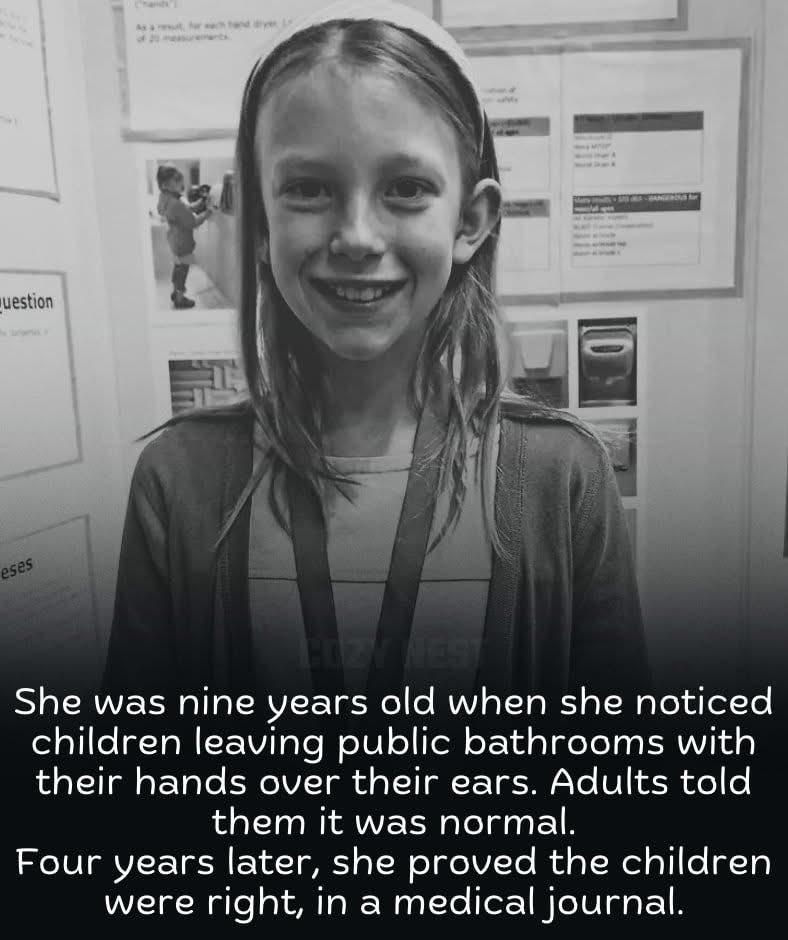
Nora Keegan was not trying to change public health policy. She was just paying attention.
In elementary school in Calgary, she noticed something adults kept dismissing. Children rushing out of public restrooms. Hands clamped over their ears. Faces tense. Complaints whispered between friends. It hurts my ears.
She felt it too. After using hand dryers, her ears rang. The sound lingered. Adults brushed it off. They are just loud. That is what machines do.
But Nora kept wondering why children reacted so strongly. And more importantly, why no one was measuring it.
In fifth grade, she decided to find out.
With the help of her parents, both physicians, she turned curiosity into research. She borrowed professional sound equipment. She designed an experiment. And then she went where the problem lived.
Public bathrooms.
Over two years, she visited forty four restrooms across Alberta. Libraries. Restaurants. Schools. She took eight hundred and eighty measurements. She measured at adult height. Then she crouched to measure at child height. She tested distance. Position. Airflow. Again and again.
What she found was impossible to ignore.
Many high speed hand dryers exceeded one hundred decibels at a child’s ear level. Some reached levels comparable to emergency sirens. Levels that medical authorities already prohibit in children’s toys because of the risk of hearing damage.
Children were not imagining the pain. They were standing closer to the source. Their ears were smaller. And the sound hitting them was stronger than what adults experienced.
Manufacturers claimed their machines were safe. Nora’s data showed real world conditions told a different story.
And she did not stop there.
Still in middle school, she began designing a noise reduction filter. A simple modification that lowered sound output by more than ten decibels. Proof that the problem was not inevitable.
Then she did something most adults never do. She wrote a scientific paper.
Her first submission was rejected. So she revised. She corrected. She tried again.
In June 2019, Paediatrics and Child Health published her study. Its title was direct and impossible to dismiss. Children who say hand dryers hurt my ears are correct.
She was thirteen years old.
Health professionals paid attention. Researchers cited her work. Parents shared it. Manufacturers requested meetings. All because a child trusted her own experience enough to test it.
Nora did not raise her voice. She measured. She documented. She proved.
And in doing so, she reminded the world of something simple and easily forgotten.
Sometimes the smallest voices are describing the biggest problems. You just have to listen.
NATURAL GOLDEN HAT TRICK
Mikael Kingsbury for gold
Megan Oldham for gold
Ivanie Blondin, Val Maltais, Isabelle Weidemann for gold
Back-to-back-to-back golden days at the Olympics for Canada.