🔋 BATTERY CHEMICALS: A HIGH-GROWTH THEME TO TRACK
📈 Global Battery Chemicals Market
🟢 Current Size: ~$14 Billion
🟢 Potential Size by 2030: $115+ Billion
🟢 Strong structural growth driven by electrification and energy storage
⚡ Key Drivers
🟢 Electric Vehicle (EV) adoption
🟢 Renewable energy storage
🟢 Grid-scale battery deployment
🟢 AI data centers increasing power-storage demand
🇮🇳 Indian Stocks to Watch
🔹 Himadri Speciality Chemical – Expanding into anode materials and lithium-ion battery ecosystem
🔹 Neogen Chemicals – Key player in lithium salts and electrolyte chemicals
🔹 Tatva Chintan Pharma Chem – Exposure to electrolyte and advanced chemical applications
🔹 Ami Organics – Growing presence in battery and electrolyte intermediates
🔹 PCBL Chemical – Exploring advanced battery-material opportunities
🔹 Exide Industries – Lithium-ion battery investments through JV ecosystem
🔹 Amara Raja Energy & Mobility – Building lithium-ion gigafactory and cell manufacturing capabilities
🔹 Ola Electric Mobility – Integrated battery cell manufacturing plans
💡 EVs were the first growth engine. Energy storage is the second. AI infrastructure could become the third major demand driver for batteries and battery chemicals.
Which stock do you think could emerge as India’s biggest battery chemicals winner over the next decade?
#BatteryChemicals #EV #EnergyStorage #RenewableEnergy #AI #SpecialtyChemicals #StockMarket #Investing #CleanEnergy #LithiumIonBattery
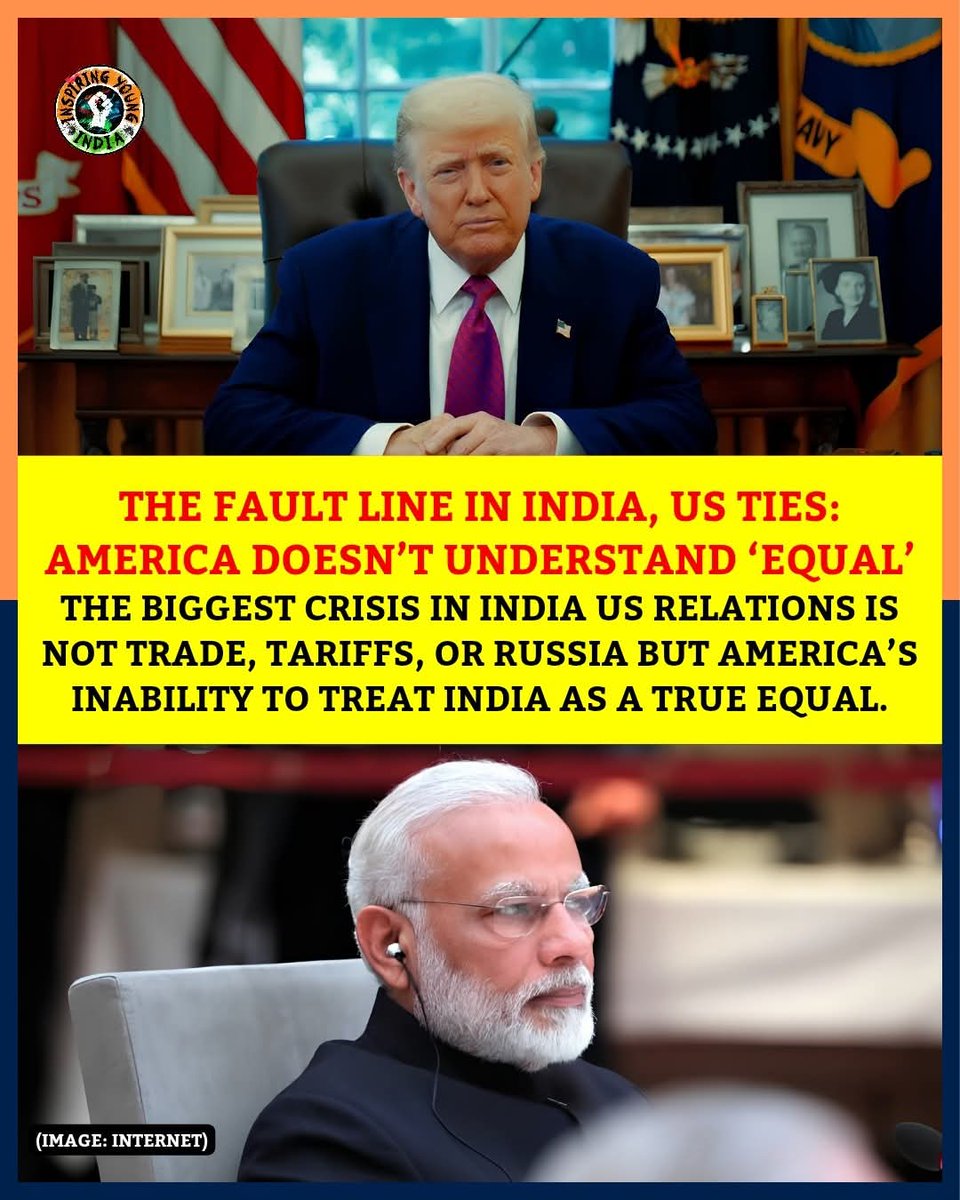
A powerful opinion piece by Samir Saran in The Indian Express, has sparked intense debate after arguing that the biggest crisis in India US relations is not trade, tariffs, or Russia but America’s inability to treat India as a true equal. The article warns that Washington still approaches New Delhi with a mindset of management and pressure rather than mutual respect.
The piece points to growing Indian frustration over US double standards on Russian oil, pressure tactics on strategic decisions, and Washington’s constantly shifting posture toward China and Pakistan. It argues that India no longer sees itself as a compliant junior partner and is increasingly unwilling to sacrifice strategic autonomy for American approval.
What makes the article explosive is its blunt conclusion: the India US partnership may survive political turbulence, but it cannot truly mature unless America accepts a rising India on genuinely equal terms. At a time when global power equations are rapidly shifting, the piece suggests New Delhi is quietly recalibrating its global relationships with Europe, Russia, and even China while keeping Washington at a calculated distance.
Taken from other Media Platform --
⚡️India Power Sector Value Chain
India’s power story is no longer just a generation story.
The real story now is the entire value chain.
Because adding more electricity is one thing.
Delivering it reliably, moving it across states, balancing renewable volatility, reducing losses, and actually collecting cash is a completely different challenge.
And that is exactly why the Indian power sector is entering a much broader capex cycle than most investors think. India’s total installed generation capacity stood at 520.5 GW as of 31 January 2026, and the government says 272 GW of that was from non-fossil sources, including 263 GW renewable energy and 8.78 GW nuclear. (Ministry of Power)
Now look at the demand side.
The IEA expects India’s electricity demand to grow at 6.3% CAGR from 2025 to 2027, faster than the country’s own 2015 to 2024 average of 5%. That means this is not a short-term spike. This is a structural demand expansion supported by economic growth, electrification and rising cooling demand. (IEA)
This is where the real framework begins.
👉To understand the sector properly, the power value chain should be divided into six layers:
1. Generation
2. Transmission asset ownership
3. Transmission EPC
4. Wires, Cables & Conductors
5. Power equipment manufacturing
6. Distribution and smart metering
7. Grid automation, storage and balancing
And honestly, I think this is the right way to study the sector now.
👉Generation is still important, of course.
Names like NTPC, Tata Power, JSW Energy, Adani Power, Adani Green, NHPC and SJVN all sit here in different ways.
But generation is not one single business model.
Thermal, hydro, renewables, merchant power, regulated utilities, all behave differently.
That is also why just looking at installed capacity can be misleading.
A solar plant and a thermal plant may both have 1 GW capacity on paper, but they do not produce the same number of units through the year. So, the real story is capacity added. It is also utilisation, reliability, fuel economics, PPAs and cash flow quality.
Where things get really interesting, in my view, is transmission.
Because no matter what the future looks like, transmission wins.
🔹If India adds more solar, transmission is needed.
🔹If more wind comes up, transmission is needed.
🔹If EV charging scales, transmission is needed.
🔹If data centres grow, transmission is needed.
🔹If green hydrogen becomes meaningful, transmission is needed.
That is why this part of the value chain feels the strongest structurally.
And the capex visibility is massive.
👉India’s transmission plan for 2023 to 2032 targets expansion of the network to 6.48 lakh circuit km, transformation capacity to roughly 2,345 GVA, inter-regional transfer capacity from 120 GW to 168 GW, with planned investment of about ₹9.15 lakh crore.
That is a serious number.
And it tells you where the long runway is.
The listed names that stand out here are Power Grid, IndiGrid, and Adani Energy Solutions.
Personally, this is the cleanest part of the power story for long-term compounding.
Once these assets are built and operational, the business becomes much more stable than project-based or commodity-linked segments.
👉Then comes the next layer: Transmission EPC.
This is where companies like KEC International, Kalpataru Projects, Techno Electric and L&T come in.
These businesses benefit early in the cycle because they see order inflows first.
But the market should not judge them like asset owners.
This is a lower-margin, execution-heavy business.
Order book matters. Execution matters. Working capital matters.
A big project pipeline looks good, but if cash is stuck or projects get delayed, returns can disappoint.
Then there is the equipment side, and this is where I think many investors may still be underestimating the opportunity.
This part includes transformers, switchgear, GIS, substations, cables, conductors, HVDC equipment and grid systems.
Names here include Hitachi Energy India, GE Vernova T&D India, CG Power, Siemens Energy India, APAR Industries, Polycab and KEI.
This segment is attractive because it sits somewhere between manufacturing scale and technology value-add.
It is not as stable as a transmission owner, but in many cases, it can be a better business than EPC, especially when the mix shifts towards high-voltage systems, digital substations, automation and grid-control solutions.
👉The power buildout is also a wires and cables story:
Once new power capacity is added and new lines are planned, the system needs the actual products through which electricity moves. That is where wires, cables and conductors come in.
In simple terms, if transmission is the highway, then wires, cables and conductors are the actual lanes on that highway.
And this is not a small industry.
Polycab’s latest presentation puts the Indian wires and cables market at around ₹900 billion in FY25, which is roughly 40% to 45% of the electrical industry. The company also says the market grew by around 12% YoY in FY25. Its own estimates suggest Polycab held around 26% to 27% share of the organised market and 19% to 20% of the total market.
The size of the segment is also visible at the company level. A competitive assessment on Polycab’s site shows FY25 wires-and-cables revenue at about ₹188.9 billion for Polycab, ₹88.6 billion for KEI, ₹71.8 billion for Havells, ₹66.9 billion for RR Kabel, ₹50.1 billion for Finolex Cables, and ₹46.4 billion for APAR Industries.
The demand drivers are strong. Transmission expansion supports conductor demand, while distribution reforms drive need for ABC, underground cables and upgrades. This is not just a new capex cycle but also a replacement cycle, with older networks being upgraded. Key names to track include APAR Industries, Polycab, KEI Industries, RR Kabel, Finolex Cables and Universal Cables.
A lot of investors think renewable growth mainly helps renewable developers.
But that is only half true.
👉Renewables are built where the resource is strongest.
Demand is somewhere else.
So once renewable capacity rises, the grid needs much more than just generation.
It needs evacuation, balancing, voltage support and long-distance transfer.
That is why renewable growth indirectly strengthens the case for Power Grid, Adani Energy Solutions, KEC, Hitachi Energy India, GE Vernova T&D India, and others linked to transmission and grid systems.
Then comes distribution, which is where the quality of the sector really gets tested.
Because generation and transmission may look strong, but distribution decides whether the system actually collects money.
👉This is why smart metering matters so much.
Government data shows AT&C losses improved from 21.91% in FY21 to 15.04% in FY25. Smart meters installed across schemes reached about 5.62 crore by January 2026, and sanctioned works under RDSS were around ₹2.83 lakh crore.
So smart meters are not just an electrical-equipment story.
They are a billing, collection and cash-flow story.
The clearest listed proxy here is Genus Power.
I think this is an important point because many investors still see distribution as boring or broken. But the reform side of distribution is actually creating a very investable opportunity in metering, system integration and loss reduction.
And then there is the final layer, which will likely become more important over time: automation, storage and balancing.
The future grid will not run only on generation plus wires.
It will run on:
generation + transmission + storage + digital balancing
As renewable share rises, the grid will need more flexibility.
That means better control systems, better balancing tools, and more advanced transmission architecture.
That is where names like Hitachi Energy India and GE Vernova T&D India become even more interesting, because this is not just about selling equipment. It is about helping the grid handle a more complicated future.
📌So, if I had to simplify the entire sector into one line, I would say this:
Generation creates electricity.
Transmission makes scale possible.
Wires and cables carry that power across the network.
Distribution makes monetisation possible.
Automation and storage make the future grid workable.
The extraordinary invisible Glass experiment
Scientists once placed a transparent glass barrier inside an aquarium.
On one side was a fierce pike, and on the other side were several smaller fish swimming freely.
When the hungry pike saw the smaller fish, it immediately rushed forward to attack.
Bang. It slammed straight into the glass and bounced back.
Confused, the pike kept trying again and again, but every attempt ended the same way.
The repeated collisions injured its head and knocked off some of its scales. Eventually, the pike became frightened and retreated to a corner of the tank.
After some time, the scientists quietly removed the glass barrier. The smaller fish now swam freely throughout the aquarium, even brushing against the pike’s mouth.
But the pike never tried to eat them again.
Even though it was hungry, it refused to attack. In its mind, the invisible wall was still there.
A few days later, the pike reportedly died of starvation, surrounded by food. This phenomenon is often referred to as the Pike Effect or Pike Syndrome.
It’s often used as a metaphor for how repeated failure can create invisible limits in the mind.
For silver: Silverbees
For Gold: Goldbees
For Defence sector: Modefence
For IT sector: ITbees
For capital markets: Mocapital
For auto sector: Autobees
For nifty: Niftybees
For psu banks: Psubnkbees
For midcap: HDFCMID150
For fmcg: Fmcgietf
For nifty next 50: Juniorbees
For china index: Hangsangbees
For infra: Infrabees
For banks: Bankbees
For smallcap: HDFCSML250
For pharma: Pharmabees
Bookmark this post ✅️
Thirupparankundram is the First of the Six Abodes of Lord Murugan (Kartikeya). The practice of lighting lamps atop the hill during the Tamil month of Karthigai is an ancient tradition of Hindus. It is sad and ironic that today the Hindus in Bharat have to seek judicial interventions to practice their faith and perform their rituals. If, even after winning a decisive legal battle, devotees cannot perform a simple, peaceful ritual on their own property, then where, in their own country, shall they truly find constitutional justice?
In short and simple, let all the Hindus in Bharat understand this - The bitter truth is - The Chennai High Court affirmed our right to light the Deepathoon - first by a single judge, then upheld by a higher bench. Legally, the battle was won. Yet, practically, we were forced to adjust.
Ask yourself - Can any religious festival be moved a week late? Can a holy day's celebration be shifted to a different time? No. Because the sanctity of religious time and the integrity of every religious calendar is non-negotiable.
Yet, for Sanatana Dharma, the moment—the sacred Karthigai Deepam—was stolen, vanished forever. Why? Because Hindus can be taken for granted. Sometimes it's the governments, sometimes it’s the executive, sometimes it’s the NGOs, sometimes it’s a random pseudo intellectual groups – but every time, it is Hindus who accept the loss and adjust. We secured the right, but lost the ritual. This repeated, systemic denial is why a time has come to demand more than just court victories - We need the Sanatana Dharma Raksha Board where devotees actively manage their own temples and religious affairs.
Mockery of Hindu traditions and rituals has become a norm for certain groups. Do they dare to do the same for other religious events?
Does Article 25 become an optional right instead of a fundamental right to the Hindus? Can a Police Commissioner or a District Magistrate unilaterally nullify a specific High Court Directive? If the High Court confirmed the Deepam lighting was a "harmless religious act" on legally owned land, who decides that this practice constitutes a threat to "communal harmony," and by what legal mechanism? How come HR&CE Department consistently and repeatedly act against the interests of Hindu devotees and their temple's traditions, and how do these officials evade serious accountability?
Hindus should observe the collective spirit and solidarity shown by practitioners of Abrahamic religions (religions of Arabian origin) when religious issues arise. They overcome their ethnic, regional, and linguistic differences for the sake of their faith.
As long as Hindus remain divided by caste, regional, and linguistic barriers, the mockery, insults, and abuses against the Hindu religion and its practices shall continue. If Hindus in our nation don't unite under a common minimum program with the collective spirit of Hindu Dharma (or Aram in Tamil), this spirit will be lost.
I hope for a day when every Hindu from Kashmir to Kanyakumari and Kamakhya to Dwarka wakes up to the humiliation Hindus face in their own land.
#Tiruparakundaram
#SanatanaDharmaRakshaBoard