Demand for Astra is really unprecedented. We're pulling all the levers possible to sustain the demand, but I've not seen anything like it until now and we went through very steep growth before. Priority will always be to keep excellent service for existing users, but we might have to pause new Pro subscriptions for a bit if this continues.
$SIVE — quick channel check from Sivers’ booth at CIOE 2026 today.
Stopped by Sivers’ booth and spoke with their Sales Director for China, Korea & Japan.
A few takeaways from our conversation:
1/ China customer engagement
Q: Are you currently in contact with Chinese pluggable/transceiver players?
A: Yes. This is Sivers’ first time exhibiting at CIOE. They are currently setting up their China office and are just starting to work with Chinese pluggable players.
They wouldn’t disclose any customer names.
2/ CW laser pricing
Q: What are you seeing on laser ASPs given the current supply environment?
A: Supply is very tight, and Sivers has raised prices.
They wouldn’t disclose the magnitude of the price increases.
3/ Where is supply tightest?
Q: Which CW laser products are currently the most supply-constrained?
A: 70mW is particularly tight, which they associated with 800G pluggable applications.
They also said tightness is fairly broad, including both 70mW and 100mW.
200mW has not reached mass production yet.
4/ Sivers’ own capacity
Q: Does Sivers currently have enough supply/capacity to meet demand?
A: Yes. They said they currently have sufficient supply and are actively expanding capacity.
5/ A few observations from the booth
Sivers’ booth was very small, with only two people there when I visited — the Sales Director for China/Korea/Japan I spoke with and another representative whose title was Country Manager.
There were no physical products or demos on display. The booth was noticeably more minimal than larger semiconductor/optical vendors at CIOE such as GlobalFoundries, Tower Semiconductor and Credo.
Given that this is Sivers’ first CIOE and they are only now establishing their China office, my impression is that their China presence is still at a very early stage.
Glad $SIVE is attending CIOE Shenzen and hope my followers can go too!
If you want my read on current landscape:
-> Chinese pluggable makers like CIG (剑桥科技) are facing severe shortages in 70mW-200mW lasers.
If you look at filings from CIG, they claim "substantially longer delivery times and deposits to secure capacity” along with statements of shortages.
-> Innolight and others were also looking to secure multiple laser suppliers with LTAs recently from their filings.
On the US side of things:
-> $COHR was a major merchant laser supplier before, but largely withdrew from the market after rerouting them internally.
"I do not see any time in the near future where we would be selling Indium Phosphide lasers externally." From their ER transcript.
And then likely turned into a buyer in an already supply constrained market... where
"over the long term, we will have some portion of our datacom transceivers that will be supported by external sources."
-> $AAOI not really known to be a merchant supplier, but said same thing about laser capacity being rerouted towards transceivers. And having to turn away customers for lasers.
-> For $LITE, they still supply lasers but stated: "We are commanding a significant price premium" for CW lasers
$LITE Wupen Yuen: "wherever they can get the laser source, they will use that solution to support their build-out."
So hinting... about customers just finding anything available due to shortages.
-> $MTSI has no meaningful capacity online now, but they're already stating customers are approaching them with urgency to secure CW laser supply.
-> Trendforce reported $AMD and hyperscaler CSPs are aggressively going out to secure CW laser supply to avoid future bottlenecks.
And then you have Europe...
Where $SIVE is coming online with "tremendous capacity available now" from their foundry partners.
With 100M+ laser capacity Q4 2027, and maybe if you look at their 2:1 ratio implying ~200M targeted laser capacity from external foundries.
They also happen to offer the same power range (70mW, 100 mW, 200mW) as the ones currently in shortage by pluggable makers in China.
There's a massive void to fill, so this dramatically increases the chance of converting customers. (esp. Supported by Lumentum statements)
My speculation was that some of the 6 active pluggable engagements were from China?
Which is why they're attending the conference.
So to any of my Chinese followers, maybe you can ask a few questions like:
- if Europe is a laser source geography, if Innolight/Eoptolink/Cambridge are considering $SIVE.
- if they're seeing ASP hikes in lasers, and what CW products are hardest to obtain
If you are attending CIOE in Shenzhen!
I resigned from Anthropic today. I spent the last three years doing pretraining research at both OpenAI and Anthropic. Neither company is acting responsibly. They are racing straight to self-improving superintelligence and gambling with our lives. More thoughts below.
$NBIS is back, and coming in hot with a new partnership with $PLTR.
Palantir also named Nebius its preferred sovereign AI infrastructure partner.
The implications are potentially significant considering Palantir’s existing relations with the US Gov + Enterprises.
We are partnering with Palantir to bring trusted AI cloud infrastructure to Palantir’s commercial customers.
Palantir has named Nebius its preferred sovereign AI infrastructure partner.
Nebius compute and inference endpoints will run inside the Palantir enterprise perimeter – giving customers control over their compute, data, and models.
The partnership is based on a shared vision that open models, continually adapted using customers’ own data, can deliver better domain-specific intelligence while improving control and security.
Read the full press release: https://t.co/OxFxKSOrqr
🚨 JUST IN:
$NBIS and $PLTR partner to deliver a complete sovereign AI stack to Palantir customers
- Palantir names Nebius its preferred sovereign AI infrastructure partner, bringing Nebius compute and inference inside the Palantir perimeter
- Strategic partnership based on shared vision that open models and looped customer data create the smartest domain intelligence and provide better security
- Companies will work together to bring new AI capacity online faster
“Nebius’ compute infrastructure powers your ability to run your own AI models under conditions you control. Our ontology and their infrastructure will undergird the sovereignty our partners are demanding.”
- Alex Karp
“Organizations need both the performance of large-scale AI infrastructure and control over their data and models. Together with Palantir, we are bringing this to commercial clients enabling them to run their optimized open models on trusted infrastructure.”
- Arkady Volozh
Palantir selected Nebius for what few providers can claim: being built for AI from the ground up rather than adapted from general-purpose computing, with infrastructure and software designed together for demanding AI workloads, and able to be integrated directly into Palantir’s Sovereign AI Operating System.
There’s a ton of “if you had invested $1,000 in <successful stock> 25 years ago, you’d have x today!”, but sometimes it’s interesting to look at the rest of them.
What if you had invested in one of the most exciting growth names a century ago?
In 1926, the major market themes were aviation, office/industrial automation and electrification. One of the best performing big board stocks over the next 3 years was Burroughs Adding Machines - a company that made, you guessed it, adding machines.
It rode the proliferation of office work to a +1,996% gain over the next 168 weeks.
And it still survives today. It acquired Sperry Rand in 1986 and the combined company was renamed Unisys, which trades today as UIS.
If you had invested $1,000 in Burroughs Adding Machines in 1926, the shares would have been worth ~$20,900 at the 1929 peak. And $2,800 today.
But Burroughs, like many companies a century ago, was an aggressive dividend payer. Assuming you reinvested dividends, you’d have around $35,000 today.
Seems decent, you outperformed the consumer price index by about 85%. But you’ve underperformed the index by a factor of 640 to 1.
That same $1,000 invested in the S&P500 (or similar large cap U.S. index, using Shiller/BLS data) would be worth $22.4 million today.
An investor in 1926 picks a defining technology winner of their generation, a company that manages to continue to exist for a century. But a century was long enough to go through disruption -> hypergrowth -> dominance -> maturity -> tech transition -> renewed relevance -> consolidation -> new disruption -> terminal decline.
I don’t know exactly what the point is here but I find it pretty interesting considering most of the historical stock selection focuses on companies that survived and thrived.
Just a reminder from optical earnings:
-> $LITE: "Lasers will remain effectively sold out for the foreseeable future despite our rapid capacity expansion."
-> $COHR: "The demand is robust across almost every single product across data center and comms, and it is really just a matter of whether we can sell as fast as we can ramp production.”
-> $AAOI: Revenue "bounded almost entirely by our production capacity and key component availability".
I'm personally expecting additional margin expansion for the optical players in the coming quarters thanks to their pricing power + higher ASP products e.g. 3.2T initial volumes coming online next year.
You've also got LTAs minimizing cyclicality fears, with $LITE and $COHR until 2030 and $AAOI doing 3 year LTAs with a handful of customers.
Feels like everything's set up for success right now, confirmed w/ new GS TAM forecasts today being revised-up by over 100% for 2028.
For a TLDR: continued growth is due to ramp ups for rack-level AI servers + AI ASICs w/ higher attach ratios of optical modules.
On top of this, $NVDA GB200 uses 400G-1.6T, with Rubin and Rubin Ultra migrating further to 1.6T and 3.2T. All driving the adoption of higher speed transceivers as Nvidia rack volumes scale up in 2026-28.
Then looking at ASIC users, $GOOGL and $META are expanding 800G+ w/ Google being an early adopter fpr 1.6T. It's also expected that Meta use more Optical transceivers per ASIC vs. GPUs (i.e. on GPU servers typically there are 2-3 optical transceivers per GPU) per GS.
I still think that these optical players are all about capacity expansion moving forwards. The sooner they add capacity, the faster the fabs ramp.
Side note - I personally don't think pricing power will be impacted as a result. The name of the game lately is to undersupply vs. demand to capture margins, and they all know those demand dynamics better than anyone.
Is there any other industry... Where every investor is cheering for shortages and price hikes?
SED reported today that: Samsung / $SKHY "stockpiles have fallen to less than 10 days of supply, and a severe shortage could emerge next year, according to a new forecast"
KB Securities said that the memory market next year will see "the tightest supply conditions in history"
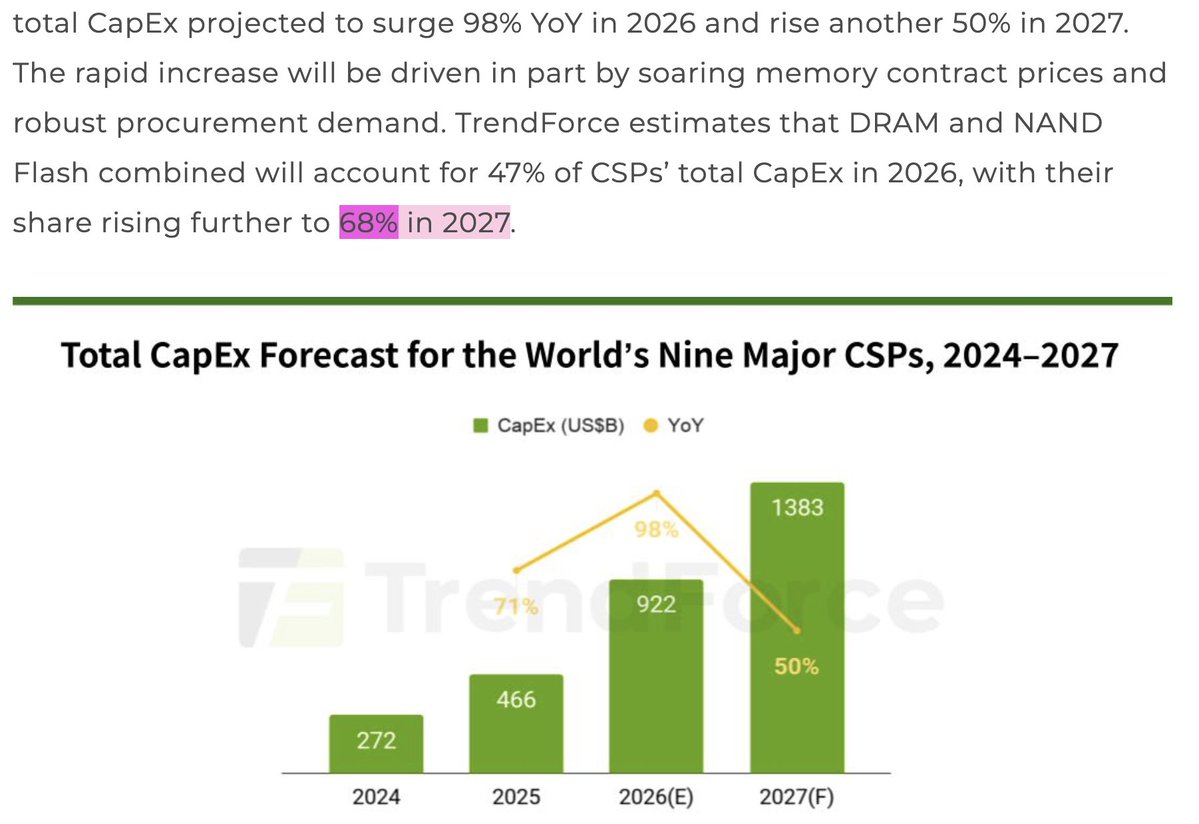
KB Securities projects memory's share of AI infrastructure costs to expand from 40% this year to 57% next year, with others like TrendForce placing next year's figure at 68% (total hyperscaler capex, pretty wild forecast attached)
"Both stocks have fallen 38% from their peaks over the past three months, pushing their price-to-earnings ratios based on next year's expected results down to about three times."
Likewise, commentary around Phison stated they expect extremely tight NAND supply in 2027, so hard to see memory flooding the market or prices collapsing next year...
They gave some color that "soaring NAND prices have forced some Chinese consumer module makers to liquidate inventory, giving Phison opportunities to buy lower-priced stock", so it does show some price declines can coexist with broader shortages.
TLDR: KOSPI + read through for other names like $MU / $SNDK might be happy for 2027 given demand causing shortages + infra spend share increase.
Got curious and decided to track which thesis of mine were still up 100%+ YTD after the recent drawdown:
1. $AXTI - InP substrates
2. $NBIS - Neoclouds
3. $MU - Memory
4. $INTC - Foundry
5. $LITE - Photonics
6. $IQE - Epiwafers
7. $AAOI - Photonics
8. $GDRZF - Venezuela
9. $AEHR - Machines
10. $EWY (volatility + underlying)
11. $RPI - AI orchestration
12. $SOI - SIlicon Photonics Substrates
13. $SNDK - Memory
14. $SIMO - Memory
15. $MRVL - ASICs
16. Nanya - memory
17. Unimicron - substrates
18. $ARM - CPUs
19. $SIVE - Photonics
From H1 2026, around 19 names across several themes up 100%+ still from the selection of winners.
Since many like $TSEM / $HPS.A / $LPK / $ALRIB fell out of the range. (obviously not all are green like Shunsin / $XFAB and disappointed by performance).
Regardless, glad a lot of my ideas turned out decently, rather than just being known for one like $AXTI. To the point the Chinese community gave my investing style a name "Perilla Leaf Theory".
Again not too sure if my new ideas replicate this performance again in H2 2026 or 2027...
For H2, my new thesis was on $CCXI for humanoids/downstream physical AI shift and ESMT for DDR2/DDR3/legacy memory.
But I'll keep sharing my core ideas and thought process for free so people can poke holes or debate it until things get validated.
Key take-aways for me from today's OpenAI announcements:
- OpenAI "making strong progress" toward creating the automated AI researcher.
- Jakub Pachocki: "I have a strong expectation that [OpenAI's] speed of progress could be sustained into RSI".
- Automated AI researcher will "work under human supervision". One of OpenAI's "north stars" includes "finding ways for people to remain part of the self-improvement loop".
- "An automated AI researcher can also be an automated safety or alignment researcher." One of OpenAI's "north stars" includes "iterating [with the automated AI researcher] on the alignment problem".
- Decision on whether to pursue rapid RSI depends on ability to preserve human control and on informed democratic choices about benefits and risks.
- OpenAI "do[es] not yet know how to safely get all the way to aligned, full RSI".
- OpenAI believes that "we and other companies" should be required to publicly track their progress towards RSI; OpenAI will continue to be transparent about its progress to RSI.
- Graphs provided by OpenAI show a very sharp increase in internal usage of Agents around July 2026. I assume that's from Astra?
- Jakub Pachocki on scaling laws: "There are new algorithms that have been developed along the way, new feats of ingenuity from teams and individual researchers. I see them largely as discoveries along the path of scaling; the science of deep learning is still nascent, and meaningful algorithmic progress tends to correlate with access to compute." (My note: If the science of deep learning is "still nascent", that has meaningful implications for the speed of progress we should expect from RSI.)
- Jakub Pachocki on OpenAI's focus on general models: "We believe we could make the models better at specifically mathematics research with additional focus, but we do not prioritize this direction because of the urgency we feel about RSI and automated alignment research."
- Jakub Pachocki on pacing AI development: "Currently I believe that no lab has solved alignment and monitoring to a sufficient degree to continue responsibly scaling at maximum speed for much longer. I expect and hope for voluntary slowdowns to become commonplace until shared safety bars are established. And I believe that international coordination on future AI development needs to become a top priority for governments around the world."
@ChaseLochmiller@OpenAI GPT-6 Astra, trained on ~100K+ NVIDIA Grace Blackwell NVLink72. From ChatGPT to o1 to Astra in 4 years.
AGI has arrived. Congratulations @OpenAI team.
400K GPUs coming online next.