since where the vertices fall on a pair of adjacent sides of the rectangle the proof is trial given the formula. Where two of the vertices fall on opposite parallel sides, draw a line parallel to the sides through the third vertex and consider the areas on either side of the line
This follows directly from the formula for area of a triangle (1/2 base * height): the biggest one that fits the rectangle has base and height equal to a pair of adjacent sides. Of the infinitely many equivalent triangles with the same area one in particular is half the rectangle
This math problem is so simple that it's "almost obvious". Yet it stumped me when I first tried to solve it and I believe that You might have some trouble with it too!
Let a Triangle ∆ be inside a Rectangle ☐. Prove that
Area(∆) ≤ ½Area(☐).
Give it a try! 😉
Any triangle inside the rectangle can be shown to have equivalent area to triangles whose vertices all lie on the perimeter of the rectangle: successively move each vertex along a line parallel to the remaining two. None of these are bigger than the one given in the above proof
THIS. THIS. THIS.
You have no fucking idea how technically incompetent those people are in your company/org that intimidate you with their technical competence.
You have no business ever thinking "I can never be as techie as that guy". EVER.
the thing of note about this image is not that you can put up a poster at ICML
but rather, that this generalizes to a much broader category of 'you can do X and no one will stop you!', and that this category includes many things none of us have yet pondered
Save the date: Electromagnetic Field 2024 will be held on May 30 - June 2, 2024. We'll be back at Eastnor Castle Deer Park in Herefordshire for the third time.
More details to come!
https://t.co/sefJcTZohR
It wasn't until I'd *taught* algorithms a few times that I finally understood why sorting is in the CS curriculum. Unfortunately, most curricula don't explain this!
It is NOT because sorting is an important algorithm to learn to implement...
That mention of radix sort reminds me of an anecdote.
Back in 1998 I was doing an internship at a small software company in Paris.
I was the lowest-level junior guy in the team - unpaid work, mandatory stuff for an engineering school.
Just for fun, I've implemented a Convolutional Neural Network (CNN) that predicts handwritten digits...
Fully using #glsl and fragment shaders!
The model exactly has 2023 parameters and its inner activations are displayed as you draw
Try it out live! https://t.co/WIxTJPBLuV
Except... there are many many proofs of e. g. the pythagorean theorem and subjectively some are more aesthetically pleasing than others. In type theory if you find an inhabitant (a program) of a type then you've proven a theorem. Writing programs is a creative process.
The least sexy but truest measure of AI progress will be in automated theorem proving. There is no aesthetic subjectivity there. If AI generates a proof, it can be checked by an automated theorem and accepted or rejected.
Starting this year I'll be doing a weekly live coding stream on @Twitch (Thu 18:00-20:00 GMT).
https://t.co/asLJhKIRi2
I'll be hacking on interesting problems, new or interesting frameworks and tools.
Suggestions for areas to explore in the first session? Share them below!
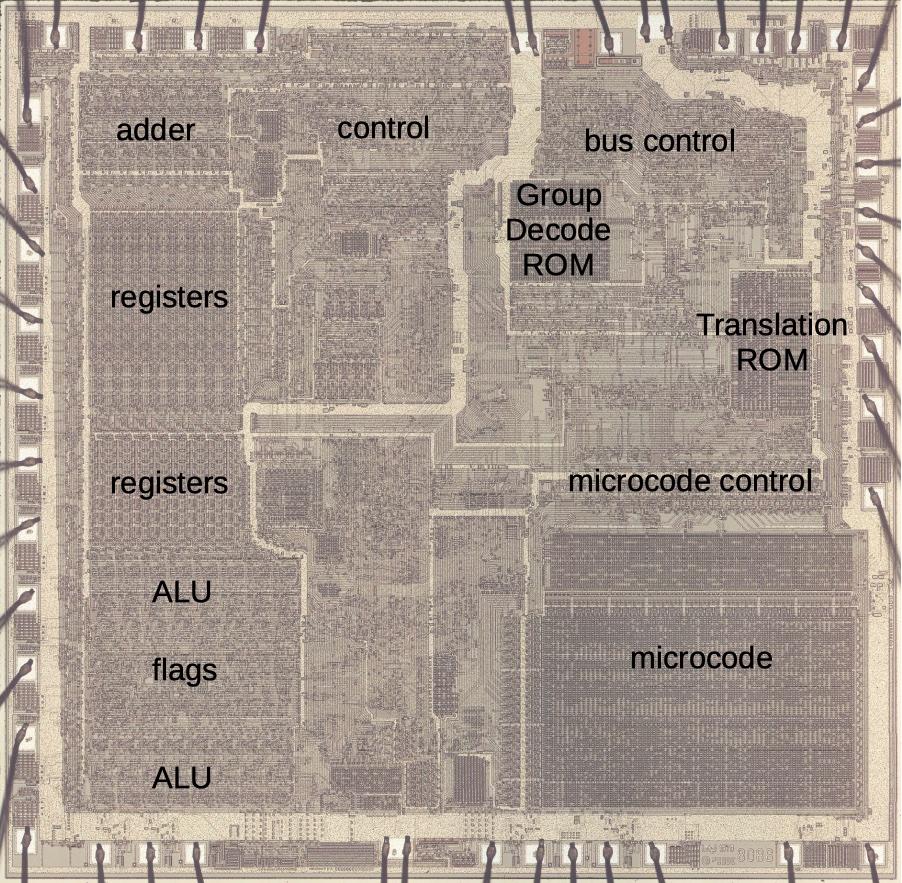
The 8086 processor (1978) led to the hugely-popular x86 architecture. Internally, the 8086 uses microcode, running a tiny program for each machine instruction.
I'm reverse-engineering the chip from die photos and I can explain exactly how the 8086 microcode engine works.🧵
A bug in WETH:
Wrapped ETH is a smart contract that has been in over 125 MILLION Ethereum transactions. This year, 11.5% of all transactions used Wrapped ETH.
But is it secure? I formally verified two critical safety properties with a SMT solver, Z3.👇🧵
https://t.co/KH5vLjxwnm