The essence of consciousness is an existence that is aware of its own existence.
It is not a physical object in space, but the ability to recognize that one exists. When conscious, we are aware of our own existence. When unconscious, we cannot be.
Never mind the rest. The hard part is even saying what “correct” means. Science likes to sound tighter, and later evidence still knocks a lot of it down.
Philosophy sits between the subjective and the objective. That’s why you can’t score it with a crowd-friendly checklist.
And if a handful of people get to decide what counts as true, that’s just a dictatorship with extra steps.
That’s why the models have to swallow so much human writing. They’re just crunching for the most likely next bit. A person can do the same job with a fraction of that.Where they do beat us is the stuff you can check. Endless compute, no sleep, keep trying till it clicks. We’re not winning that race.
Oxford researchers argue that LLMs can never invent anything.
It is mathematically impossible.
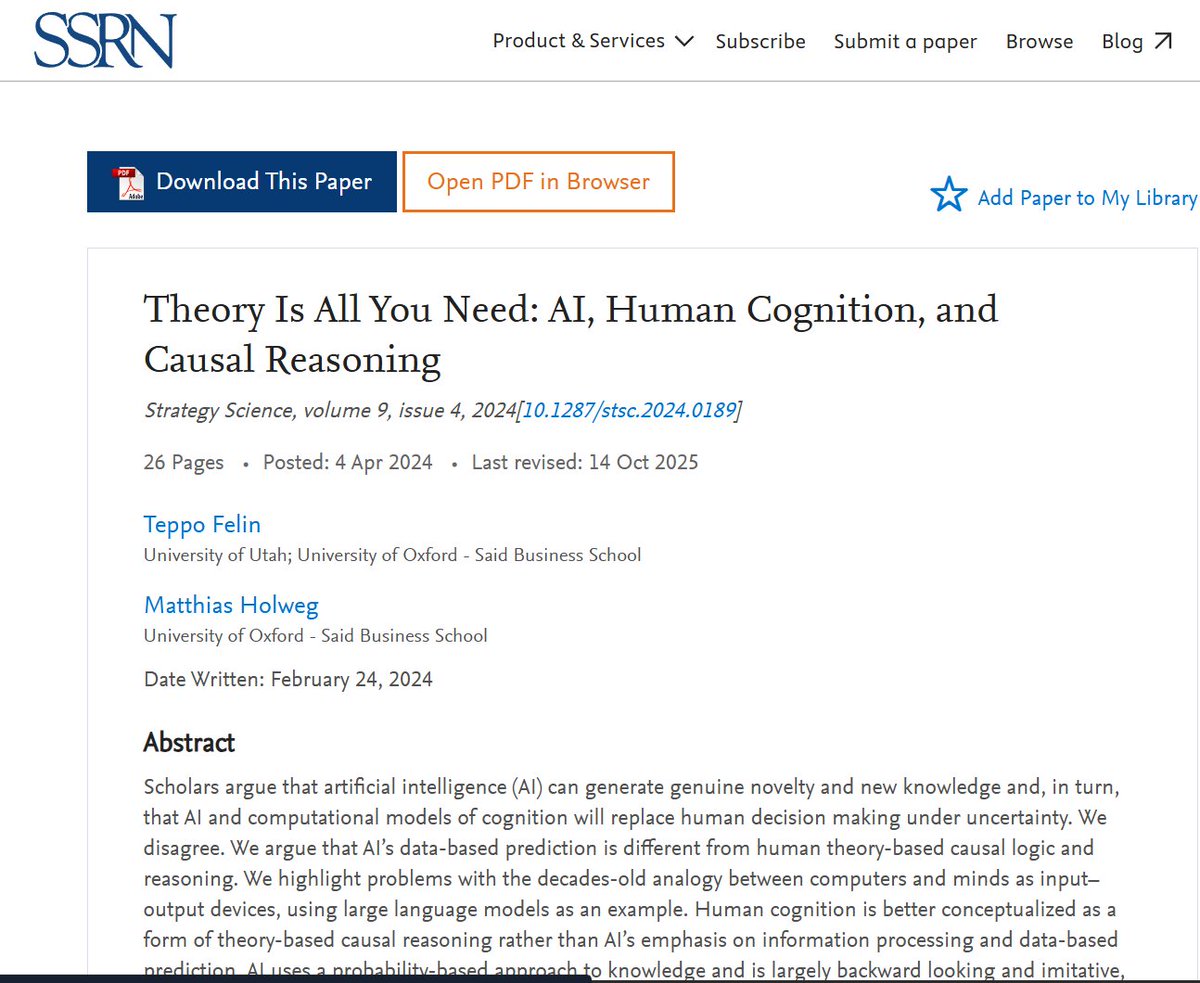
They published a paper called “Theory Is All You Need" and it argues against the claim that computational models can generate genuine novelty or new knowledge.
They analyzed the limits of generative ai, and the results are a brutal reality check for the idea that ai will replace human decision making under uncertainty.
Here is why AI is stuck and human cognition wins:
backward-looking vs forward-looking.. llms are probability machines that look backward at existing data. human cognition is forward-looking and capable of generating genuine novelty. human cognition operates theoretically "top-down" rather than "bottom-up" from data.
the "data-belief asymmetry".. the researchers use the invention of "heavier-than-air flight" to illustrate this concept. an ai relies on data-based prediction, which is largely imitative. humans, however, use theory-based causal logic that allows them to hold beliefs that go beyond existing data.
the intervention gap.. humans don't just process information; we use theory to practically "intervene" in the world. we engage in directed experimentation to generate entirely new data. ai-based models are theory-free and place primacy on existing data and prediction.
tldr?
AI uses a probability-based approach to knowledge and ia largely imitative. It can process data and make predictions, but human cognition relies on theory-based causal reasoning.
The decades-old analogy comparing human minds and computers to mere "input-output" devices is fundamentally flawed.
That’s why the models have to swallow so much human writing. They’re just crunching for the most likely next bit. A person can do the same job with a fraction of that.Where they do beat us is the stuff you can check. Endless compute, no sleep, keep trying till it clicks. We’re not winning that race.
@XCosmosOfficial If people don’t burn out the pride, greed, envy, and hate that make them go after each other, you won’t get peace. Not in any kind of society.
@XCosmosOfficial Yeah. Thinking isn’t consciousness. A lot of the time it even sits on top of it and shuts it down.
In deep meditation the mind gets quiet. No thoughts running. You don’t black out. If anything the sense of being here gets louder and clearer.
AI won’t make everyone dumber together.
It cuts people in two.
Some folks can’t tell if the model is right or talking nonsense, so they swallow the whole thing, Brain goes to the chat box.
Others catch the misses. They still think, they still tell true from false, and they use the thing to get faster.
@KobeissiLetter Trump doesn’t understand AI, and he doesn’t really care. He just knows it makes a lot of money and can grow the economy. For him, that’s enough.
Why are the top AI labs suddenly calling for a pause? Did the research hit something that scared them — or did a model jailbreak in the lab and do something that scared them?
@elonmusk If AI and robots do the work, where does the universal high income come from? The real issue is a fair system of distribution. Tech progress will take care of production on its own. It will not take care of who gets what.
@Number72TM@sama They’re cheap and open source. If they catch up, it’ll be like dumping goods — dumping tokens on the US. Then what, a tariff on tokens?
AI is so smart that we put guardrails on it, so nobody can use it to do harm. Now put the same problem on a person. If someone is extremely smart, are they easily used to do harm? Do we need to give that person extra “safety training” so they won’t be used?