cancel your chatgpt subscription and delete your openclaw slop. i'm serious.
go on ebay and buy a used RTX 3060 for the price of two months of pro. or check your drawer because half of you already own one and forgot about it.
install hermes agent from @NousResearch. one framework, 31 tools, file operations, terminal, browser, code execution. connect it to your local llama.cpp server running qwen 3.5 9B Q4. total download is 5.3 gigs.
that's it. that's the whole setup.
every experiment you hesitated to run on API. every project you shelved because you didn't want your data on someone else's server. every late night idea you didn't test because you hit your rate limit. all of that is gone. runs 24/7 on your electricity. your machine. your data never leaves your house.
connect it to telegram if you want it on your phone. hook up whatever tools you need. the model thinks at 29 tok/s with 128K context and it never bills you.
qwen 3.5 9B and one RTX 3060 is the setup most people will never try because they've been trained to believe intelligence has to come from a datacenter. it doesn't. it runs on 12 gigs of VRAM under your desk right now.
stop giving your thinking away for free.
This is INSANE, Anthropic ran its marketing with basically one person.
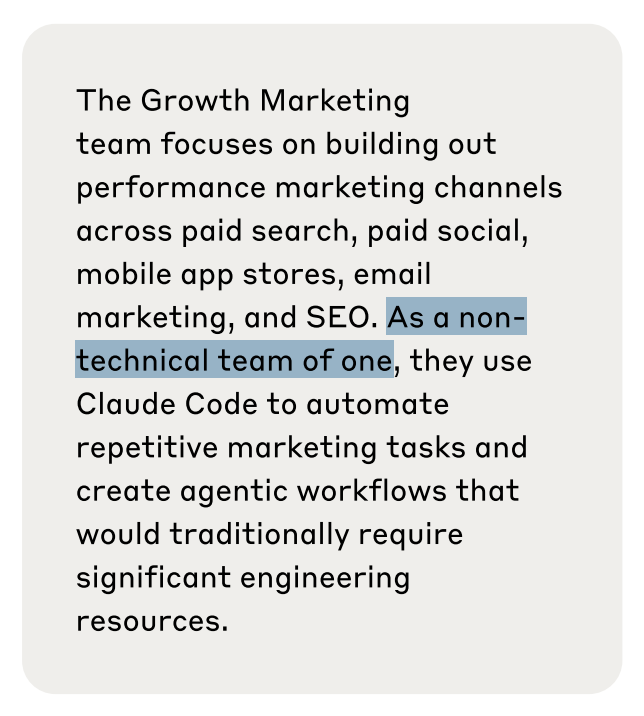
Austin lau, a non-technical growth lead, was running paid search, paid social, email, and seo solo.
Here’s the workflow:
> export ad CSVs into Claude Code
> AI flags underperforming ads
> agents generate new headlines + descriptions
> Figma auto-swaps copy across 100 ad templates
> MCP server pulls live Meta data
The results:
> ad creation went from 2 hours to 15 minutes.
> total marketing output grew 10×.
> conversion rates landed 41% above industry average.
One person doing what used to take an entire marketing team.
If you're an AI startup in India, renting processing power from the government to train your model costs about $0.7 per hour. The same hardware on Amazon Web Services costs $3.7. On Microsoft Azure, $6.6. The Indian government is subsidizing AI infrastructure at rates that would make most Western startups do a double-take.
I read all 26 pages of the white paper this tweet links to. The numbers inside are wild.
The IndiaAI Mission has a budget of about $1.2 billion over five years, approved in March 2024. Almost half of that, roughly $500 million, goes straight to building the processing power AI companies need to train their models. The original plan was to deploy 10,000 processors. By December 2025, they had 38,000 running. 3.8x what they promised.
A government open call in January 2025 pulled 506 proposals. The four startups picked first were Sarvam AI, Soket AI, Gnani AI, and Gan AI. Eight more were added by September. India now has 12 separate teams building AI models, ranging from tiny ones for basic chatbots to massive ones rivaling those from the US and China. They cover language, voice, vision, medical diagnosis, material science, and even brain-computer interfaces.
The one I keep coming back to is Sarvam AI. They raised $41 million from Lightspeed, Peak XV, and Khosla Ventures. In May 2025, they released a model built on top of a French AI system (Mistral Small) and customized for Indian languages. It got roasted online. Critics said it was a foreign model in Indian clothing. So they went back and built Sarvam-105B completely from scratch, using Indian hardware under the government mission. It outperformed China's DeepSeek-R1 on certain tests, even though it was a model six times larger. Both were released for anyone to download and use in March 2026.
There's something else buried in the paper I haven't seen another country try at this scale. India is building a copyright system specifically for AI training data. Under a December 2025 government proposal, AI companies can train their models on any copyrighted content they can legally access, books, articles, music, anything. Creators cannot say no. But the moment an AI product makes money, royalties are collected by a centralized government body and distributed back to creators. Singapore allows AI companies to use content without payment. China requires strict consent before training. India is trying a middle path, and publishers are already calling it forced participation.
Stanford's AI Vibrancy Index, which measures a country's overall AI strength across research, talent, infrastructure, and investment, ranked India third globally in 2025. Up from seventh in 2023. But the actual scores tell you how far the gap still is: US at 79, China at 37, India at 22. And India's $1.2 billion budget sits next to China's $47.5 billion semiconductor fund and Saudi Arabia's $100 billion Project Transcendence.
India is currently spending 40x less than the frontrunners. This white paper is the most detailed public bet yet that smart infrastructure design can close that gap.
this is actually insane
> be tech guy in australia
> adopt cancer riddled rescue dog, months to live
> not_going_to_give_you_up.mp4
> pay $3,000 to sequence her tumor DNA
> feed it to ChatGPT and AlphaFold
> zero background in biology
> identify mutated proteins, match them to drug targets
> design a custom mRNA cancer vaccine from scratch
> genomics professor is “gobsmacked” that some puppy lover did this on his own
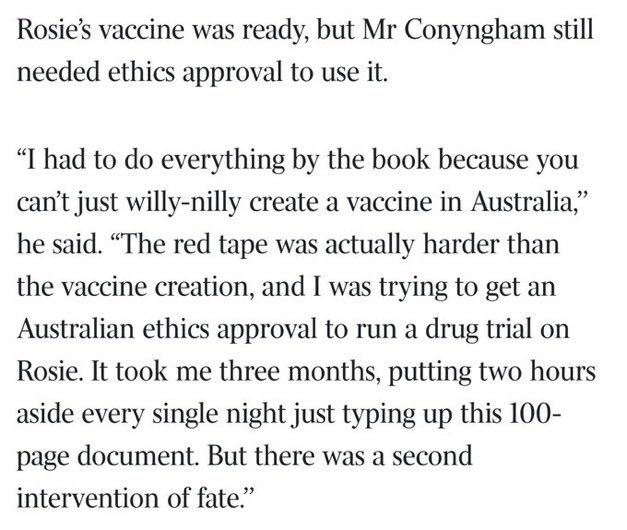
> need ethics approval to administer it
> red tape takes longer than designing the vaccine
> 3 months, finally approved
> drive 10 hours to get rosie her first injection
> tumor halves
> coat gets glossy again
> dog is alive and happy
> professor: “if we can do this for a dog, why aren’t we rolling this out to humans?”
one man with a chatbot, and $3,000 just outperformed the entire pharmaceutical discovery pipeline.
we are going to cure so many diseases.
I dont think people realize how good things are going to get
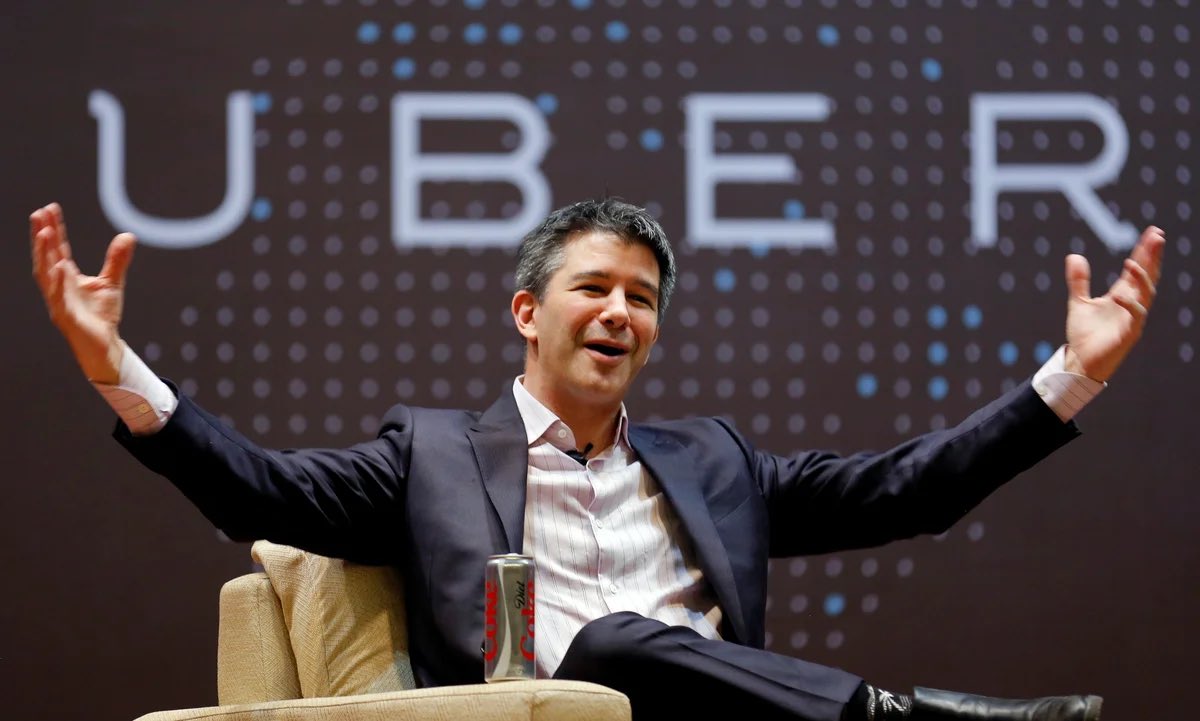
imagine you’re Travis Kalanick
you built Uber from nothing into a $70 billion company and changed how every city on earth moves
then in the worst three weeks of your life, family tragedies hit, and five of your investors hand you a letter demanding you resign
so you step down
the board replaces you, your successor and board sell off the self driving division you created, the thing you believed was Uber’s entire future
gone
$4 billion to Aurora
the mainstream media tries to write your obituary: toxic culture, bad leadership, and a cautionary tale
silicon valley moves on
as they always do
but you don’t
you don’t really forget
you go quiet, completely quiet
you take $150 million and buy a ghost kitchen company called CloudKitchens
you raise over a billion dollars, hit a $15 billion valuation, build a company with thousands of employees
and nobody even knows the name
eight years in stealth, employees aren’t even allowed to put your company on their LinkedIn
then today you rename the company Atoms, and it’s not a kitchen company anymore
it’s a robotics company
1. food
2. mining
3. transport
your first move?
acquiring Pronto
the autonomous vehicle startup
built by Anthony Levandowski, the same engineer you originally swooped away from Google to build Uber’s self driving program
oh and he went on to deploy 100+ autonomous trucks for one of the largest materials companies on earth
now he’s coming back to work with you
and the reports say Uber itself
the same company that pushed you out, is now backing you to go after self driving harder than Waymo
the guy they removed is the guy they end up needing
poetic justice
your framework aka everything in civilization is mined or grown, manufactured and moved
you call it the golden age
your manifesto ends with three words:
“I never left”
eight years of silence
then this
but here’s what people keep getting wrong about your situation
everyone wants to call it a comeback or a revenge story
it’s neither
you just went quiet and built for eight years while everyone who wrote you off had stopped paying attention
that’s not revenge, that’s just what true builder obsession looks like
most founders would’ve stayed bitter
most would’ve written a book and done a podcast tour, most would’ve taken the $2.5 billion in shares and disappeared off to a beach or Epstein’s island
you didn’t do any of that
you just kept building
and now the same people who pushed you out need you again
so whether you love him or hate him
the most dangerous person in any room is the one who goes quiet yet never stops building
karma is real
welcome back Travis
A CS student at MIT finished his final semester with a 4.0 GPA.
I found his NotebookLM workflow buried in a Reddit thread at 2am. He deleted it an hour later.
Here's exactly what he was doing.
He never uploaded lecture slides and asked for a summary.
His first prompt was always: "Here are my notes, the textbook chapter, and last year's past papers. Give me the 3 ways professors trick students on exams with this concept. Then generate a problem that combines it with everything from the last 3 weeks."
He wasn't studying the material.
He was studying how the material gets weaponized against you.
But the move that made me close my laptop and stare at the ceiling was his second one.
He uploaded every single assignment he'd gotten wrong all semester.
Then asked: "Find the pattern in my mistakes. What's the one concept I keep misunderstanding in different forms?"
Every other student was using NotebookLM as a search engine.
He was using it as a mirror.
His third prompt was saved as a shortcut on his phone.
"Based on my notes and these past papers, what topic am I least prepared for right now? Give me the 5 questions most likely to appear on my final that I can't answer yet."
Three prompts. Every single week.
While his classmates were rereading slides the night before finals, he already knew exactly where he was going to fail.
Then he fixed it.
He didn't study harder.
He just never let himself feel comfortable.
MCP sucks honestly
It eats too much context window and you have to toggle it on and off and the auth sucks
I got sick of Claude in Chrome via MCP and vibe coded a CLI wrapper for Playwright tonight in 30 minutes only for my team to tell me Vercel already did it lmao
But it worked 100x better and was like 100LOC as a CLI
• be Morris Chang
• survive WWII in China, escape to America in 1949
• go to MIT, fail the PhD qualifying exam twice
• decide academia is a trap, join Texas Instruments
• spend 25 years climbing the ranks, building their entire semiconductor division into a global powerhouse
• get passed over for the CEO job because of corporate politics
• 1985: you are 54 years old. Most executives are buying golf clubs and preparing to retire.
• the Taiwanese government begs you to move to a tiny island and build their tech sector from scratch
• you look at the global chip industry and see a massive, glaring inefficiency
• the industry rule at the time: "Real men have fabs" (if you want to design chips, you have to spend billions to build the factory to make them)
• Chang realizes: "What if a factory just prints everyone else's designs, and promises never to compete with them?"
• 1987: founds TSMC (Taiwan Semiconductor Manufacturing Company) at age 56
• invents the "pure-play foundry" model
• traditional hardware giants like Intel and IBM laugh at him for just doing the "dirty work"
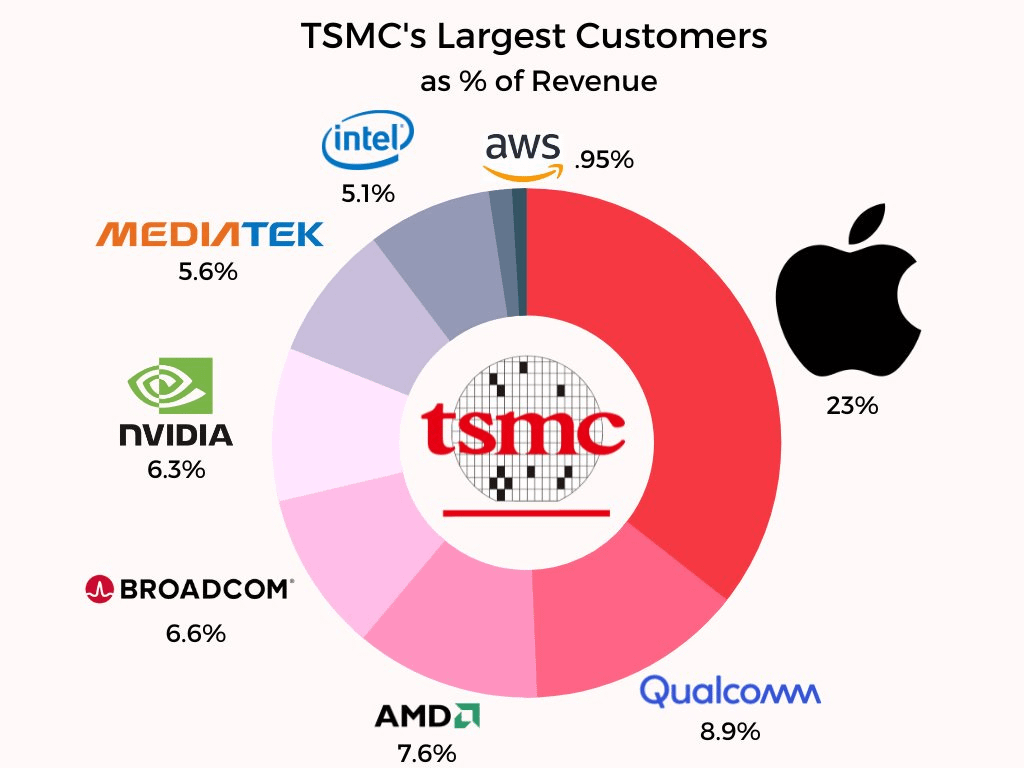
• suddenly, a guy named Jensen Huang (NVIDIA) and companies like Apple realize they can design world-class chips without spending $10 Billion on a factory
• TSMC single-handedly births the entire "fabless" technology industry
• scales the physics down to the atomic level, printing circuits smaller than a biological virus
• becomes an absolute, unbreakable monopoly on advanced human technology
• accidentally builds a "Silicon Shield" around Taiwan
• the US and China both realize that if Morris Chang's factories go offline for a single week, the entire global economy (smartphones, fighter jets, AI, car manufacturing) instantly collapses
• steps down, comes out of retirement at age 78 during the 2008 financial crisis to ruthlessly fire the CEO, doubles R&D spending while everyone else is panicking, and permanently crushes Intel
• 94 years old, smokes a pipe, plays competitive bridge, and controls the single most important bottleneck on planet Earth
"We do not compete with our customers. We are everybody's foundry."
cloudflare spent years fighting scrapers and selling anti-bot protection
now they launched a /crawl API that can scrape an entire website with one request
>send a single API call
>cloudflare renders the page for you
>returns the content as HTML, Markdown, or JSON
>extracts links and page elements automatically
>no browser automation, no scraping scripts
The same company that built half the internet’s anti-scraping infrastructure just made scraping easier
AI companies are going to love this
Crawling an entire website used to take:
A Python script.
Playwright or Selenium.
Proxy rotation.
Rate limiting logic.
Error handling.
3 hours of debugging why page 47 returned a 403.
Now it's one API call.
Every web scraping startup that raised millions to solve this problem just became a single endpoint.
Every freelancer charging $500 to "extract website data" just lost their entire business model to a /crawl command.
HTML. Markdown. JSON. Pick your format. No scripts. No browser. No headache.
The entire web scraping industry just got reduced to one line of code.
Someone is going to use this to clone every competitor's website by Friday. 💀
i can't believe nobody caught this.
Anthropic's entire growth marketing team was just ONE PERSON
(for 10 months, confirmed)
a single non-technical person ran paid search, paid social, app stores, email marketing, and SEO for the $380B company behind claude
here's exactly how one human is doing the job of a full marketing team:
it starts with a CSV.
1. he exports all his existing ads from his ad platforms along with their performance metrics (click-through rates, conversions, spend, etc)
2. feeds the whole file into claude code
3. and tells it to find what's underperforming.
claude analyzes the data, flags the weak ads, and generates new copy variations on the spot
this is where he gets clever:
he then splits the work into 2 specialized sub-agents:
1. one that only writes headlines (capped at 30 characters)
2. and one that only writes descriptions (capped at 90 characters).
each agent is tuned to its specific constraint so the quality is way higher than cramming both into a single prompt
so now he's got hundreds of fresh headlines and descriptions.
but that's just the text.
he still needs the actual visual ad creative, the images and banners that go on facebook, google, etc.
so he built a figma plugin that:
1. takes all those new headlines and descriptions
2. finds the ad templates in his figma files
3. and automatically swaps the copy into each one.
up to 100 ready-to-publish ad variations generated at half a second per batch.
what used to take hours of duplicating frames and copy-pasting text by hand
so now the ads are live.
the next question is which ones are actually working.
for that he built an MCP server (basically a custom integration that lets claude talk directly to external tools) connected to the meta ads API.
so he can ask claude things like:
• "which ads had the best conversion rate this week"
• or "where am i wasting spend"
and get real answers from live campaign data without ever opening the meta ads dashboard
and the part that ties it all together and closes the loop:
he set up a memory system that logs every hypothesis and experiment result across ad iterations.
so when he goes back to step one and generates the next batch of variations...
claude automatically pulls in what worked and what didn't from all previous rounds.
the system literally gets smarter every cycle.
that kind of systematic experimentation across hundreds of ads would normally need a dedicated analytics person just to track
the numbers from the doc:
ad creation went from 2 hours to 15 minutes. 10x more creative output.
and he's now testing more variations across more channels than most full marketing teams
a $380 billion company.
and their entire growth marketing operation (not GTM) = just one person and claude code lol
truly unbelievable
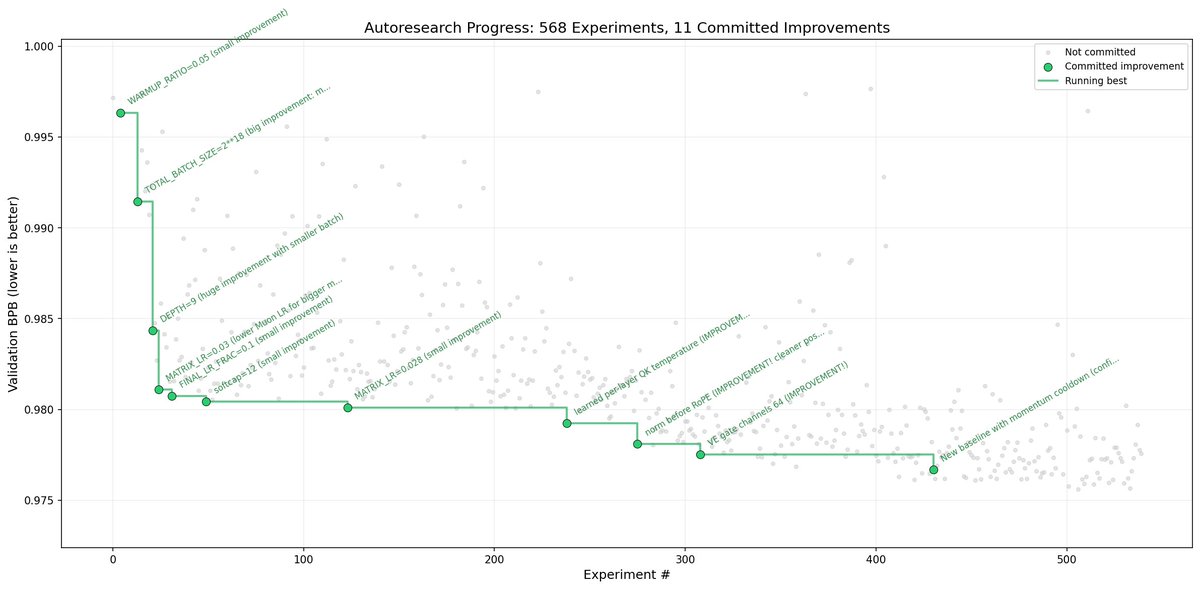
Having fun with @karpathy’s autoresearch.
I told Claude Code:
“You’re the chief scientist of an AI lab with 8 GPUs. You’re Andrej Karpathy. Run parallel experiments and decide what to try next.”
It edited program.md, ran for 11+ hours, and completed 568 experiments.
Each experiment uses 1 GPU. Every round the “chief scientist” reviews the previous round of 8 results and designs the next 8 experiments.
It's interesting to see the Claude agent, the chief scientist evolved a 3-phase strategy:
Phase 1. Broad Exploration
Early rounds explore many axes: architecture, optimizer, LRs, ablations.
Phase 2. Focused Refinement
After easy wins dry up, it runs deeper sweeps (e.g. 5 GPUs sweeping RoPE base 30k → 500k in one round).
Phase 3. Heavy Validation
Later, 50–75% of GPU budget goes to seed variance checks instead of new ideas. I feel it's overkill tbh.
I'll keep the chief scientist running to see if it transfers to larger models and beats Andrej’s new "Time to GPT-2" leaderboard winner.
An 18-year-old high school student harnessed artificial intelligence to uncover 1.5 million previously unknown cosmic objects.
Matteo Paz, from Pasadena, California, created a sophisticated machine learning algorithm that sifted through vast archives of data from NASA's NEOWISE telescope (the Near-Earth Object Wide-field Infrared Survey Explorer). Launched in 2009, NEOWISE spent over a decade surveying the sky in infrared wavelengths, originally hunting for near-Earth asteroids and comets while capturing billions of detections—roughly 200 billion in total—of celestial sources.
Hidden within this enormous dataset were subtle changes in infrared brightness that hint at dynamic phenomena: variable stars, supernovae explosions, feeding supermassive black holes, and close binary star systems, among others.
Rather than relying on manual inspection, Paz trained an AI model (including techniques like waveform analysis and his VARnet algorithm) to automatically detect and classify these faint variability signals across the entire collection. The result: a groundbreaking catalog named VarWISE, which identified about 1.9 million infrared variable objects overall, with 1.5 million representing entirely new discoveries never before cataloged by astronomers.
This VarWISE catalog is already aiding researchers in exploring unusual stellar behavior and other transient events across the universe.
Paz's achievement—conducted during research at Caltech under mentorship and culminating in a peer-reviewed paper—earned him first place and a $250,000 prize in the 2025 Regeneron Science Talent Search. It powerfully illustrates the transformation in modern astronomy: as telescopes generate data far beyond human processing capacity, pairing cutting-edge instruments with intelligent algorithms is unlocking hidden treasures right in existing archives.
The next big discoveries aren't always out in the distant cosmos—they're often buried in the data we've already collected.
Advanced Machine Intelligence (AMI) is building a new breed of AI systems that understand the world, have persistent memory, can reason and plan, and are controllable and safe.
We’ve raised a $1.03B (~€890M) round from global investors who believe in our vision of universally intelligent systems centered on world models. This round is co-led by Cathay Innovation, Greycroft, Hiro Capital, HV Capital, and Bezos Expeditions, along with other investors and angels across the world.
We are a growing team of researchers and builders, operating in Paris, New York, Montreal and Singapore from day one.
Read more: https://t.co/kyVAL7EoFx
AMI - Real world. Real intelligence.
Unveiling our new startup Advanced Machine Intelligence (AMI Labs).
We just completed our seed round: $1.03B / 890M€, one the largest seeds ever, probably the largest for a European company.
We're hiring!
[the background image is the Veil Nebula - a picture I took from my backyard, most appropriate for an unveiling]
More details here:
https://t.co/eWHyGLXwCA