𝐖𝐄𝐋𝐂𝐎𝐌𝐄 𝐓𝐎 𝐄𝐁𝐎𝐍𝐘𝐋𝐈𝐅𝐄 𝐏𝐋𝐀𝐂𝐄 𝐋𝐎𝐍𝐃𝐎𝐍.
Today is our Grand Opening, and we are opening the doors to a new destination for Black and African creativity, culture and connection in the heart of London.
A space rooted in Africa, inspired by London and open to everyone.
A place where film, fashion, food, music and art come together.
A place to experience, discover, connect and celebrate.
We invite the world to come inside.
𝐀𝐌𝐀𝐍𝐈 𝐀𝐔𝐃𝐈𝐓𝐎𝐑𝐈𝐔𝐌
160 seats. Cinema. Culture. Entertainment.
Home to the only Black and African cinema in the United Kingdom, Amani is where premieres, screenings, performances, listening parties and special events come to life.
#AwesomeGod
#EbonyLifePlaceLondon
This should be Yoruba anthem!
Composed and sang by Chief Hubert Ogunde troop in 1960!
What an Anthem. Many Gen Z will think it is witches song.
Thank you Our Nollywood actors for bringing this to bear
He’s also a Professor of Law and a highly regarded pastor. He is former boss and a mentor. Two amazing thing about him are that:
1. despite being a pastor, he never stoped sending me Ramadan texts (from Day 1-30) and Sallah texts or any Islamic related texts.
2. since I left his firm in 2023, he never stoped referring clients to me, even as recent as last month.
Today's Spotlight: Konyinsola Ajayi, SAN.
He is Senior Partner at Olaniwun Ajayi LP and the son of Late Sir Olaniwun Ajayi.
He's held board chairman/director roles at:
• Dangote Fertilizer
• Leadway Holdings
• Afreximbank African CDD Repository Committee
• Nigerian Economic Summit Group(NESG)
• Dangote Sugar
• Leadway Assurance
He is an inspiration to the younger generation.
@egi_nupe Ìṣẹ̀ṣe encompasses a people’s customs, values, worldview, spirituality and ways of life; reducing it entirely to religion misses the larger meaning.
As we count down to 'Isese Day', let’s set the records straight.
There’s a lot of talk about our culture. But what’s Myth and what’s Truth?
Swipe to learn 👉
From Ikeja to Badagry to Ikorodu to Lagos Island and to Epe.
Across the 5 IBILE Divisions, one thing is clear:
Isese is our identity.
Isese is not outdated.
Isese is not division.
Isese is our language. Our values. Our festivals. Our way of life.
This August, Lagos honours our roots. Let’s learn from our culture, not assumptions.
Let’s protect it. Let’s celebrate it.
Get your mind ready.
Be Proud. Be Yoruba.
Source: LASG
#IseseDay
#CountdownToIsese
#MythVsTruth
#PreserveOurHeritage
#TheIBILECulture
#IseseIsWhoWeAre
#AGreaterLagosRising
#LASG
Yorùbá elders clocked this waaay back.
They say "Ọsán já, ọrún dọ̀pá. Àtàǹpàkò ò sí, ọwọ́ dìlagbà."
Meaning: Once the bowstring snaps, the bow 🏹 becomes just an ordinary stick. In the absence of the thumb, the hand is reduced to a helpless, clumsy stump.
Our forebearers were scientists and they recorded most of their observations and inferences in different proverbs.
Cardinal Onaiyekan did absolutely nothing wrong by going on television to disclose what transpired during the meeting with the catholic bishops. The catholic bishops are highly educated people who cannot be intimidated even during the military period they stood strong, so I strongly advise the presidency to heed their counsel about what’s happening in the country…
— Dr Abatti
Ìfura loògùn àgbà; páńṣá ò fura, páńṣá jóná; àjà ò fura, àjà jìn; bí onílé ò fura, olè ni yóò kó o. /
Vigilance is the hallmark of elders; the (dried) calabash plant that wasn't vigilant, got burnt; the ceiling that wasn't vigilant, caved in and any resident who is not vigilant, will have his/her home burgled.
[Small risks become major disasters when neglected; anticipate and prepare for minor dangers, lest they become major catastrophes.]
"Who Naija languages help?"
In this age of heightened awareness of identity, culture and decolonisation, I still find it astonishing that some people can harbour such deep disdain for their own heritage.
But then again, what do I know?
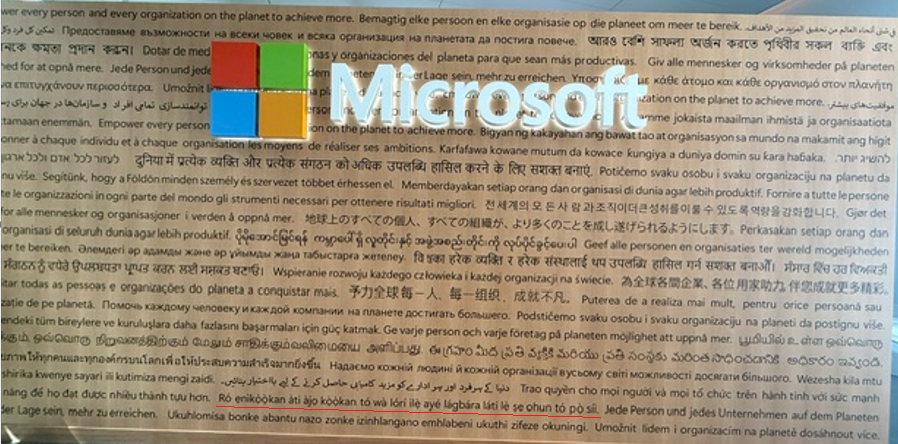
I took this picture at the Microsoft Seattle Campus earlier this year. Yoruba is probably the only Nigerian language on that wall.
My colleagues of European and Asian heritage all found theirs and could read them out loud. Someone asked if my language was up there too.
Imagine if I couldn’t speak or read Yoruba. I would have been so ashamed. #Yoruba
"Who Naija languages help?"
In this age of heightened awareness of identity, culture and decolonisation, I still find it astonishing that some people can harbour such deep disdain for their own heritage.
But then again, what do I know?
I want to be fair to @PeterPsquare . He is not wrong that French opens doors Igbo does not. He is not wrong that parents get to decide how they raise their own children. But I guess he underestimates the fact that he is not just any parent. P-Square is a name millions of Igbo people grew up admiring, their success made them proud to be who they are. People all over the world sang their songs using Igbo words. So when a voice like that says Igbo is not worth passing on, it does not land like one man’s private choice. It gives permission for a belief a lot of people were already quietly carrying, that English and French, in short anything foreign, sits above Igbo, that their native language is something to graduate out of rather than something to hold onto.
I am not Igbo. I am Swiss. But my husband made it clear from the beginning that our children would speak Igbo, and I have never once seen that as a burden or a complication. Our children speak Swiss German, English, and Igbo at home, German at school, and now French as well, since that is part of their school curriculum too. Five languages, and none of them fighting each other for space. That is the part people forget when they frame this as a choice. Children do not need to pick one language to be strong in. They can navigate several at once, easily.
It is adults who turn language into a competition. Children just absorb what is spoken to them and grow fluent in all of it.
A language is not only a tool for getting ahead. It is also a rooting tool, the place where love, memory, and belonging live. It is the specific way a grandmother scolds you and forgives you in the same breath. It is a joke that only works in the original. Lose the language, and you do not just lose a skill. You lose a room in your own house, one you can still visit as a guest but never quite live in again. That is what worries me most in this conversation. A child who cannot speak their father’s or mother’s language will, at some point, stand in that homeland and feel like a stranger. Not unwelcome, not unloved, just outside something that was supposed to be theirs by birth.
One day, my sons will be handed a kola nut, and in that moment, no one should have to do it for them. They should know how to receive it, how to speak over it, how to break it themselves, not pass it along to someone else because they never learned the words or the meaning behind them. That is such a small moment, and yet it says everything. It is the difference between being someone’s guest and being someone’s own.
So when I hear “Igbo is useless,” what I actually hear is a wound that has not healed.
From the outside, I have watched how often English or French get treated as the languages worth keeping, while Igbo gets treated as the one you can afford to let go of. That preference did not come from nowhere. It is a colonial hierarchy that convinced generations of people that closeness to their own culture was a limitation rather than a foundation. I don’t say this to shame anyone, least of all a man raising his own family the best way he knows how. I say it because the people who shape how we see ourselves carry a weight beyond their own households, whether they asked for it or not.
My hope is simple. That we stop treating our children’s languages as a competition with only one winner. That we let them have both the world and their roots, and trust that they are capable of holding both without ever having to choose.
Ìhòhò là ńse ẹyẹ kòwéè; òru là ńjẹ ẹyẹ kòwéè, a kì í jẹ ẹ́ lọ́ọ̀sán; apá ọ̀tún ẹyẹ kòwéè ni wọ́n ńjẹ, wọn kì í jẹ apá òsì. Wàhálà ṣe wá pọ̀ tó báyìí, lórí ẹyẹ kòwéè tí kò tóbi tó adìyẹ? /
You must be stark naked when cooking the kòwéè bird; you must eat it in the dead of night, never during the day; you may eat only the right half, never the left. Why all this hassle for a bird far smaller than a chicken?
[Cost should not exceed benefit; the juice should be worth the squeeze; never make a mountain out of a molehill.]
A few months ago, many people were upset that Google included Yoruba and Hausa in its AI language models while their own language wasn’t included. They argued it was marginalization because they understood that language representation matters.
Yet here we have a prominent celebrity publicly asking, “Who has speaking a Nigerian language helped?” That’s the kind of mindset that accelerates language loss.
Nigeria is a political state created in the 20th century. Yoruba civilization, language, and identity existed for centuries before it. My loyalty to my language isn’t dependent on whatever language the Nigerian government designates as official. Countries rise and fall. Borders change. Governments change. A people’s identity survives only if its people refuse to abandon it.
If the English, French, Chinese, Japanese, or Arabs had adopted this same mentality centuries ago, they wouldn’t have the languages they proudly speak today. Languages don’t survive by accident,they survive because each generation chooses to preserve them.