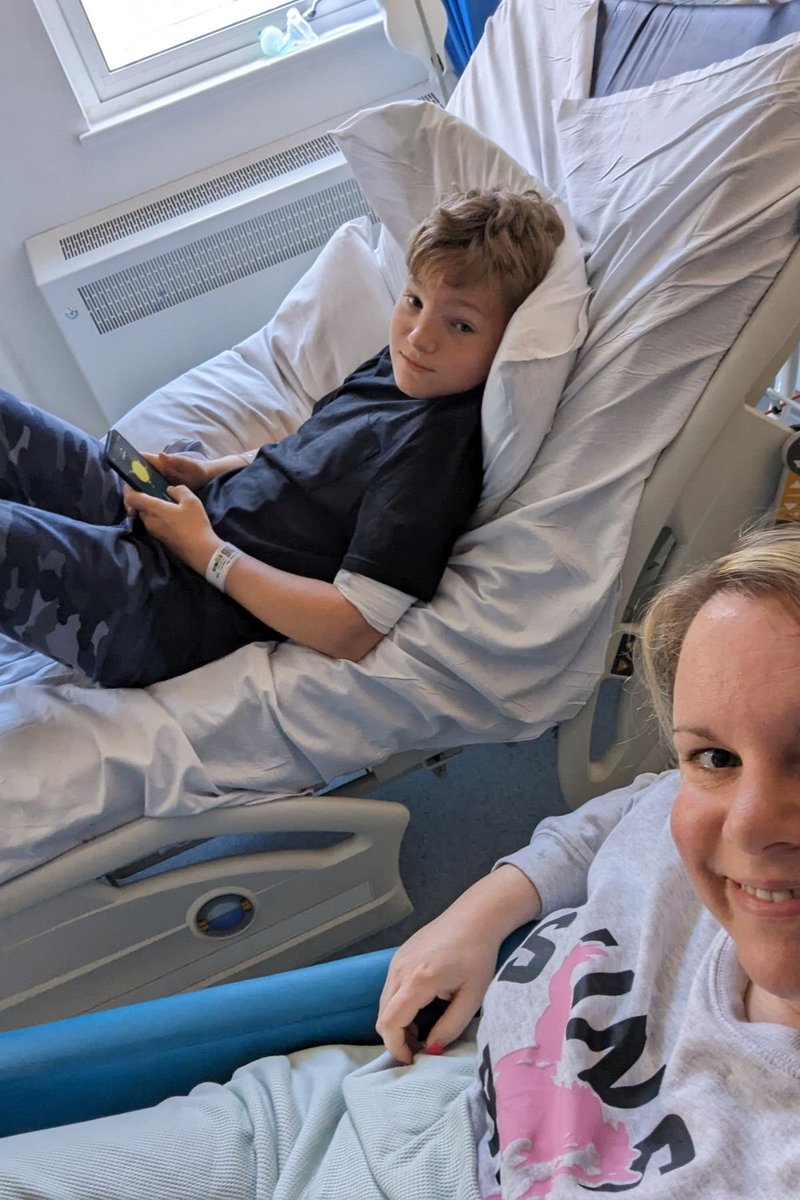
Thirteen-year-old Jake passed away just two weeks before his 14th birthday after what his mum thought was just severe hay fever turned out to be an aggressive cancer 💔
Before he was diagnosed, Jake's mum Lynsey was giving him antihistamines before school because he had a stuffy nose and watery eyes.
She put his sheer exhaustion down to the warm summer weather and the end of the school term.
But when a swelling appeared across the bridge of his nose, an X-ray at Salisbury District Hospital revealed a mass in his nasal cavity.
Jake was diagnosed with stage 3 fusion-positive alveolar rhabdomyosarcoma, a rare soft-tissue cancer, in July 2023.
He went through nine rounds of chemotherapy and 28 sessions of proton beam radiotherapy in London, but the cancer still spread to his lymph nodes.
When further chemotherapy caused severe seizures that placed him in intensive care, Jake made the brave decision to stop his treatment entirely.
Lynsey said he was incredibly calm about it, simply telling her, "We tried our best."
He even managed to joke that at least he wouldn't have to deal with the cost-of-living crisis.
Jake passed away peacefully at home on April 26, 2024.
Before he died, he gave strict instructions for his own funeral, asking for a blue coffin and for 'Here Comes The Sun' by the Beatles to be played 💙
His final wish to his mum was that he wanted to be well-known and not forgotten.
Lynsey is now honouring that promise by joining forces with a children's cancer charity and studying radiotherapy at the University of Liverpool.
RIP Jake, you won't be forgotten 🕊️
My mate back in England married his first ever girlfriend.
They met at school. Never left our hometown. He still works at British Gas, the same company he joined at 21. Heads down the pub every Friday.
They've got two kids, a garden, a dog. She still looks at him like he's the only man in the room.
He's never read Atomic Habits. Never "worked on himself." Never bothered to optimize his supplement stack.
I moved to four countries, built a business, reinvented my entire life. I wouldn't change any of it.
But when he sends a photo of his family eating Sunday roast together, I think maybe we're all overcomplicating this.
The Game of Thrones theme was composed by Ramin Djawadi, who is of Iranian descent.
Hearing this melody played with Persian instruments and the daf drum is absolutely beautiful.
@Askash The Marlow is adjacent to the railway line!!! Imagine spending all that money to be faked into buying a property with a train line behind you😆 the mountain views cannot take away the noise pollution
Djokovic’s first-ever tennis practice at 4 years old in Kopaonik, Serbia (1991)
Who knew this kid will go on to be the greatest of all time....Incredibly rare footage !!!
Nobody wants data centers everywhere. Nobody wants flying cars. Nobody wants a city on Mars. Nobody wants AI in every app. Nobody wants a robot butler. All we want is clean water, we want bees to survive, and we want a habitable planet.
SOUTH AFRICA IS NOW THE WORLD’S LEADING CITRUS EXPORTER.
South Africa has overtaken Spain and is now the world's leading exporter by volume.
Citrus is the leading agricultural export product, accounting for 17% of South Africa’s agricultural exports of US$15.1 billion in 2025.
A whole generation of South Africans would be shocked to read this, especially when they look at where the country is today.
Before 1994, South Africa built capabilities that few countries in the world could claim.
It developed nuclear weapons, a rocket programme, large-scale synthetic fuel production, a globally respected defence industry, and medical breakthroughs that made world history. At the southern tip of Africa, one country achieved all of this before the Cold War had even ended.
Today, Africa is often spoken about as if it is still waiting to industrialise, still dependent, still trying to build what others already mastered long ago. That is what makes this history so striking.
While South Africa was enriching uranium at Pelindaba, testing rockets at Overberg, producing fuel from coal at Secunda, and carrying out the world’s first human heart transplant at Groote Schuur, much of the rest of Africa was being pulled in a very different direction. Instead of industrial self-reliance, many newly independent states were sold ideology. Instead of building durable technical capacity, they were pushed toward socialist models that too often ended in weak institutions, dependency, and collapse. The pattern repeated itself across the continent.
South Africa, by contrast, built real strategic capability under sanctions and international pressure. It developed its own uranium enrichment process, built six nuclear weapons, and then voluntarily dismantled them before the democratic transition, opening its programme to international inspection. No other nuclear state has done that in the same way.
It also built a serious rocket programme. Vehicles in the RSA series were designed and tested, and the country came close to having its own orbital launch capability. That programme was not simply paused. It was dismantled.
Sasol achieved something equally remarkable: turning coal into fuel on a huge scale. When South Africa could not secure enough oil, it used chemistry and engineering to produce its own supply. That was not theory. It was functioning industrial independence.
The defence sector was another pillar of that capability. South Africa designed and produced advanced artillery, armoured vehicles, aircraft projects, and attack helicopters. Some of these systems went on to influence military designs far beyond its borders.
Then there was medicine. In 1967, Christiaan Barnard and his team performed the world’s first successful human heart transplant in Cape Town. That was not an isolated achievement. It reflected a wider culture of scientific and medical excellence.
So the uncomfortable question is this: if all of this is documented, why is so little of it widely remembered?
The answer may be that it does not fit neatly into the version of history most people are taught. Pre-1994 South Africa is rightly remembered for apartheid and injustice, but that is not the whole story. It was also the most technologically advanced state Africa had produced, and acknowledging that forces people to confront how much capability existed, and how much has since been lost.
South Africa did not inherit these achievements. It built them under pressure, under sanctions, and largely on its own. That is not nostalgia. It is history. And the fact that so many people barely know it happened says a great deal about how history is told.
George Michael died in his sleep on Christmas Day 2016. The world mourned the voice, the music, the icon.
Then something unusual happened.
In the days that followed, ordinary people began to speak — not celebrities or publicists, but volunteers, charity workers, waitresses, and strangers who had quietly carried a secret for years. One by one, they stepped forward to describe the same man: someone who had spent decades giving away millions of pounds in near-total secrecy, and who had actively fought against anyone finding out.
A woman appeared on the TV game show Deal or No Deal and mentioned she needed £15,000 for IVF treatment. George Michael was watching. The next day, he quietly phoned and paid the full amount. She didn't know who her donor was. She only found out after his death, when the story broke online.
A volunteer at a London homeless shelter noticed a familiar face one evening — serving food, cleaning tables, blending in. It was George Michael. He had asked the staff not to tell anyone he was there. He came back more than once. "I've never told anyone," the volunteer later posted. "He asked we didn't. That's who he was."
Every Easter, DJ Mick Brown would run a charity appeal at Capital Radio for Help A London Child. Every year, without fail, a call would come in at 3:30 in the afternoon. A £100,000 donation. No fuss. No publicity. George would give and hang up.
After his mother died, he organized a private concert — entirely unannounced — for the NHS nurses who had cared for her. It was not filmed. It was not advertised. It was simply a thank you, offered directly to the hands that had shown kindness when fame could offer none.
He donated royalties from "Jesus to a Child" to children's charities for years. The Terrence Higgins Trust, which he supported for decades, confirmed he gave generously and consistently — insisting his name never appear in any fundraising materials. Childline's founder later revealed he had donated millions, entirely anonymously, over the course of his life.
He struggled, too. Publicly and painfully. Addiction. Loss. The relentless scrutiny of fame. But those who knew him said the struggles never hardened him. If anything, they deepened his understanding of what it means to need help — and to receive it without strings.
In 1999, a journalist managed to get him to comment on the rumors of his giving. He said simply: "I really don't like to talk about the amount I've given to charity over the years. I know it's very substantial. I don't exactly know what it is, and I don't really like to linger on it."
After his death, the full shape of what he had done became visible — not because he wanted it known, but because the people he had helped could no longer stay silent. Patients who received care. Students who stayed in school. Families who kept their homes. Children whose charities kept their doors open.
George Michael understood something about kindness that most of us only glimpse: that it loses something the moment it starts seeking applause.
He gave without witnesses.
The world found out anyway. And maybe that's exactly as it should be.