Chainlink’s mission from day one: build the most secure & decentralized infra to safely scale DeFi into a trillion-dollar industry.
This uncompromising approach to security is what makes Chainlink CCIP the industry-standard for cross-chain interop.
🧵⬇️
https://t.co/aras69JN3n
Chainlink Runtime Environment (CRE) is now live. Here's a 101 video that I made with NotebookLM to illustrate what it is.
"We are moving from a world of slow, siloed financial systems, to one where any asset, any piece of value, can be programmed and connected to any other system. The question is no longer if this is going to happen, but what are we going to choose to build in this new hyperconnected world."
THE CHAINLINK ENDGAME
The updated Chainlink vision is here.
What started as a data solution is now an extensive platform of essential services for integrating the world into the onchain economy ⬇️
https://t.co/HlnmFeiEWY
What TCP/IP did for the Internet and the Java Runtime Environment (JRE) did for online development, Chainlink is doing for blockchains and onchain apps.
In the early days of the Internet, scaling required more than innovation—it required unification and seamless orchestration.
TCP/IP and the JRE emerged, bringing coherence to a fragmented digital world and abstracting away complexity so developers could focus on building.
Blockchains are at the same turning point.
With more chains and even more financial institutions and real-world assets moving onchain, the main challenge now is building apps that efficiently orchestrate across blockchains and existing systems.
Advanced blockchain apps now involve multiple types of data, cross-chain interoperability, compliance policies, integration with legacy systems, and much more.
Building these next-gen apps is nearly impossible to do in-house and overly complex if you have to rely on a growing list of vendors, who each only solve a small portion of the application’s overall requirements.
Chainlink changes that.
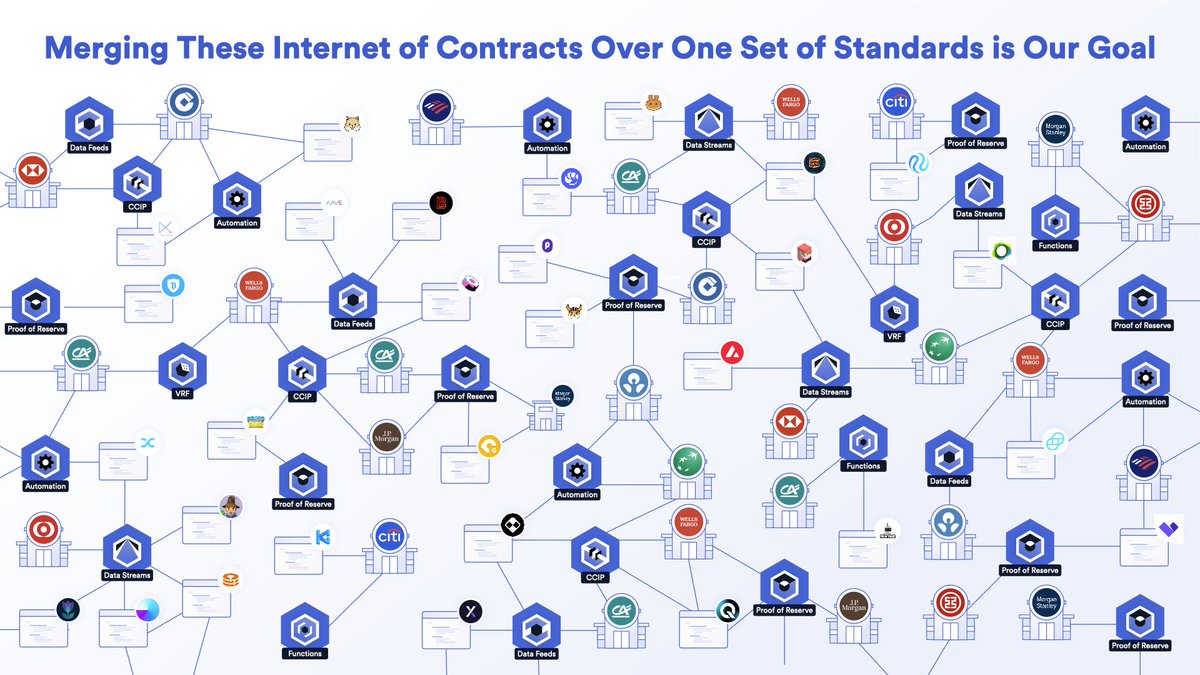
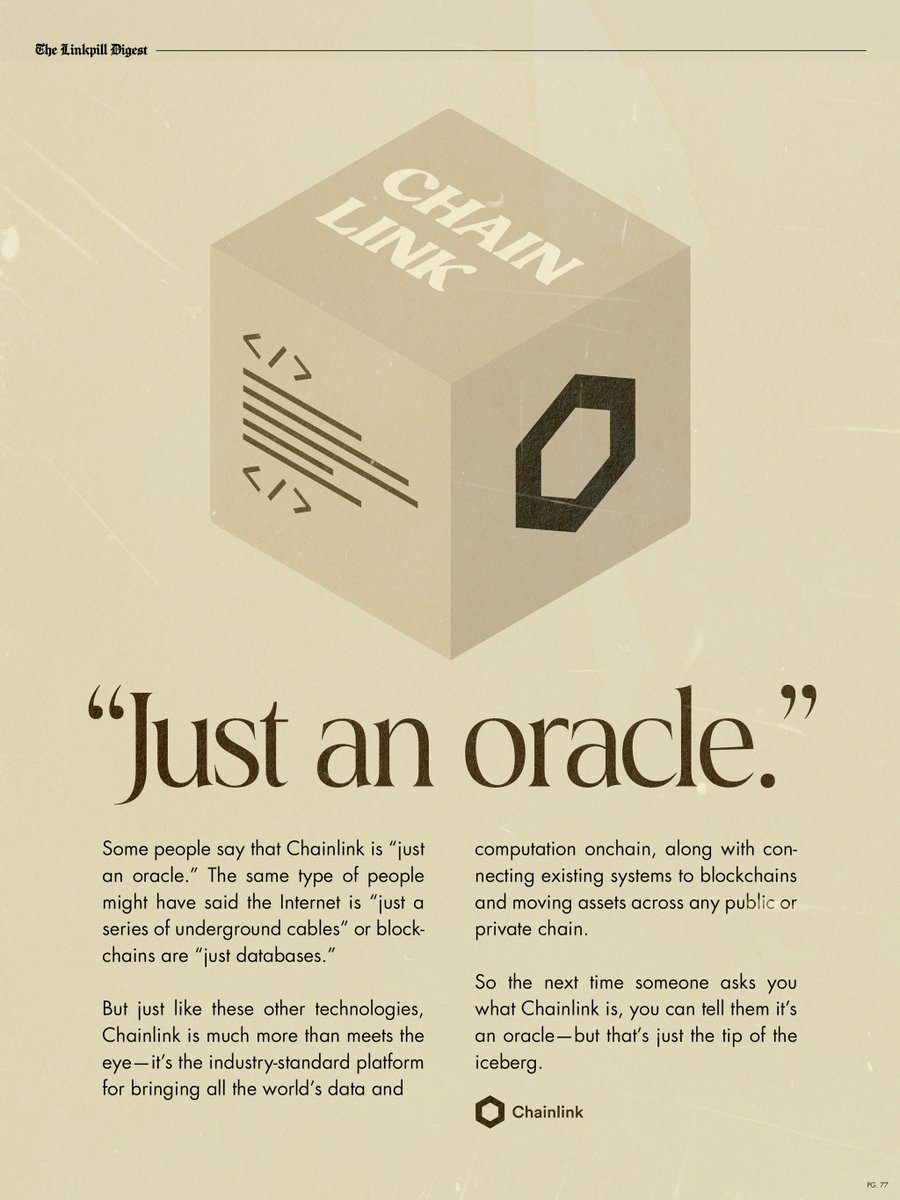
Chainlink is not just a price feed. It’s a unified oracle platform that underpins critical standards, services, and end-to-end solutions needed to unlock advanced blockchain applications:
• Data oracles for publishing mission-critical data onchain
• Interoperability oracles for moving data and value cross-chain
• Compliance and privacy oracles for meeting regulatory and internal business requirements
• Legacy system integration for seamless connecting between onchain and offchain systems
• Verifiable orchestration and compute to power entire applications in a decentralized manner
Like Java and TCP/IP before it, Chainlink unifies blockchains and abstracts away complexity, empowering developers and institutions to build and power the entire lifecycle of onchain use cases via a single, secure platform.
Now, enterprises can efficiently build onchain apps that mirror the sophistication of traditional finance yet benefit from the transparency, security, and composability of blockchains and Chainlink technology.
Chainlink is how the world integrates into the onchain economy.
I think the technical term to describe this situation is "now we're cooking with gas"
I wonder what happens when the world's largest financial institutions decide to go on-chain because being on-chain becomes a "national priority".
Seems likely they will need a secure and reliable way to utilize various kinds of data on-chain to build their financial products. I can also see them needing a reliable way to interconnect all their chains to transact in a secure, compliant and efficient manner accepted by regulators. Something like what TCP/IP does for the internet, but built to handle cross-chain transactions and able to work for institutional systems/use cases.
It might also be nice if they had a simple development environment from which to manage all this complexity, something like a runtime environment that makes it easy to rebuild all their existing financial products and transactional flows on-chain. If that development environment was already integrated with their existing standards like Swift and their existing CSDs like DTCC, that would make it a lot simpler for them. If only there was a single platform where they could get all of these key building blocks to work together in a secure way...
Exciting times ahead.
“Swift payment flows can be used to trigger onchain digital asset movements.”
How Swift (@swiftcommunity) and the Chainlink standard can enable onchain and offchain payment flows ↓
As the amount of bank chains rapidly increases, all of the smart contracts on those chains will need data to generate their real world assets and connectivity to transact across hundreds of different chains. Chainlink is the only platform that provides both in one solution.
Video: https://t.co/Y40YX0aXjn
Slides: https://t.co/bZ3bMp5VL1
If $LINK isn't part of your portfolio because you think it can't do many more multiples then you don't have any clue how big CCIP is.
Any price target you have is FUD, it will be HIGHER!
@chainlink's Proof of Reserve cryptographically guarantees audits every second, providing on-chain attestation, which increases transparency & reduces the risk of fraud compared to traditional annual audits that are opaque & unreliable
#Chainlink continues to advance #Web3 innovation by unlocking novel cross-chain use cases and providing dApps with secure access to off-chain data and computation.
Explore today’s announcements across #Avalanche, #BNBChain, and #Ethereum🧵👇