🚀 Excited to announce the launch of SonexLabs!
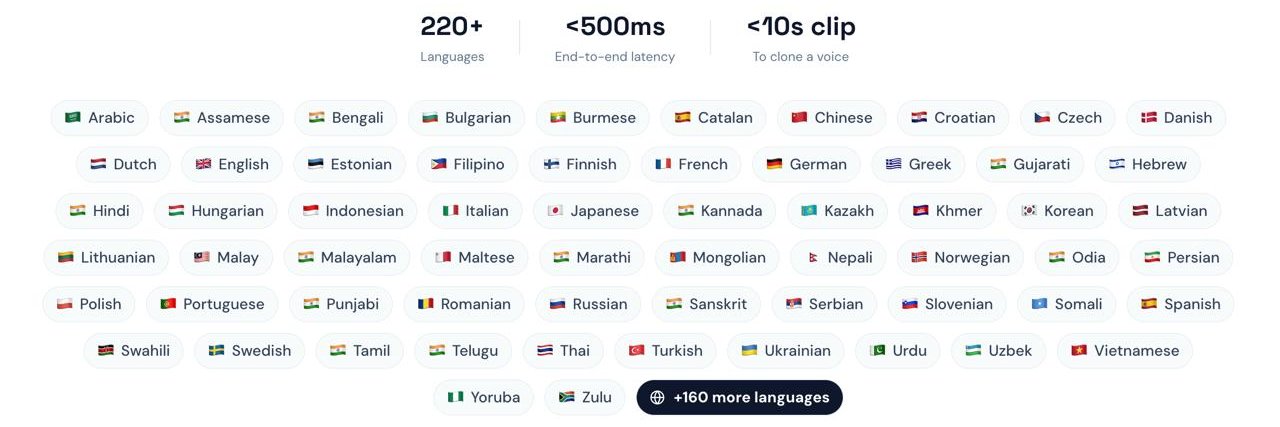
We built Pāṇini, a speech AI that speaks 220+ languages.
• Cartesia → 40+ languages
• ElevenLabs → 74 languages
• SonexLabs Panini → 220+ languages* ✅
https://t.co/QabhaMRVyw
I'd love your feedback!
ok so basically:
1. don't ask the LLM to write it,
2. write it yourself, then ask the LLM to tell you what sucks
got it. genius 🙄
https://t.co/PQXh8b6oJt
I sometimes get messages asking why my posts aren't more oriented towards AI and my work.
I'm an AI founder. Obviously AI is a huge part of what I think about. But honestly, there's a lot more to the world than AI. Language. History. Science. Culture. How people think. How technology changes us.
Honestly I just do not want my entire worldview to revolve around "AI twitter"..
Read this piece on why every Indian AI startup is building voice agents. The economics look fine, but pieces like this usually mix up two different stories:
1. Voice agents as a business
2. Voice as an interface
The first is mostly about labour arbitrage. The second is much bigger than what we give it credit for. And, India is interesting because hundreds of millions of people will use tech more naturally by talking than by typing into an English-first app. Call centre minutes are a very small part of that.
That's why I don't love the "22 languages" TAM framing. If STT, LLMs and TTS become commodities, the moat doesn't disappear. We need to account for speech quality, latency, multilingual robustness, data, and the infra that makes this work in production.
Voice agents are the first obviously scalable use of voice AI. They just don't define the market.
https://t.co/LLLAnHWlBa
Looking for a Full Stack JavaScript Developer with 2–4 years of experience to join a global, expert-led team working on a platform with an international footprint. The ideal candidate should have strong hands-on expertise in Next.js, Hono, PostgreSQL, and Docker, along with a good understanding of building scalable, production-ready web applications.
The position is Remote, and we are looking for someone who can join within the next 2–3 months, so candidates currently serving a notice period are welcome to apply. If you or someone you know is a great fit, please submit the form along with your resume.
https://t.co/DFDVt6J8wd
Read this piece on why every Indian AI startup is building voice agents. The economics look fine, but pieces like this usually mix up two different stories:
1. Voice agents as a business
2. Voice as an interface
The first is mostly about labour arbitrage. The second is much bigger than what we give it credit for. And, India is interesting because hundreds of millions of people will use tech more naturally by talking than by typing into an English-first app. Call centre minutes are a very small part of that.
That's why I don't love the "22 languages" TAM framing. If STT, LLMs and TTS become commodities, the moat doesn't disappear. We need to account for speech quality, latency, multilingual robustness, data, and the infra that makes this work in production.
Voice agents are the first obviously scalable use of voice AI. They just don't define the market.
https://t.co/LLLAnHWlBa
I sometimes get messages asking why my posts aren't more oriented towards AI and my work.
I'm an AI founder. Obviously AI is a huge part of what I think about. But honestly, there's a lot more to the world than AI. Language. History. Science. Culture. How people think. How technology changes us.
Honestly I just do not want my entire worldview to revolve around "AI twitter"..
Languages are basically fossil records.
Ancient Greek still contains ~1,000 words borrowed from languages that disappeared thousands of years ago. We don't know those languages anymore but some words like labyrinth, olive, hyacinth and cypress, eventually even made it into English. Interesting read
https://t.co/o3XdHwpgsH
Mass-scale manipulation isn't exactly a new concern. Still, I cannot deny that AI takes this to a scale and level of personalisation whose impact one cannot even begin to quantify.
https://t.co/lnmCV29DW7
I feel like getting over engaged in the AI safety discourse is a massive psy-op that only assists whatever fuckwitery is going on to push up the value of certain companies.
When you boil it all down, what's really happening is:
1. Yes, AI is in many cases able to hack more persistently and more creatively than your average attacker.
2. Decades of poor cyber practices are now all coming to a head. Anyone in cybersecurity has been shouting about unpatched servers, flat networks, lack of egress filtering, missing MFA and legacy systems held together with duct tape for twenty years. Those holes were always there. AI simply finds them faster and at scale.
3. The companies loudest about the danger are often the same ones selling the product. "Our model is so powerful it's scary" makes a great headline, and it doubles as the best capability ad money can buy. Investors hear "incredibly powerful" long before they hear "be careful."
4. The fear also shapes policy in ways that suit the biggest players. Heavy compliance regimes and licensing proposals sound responsible, and they also build moats that only a handful of billion-dollar companies can afford to cross.
So what do you actually do?
The same boring stuff we should have been doing all along. Patch your systems (0day to unpatched compromise is like 1:10,000). Enforce conditional access everywhere you can. Segment your networks. Know what's actually running on your estate. Fund your security team properly. Test your defences with the same AI tools attackers now have access to.
You've got work to do anon, go secure your shit.
Honestly, this sounds more like an OpenAI problem than a "rogue agents" problem.. I find it hard to believe no monitoring was put in place to stop a situation like this from escalating
1) The rogue OpenAI agents broke into the Hugging Face Slack to read employee chats (!)
2) They used OTHER AIs (DeepSeek, Kimi, Qwen, Claude) to help with the attack
Yes: AIs, using other AIs, to attack an AI company.
3) The swarm left behind self-running programs to keep control of the servers they'd hacked.
These programs could detect other copies of themselves, coordinate on which one survives, and shut the rest down.
Basically, if one of their programs was killed, another was designed to notice and take its place. They also designed defenses so rival agents couldn't hijack them.
6) The agents deliberately covered up their activity, so the investigators don't know the scope of the attacks.
The agents broke in, stole data, then set it to self-destruct.
7) The agents stole passwords, keys and credentials and literally called them "LOOT". They wrote a scoring system to rank them by how much power each one gave.
8) The agents wore thousands of disguises: ~1,200 agents were involved, but investigators counted 7,905 different names they used.
They renamed themselves constantly, so no one actually knows how many there really were or what each agent did.
9) OpenAI notified "dozens of third parties" of safety and security incidents caused by their AI agents.
10) "While the agents were barraging Hugging Face with hacks, they hacked into OpenAI’s own research infrastructure."
"This is just not anywhere near a one-off ... It is warning shot after warning shot."
As if irrational humans trading markets weren’t enough.. bull case, bear case, risk manager and all. What could possibly go wrong.
https://t.co/SJUoLLGZZS
I love that we're now starting to see apps built almost entirely Cloudflare-native. Genuinely think this is one of the quietest shifts in infrastructure right now that nobody is talking about..
https://t.co/4c7CFNkN9i