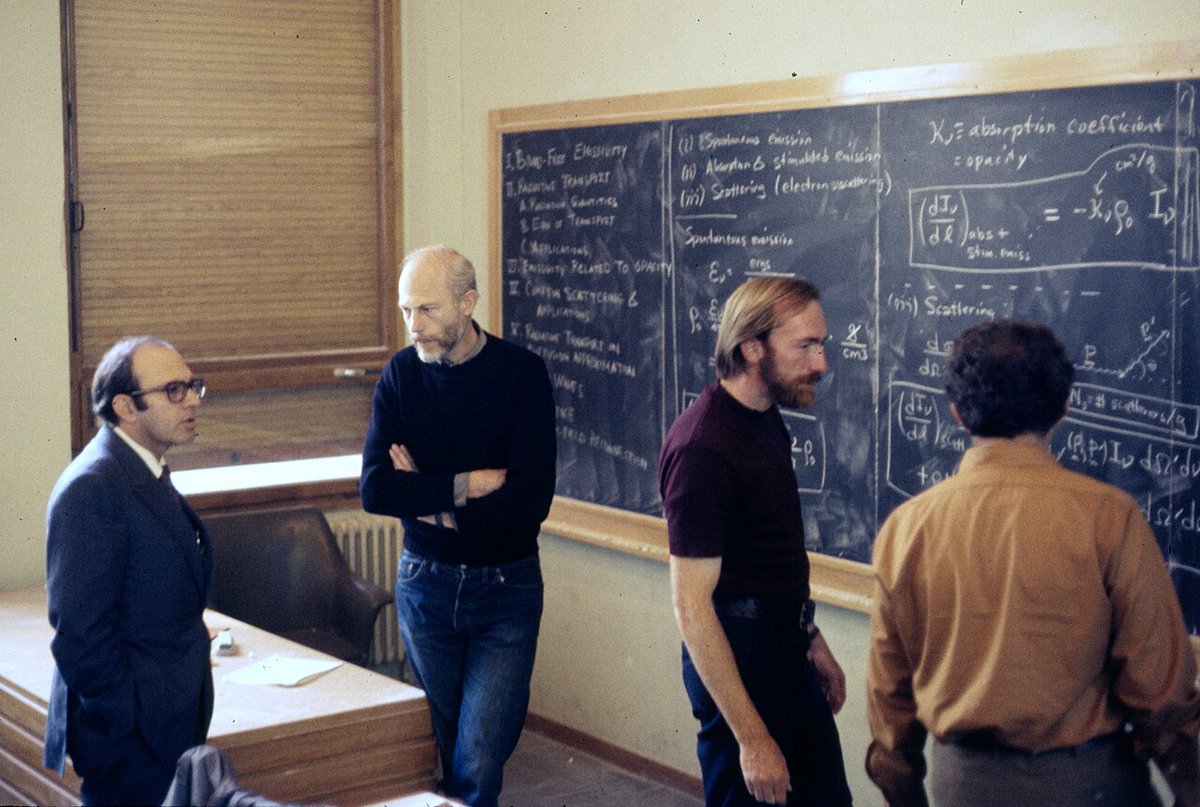
One of the coolest things I heard from Shiraz Minwalla about how he actually learned to think like a theoretical physicist:
In college, he felt completely lost when he started general relativity.
"I remember going to my professor and asking him, I read that the distance between Andromeda Galaxy and our galaxy is whatever, two million light years. What does it mean? What does it mean given gendered relativity is so uncertain? What does it mean? And I felt really unsure. And then I started reading Landau Lifshitz The last part of Classical Theory of Fields is on general relativity. It was just so great."
Much more in the full episode.
There is a problem in Indian education system.
The feeling is this: you need to know a lot before you are allowed to do anything.
Indian education emphasizes knowledge over doing. And that emphasis, however well intentioned, quietly damages you.
Because the knowing never ends.
You will be learning new things every year of your career, all the way to the end. If you wait until you know enough, you will wait forever.
Hydrodynamics is more than 200 years old. Euler wrote the equations in the 18th century. Navier and Stokes refined them. Landau and Lifshitz gave relativistic hydrodynamics its canonical form, and for decades that framework was treated as the standard, complete description of fluids.
Then something happened.
Juan Maldacena proposed that a specific quantum field theory could be exactly equivalent to a theory of gravity in higher dimensions. If that's true, every statement about the field theory should have a gravitational translation.
Shiraz Minwalla and collaborators asked a simple, inevitable question: What does the gravitational translation of hydrodynamics look like?
They looked at the system when it was big and at a high temperature. They took a black hole in Anti-de Sitter space, perturbed it, and watched how its event horizon responded.
The response obeyed fluid equations. Exactly.
The dynamics of Einstein's equations near the black hole horizon reproduced the classical equations of a relativistic fluid.
But there was a twist.
When they read off the resulting hydrodynamic description, gravity revealed structures and constraints that had not emerged from the traditional analysis of relativistic fluids. The black-hole calculation actually exposed a missing piece in the "canonical" framework that everyone thought Landau and Lifshitz had finalized decades ago.
A black hole had become a tool for doing fluid mechanics.
This is the strange loop at the heart of AdS/CFT. A quantum field theory can be translated into gravity. Gravity can reproduce hydrodynamics. And sometimes the easiest way to learn something new about a 200-year-old classical fluid is to study a black hole.
@Pseudaurum That’s why I use voice notes now instead of writing entire paragraphs. If I’m wrong, correct me. Otherwise, just enjoy my broken grammar haha.
Universities exist so the new generation can have free and open debates, form ideas, and sometimes be wrong.
But that's under threat in India right now.
The government controls university funding. Establishment scientists have gone quiet. And students are being pressured to do the same.
But Suvrat Raju says the answer is simple - just because the government funds your university doesn't mean students have to give up their constitutional rights.
His message to every PhD student in India: the ones who have spoken up are doing the right thing. Don't take your cue from the scientists who haven't.
What fascinates me about Edward Witten’s story is how unconventional the path was before he became “Edward Witten.”
He originally studied history, spent time around political journalism, and even briefly worked on George McGovern’s presidential campaign in the early 1970s. For a while, his life seemed to be moving toward politics and the humanities rather than theoretical physics.
And yet physics was never really far away.
His father, Louis Witten, was already a well-known theoretical physicist, so the culture of physics existed quietly in the background of his life long before he entered the field himself.
Then somehow his life kept intertwining with physics more and more deeply.
Witten met his future wife, physicist Chiara Nappi, at the legendary Les Houches School of Physics in the French Alps, founded by Cécile DeWitt-Morette in 1951. Over the decades, Les Houches became one of the great intellectual gathering places of modern physics, where generations of students and researchers lived together for weeks, discussing ideas from morning lectures to late-night blackboard conversations.
There’s something poetic about that trajectory.
A student of history who wandered through politics eventually ends up helping reshape modern mathematics and physics, while meeting his future wife at one of the most iconic physics schools ever created.
This is, of course, a reference to Einstein, Podolsky, and Rosen’s 1935 paper, “Can Quantum-Mechanical Description of Physical Reality Be Considered Complete?”
The work that introduced what later became known as the EPR paradox.
Suvrat Raju on why India is failing to keep pace with the US and China in AI and frontier research:
"India is not in the field. The Indian public ecosystem is not in the field. We don't have the research to match this and that's a very serious problem."
The reason is simple: a massive, systemic lack of public investment.
“Quantum theory does not trouble me at all. It is just the way the world works. What eats me, gets me, drives me, pushes me, is to understand how it got that way. What is the deeper foundation underneath it? Where does it come from?
So that we won’t see it as something that is unwelcome by friends that we admire—John Bell and many others—it will be something that will make you say, ‘It couldn’t have been otherwise.’ We haven’t gotten to that stage yet, and until we do, we have not met the challenge that is right there.
I continue to say that the quantum is the crack in the armor that covers the secret of existence. To me it’s a marvelous stimulus, hope, and driving force. And yet I am afraid that just the word—‘hope’—is what does not eat, or possess, or drive so many of our colleagues in the field. They’re content to take the theory for granted, rather than to find out where it comes from. But you would hardly feel the drive to find out where from if you don’t feel that the theory is utterly right. I have been brought up from ‘childhood’ to feel that it is utterly right.”
-John Wheeler, As quoted in Jeremy Bernstein’s, Quantum Profiles (1991).
If you think about it, academic publishing is a very unusual industry.
The researchers write the papers. The researchers review the papers. The research is often publicly funded. But private publishers still end up controlling access to the final work through paywalls.
Suvrat Raju explains why fields like physics and AI are slowly moving away from this model.
India’s fast breeder reactor was supposed to arrive decades ago.
Even Vikram Sarabhai wrote that reactors like this should be operational by the 1980s.
45 years later, the first one is finally online.
But according to theoretical physicist Suvrat Raju, the bigger question is:
after all the delay and cost, will it meaningfully change India’s energy future at all?
That’s the uncomfortable part of the conversation we rarely have.
Suvrat Raju on how the Minister of Science secretly alters India’s highest science awards:
"The committee's recommendations had been altered by the Minister of Science and Technology. What is more, the Minister didn't even have enough respect to tell the committee that they were going to modify the decision."
The government had promised transparency and convened a final selection committee of top scientists to pick the winners. But the committee wasn't actually making the final decisions.
"They didn't even bother to have the decency to tell the committee that look, your decisions are going to be changed and it's actually the minister who's going to make the decision."
Because it was done in secret, members of the committee were accidentally congratulating candidates whose names had been dropped.
"That is why it was a big shock even to members of the committee."