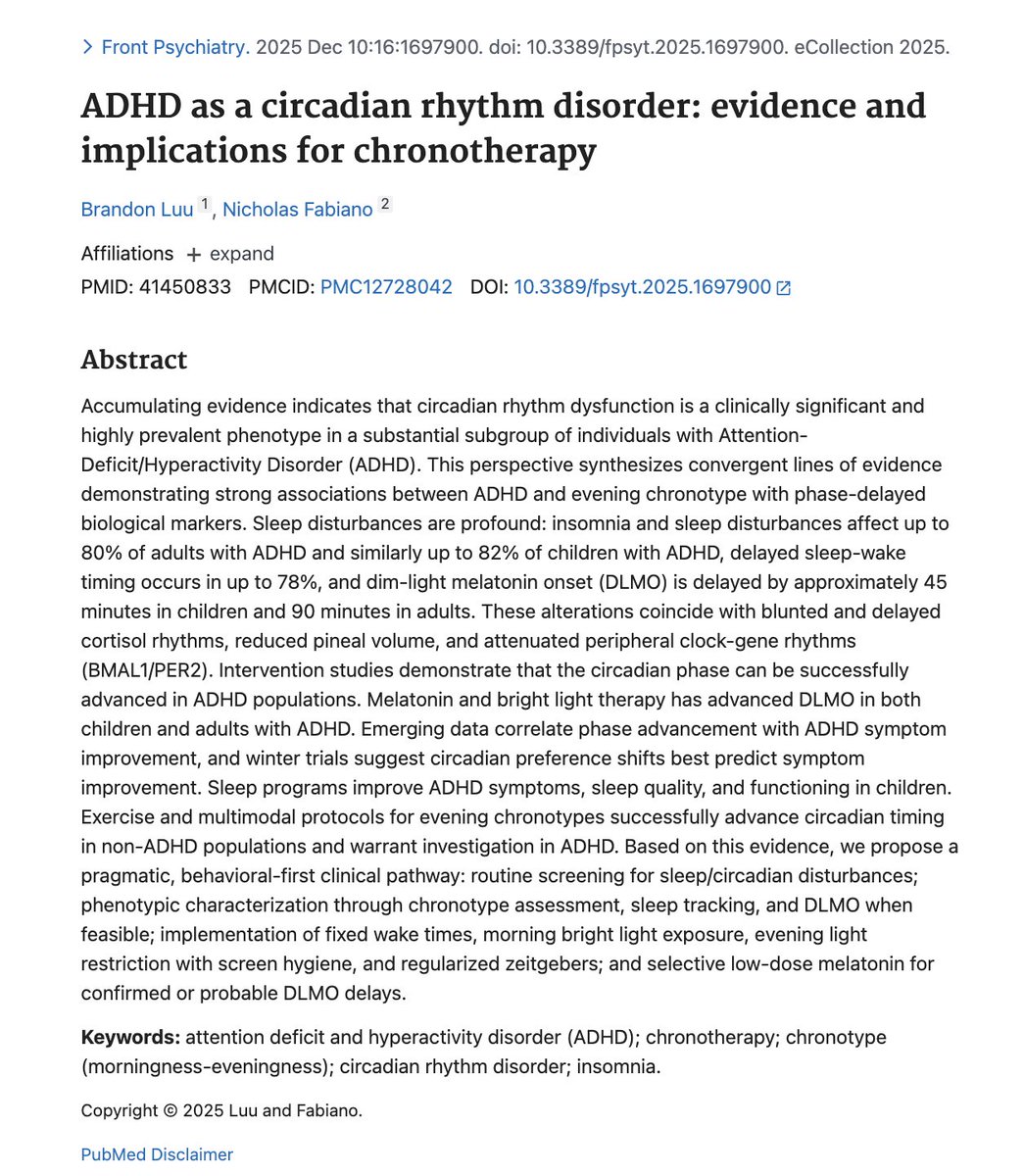
Up to 78 percent of people with ADHD have a body clock that runs late, and moving that clock earlier has been linked to fewer ADHD symptoms. A 2025 paper by two Canadian doctors pulled the evidence together and laid out a treatment plan.
Melatonin, the hormone that tells your body it's time to sleep, starts rising about 45 minutes later at night in children with ADHD and about 90 minutes later in adults. Brandon Luu of Queen's University and Nicholas Fabiano of the University of Ottawa gathered this research in Frontiers in Psychiatry. Sleep problems affect up to 80 percent of adults with ADHD and up to 82 percent of children.
People with ADHD also tend to have a flatter, later daily cortisol rhythm, and some studies have found a smaller pineal gland, the tiny gland deep in the brain that makes melatonin. Their body clock genes show weaker daily swings too.
Melatonin and bright light therapy have both moved the body clock earlier in children and adults with ADHD. Early studies link that shift to fewer ADHD symptoms, and sleep programs for children have improved symptoms, sleep, and daily functioning.
Screening every ADHD patient for sleep and body clock problems is the first step in the plan the authors propose. After that come a fixed wake-up time, bright light in the morning, less light and screen time at night, regular daily routines, and low-dose melatonin for people whose clock is clearly running late.
The paper is a perspective piece that summarizes earlier research, and much of the treatment evidence is still early. For the large group of people with ADHD whose clocks run late, the first steps it recommends are about light, timing, and routine. https://t.co/hmKclkvAUH
You genuinely have no idea how deep the rabbit hole goes.
There's a documented case of a 7-year-old girl with 82 warts, present for over a year and unresponsive to every standard dermatological treatment.
As a last resort, hypnosis was used.
Under hypnosis, she was told the facial warts would clear before the ones on her body. Two weeks later, 8 of her 16 facial warts were gone, with no change anywhere else. After three more sessions, all 82 had vanished.
And cases like this are more common than you would think.