When optimizing apps we often use other popular apps as baselines - so we built a benchmarking leaderboard to see how we compare!
Is your app faster? Come find out! 👇
@trozee_dev ShadowList is open source. ShadowGrid is a high performance framework for building tables and grids, I’m currently testing it for production readiness.
A few years ago, this would've been a native-only feature.
Now you can build real-time video effects, virtual backgrounds, Center Stage, and Air Draw all in React Native.
@RiteshRk14 breaks down how he built it with VisionCamera, LiveKit, and WebRTC 👇
Four years ago, react-native-quick-crypto was just a way to make crypto faster for wallet apps.
Today, it's grown into one of the most complete crypto implementations for React Native.
Here's what the latest benchmarks look like 👇
Virtualization and offset math live in a standalone C++ core. It works together with ShadowNode::layout to calculate offsets, then passes the visible indices back to JS, where React lays out the visible elements as usual. The same C++ core is compiled to WASM on the web.
A preview of the React Native list library I've been building.
– Inverted lists with first-class native support
– Precise MVCP
– DraggableList, SectionList, TreeList & Masonry layouts
– Pull to refresh, snap to item, bidirectional infinite scroll
– Keyboard handling
Introducing proof of concept React Imgui! The name is a joke, but it is accurate enough.
In the last few days I have been working on a prototype of React driving Dear ImGui using Static Hermes.
The result is a fully native app written almost entirely in JavaScript, using unmodified React, typed JS, plus a very small amount of glue C++ code and unmodified Dear ImGui and Sokol.
The actual renderer translating React into Dear ImGui is written entirely in typed JS using zero-cost FFI.
Of course this wouldn't be possible without React's great design and flexibility. I find it really fascinating that I was able to take literally unmodified React, write a little extra JS, and get a functional fully native app so quickly.
Of course everything is unoptimized, and prototype code quality, and who knows how buggy, but it seems to work well enough.
Please, watch the video to see it in action.
If there is interest, I will write a more detailed article.
For our new product, we built a chat in React Native that feels like iMessage
Here's how we did it:
① Fabric Swift View
② UICollectionView
③ SwiftUI cells via UIHostingConfiguration
React is responsible for the state - mutations, fetching, infinite loading - all via React Query. The native Fabric view is purely for rendering. React decides what to show, native decides how to show it
The bridge between three frameworks was tricky but worth it. UICollectionView animations come for free and scroll performance is native-smooth
No blank spaces and no FPS drops - all powered by the New Architecture
Who wants to see the code?
Let me introduce you to new library 🚀 It's called hermesx!
- 😎 Quickly run Typescript scripts in Hermes environment
- 📦 Use 3rd party dependencies
- 🏁Very useful for performance profiling of single function without need to build whole RN app
Check it out 👇
I'm currently working on a new react-native-nitro-fetch library📡. I hope we will be able to release it next week. Key things:
- drop in fetch replacement
- prefetch and prefetchOnAppStart
- built with nitro and cronet
- works with worklets
- fetchOnWorklet
and it's faster 🏎️
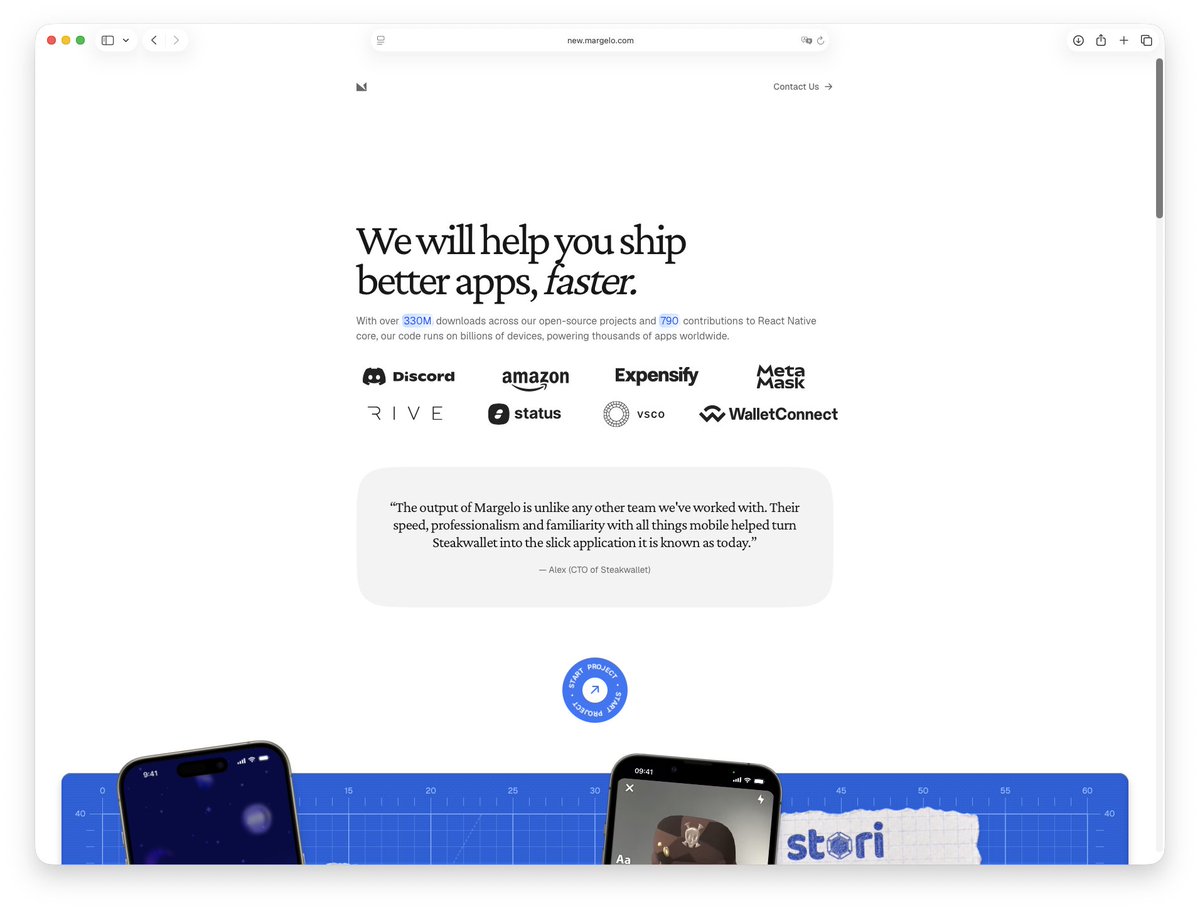
Introducing the @margelo_com design team. ✨
We spent the last year quietly assembling an S-tier crew and collaborating with a few select clients.
Now, we’re ready for more!
→ [email protected]
@mironcatalin It's still too early to use, but good enough to confirm the idea of steady 60fps lists in RN. I'd appreciate help from anyone familiar with fabric here: https://t.co/JkuiZxeBp0
Thanks for the shoutout!