Professor Diabaté of #TargetMalariaBurkinaFaso was named one of the Personalities of the Year by BF1 Télévision @bf1tv for receiving the prestigious @Falling_Walls Science & Innovation Prize 2023.
Congratulations to Prof. Abdoulaye Diabaté!
Watch here⬇️
https://t.co/UJc45YjDc7
The 2nd Health Geography Symposium started today. This event is the @IGUhealth annual online symposium to facilitate exchange and discussions. #HGS2023 Much success to all presenters
Cool! Contrary to rumors, Bill Gates has not released genetically modified mosquitoes in Africa.
~
His involvement, through the Bill and Melinda Gates Foundation, is in providing substantial funding for health research, including malaria control. However, Decisions on using genetically modified mosquitoes ultimately rest with the individual countries. African scientists and technology developers are working jointly, transparently and conscientiously to evaluate and address concerns related to these new technologies
Here are examples of groups currently involved in the scientific evaluation of genetically modified mosquitoes in Africa.
~
Target Malaria (https://t.co/PB79XIIxY4) is a project aimed at reducing malaria-transmitting mosquito populations in sub-Saharan Africa, with operations in countries like Uganda and Burkina Faso. @TargetMalaria
~
Transmission Zero (https://t.co/D6EHpSYBU6) focuses on genetically modifying malaria mosquitoes to prevent disease transmission, with Tanzania as its primary African partner. This group successfully created the first ever genetically modified mosquito in Africa. @transm0
~
The Stop Malaria (https://t.co/MydfJLcluj), a project of the University of California Malaria Initiative. Aims to modify malaria mosquitoes to halt transmission, partnering mainly with The Democratic Republic of São Tomé and Príncipe.
~
Additionally, Oxitec (https://t.co/4rzmnkqaH5) works on controlling the invasive Asian malaria mosquito (Anopheles stephensi), which has recently invaded Eastern Africa, including Kenya, to prevent its spread to urban areas. Their focus is currently in Djibouti city. @Oxitec
Separate from malaria, the World Mosquito Program (https://t.co/ddIp6ncIcx) uses Wolbachia bacteria in dengue mosquitoes to reduce infections. This program, which started in Australia and contributed to the elimination of dengue there, has significantly reduced dengue cases in countries like Colombia and Indonesia @WMPglobal
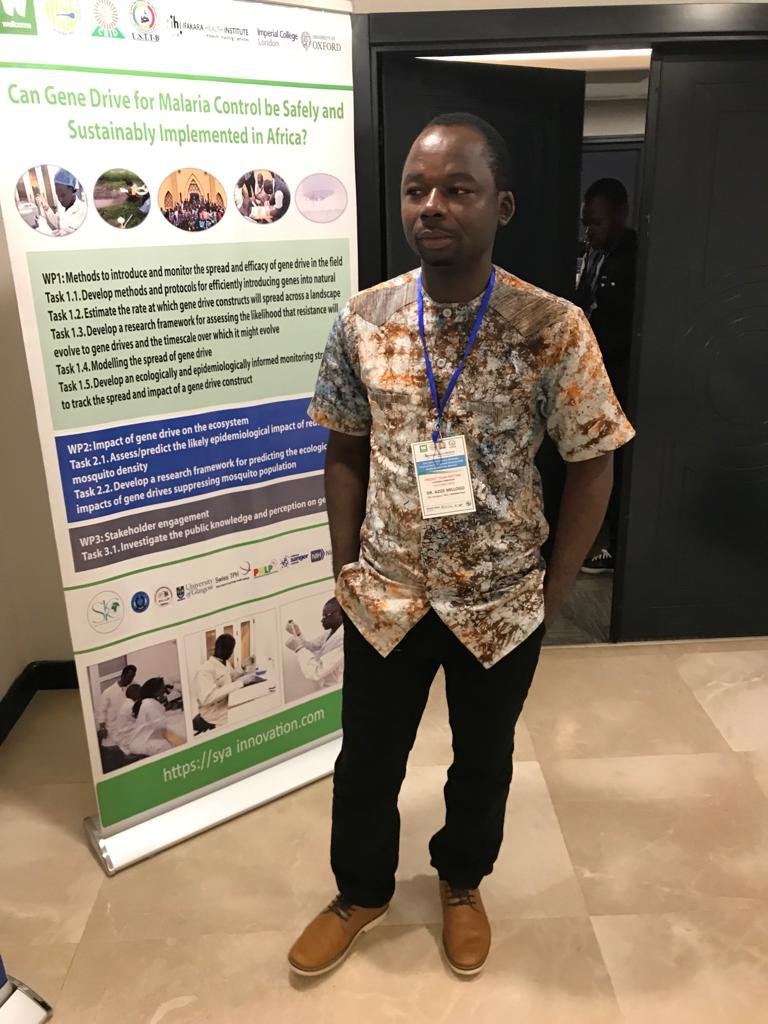
Presenting "How GIS supports entomology surveillance system ?" in the framework of WellcomeTrust Consortium on Safe and sustainable implementation of Gene Drive for Malaria Control in Africa.
@cam_crid@maigahamid@Fredros_Inc@Diabate17699096@IrssF💪
Nous souhaitons aux membres de notre équipe, à nos partenaires, à nos parties prenantes et à ceux qui nous suivent à travers le monde un #Ramadan heureux et paisible 🌙