🚨BREAKING: AI just killed Tableau & Power BI.
Forget hours wasted in creating manual dashboards.
I found an AI tool that turns any CSV, Excel, or PDF into a live dashboard instantly.
Here's how you can turn raw data into a live dashboard in seconds with AI:
Top 10 Tools for Creating AI influencers in 2025:
1. https://t.co/nRj2xkiWs2 – Viral Influencer
2. https://t.co/q5eWywZxTg – AI Avatars
3. https://t.co/G9mU7c6nbs – Face Swap
4. https://t.co/aF34re7rIw – Video Avatars
5. https://t.co/UKYMZhIhm3 – Talking Photos
6. https://t.co/NKZAFw5gQY – Digital Humans
7. https://t.co/ZI6dL6Ij2s – AI Presenters
9. https://t.co/T1FIqfQrPH – AI Models
10. https://t.co/CCnE82X3oZ – AI Characters
Follow @I_Muhammadali44 for more
BREAKING: AI just killed Excel.
Forget about formulas, filters, and endless spreadsheets.
One prompt in → organized, ready-to-analyze data out.
Here’s how to streamline your data in seconds:
🚨BREAKING: You can use all the top AI video generators in one place.
Veo, Kling, Minimax, PixVerse ,all unlocked.
No multiple subscriptions. Just prompting
Here's how VEED’s AI Playground works: 👇
Emergent 2.0 is unreal
From idea → full stack + mobile app in 10 mins
Just describe what you want - and it builds it
Here are 7 creations that blew me away:
🚨BREAKING: AI can now read, watch, and explain everything for you.
It reads your PDFs, watches YouTube videos, drafts contracts, and even answers your follow-up questions better than you could.
Let me show you how ↓
🧵 It's funny and painful to watch so-called Canadian elites argue about something they know little about. Not to mention #1 goal being to GASLIGHT all the time, 24-7.
Here's what really happened with Canadian inflation and government. PLEASE share with anyone who's GASLIGHTING anyone.
In 2024, Trump said about tariffs:
It is "the most beautiful word in the dictionary."
Today, 'Liberation Day' - tariffs begin.
Canada, China, and the EU are preparing devastating 25% counter-strikes.
Here's what the next 12 months look like for America, and your wallet:🧵
The American empire isn’t ending—it’s evolving.
Beneath the chaos is a fast, unorthodox, and deliberately under-explained strategy to reshape the U.S. role in a multipolar world. Tariffs, geopolitics, alliances—none of it’s random. It’s a new kind of statecraft. Let’s unpack it.
As for a monetary-military basis of "empire," I believe this depends on the point in history you go to. The U.S. "empire" very much rose on the might of manufacturing exports—being the post-war factory of the world. The idea of a purely financial empire has some truth, but it isn’t the full blueprint of American power.
A monetary-military strategy can be traced to 1971, accelerating through asset bubbles in 2000, 2008, and Covid. It's fair to argue that the limits of that model have now been reached. There’s a ceiling to financialized growth—and it was overdue for those steering the ship to realize this and course correct.
I don’t think the MAGA blueprint mirrors the Russian post-USSR strategy. The MAGA strategy may appear incoherent because of the execution speed and the lack of an articulated vision (possibly by design). But there is a complex, unorthodox policy rationale—which is also why it draws so much flak from the old guard.
In this model, the first step is redrawing America’s geopolitical and economic role to reflect today’s true flashpoints and imbalances. That explains the upheaval, the new alliances, and the resets being attempted through tariffs and trade. The Triffin dilemma is now coming to roost, and the decision is to not run a trade deficit which "exports industry" but to balance trade and reshore.
The second key move: if trade can be reset to reshore industry, currency devaluation becomes a lever to offset price rises. But this hinges on two things:
- Tariffs staying under ~20%
- A sufficient industrial base being rebuilt in the U.S.
Even if tariffs are managed, reshoring will take time. To fast-track it, a revolutionary scale of industrial policy would be needed. And then comes the labor challenge—where an AI-centered industrial strategy could be decisive. I’ll share more on that soon.
I don’t believe the U.S. is letting go of empire. I believe it’s regrouping—redrawing its tools to stay effective in a changed game. The old levers (Bretton Woods institutions, the UN, etc.) no longer shape the world as they once did. The world is now truly multipolar.
The previous trajectory was unsustainable. Financial and military power were overstretched, risking collapse from within—whether through military defeat or institutional failure. More importantly, trust in the ruling class was eroding—where true destabilisation of empires always begins.
There’s a real effort underway to sustain American dominance beyond its sunset phase. The real challenge: how much of this can be done in four years? And how many bold moves can actually land in this year?
Where I agree with you: angering allies complicates the path—not because the reset is wrong, but because a full-blown tariff war and geopolitical strain could break the fragile calculations behind making this work.
But if it holds, America may not be fading. It might just be shifting toward a very different kind of dawn.
Trump’s new tariffs aren’t a trade tweak—they’re the first move in a full-spectrum reset.
$9.2T in debt matures in 2025. Inflation lingers. Alliances are shifting.
One announcement just set a dozen wheels in motion.
Here’s what’s really happening—and why it matters 🧵
DeepSeek is omega-bullish for Bitcoin.
Nasdaq is crashing pre-market and taking Bitcoin down with it.
But this is a temporary correlation.
The narrative is that Deepseek is exposing just how overvalued US tech stocks are.
On the eve of an AI and robotics revolution, US equities seemed like the best game in town...
But if Chinese companies can produce similar innovation at a fraction of the cost, what does that say about US tech valuations?
In my opinion, this will likely end up being a temporary sentiment reset.
Similar to the Yen carry trade or "war in the middle east" panic that served to shake out weak hands before the bull run could continue.
But here's the bigger picture:
We are headed into an era of unprecedented technological innovation.
And businesses that look like sure winners one day WILL end up being disrupted overnight.
Storing your value in equities will end up being a more and more dangerous game.
This Deepseek shock should serve as a wake up call to anyone who is planning on storing their life's savings in equities over the next decade.
Can you count on the businesses that you own not to be disrupted overnight?
Which businesses will be able to maintain their advantage in an age of cheaper and cheaper AI & robotics?
"well that's why I buy indexes"
When you buy the Nasdaq, you're betting on the USA. But what if China eats their lunch?
Or the US rapidly devalues the currency in which the Nasdaq is denominated?
These are difficult questions to answer.
And they highlight the problem we all face: Where to store our value for the long-term.
Bitcoin is the solution to the store of value problem.
Bitcoin will not change.
Bitcoin will not be disrupted.
And It cannot be seized or debased.
In an era of rapid change, Bitcoin's boring predictability is its biggest strength.
Finite supply, new block every ~10 minutes, and a security network tied to real-world energy expenditure that cannot be replicated.
Equities are an artifice built upon the shifting sands of the market, vulnerable to the tremors of creative destruction.
Bitcoin is the solid bedrock on which you want to build your financial future.
This idea is far from understood, and even further from being priced in.
Equities are still THE consensus store of value.
But I expect to see more and more investors conclude that the coming technological revolution requires a new approach to storing value.
History is full of example of investor consensus changing.
Investors used to store value in savings accounts, gold bars, war bonds, etc.
The best ideas of previous eras always end up looking silly in the future.
I think the idea of blindly investing in equity indexes will ultimately be seen as a stepping stone on the journey to finding the ultimate store of value asset.
The best we had until Bitcoin.
Let global companies rapidly innovate and drop prices for everyone.
This should be something we celebrate - not fear because it disrupts equity markets and takes down our store of value assets.
Hold Bitcoin, celebrate creative disruption, and get outside ✌️
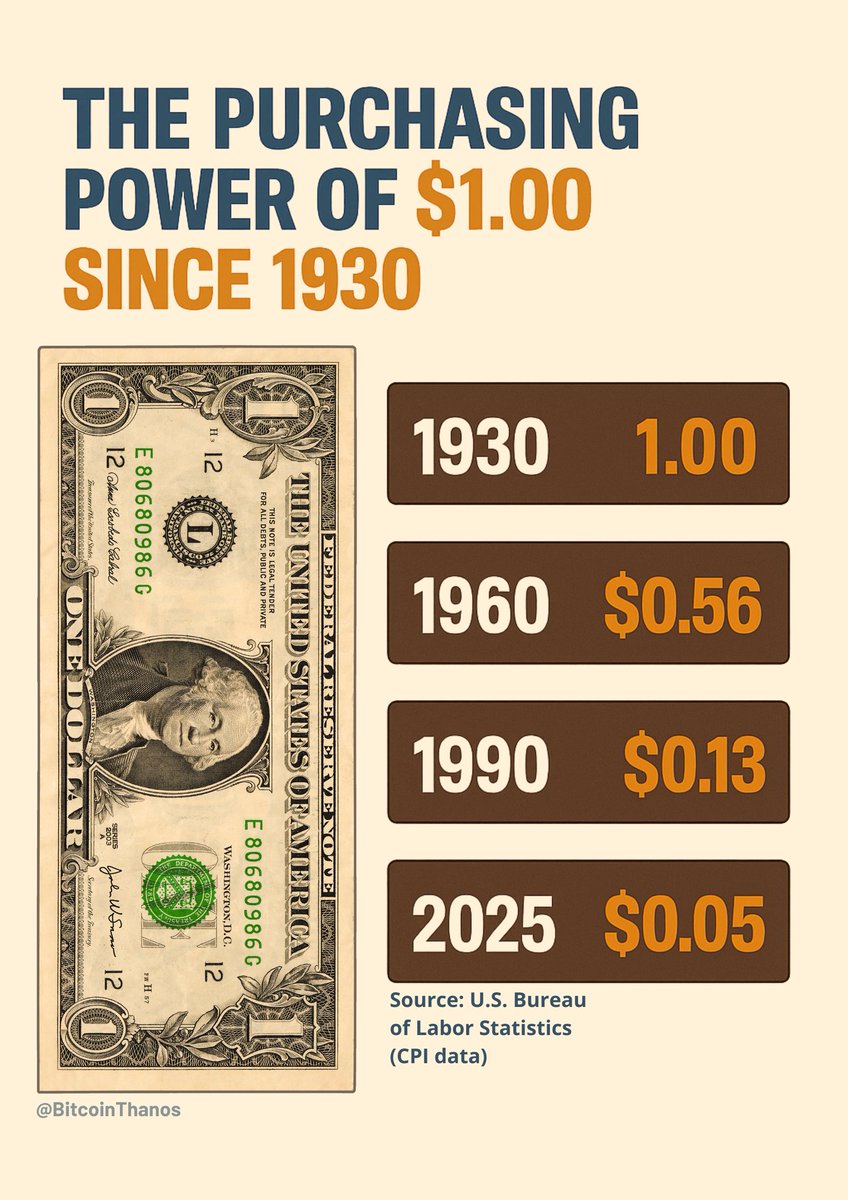
So why don't incomes keep up with groceries, rent, real estate and life?
This isn't the whole answer but it's absolutely a large part of it and very few understand what's going on ... let's get to it:
Incomes are close to very LAST to access new money in the economy.
New money is created with debt.
Things that are closest to this new debt creation get the money first and benefit first...
...think real estate via all the new mortgages (aka, new debt).
There's a lot of new debt in the real estate industry and it "benefits" from the new money early.
Real estate sales people benefit. Real estate prices go up first and fast. Real estate developers benefit etc. etc.
And when interest rates are low guess where new money is created first and fastest? Yup, real estate.
Is there a lot of new debt being created in the payroll department of your company?
Not so much.
Incomes don't get access to any new money very quickly at all.
There are other factors at play here. Global labour force competition driving down wages, movement of higher income industries out of the West etc. etc.
But it doesn't change the fact that most incomes are just not closest to any new money.
Bankers are of course.
Finance types are close to new money.
Real estate people of all sorts are.
Anyone selling anything with a lot of access to new "credit" for the purchases are also close to new money.
The bottom line is this...
The closer you are to the new money creation process the faster you benefit and the more likely you are to keep up with the cost of life.
The further you are away from the creation of new money the more you lag behind.
Fair? Nope.
True? Yes.
Most salary's are very far away from the creation of new debt so they naturally lag in their growth.
This is the way the system works.
When rates are low new money comes in via mortgages and real estate pumps first.
When cheques are mailed out to everyone (or direct deposited) because of "pandemic relief" then consumer goods, like groceries, get access early and retail prices climb fast and first.
Track where the new money is entering the economy and the people closest to that new money are likely "getting ahead".
It's not right but it's the way this economic system works.
When bankers and politicians can wave their magic wands and create new money out of thing air they benefit first.
Unfortunately not everyone has this magic money wand.
But there is a new magic emerging.
A new money that cannot be created with a magic money wand.
It's magic in it's own right though.
Magic internet money.
It's finite in its supply.
It's global.
It's open to all.
It's permissionless
It's beautiful.
You can take ownership of it yourself directly.
It's called Bitcoin.
If you slowly move into this new network your money cannot be debased by new debt. It cannot be debased at all.
You are now back in control.
It's a very liberating thing.
Check out the Bitcoin network protocol. And the best part is you can own some of it yourself.
Instead of dismissing Bitcoin, change your perspective.
Bitcoin is a chance at freedom.
How close are you to the money?
Fix the money, fix the world.
I hadn’t planned to share this conversation, but it’s just too good to keep private. @JeffBooth gave me a brilliant, private Masterclass on inflation, deflation, and the problem Bitcoin solves. It completely transformed the way I think about these concepts, and I know it will do the same for you.
This is a must-watch — one you’ll want to bookmark and share with friends.
Timecodes:
00:00 I'm writing a book
1:54 Producitivity growth drives deflation
3:42 Explaining inflation
10:07 Natural state of free market is deflation
13:23 Why do some prices go up?
15:53 Why do prices drop?
18:26 History of inflation
28:45 Business cycles explained
32:54 Inflation is a lie
35:58 Examining inflation
38:48 Home prices and affordability
45:59 Bringing people out of poverty
46:39 Attacking the wealthy
52:31 US Dollar value
56:09 Inflation is wage deflation
58:22 Why don't companies pay more?
1:00:51 Quality of goods and services
1:03:41 Bitcoin as money
1:07:36 Does centralization mean confiscation?
1:09:04 Bitcoin and the US debt
1:09:49 Strategic Bitcoin Reserve