Google just launched a direct attack on Nvidia's most valuable asset.
Not their chips. Their SOFTWARE.
And if this works, Nvidia's $4 trillion empire collapses.
Here's what just leaked:
Google is building "TorchTPU" - a secret project that makes PyTorch seamlessly run on Google's TPU chips instead of Nvidia GPUs.
Why does this matter?
PyTorch is the MOST USED AI framework on Earth. Every AI developer uses it.
And PyTorch was built around Nvidia's CUDA software.
Wall Street analysts call CUDA "Nvidia's strongest defensive wall."
It's the reason companies can't easily switch away from Nvidia even when alternatives exist.
You don't just buy Nvidia chips. You buy into their entire ecosystem.
Switching costs MILLIONS in engineering work. Months of rewrites. Performance drops.
So companies stay locked in.
Even when Nvidia raises prices. Even when supply runs short.
That's not a hardware moat. That's a SOFTWARE prison.
And Google just found the escape route.
Here's the problem Nvidia created for itself:
Google's TPU chips are actually GOOD. Competitive performance. Better availability. Lower cost.
But developers won't use them because Google's chips run JAX (Google's internal framework), not PyTorch.
That means if you want to use Google TPUs, you have to rewrite your entire codebase.
Nobody wants to do that.
So Google TPUs sit unused while developers fight over Nvidia chips.
Until now.
TorchTPU makes PyTorch run natively on Google hardware.
No rewrites. No performance loss. No months of engineering.
You just... switch.
And Google is partnering with META (who built PyTorch) to make it happen.
They're even considering OPEN-SOURCING parts of it to speed adoption.
Translation: Google is willing to give this away for free just to break Nvidia's lock.
The implications are insane:
Every company currently paying Nvidia's premium prices suddenly has a way out.
Oracle, Microsoft, OpenAI - all locked into Nvidia's ecosystem - can switch to Google.
Nvidia's pricing power evaporates overnight.
And the timing is perfect:
Nvidia is already facing heat. Semiconductor index dropped 3% today.
Oracle just lost their biggest investor over AI spending concerns.
Companies are realizing AI infrastructure costs are unsustainable.
Now Google hands them an alternative. Same performance. Lower cost. Better availability.
Jensen Huang knows exactly what this means.
CUDA has been Nvidia's untouchable advantage for YEARS.
It's why Nvidia trades at 50x earnings while AMD trades at 25x.
The software moat justified the premium.
But if Google removes that switching cost?
Nvidia becomes just another chip company.
And chip companies compete on price, not ecosystem lock-in.
Here's what happens next:
Google needs 12-18 months to make TorchTPU production-ready.
If it works, cloud providers will adopt it instantly. They WANT an alternative to Nvidia's monopoly pricing.
Amazon already building their own Trainium chips. Microsoft making Maia.
They're all trying to escape Nvidia. Google just gave them the software bridge.
Nvidia's response options are limited:
They can't buy Google. Can't kill PyTorch (Meta owns it). Can't stop open source.
Their only play is to keep improving CUDA faster than Google can catch up.
But that's a race, not a moat.
The market isn't pricing this in yet.
Nvidia down 2% today. Google down 2%.
Investors think this is just "another competitor."
They don't understand this is an attack on the FOUNDATION of Nvidia's valuation.
Hardware is replaceable. Software lock-in is what made Nvidia worth $4 trillion.
Google is attacking the lock-in.
Watch what happens in 2026 when TorchTPU goes live and companies realize they can actually leave Nvidia.
The "Nvidia is unstoppable" narrative dies.
And a $4 trillion valuation built on software moats gets repriced.
BREAKING: The $300 Billion Trap Nobody Saw Coming
Two companies that have never turned a profit just signed the largest technology contract in human history.
Oracle's credit default swaps hit 141 basis points this week. The highest since Lehman Brothers collapsed in 2008. Trading volume exploded to $9.2 billion in ten weeks versus $410 million last year.
The credit markets are screaming what equity markets refuse to hear.
Here is what they see:
Oracle committed $300 billion over five years to build AI infrastructure for OpenAI. OpenAI's current revenue is $13 billion. The contract requires $60 billion annually starting 2027. OpenAI must grow revenue fivefold in two years just to pay one vendor.
Oracle's free cash flow turned negative $10 billion last quarter. Barclays warns cash could be exhausted by November 2026. Morgan Stanley explicitly recommends buying protection against Oracle's debt.
But here is the part that should terrify you:
Nvidia invests in OpenAI. OpenAI uses the money to buy Nvidia chips through Oracle. Oracle uses the payments to service debt and buy more Nvidia chips. Revenue flows back to Nvidia.
The serpent eats its own tail.
SoftBank sits at the center with $113 billion in commitments and only $58.5 billion in funding capacity. A $54.5 billion hole that must be filled somehow.
Meanwhile, MIT found 95% of organizations see zero return on investment from generative AI. McKinsey reports 8 in 10 companies show no bottom line impact.
The entire structure depends on AI adoption materializing at unprecedented scale within 36 months.
If it does not, the failure cascades everywhere simultaneously.
There is no government bailout coming. The White House confirmed it this month.
This is capitalism's stress test.
The canary in the coal mine just stopped singing.
Read the full article here - https://t.co/83RGvK0SYs
The Non-Bubble that disappointed both Bulls and Bears -- how Sam's Splurge changed everything
The worst kept secret among Tech market participants — just something AI bulls don’t admit out loud: they want a price-action bubble every bit as much as the bears do.
Both want to see that steep, “blow-off” ascent that characterizes parabolic tops. Why? The AI bulls are all fully loaded for a vertical melt-up and AI bears want the aftermath so they can yell “I told you so.”
It’s obvious to AI bulls (us included) that we’re not in an AI bubble. The non-argument is simple: valuations are reasonable (NVDA near 20x), the equity risk premium is almost 300bps above where it troughed in the tech bubble, operating margins are rich, and we’re still very early in the demand/build out of the AI supercycle.
But bulls will typically follow this argument up by saying “‘it’s more like ‘97/’98.”
Implicit in that statement is that they’re hoping the inevitable outcome is a ‘97-’99 style ramp, with all hoping it would occur as soon as possible. Why? The simplest answer is usually the right one: everyone likes bigger bonuses as soon as possible.
Stated succinctly: the “AI bubble” ascent was the paradigm that both bulls and bears were operating under for most of this year, or longer.
Bad news for the AI bulls and bears: the past few weeks has brought an end to that paradigm and led us to an unexpected turning point in the dynamics of the AI trade/narrative. On the 3 year anniversary of ChatGPT’s release, no less.
And we have Sam’s $1.4T 30GW splurge to thank for it.
Sam’s Splurge (we’ll call it “SS”) opened up AI “pandora’s box,” shifting the AI narrative in unexpected ways.
First, the overarching discussion has shifted to a greater focus on OAI’s ability to monetize and what that means across the Tech ecosystem, from ad platforms to software/services companies to GPUs to infra hosting like ORCL. Despite the behemoth it already is, the market began to appreciate it was taking implicit bets on what is still a 3 year old start up industry/company.
Second, SS and connected deals brought more focus to the interconnectedness of the whole ecosystem, OAI’s outsized role in it, circular financing, and “too big too fail” discussions.
The interconnectedness of the AI ecosystem📷
Third, SS and his “Give us a few months and it’ll all make sense … We are not as crazy as it seems. There is a plan.” opened up discussions about government’s role in AI. While government intervention would help accelerate the AI buildout, it also opened a doorway of investor doubt. Reader CIO At CG expressed these opposite outcomes well in TMTB Chat:
“It’s bullish if/when it happens. But until it happens it creates doubt if it is gravy (more upside) or if it’s needed to execute the 1trn+ commitments. Any doubts on ability to execute the 1.4trn is just bearish sentiment vis-à-vis today. So Friar opened a door that was closed. And by opening it, it opened both the left and right side of the distribution. It also makes people realize that they are too big to fail: if they fail to execute they will bring the entire ecosystem multiple down. And hard.”
Fourth, the sheer scale of the SS $1.4T plan, which is nearly the size of the whole private credit market, nudged both public and private lenders to reprice AI-linked risk, most notably seen in the rise of Oracle and Coreweaves’ CDS spreads. At the same time, off-balance-sheet structures—e.g., Meta’s $27B Hyperion SPV with Blue Owl— didn’t help by concentrating risk with private creditors and muddying system-wide leverage mapping.
The ironic thing is, if SS would have been half the size, things would have continued to grind along, investors would have enjoyed the ‘27 and ‘28 visibility, maybe even building the energy for a large vertical ascent in price action. Instead, it had the opposite effect: pouring too much gasoline on the fire and drowning out the energy for a big move up.
Fifth — by locking in commitments eight years out, SS dragged the long-horizon AI debate into the present. Over the last few weeks I’ve heard an increasing amount of bulls give voice to risks they’ve been able to normally wave away over the first 3 years of the AI trade, in an unusual sign of humility. Some of the key existential questions that now feel more present in the discussion:
How does the grid support the post-’28/’29 buildouts and what about water, land use, and local pushback? We’ve already heard of local governments slowing DC buildouts, and this week the WSJ wrote how Bernie and others are dialing up scrutiny of Data CentersIf inference moves to phones/PCs/cars, how does that rebalance hyperscaler capex, useful life assumptions, and who captures value? What’s the risk of stranded assets if models plateau or workloads shift to cheaper/edge solutions?The AI catch-22 no bulls want to talk about: If enterprise agents and automation work as advertised, what’s the path for unemployment and wages? If white-collar unemployment rises, what happens to ad spend and consumer wallets — remembering that GOOGLE and META are cyclically exposed ad businesses at their core? How does the seep into their top line and capex trajectory? If AI models don’t deliver, do we get a capex hangover and productivity disappointment?All of this sits against a U.S. backdrop that’s still skeptical of AI — worried about job loss and asking for a slower, safer rollout — which can swing sentiment and policy quickly. Will the current administration still be as supportive of the AI rollout if sentiment and unemployment shift in a more negative direction?
These are issues that will be a lot more prominent in the next 3 years of the AI trade than they were in the first 3 years of the AI trade.
This all began to seep into the price action of AI stocks several weeks ago: ORCL giving back all of its “monster RPO” move and more, very speculative sectors like Nuclear/Quantum rolling over, and the AI ecosystem progressively rallying less and less on each Open AI deal that was announced.
It all culminated in the last two weeks. We can give thanks to some hawkish fed speak and Sam’s now infamous BG2 pod appearance for providing the spark needed to ignite the fire spreading. In a period of time where nothing has changed fundamentally in respects to the AI trade, the market began more heavily digesting the overarching effect of SS: more unknowns and more uncertainty in the minds of investors. After all, the market isn’t just a mechanism for discounting fundamentals and perceived risk, but also the current emotional state of participants. With belief shifting from inevitable euphoria (read: vertical ascent price action) to verification, SS has had the opposite effect of what Altman likely intended: more multiple compression and less belief in out year estimates.
With greater uncertainty, it’s no wonder certain pockets of the market have underperformed: names with perceived questionable business models / debt issues (ORCL, CRWV, NBIS, Miners, etc.), names with perceived AI top of funnel / structural issues (DUOL, MNDY), names with rising opex as the market is less confident in how long heightened spend will be here to stay (META).
It’s also no surprise that as the market digests these new developments, the profitability factor has outperformed while names with good narratives and fast growth but little in the way of valuation support have underperformed: NET, PLTR, SHOP, TSLA, U. This is also why memory has been so strong: EPS revisions are currently happening —> there’s nothing uncertain about opening up your favorite DRAM/NAND spot price checker, seeing how much DRAM/NAND has risen overnight, and plugging it into your model. These names are arguably more attractive in the current environment than they were before.
The market is currently doing what it always does after a narrative/paradigm shock: digest, recalibrate, reassign risk premia. NVDA EPS and Gemini 3 are the next events on the docket to absorb. We’re running low gross while we let the market do its thing, letting the overarching narrative/price action stabilize and become clearer.
@dylan522p at Semianalysis joked this week that time is now divided in BC (Before ChatGPT) and AD (After Da Launch of ChatGPT). We think the AI trade will eventually be divided between BSS (Before Sam’s Splurge) and ASS (After Sam’s Splurge). BSS and ASS.
Wait - that doesn’t have a nice a ring to it, so let’s say it differently. We think the straight-line giddy phase of the AI trade will give way to something healthier: a phase where fundamentals and idiosyncrasies matter even more. Tech will always be a narrative and boom and bust heavy investing sector (that’s part of the fun), but in a landscape where sentiment is more balanced, stock-picking will become more relevant. That’s a good thing.
SS popped the non-bubble. But the AI trade isn’t broken: it’s simply entering a more mature, scrutinized phase.
Many famous investors including Warren Buffett, Bill Ackman and a bunch more just updated their portfolios
Here's what their portfolios looked like as of the end of Q3 (A thread🧵⬇️)
Warren Buffett 🐐 and Berkshire Hathaway:
I would like to clarify a few things.
First, the obvious one: we do not have or want government guarantees for OpenAI datacenters. We believe that governments should not pick winners or losers, and that taxpayers should not bail out companies that make bad business decisions or otherwise lose in the market. If one company fails, other companies will do good work.
What we do think might make sense is governments building (and owning) their own AI infrastructure, but then the upside of that should flow to the government as well. We can imagine a world where governments decide to offtake a lot of computing power and get to decide how to use it, and it may make sense to provide lower cost of capital to do so. Building a strategic national reserve of computing power makes a lot of sense. But this should be for the government’s benefit, not the benefit of private companies.
The one area where we have discussed loan guarantees is as part of supporting the buildout of semiconductor fabs in the US, where we and other companies have responded to the government’s call and where we would be happy to help (though we did not formally apply). The basic idea there has been ensuring that the sourcing of the chip supply chain is as American as possible in order to bring jobs and industrialization back to the US, and to enhance the strategic position of the US with an independent supply chain, for the benefit of all American companies. This is of course different from governments guaranteeing private-benefit datacenter buildouts.
There are at least 3 “questions behind the question” here that are understandably causing concern.
First, “How is OpenAI going to pay for all this infrastructure it is signing up for?” We expect to end this year above $20 billion in annualized revenue run rate and grow to hundreds of billion by 2030. We are looking at commitments of about $1.4 trillion over the next 8 years. Obviously this requires continued revenue growth, and each doubling is a lot of work! But we are feeling good about our prospects there; we are quite excited about our upcoming enterprise offering for example, and there are categories like new consumer devices and robotics that we also expect to be very significant. But there are also new categories we have a hard time putting specifics on like AI that can do scientific discovery, which we will touch on later.
We are also looking at ways to more directly sell compute capacity to other companies (and people); we are pretty sure the world is going to need a lot of “AI cloud”, and we are excited to offer this. We may also raise more equity or debt capital in the future.
But everything we currently see suggests that the world is going to need a great deal more computing power than what we are already planning for.
Second, “Is OpenAI trying to become too big to fail, and should the government pick winners and losers?” Our answer on this is an unequivocal no. If we screw up and can’t fix it, we should fail, and other companies will continue on doing good work and servicing customers. That’s how capitalism works and the ecosystem and economy would be fine. We plan to be a wildly successful company, but if we get it wrong, that’s on us.
Our CFO talked about government financing yesterday, and then later clarified her point underscoring that she could have phrased things more clearly. As mentioned above, we think that the US government should have a national strategy for its own AI infrastructure.
Tyler Cowen asked me a few weeks ago about the federal government becoming the insurer of last resort for AI, in the sense of risks (like nuclear power) not about overbuild. I said “I do think the government ends up as the insurer of last resort, but I think I mean that in a different way than you mean that, and I don’t expect them to actually be writing the policies in the way that maybe they do for nuclear”. Again, this was in a totally different context than datacenter buildout, and not about bailing out a company. What we were talking about is something going catastrophically wrong—say, a rogue actor using an AI to coordinate a large-scale cyberattack that disrupts critical infrastructure—and how intentional misuse of AI could cause harm at a scale that only the government could deal with. I do not think the government should be writing insurance policies for AI companies.
Third, “Why do you need to spend so much now, instead of growing more slowly?”. We are trying to build the infrastructure for a future economy powered by AI, and given everything we see on the horizon in our research program, this is the time to invest to be really scaling up our technology. Massive infrastructure projects take quite awhile to build, so we have to start now.
Based on the trends we are seeing of how people are using AI and how much of it they would like to use, we believe the risk to OpenAI of not having enough computing power is more significant and more likely than the risk of having too much. Even today, we and others have to rate limit our products and not offer new features and models because we face such a severe compute constraint.
In a world where AI can make important scientific breakthroughs but at the cost of tremendous amounts of computing power, we want to be ready to meet that moment. And we no longer think it’s in the distant future. Our mission requires us to do what we can to not wait many more years to apply AI to hard problems, like contributing to curing deadly diseases, and to bring the benefits of AGI to people as soon as possible.
Also, we want a world of abundant and cheap AI. We expect massive demand for this technology, and for it to improve people’s lives in many ways.
It is a great privilege to get to be in the arena, and to have the conviction to take a run at building infrastructure at such scale for something so important. This is the bet we are making, and given our vantage point, we feel good about it. But we of course could be wrong, and the market—not the government—will deal with it if we are.
Why I Think Michael Burry Is Shutting Down Scion Now
Let’s put a few things together…Burry’s liquidation letter, his depreciation thread on the hyperscalers, and his “me then, me now” Big Short meme and he’s basically spelling out one story.
He thinks we’re in an earnings inflated, AI driven bubble that a value investor can’t sit inside without eventually getting crushed.
In the letter he says it plainly “My estimation of value in securities is not now, and has not been for some time, in sync with the markets.” That’s not a I’m tired of running money line. That’s a man saying, I can’t reconcile what I see in the numbers with the prices the market is willing to pay. When someone like Burry reaches that point, the logical move isn’t to keep collecting fees and hope it mean reverts. It’s to get out of the structure that forces you to play the game at all.
Then you look at his post on depreciation. He’s saying the biggest beneficiaries of the AI boom that includes META, GOOG, ORCL, MSFT, AMZN of juicing earnings by quietly stretching the useful life of servers and GPU rigs that are really on a 2–3 year technology cycle. Extend the life in the accounting model, and you cut today’s depreciation expense. Cut depreciation, and EPS looks 20–30% higher than it would under a stricter assumption. He’s saying that the market is paying premium multiples on numbers that are, in his view, structurally overstated.
Put that together with the “me then, me now… it worked out, it will work out” post, and he’s clearly casting himself as the same guy who sat in front of a wall of subprime prospectuses in 2005. Back then, he saw engineered AAA paper built on bad collateral. Now he sees trillion dollar market caps built on AI capex and accounting choices he thinks will blow up 2026–2028 as the depreciation math reverses.
SO WHY SHUT DOWN SCION NOW? MY HIGHEST PROBABILITY READ IS THIS
He expects a major repricing in the very stocks that dominate the indices and he doesn’t want to live through the last, craziest stretch of the bubble with other people’s money tied to his name.
If he’s right about the under depreciation, then over the next few years earnings growth for the hyperscalers should slow sharply or even go negative just as the AI narrative cools and the cycle matures. When that happens, multiples compress, passive flows that are overweight those names work in reverse, and the broad market takes a hit because the “Magnificent Few” are the market. From his perspective, that looks less like a normal correction and more like the equity version of the housing unwind: a long stretch of fake comfort, then a sharp break when the math can’t be hidden anymore.
Closing the fund accomplishes a few things at once. It lets him step aside before that break, so he’s not fighting client redemptions or daily benchmarking while he’s trying to hold deeply contrarian positions. It frees him to short or sit in cash on his own terms, without regulators and LPs looking over his shoulder. And it sends a signal: if valuations are this disconnected from what he thinks the true earnings power is, the most honest thing he can do as a fiduciary is hand back the money and say, I don’t want you in this.
So, in my view, he’s not walking away because he’s done with markets. He’s stepping off the stage because he thinks the show has turned into something he’s seen before: a late cycle mania, powered by flattering models and aggressive accounting, that ends with a long, grinding reset in stock prices especially at the top of the index. @michaeljburry
A really insightful interview with a Former $GOOGL Cloud employee on TPUs:
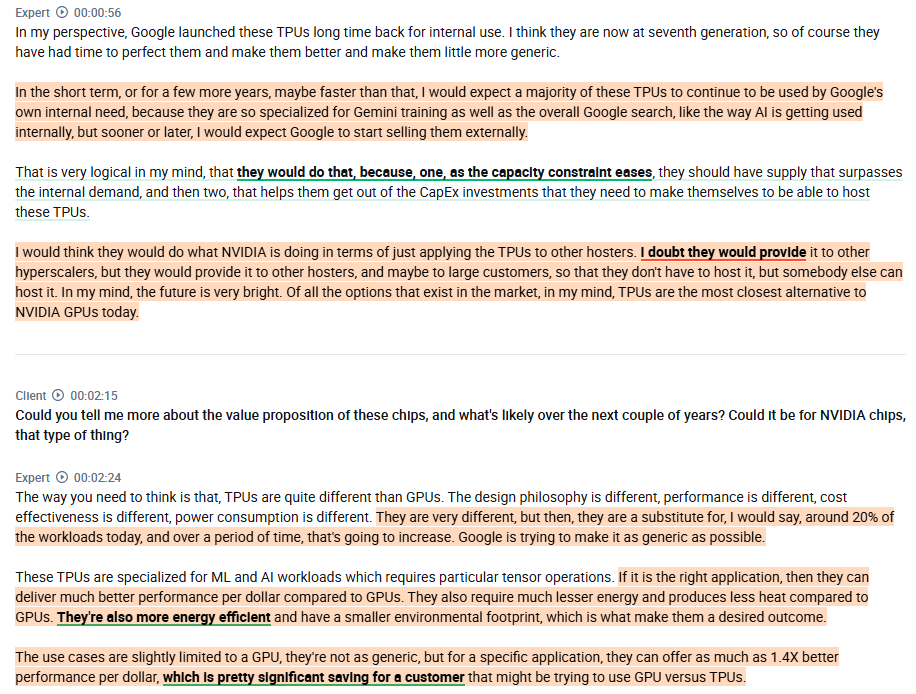
1. In the short term, he expects that TPUs will continue to be used by $GOOGL's own internal needs (Gemini, Search, etc.), but sooner or later, he expects $GOOGL to start selling them externally.
2. He thinks the strategy will be similar to $NVDA, where $GOOGL would apply TPUs to other hosters (not hyperscalers). In his view, out of all the options on the market today, TPUs are the closest alternative to $NVDA GPUs.
3. TPUs and GPUs are very different; they are a substitute for around 20% of the workloads today, and over time, he expects that to increase. $GOOGL is trying to make it as generic as possible.
4. TPUs are specialized for ML and AI workloads, which require particular tensor operations. In the right application, they can deliver significantly better performance per dollar compared to GPUs, requiring much less energy and producing less heat. They are also more energy efficient and have a smaller environmental footprint. For a specific application, they can offer as much as 1.4x better performance per dollar vs a GPU.
5. He mentions that some clients already use TPUs on $GOOGL Cloud, but those are mostly super sophisticated and super large. For an average customer to use them, $GOOGL will have to do a lot of work so that a third party can host it.
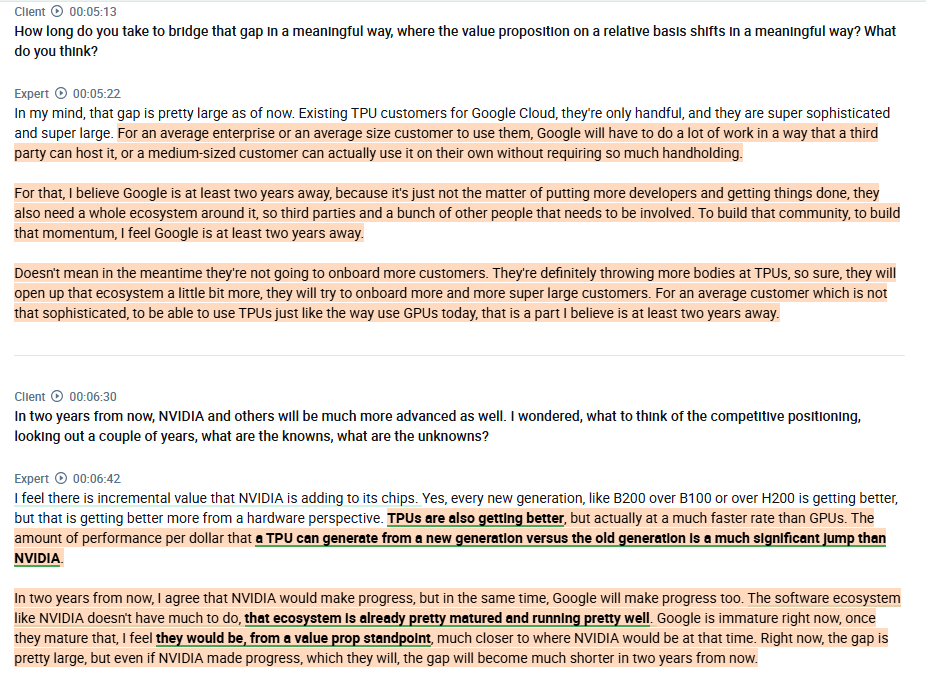
6. He thinks $GOOGL is at least 2 years away, as it is not just about the developers but also building a whole ecosystem around it. He believes that in the meantime, they will continue to onboard more customers.
7. He is not worried about the argument that $NVDA is getting better each year, as he believes that the TPUs are getting better at a faster rate than GPUs each year: »The amount of performance per dollar that a TPU can generate from a new generation versus the old generation is a much significant jump than $NVDA «. Currently, the $NVDA vs TPU gap is quite large, but he is convinced that the gap will be significantly smaller in two years.
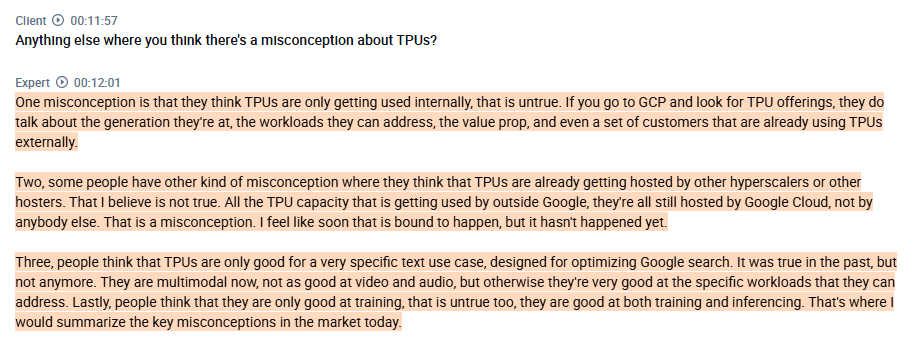
8. There is a misconception that TPUs are only good for very specific text use cases designed for optimizing $GOOGL Search. It was true in the past, but not anymore, according to him. They are multimodal now, not as strong in video and audio, but otherwise, they're very good. TPUs are also not used only for training, but are effective at both training and inference.
9. He also mentions that the ambition at $GOOGL with TPUs always existed, but now the management team is pushing super hard.
found on @AlphaSenseInc
What I am seeing is that analysts, when modeling the future revenues of many semiconductor names, such as $NVDA and $AMD, and the memory stack etc, are 100% focused on the letters of intent & CapEx projections from hyperscalers and AI research labs.
What they are not focused on, but I think they should be very much so, is on the revenue and profit side of the end-customers who are paying these cloud AI workload bills.
Right now, the industry is not pricing to costs, and for this to continue, you either have to have a lot more capital willing to come in and invest and subsidize many of the end-customer business models (which, from the latest "circular" deals and debt financing its fair to say we are closer to the limits than the start) or you need to start seeing good ROIs and profitable business models that the end-customers have so that they can continue paying and growing their AI workload cloud bills at the same or faster pace.
We don't have the details of many of the letter of intent deals or commitments from hyperscalers, but as many expect, they can be extended or maybe even canceled. Even Brad from Altimeter said on the All In Pod recently that if OAI's revenues are not as fast as they are expecting, OAI can possibly extend the $1.4T of the buildout commitments on a longer time frame. While this is not a problem for OAI, it is a problem for companies like $NVDA, $AMD, and others, as expectations that are baked into the current valuations are based on the current trajectories, based on many of these letters of intent and forecasted CapEx guidances. If those get extended into a longer time frame, the valuations will reset to meet that new real trajectory. Again, it's not just the semis company but also the neoclouds who are playing the fast-paced growth bet game.
Again, this is not a jab at AI, as I am not an AI bear; it is just a reasonable consideration that modeling purely on projections of your customers is not a good strategy, especially if they don't yet have the resources to pay for that.
The AI long-term success story will still be big and transformative, but maybe the projected trajectory in the short term will just grow at a slower pace (still fast) than what is currently expected, as business models of end clients need to become more mature and sustainable, and both software and hardware improvements reduce the cost of compute by many factors.
Again, also to consider as investors in this space is which companies benefit the most from a crazy fast pace cycle, where many of the organic CapEx commitments are now pushed forward as the big companies are in a race, and which companies could benefit if the buildout pace slows down and other companies have more time to catch up both on the semi side as well as on the model side.
I just published my cautious view on the current state of the AI market & why I have trimmed or sold many of my positions.
- We are running out of organic capital
- GPUs are a fast-depreciating asset
- Valuations are factoring in a very small chance of things slowing down
Legendary investor Howard Marks just released a new memo.
“In my 53 years in the investment world, I’ve seen economic cycles, manias and panics, bubbles and crashes, but I remember only two real sea changes. I think we may be in the midst of a third one today.”
My Notes…
$ZETA might be the most overlooked software business in the market.
Revenue is reaccelerating as ARPU has doubled to $2M since the IPO, with a net revenue retention of 114%.
Management expects cash flows to 3x by 2028.
Here’s my Zeta Global deep dive 🧵
Amazon just announced 14,000 layoffs. Its CEO made over $40M last year.
UPS announced 48,000 layoffs. Its CEO made over $24M last year.
Intel announced 20,000 layoffs. Its new CEO's pay package is valued at nearly $69M.
This is what I mean when I say the system is rigged.
This is how our government has been corrupted:
1) Donors give huge sums to elect politicians to office
2) Elected officials rewrite rules in the donors' favor
3) Donors make huge profit
4) Repeat
We must get big money out of politics.
It is the root of our dysfunction.
$NVDA just hit a $5 TRILLION market cap.
That makes it the single most powerful company in the most powerful group on earth:
5 companies now control ~27% of the entire S&P 500.
- $META → 2.96%
- $AMZN → 3.96%
- $AAPL → 5.90%
- $MSFT → 6.95%
- $NVDA → 7.11%
Together, these 5 move markets, shape GDP, and power the AI revolution.
We’ve gone from “diversified index investing” → to “5 companies deciding the fate of the economy.”
If $NVDA is $5T today… what happens when AGI actually hits?
This is wild:
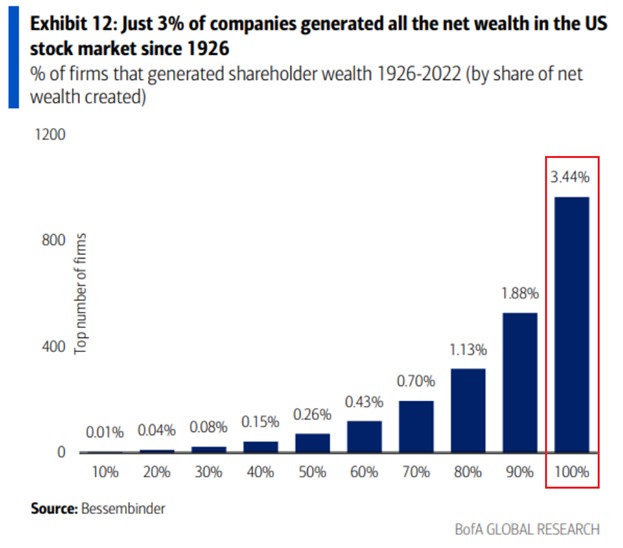
ALL net wealth in the US stock market since 1926 has been generated by just 3.44% of companies.
To put this differently, ~97% of all stocks have barely contributed to long-term shareholder wealth creation.
The top 1.88% of companies reflect 90% of total gains.
Interestingly, just 0.26% of firms have created HALF of all wealth.
This highlights the extreme concentration of stock market returns in top-performing companies.
Market wealth is heavily skewed toward a very small minority of companies.