Maverick - Capitalist - Investor - Trader - World Traveler - Tech Enthusiast - Futurist “I did not intend to get rich. I just wanted to get independent.”-Munger
Agreed.
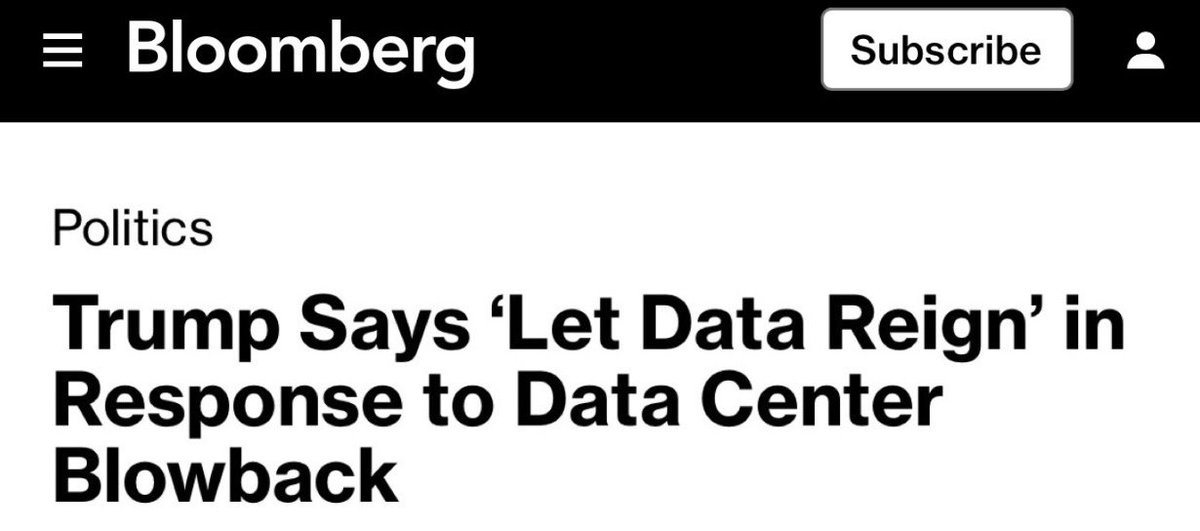
We must win the war for AI supremacy over China. They foment the ‘anti’ argument through misinformation.
There’s nothing more damaging to a Democrat than agreeing with Trump AND data centers—but what’s right is right.
Under President Trump, August usually does quite well, as we noted at the start of the month. Up 3% in August so far with a day to go, so history rhymed there.
Turns out, September has been higher four out of five years as well.
It is February and March that stocks don't like, sound familiar?
S&P 500 with a pretty solid Q3 so far, even though we've been told repeatedly this summer rally was over.
This is perfectly normal after a negative quarter then a 10% positive quarter (just like we saw in Q1 and Q2 this year).
We've been on record for years that we are in a period where multiple 20% yearly gains were likely, similar to the late 1990s.
In the late '90s, the month of September gained more than 2% for a record four years in a row.
We are up to two the past two years, and I might be lonely with this call, but I think we hit three this year.
Yes, August and September are 'supposed' to be bad, but this year hasn't been like other midterm years.
Remember, Q2 in a midterm year was also supposed to be bad (it is the worst quarter out of 4-yr prez cycle), but instead we had the greatest Q2 midterm year return ever. Will Aug/Sept continue this trend? I think so.
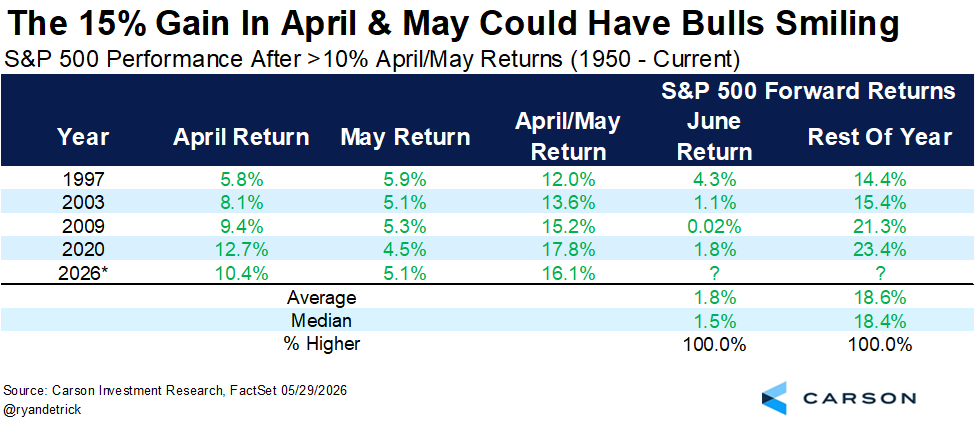
April and May gained more than 15% for the S&P 500, which suggested a very strong rest of year.
Previous times? Never lower and up another 18.8% on avg the rest of the year.
The worst three (and four of the worst five) returns ever for September took place in a midterm year.
But '74, '02, and '22 all saw weak returns heading into this month, not at all like this year.
There are parts of the economy that are booming (AI capex) and parts of the economy that are struggling (housing). It's a complicated issue, but I'd argue that hiking rates enough to even slow the booming area of the economy will - almost by definition - cause the Fed to sacrifice the labor side of their dual mandate. I do acknowledge that the neutral rate is rising due to the AI buildout.
Anyone who wants to understand why political arguments never seem to end should read Thomas Sowell’s A Conflict of Visions. Sowell understood that the dispute is not really about this tax or that programme but about something much deeper: two rival pictures of human nature.
The constrained vision sees people as limited, flawed and not easily remade. Knowledge is dispersed. Motives are mixed. Power is dangerous. The best societies do not wait for saints or master planners. They rely on evolved rules, trade-offs, incentives, and institutions that restrain our worst impulses while making use of our ordinary ones. Thinkers in this tradition - Smith, Burke, The Federalist, Hayek - treat social processes as more intelligent than any individual mind.
The unconstrained vision sees human nature and society as far more plastic. Reason and moral commitment, properly organised, can overcome inherited limits. Problems have solutions rather than mere trade-offs. If suffering persists, the cause is not the hardness of reality but the failure of existing arrangements - and of the people who defend them. Rousseau stands near the origin of this view; Marx inherited it; much modern reform politics still lives inside it.
Sowell’s point was not that one side is always kind and the other cruel. It was that these visions generate opposite conclusions about equality, justice, crime, war, and the role of government because they begin from different premises about what human beings are like and how social order is created.
That is why so many debates feel like two species talking past each other. They are not merely disagreeing about policy. They are disagreeing about the kind of creature man is, and about how much of the world can be redesigned by will.
Gavin, spot on.
AI is bringing manufacturing back to America and reindustrializing the nation after decades of offshoring.
AI is creating demand that drives investment in our aging power grid and sustainable energy, powered by market forces, not subsidies.
AI is creating construction and manufacturing jobs across energy plants, chip fabs and data centers.
AI is creating new companies and industries. $400 billion has been invested in AI startups in the past six months alone.
Builders must partner with communities to build in their hometowns, earn trust and create local benefits.
We have an opportunity to create lasting benefits for communities across America and help America lead the next industrial revolution.
Regret the tone of my post on data centers yesterday.
What I should have said:
There were reasonable concerns about data centers 18ish months ago: water, taxes, jobs, electricity prices, the environment and what they would do to small towns. Well-structured data center projects have largely addressed these concerns today and we should be celebrating this.
On balance, data centers are awesome for America in every way.
On water: U.S. data centers use a fraction of what golf courses use. A lot of the numbers from 18 months ago were off by over 1000x. Newer data centers use closed-loop systems or recycled water. Should be required by every town approving a data center project.
On taxes: looking only at sales-tax exemptions, as Ronan Farrow did, is the wrong way to evaluate this. Data centers pay significant property taxes. Loudoun County, which is the wealthiest county in America, now collects on the order of $1 billion a year from data centers. In Quincy, WA, data centers are more than half the property-tax roll. Over time, property taxes can go to zero while government spending increases in these towns.
On jobs: this has been unambiguously awesome for blue collar Americans. Demand for electricians, plumbers, welders, HVAC techs, and contractors has gone vertical, and it is not a one-time construction job. These buildings get upgraded and expanded over time. That is why the building trades are fighting for them, and why some unions are now treating opposition to data centers as a reason not to endorse politicians.
On power: the original fear was that households would pay for the incremental electricity demand in the form of higher prices. That is why the ratepayer-protection deals and the new large-load tariffs exist. The right structure is: the data center brings or pays for new generation and signs a contract long enough that existing customers are protected. Where that is happening, utilities are cutting or freezing residential rates and saying so on the record. Where it is not, people are right to object. Electricity prices are going down *today* in a number of large states because of data centers.
On the environment: data centers overwhelming use natural gas today, which is the cleanest power source outside of nuclear, solar and wind. And the companies that are building the data centers are committed to carbon neutrality such that an equivalent amount of solar will likely be built. Maybe more importantly, the data centers need batteries to function effectively and these batteries can also sell energy back into the grid (which recently prevented blackouts in Texas). Over time, data centers will run on solar plus batteries.
On the towns: Poverty in Quincy, WA fell from 29% to 6%. Data center taxes paid for a new high school, a hospital, a library, police and fire stations. This is happening in many left for dead former mill and farm towns that had no other bidder for the land.
Data centers are actually reindustrializing parts of America and creating the kind of working-class jobs both parties have spent decades claiming to support. That should not be a partisan issue. Data centers can and should be awesome for America and they increasingly, overwhelmingly are. Supporting the outsourcing of data centers to China will likely age just as well as support for the outsourcing of high quality, blue collar manufacturing jobs to China has aged.
When the facts change, I change my mind. I hope that reasonable people who had good faith reasons to oppose data centers at least consider updating their beliefs given the change in the facts over the last 18 months. This really matters for America.
I will say I also think the idea of making data centers beautiful is a good one that has yet to be implemented. Data centers should be just as beautiful as Grand Central Station. We can learn a lot from the railroad buildout. Neoclassical revival ftw.
Might write up open-weight AI tomorrow as this is equally essential to America.
HOUSING STARTS
July single-family housing starts broke below 70k.
This is the second lowest monthly print in the post-pandemic era. Only Nov 2022 has been weaker.
Remember: SF housing employs 3X MF...This level of starts points to significant residential construction layoffs.
No official change. Technically, the S&P still below our downgrade point and benchmark weight is not bearish.
But, those results further bolster our belief that semis bottomed...I wasn't really expecting near-term highs for the group...those odds go up now. Def a net bullish development. Everyone has to play the market as they see fit...I'm comfortable keeping risk (in either direction low).
Appreciate you listening.
TBC, I just follow data...Idk you and you don't know me...but, the bears have really shown their desperation for confirmation bias in interacting with this post.
To clarify, the DATA still shows strong demand for compute (insatiable demand for newer vintage GPUs). In recent days, however, older GPU availability has risen quite a bit.
Most likely, the loosening we have observed in some older vintage GPU availability is due to rental rates being too high relative to B200...Inference economics/tokenomics doesn't justify an H200 renting at the same rate as B200...Probably, the market is just finding balance. Time (and the data) will tell.
Call it the backlash to the backlash—Unions and building trades say they will oppose candidates attacking data centers, putting Democrats and other long-term allies in a pickle.
W/ @lindsayaellis:
https://t.co/p2AEtv27iI