How did humans conquer the world? People mention fire, bigger brains, and tools, but no one talks about the real reason—our evolved shoulders.
Our Shoulders are the most unique in the animal kingdom, they’re the reason we survived and thrived.
https://t.co/OZk57OR2zc
@midiv3rs@T4TUMISE@maxvayshia Not quite. What you've described is for when the username is already taken on IG. You can have an IG account and still use a different username on WhatsApp without having to verify it as long as it's not already taken by anyone (including yourself) on IG.
Source: I did it.
¿Argentina fue beneficiada por el sorteo?
En este hilo vamos a descubrir la verdad.
Porque se dicen muchas pavadas.
Empecemos.
1. El sorteo preveía que los 4 primeros del ranking FIFA (de noviembre de 2025) no se eliminaran antes de las semifinales. Y que la 1 y la 2 no se eliminaran antes de la final.
Así, las semis podrían ser España (1) / Francia (3) e Inglaterra (4) / Argentina (2)
Y la final España (1) / Argentina (2)
Introducing Project Glasswing: an urgent initiative to help secure the world’s most critical software.
It’s powered by our newest frontier model, Claude Mythos Preview, which can find software vulnerabilities better than all but the most skilled humans.
https://t.co/NQ7IfEtYk7
If you meet a Hausa person today, especially if they are Muslim, the chances are high that their name will not be Hausa in origin. Ask a Nigerian—any Nigerian—from a country that holds the world’s largest population of speakers of Africa’s second most widely spoken language, to give you “Hausa names,” and listen to what arrives. Ahmed. Aisha. Isa. Hauwa. Mahmud. Names that are treated as ordinary, neutral, automatic—so ordinary they pass as ethnic markers.
Yet none of those names are Hausa. They are Arabic and Qur’anic names, carried into Hausa life through Islam and naturalised so thoroughly that they now wear the mask of indigeneity. This is not a complaint. It is a clue. An indigenous name should tell you where a person comes from, who they belong to, what story sits behind them. When a society’s most common “native” names are imported through religion, something has happened to the society’s idea of itself.
That “something” is not unique to Hausa. Across Nigeria, names have become battlegrounds for legitimacy. The same is true for Igbo and Yoruba names, refracted through the lens of colonial religions. Hausa just makes the phenomenon harder to see because Islam is older here, closer to the foundations of power, and more thoroughly fused with public life. In many parts of Hausaland, Islam did not merely influence culture. It reorganised the conditions under which culture could appear.
This essay follows that reorganisation through the most intimate archive a society keeps: names.
Link here: https://t.co/MEVnUycPpU
I’m sorry about your discomfort. Waist pain on a bad bus is real.
But blaming fat people is misdiagnosing the problem — and misdirecting your anger.
The issue isn’t that some bodies are larger. The issue is that we’ve built a transport system that assumes a single, narrow version of the human body and then packs everyone into it because there is no alternative.
In societies with functional rail systems, wider seats, standing space, predictable schedules, and multiple carriages, people of different sizes coexist without this kind of daily humiliation and resentment. You’re not squeezed because someone is fat; you’re squeezed because the system is broken.
Unless the proposed solution is to remove fat people from public life, line them up and shoot into their fat bellies, (or force them to walk everywhere) I don’t see what targeting them achieves. That fat person beside you is also uncomfortable. Many of our parents and grandparents are fat. Many people gain weight with age, pregnancy, illness, or medication. Are they to be banned from public transport?
Also, let’s be honest: Nigerians are not built the same way. On average, Nigerians are bigger than many Europeans. Even within Nigeria, southern Nigerians tend to be heavier than Hausa or Fulani populations. Are we going to start designing public life around one body type and treating the rest as a nuisance?
What’s troubling is how quickly discomfort turns into cruelty. When we suffer, instead of asking why those in power have failed to provide humane public transport, we turn on the person closest to us, someone with no power to fix the situation.
The humane question isn’t “what do we do about fat people?”
It’s “why do we keep accepting systems that strip everyone of dignity and then encourage us to fight each other over scraps of space?”
If we care about fairness, the target should be poor infrastructure, bad planning, and lack of investment, not other human beings just trying to get to work like you are.
We can demand better transport without dehumanising people who are already sharing the same discomfort. And especially if you really are a lawyer, this is something you should think more deeply about.
Satya just told you the entire AI trade thesis is wrong and nobody is repricing anything.
Microsoft has racks of H100s collecting dust because they literally cannot plug them in. Not "won't," cannot. The power infrastructure does not exist. Which means every analyst model that's been pricing these companies on chip purchases and GPU count is fundamentally broken. You're valuing the wrong constraint. The bottleneck already moved and the market is still trading like it's 2023.
This rewrites the entire capex equation. When $MSFT buys $50B of Nvidia GPUs, the Street celebrates it as "AI investment" and bids up both stocks. But if half those chips sit unpowered for 18 months, the ROI timeline collapses. Every quarter a GPU sits in a dark rack is a quarter it's not generating revenue while simultaneously depreciating in performance relative to whatever Nvidia ships next. You're paying data center construction costs and chip depreciation with zero offset.
The players who actually win this are whoever locked in power purchase agreements 3-4 years ago when nobody was thinking about hundreds of megawatts for inference clusters. The hyperscalers who moved early on utility partnerships or built their own generation capacity have structural leverage that cannot be replicated on any reasonable timeframe. You can order 100,000 GPUs and get delivery in 6 months. You cannot order 500 megawatts and get it online in 6 months. That takes years of permitting, construction, grid connection, and regulatory approval.
Satya's point about not wanting to overbuy one GPU generation is the second critical insight everyone is missing. Nvidia's release cycle compressed from 2+ years to basically annual. Which means a GPU purchased today has maybe 12-18 months of performance leadership before it's outdated.
If you can't deploy it immediately, you're buying an asset that's already depreciating against future products before it earns anything. The gap between purchase and deployment is now expensive in a way it wasn't when Moore's Law was slower.
The refresh cycle compression also means whoever can deploy fastest captures disproportionate value. If you can energize new capacity in 6 months vs 24 months, you get 18 extra months of premium inference pricing before competitors catch up. Speed to deployment is now a direct multiplier on chip purchase ROI, which means the vertically integrated players with their own power and real estate can move faster than anyone relying on third party data centers or utility hookups.
What makes this really interesting is it changes the competitive moat structure completely. The old moat was model quality and algorithm improvements. The new moat is physical infrastructure and energy access. You can train a better model in 6 months. You cannot build a powered data center in 6 months. This is the kind of constraint that persists for years and creates durable separation between winners and losers.
I’m not usually affected by the deaths of people I don’t know personally, but this one hurts.
Chess Grandmaster Daniel Naroditsky has passed away, aged 29.
I never met him, but I’ve spent hundreds (maybe thousands) of hours watching his videos. I got back into chess during the Covid lockdowns, and I wouldn’t have fallen in love with the game without his generous, witty, and instructive lessons.
A history graduate from Stanford, Naroditsky was the most articulate and lucid commentator and teacher in chess. He was rare: a Twitch streamer and YouTube creator without a hint of ego. Everything he did was in the service of the game he loved.
He knew how to instruct weaker players like me. Commonly in his videos he’d say “you might be tempted to play…” followed by the exact terrible move I would have played, and then he’d explain why it was so bad.
I hear his voice and his idioms in my head when I play: is the opponent’s threat genuine or only a “paper tiger”? Can you set up a defence so that the opponent’s attack is “biting on granite”? Can you see a follow-up to your “sexy move” or have you succumbed to “onemove-itis?”
I’ll never be able to play as well as he did, but his videos always gave the impression that, with enough patience and effort, one day I might be able to.
It might be strange to have a teacher younger than you, but it’s even stranger to find out that he’s gone.
Remember Philip Larkin’s lines at the end of his poem “The Mower”:
"we should be careful
Of each other, we should be kind
While there is still time."
Memory eternal
She dumped me last night.
Not because I don't listen.
Not because I'm always on my phone.
Not even because I forgot our anniversary (twice).
But because,
in her exact words:
"You only pay attention to the parts of what I say that you think are important."
I stared at her for a moment and realized...
She just perfectly described the attention mechanism in transformers.
Turns out I wasn't being a bad boyfriend. I was being mathematically optimal.
See, in conversations (and transformers), you don't give equal weight to every word. Some words matter more for understanding context. Attention figures out exactly HOW important each word should be.
Here's the beautiful math:
Attention(Q, K, V) = softmax(QK^T / √d_k)V
Breaking it down:
Q (Query): "What am I looking for?"
K (Key): "What info is available?"
V (Value): "What is that info?"
d_k: Key dimension (for scaling)
Think library analogy:
You have a question (Query). Books have titles (Keys) and content (Values). Attention finds which books are most relevant.
Step-by-step with "The cat sat on the mat":
Step 1: Create Q, K, VEach word → three vectors via learned matrices W_Q, W_K, W_V
For "cat":
Query: "What should I attend to when processing 'cat'?"
Key: "I am 'cat'"
Value: "Here's cat info"
Step 2: Calculate scoresQK^T = how much each word should attend to others
Processing "sat"? High similarity with "cat" (cats sit) and "mat" (where sitting happens).
Step 3: Scale by √d_kPrevents dot products from getting too large, keeps softmax balanced.
Step 4: SoftmaxConverts scores to probabilities:
"cat": 0.4 (subject)
"sat": 0.3 (action)
"mat": 0.2 (location)
"on": 0.1 (preposition)
"the": 0.1 (article)
Step 5: Weight valuesMultiply each word's value by attention weight, sum up. Now "sat" knows it's most related to "cat" and "mat".
Multi-Head Magic:Transformers do this multiple times in parallel:
Head 1: Subject-verb relationships
Head 2: Spatial ("on", "in", "under")
Head 3: Temporal ("before", "after")
Head 4: Semantic similarity
Each head learns different relationship types.
Why This Changed Everything:
Before: RNNs = reading with flashlight (one word at a time, forget the beginning)
After: Attention = floodlights on entire sentence with dimmer switches
This is why ChatGPT can:
Remember 50 messages ago
Know "it" refers to something specific
Understand "bank" = money vs river based on context
The Kicker:Models learn these patterns from data alone. Nobody programmed grammar rules. It figured out language structure just by predicting next words.
Attention is how AI learned to read between the lines.
Just like my therapist helped me understand my focus patterns, maybe understanding transformers helps us see how we decide what matters.
Now if only I could implement multi-head attention in dating... 🤖
Still waiting for "scaled dot-product listening" to be invented.
Since this is trending, here’s a complete list of Data Structures to implement from my CS curriculum:
1. Linked List
2. Dynamic Array
3. Stack
4. Ring-buffer Queue
5. Deque
6. Binary Heap
7. Binomial Heap
8. HashMap with Open Addressing
9. HashMap with Separate Chaining
10. Binary Search Tree
11. AVL Tree
12. Red-Black Tree
13. B-Tree
14. Splay Tree
15. Treap
16. Segment Tree/Range Tree
17. Sparse Table
18. Heavy-Light Decomposition
19. Link-Cut Tree
20. Disjoint-Set Union (DSU)
21. Suffix Array
22. Suffix Tree
❤️🇦🇷 Alexis Mac Allister: "Dibu Martínez saved us all. He saved an entire country.
"I’d already been substituted. It was 3–3, heading to penalties. Everyone on the bench was really quiet, waiting for the whistle. The whole stadium was quiet, actually. It was weird. And then, all of a sudden, the world stood still. You know when it feels like the air is sucked out of the stadium? For three seconds, nobody breathed.
"All I remember was a blue shirt right in front of Dibu with the ball at his feet. Nobody around him. I’ve never felt more helpless.
"I thought, It’s over. There’s no way. We’ve lost the World Cup.
But you know what we say about keepers in Argentina right? - “To be a keeper, you either have to be crazy or an idiot.”
"Thank God, we have El Dibu, the craziest one of them all. I always say that he has the spirit of a child playing football. He does things that only a kid would think of doing, because he plays in the moment, you know?
The only way that I can describe that save is to remember what it was like when you were a little kid, jumping on the bed, pretending to be Buffon or Casillas or El Pato Abbondanzieri. You know what I mean? Were me and my brothers the only ones who did that? Whenever our mom would go out to the grocery store, we would sneak into her room, because she had the biggest bed in the house. That was our pitch, for the hour. One brother would throw the ball, and the other brother would jump around on the mattress, pretending to be El Pato making crazy diving saves.
Leaping into the air with your arms and legs stretched out, like a starfish. Doing the impossible.
That’s what El Dibu did that night. He stuck out his left leg like a crazy kid jumping on the bed, and he answered the prayers of 45 million people." @PlayersTribune
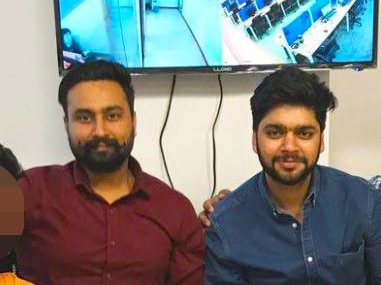
1/ Meet Gurpinder Singh and Rohit Sharma. Both of them run a scam call center in Punjab India. Together they have been stealing over $1.2 million every year since October 2016.
💻 Inscripciones del Barça 2025: Fair Play, ventas y caso Ter Stegen
Parece que se empieza a entender el plan del Barça y los motivos por los que aún no ha inscrito a los jugadores. Te lo explico aquí 👇👇
https://t.co/vIgbbjTf79
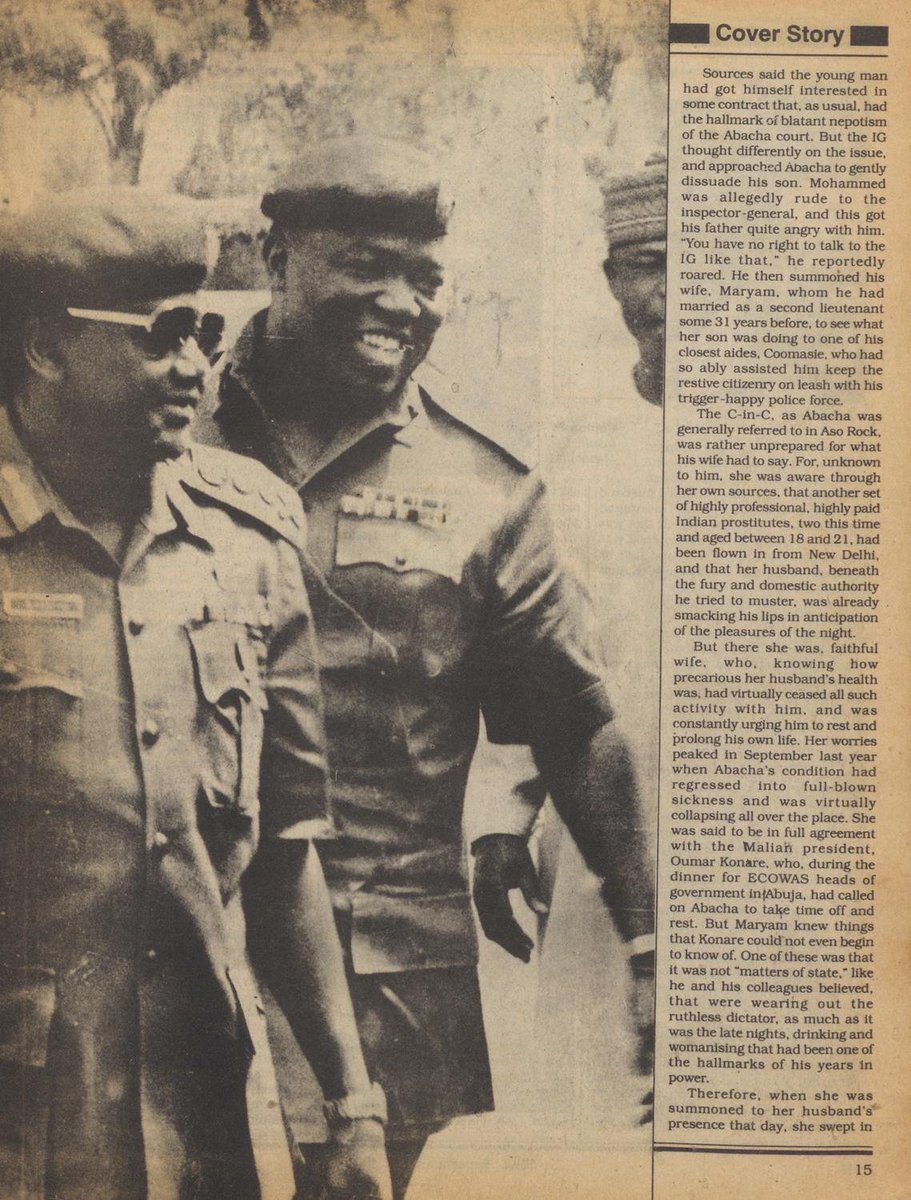
27 years ago today, General Sani Abacha suddenly died.
“June 7, the last full day he spent on earth, was a Sunday.”
Here is TELL magazine’s 1998 account of his final hours as Nigeria’s head of state.