This topic is close to my heart because I’ve been living it.
AI is changing how far each of us can carry a product idea. But building together means rethinking how we share context, review work and make decisions. Individual speed only takes us so far.
That question runs through Super IC, and it’s the focus of my next free lightning lesson: Super IC Teams: What End-to-End AI Development Really Takes.
I’ve written about why it matters in this edition of Super IC.
Join me on 11 November, 3 PM PST:
https://t.co/Z306fsRUri
I’ve spoken about a million words to my phone and computer over the last year. Average speed: 137 words per minute.
It started as a convenience. It has become the most important part of how I work with AI.
AI is only as good as the context you give it. When I type, I trim my thinking before an agent ever sees it. When I speak, the reasoning, the caveats and the half-formed ideas all make it through, and the output gets noticeably better.
The second shift was meetings. Most decisions in my week get made out loud, and they used to vanish when the call ended. Now every meeting indexes itself, and I can query months of conversations or turn one into a brief, an action list or a PRD draft. There is intelligence in the context before, during and after a meeting.
The third was connecting all this context to agents over MCP, so email, calendar, files and meetings all feed recurring agents that draft and research for me.
I’m teaching the whole stack in a free 60-minute session on October 27, part of Maven and Granola’s “Level Up Your AI with Context” series. Granola is also offering three months of Granola Business free for you and 4 team-mates.
Tuesday, Oct 27, 3:00 PM PT / 6:00 PM ET
Recording available to everyone who registers.
With @meetgranola + @MavenHQ
https://t.co/ov1suBAQKB
I have more than a hundred hours of recorded teaching. Finding useful two-minute clips means deciding where an explanation starts, where it ends and whether it makes sense on its own.
I've been using Jev, TypeSafe's System 1 decision model, to help with those judgements.
In this edition of Super IC, I share the transcript workflow and explore where a model built for small, specific decisions can be useful. I've also linked the lightning lesson, where I demonstrate this alongside support-ticket triage and an AI task router.
https://t.co/T4qbrIF4r0
Never thought I'd be getting away from the haze and pollution in Singapore (because of the Indonesian fires) by visiting - wait for it - Delhi? Clear blue skies, here I come! 😂
During one of my courses, I asked Granola what we had covered so far. The class was still going on and the notes were already useful.
I've been exploring how to use that context: asking better questions during an interview, preparing a follow-up afterwards, finding patterns across conversations, or speaking through a problem on my own.
In this edition of Super IC, I write about putting those conversations to work - and the voice-first AI stack I'll be teaching in my upcoming Maven lightning lesson with Granola.
https://t.co/ov1suBBoA9
I love building with AI. But what I am happy to delegate may be the very thing someone else loves doing.
For some people, the act of writing code, composing music or making an image is part of what makes the work worth doing. A finished result is only part of the story.
This edition of Super IC asks what happens when AI separates a practice people love from the livelihood that lets them spend their days doing it.
What part of your work would you miss if you no longer did it yourself?
https://t.co/5D5SsrhF97
Some of the most useful instructions we give AI arrive as corrections.
“This was a proposal, not a decision.”
“That number needs a different denominator.”
“There isn’t enough evidence to make this recommendation.”
Those corrections contain our judgement. Yet we often repeat them in the next conversation instead of turning them into a method the agent can reuse.
This edition of Super IC explores how agent skills can capture that expertise - and how to check whether they actually improve the work.
https://t.co/GCksreQrd1
AI can make each of us faster without making the team faster.
If I pass an unchecked AI-generated document or piece of code to a colleague, my time saving becomes their extra work. They have to find the gaps and make the decisions I skipped.
In this edition of Super IC, I explore the working agreements that turn individual speed into shared progress: visible decisions, clear ownership and work others can trust.
https://t.co/56dw0tadAN
I cut back from running five or six AI agent sessions at once to two. I was getting more output, but the quality of my decisions was slipping.
Building with AI puts you in an unusual position. You need the sustained concentration of a maker while handling a manager’s stream of decisions. What should the agent build? Is this approach sound? What did it miss? Can I trust this enough to move on?
As the work speeds up, those decisions arrive closer together. Fatigue leads to weaker choices, which create rework and yet more decisions.
In this edition of Super IC, I explore what this means for how we build - and how teams organize the working day. We need to account for the attention and judgement that all this output requires.
https://t.co/GQTxBMhfLo
(Oh - and I started a new newsletter. Check it out!)
October 13: The Voice-First AI Stack for People Who Live in Meetings
We'll cover dictation, searchable meeting transcripts, and using those transcripts to draft briefs and action items. I'll also show how to connect meeting notes, email, calendar, and files to an agent through MCP.
https://t.co/ov1suBBoA9
@aarthir I love Beavercraft tools for woodwork projects. Beautifully carved and sturdy.
A modern brand that makes superb tools is Hoto - high precision and aesthetically pleasing.
@myshell_ai Evals are a continuous process when you are changing the skill or when you need to change the skill because the underlying LLM has changed.
Every agent I use now (Claude, ChatGPT, Grok) can reason well. None of them do a task the same way twice.
I noticed this doing something boring: asking an agent to review a contract the way I do it, with my checklist, my exceptions. Tuesday's output didn't match Thursday's. Not because the model got worse. Nothing ever told it my procedure, and it forgets my last correction the moment the session ends.
That's not a model problem. It's a missing-skill problem.
A skill is a small file that teaches an agent your procedure once. Claude, ChatGPT, and Gemini all read the same format, and it stays out of the way until the task actually matches.
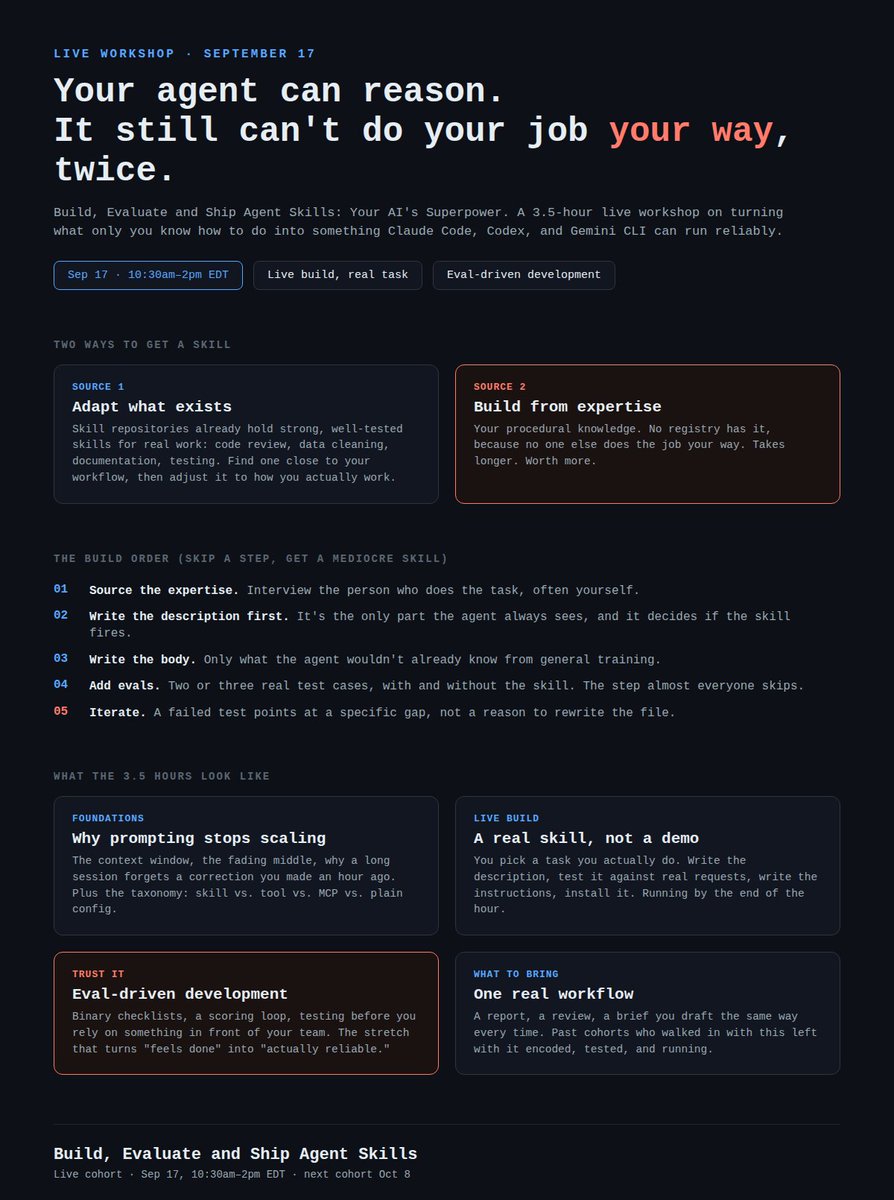
There are two ways to get one. Adapt what already exists: skill repositories now hold strong, well-tested skills for real work like code review, data cleaning, and documentation, so find one close to your workflow and adjust it. Or build one from your own expertise, the stuff no registry has because no one else does your job your way. That second kind takes longer and is worth more, but neither is the lesser option.
Building it well has an order that's easy to skip: interview yourself for the gotchas nobody wrote down, write the description before anything else since that's the only part the agent always sees, write the body next with nothing generic in it, then add two or three real evals so you're not just guessing it works. Most skills fail because someone skipped that last step.
I'm running a live workshop on this on September 17, 10:30am to 2pm EDT. We build a real skill from a task you actually do, test it, and ship it in one sitting.
https://t.co/4ZPcOgd1Np