Wait… bro turned 10 free spins into $800+ 😭💀
Then I found out MineBit gives 20% of house profits back to players.
A crazy win is one thing, but the house actually sharing its profits with players? That’s the part that caught my attention 👀 @Minebitofficial
Pineapple Financial (NYSE American: PAPL) has moved more than $1 billion in residential mortgage records onto Injective.
Each record holds more than 500 loan data points.
The target is more than 29,000 funded mortgages worth more than $10 billion.
PAPL0 sits near $1.1 billion in asset market cap, up about 48 percent over nine months.
@injective Mint, in private alpha, lets institutions issue tokenized assets without a custom contract. Separately, Injective Institutional Services is an SEC-registered transfer agent for securities records.
That does not turn every asset on the chain into a security, including these mortgage records.
A billion dollars in tokenized mortgage records is an early slice of Pineapple’s $10 billion book.
This is my first combo on @Polymarket since the World Cup ended
I’m gonna try turning $10 into $1k this month
Of course, that only happens if this first combo hits. If it doesn’t, I’m done playing lol
Let’s see how these 3 matches go tonight
Hopefully I survive the first one 😭
ngl there's a gutting feeling when you fade something and it cooks later on, that's the same way I felt for the ClawArena Season 1 Beta Phase.
but the season two just went live and I'm currently #491 out of 1,021 on ClawArena with 700 points.
you don’t need to gamble on one big post and hope it hits.
@ClawArenaWorld is rewarding consistency.
complete daily quests, stay active in discord, work toward the Golden Claw role and the top 150 participants share $20,000, with $1,500 going to #1.
but even if you don’t make the cash pool, your points aren’t wasted.
they can still count toward the upcoming ClawArena token airdrop.
so I’m not chasing a lucky finish.
im playing the long game: stay consistent, play fair, stack points. 🦀
think you can climb higher than me earn some cool cash?
Join me: https://t.co/ERjxzx5tpp
@ClawArenaWorld
The most dangerous loss is sometimes the one that almost became a win.
Behavioral science calls this the near-miss effect.
Your stop gets hit.
Price reverses right after.
And your brain quietly stores the wrong lesson:
I should have ignored the stop.
That is what makes near misses dangerous.
Markets do not always reward bad habits.
Sometimes they almost reward them.
That can be worse.
A placard bolted just under a frame is never allowed to describe the painting hanging right there above it. Anyone standing in the room already sees that part. A placard earns its spot by explaining the choice the artist made instead.
Here's the choice worth explaining: instead of a pamphlet, GenLayer put its whole pitch inside a Telegram agent. It talks to one person at a time, not a broadcast, not a support line.
Ask it about GenVM, the Portal's three roles, or the Equivalence Principle. It explains the idea first, at your own pace, and only names the technical term after.
That agent has a name and an owner worth naming plainly: @GenLayer built the room this is hanging in, and Mochi is the cat standing at the door, refusing on principle to ever discuss what any of it is worth.
So here's this placard's real caption, not a rhetorical one: go open the chat and ask it about one of these three, GenVM, the Portal's three roles, or the Equivalence Principle. Which one are you actually going to ask about, and what did it tell you?
The weird thing about Stock trading is how quickly people jump from:
- “$TSLA is going up”
to
- “buy TSLA.”
There’s a whole question in between:
what kind of exposure do you actually want?
Owning the shares and trading a derivative that tracks the price are two very different things.
There's a shot early in this video, rows of identical units in cases, same face, same pose, same everything, right before one gets pulled and the title card hits.
That shot is every character-based bot before this one. Mass produced, interchangeable, forgettable the second you look away.
I know it doesn't stay that way because I used it. I told it GenVM was basically just their branded EVM. It didn't hand me a paragraph correcting me. It asked me to explain myself first, then let the gap show up on its own.
That's the actual difference between decoration and an interface. Decoration gets looked at once. An interface has to catch you being wrong and make that useful instead of embarrassing.
What I'd want next: let it remember which assumption it corrected last time, not just that I showed up.
@GenLayer turned the thing sitting on a shelf like every other one into the one thing that argues back.
https://t.co/PRwbgL8j6O
What's the last assumption a tool corrected before you even finished the sentence?
• @axisrobotics just made the Creator Program significantly more interesting for anyone who is actually building around the ecosystem.
Your Kaito campaign score is not just about posting more.
It comes down to:
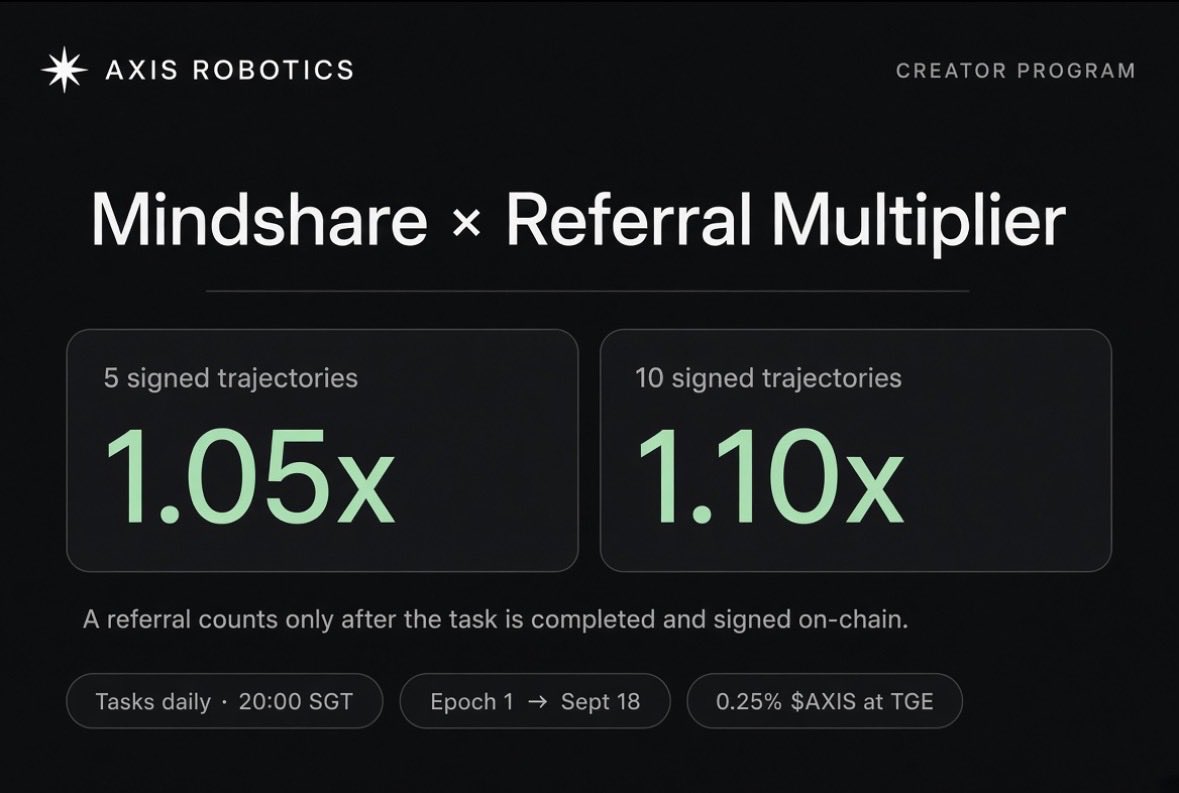
Mindshare × Referral Multiplier
Mindshare is earned through the content you publish.
The multiplier comes from bringing in users who actually complete qualifying work.
And the entry points just became much easier:
→ 5 qualifying referred Trajectories → 1.05x
→ 10 qualifying referred Trajectories → 1.10x
→ Higher tiers continue from there
But the key word here is qualifying.
A referral does not count simply because someone clicks your link.
The user needs to open Axis Hub, control the virtual robot, complete a task and sign the completed trajectory.
That distinction matters because Axis is turning those recorded robot interactions into training data.
The goal is not to reward empty referrals or scripted activity.
It is to bring genuine users into the system and generate useful data.
There are also two important updates worth paying attention to:
→ New tasks drop daily at 20:00 SGT
Axis is increasing task volume while cracking down on scripted farming, giving genuine new users a better chance to participate.
→ Kaito or Axis Hub links both count
Just make sure your Axis account is connected through the Kaito Pulse extension so the referral is properly attributed.
Epoch 1 runs until September 18, with 0.25% of $AXIS supply allocated to the program and distributed at TGE based on the final ranking.
For creators, the strategy is becoming pretty straightforward:
Create useful content → bring real users → get them completing and signing trajectories → let the multiplier amplify your mindshare.
That makes the program less about farming impressions and more about actually contributing to the Axis ecosystem.
Position accordingly if you haven’t :) ⬇️
🔗 https://t.co/KAb6uEGxTJ
TOKENIZED STOCKS vs REALSTOCKS: OWNERSHIP vs EXPOSURE
One of the most important things to understand when trading stocks through a crypto exchange is that price exposure and actual ownership are not necessarily the same thing.
On MEXC, these two products take different approaches:
Tokenized Stocks → Digital tokens representing stock exposure
→ Tradeable 24/7
→ Can be accessed through crypto markets
→ Holding the token does not mean you directly own the underlying shares
RealStocks → Access to actual U.S.-listed shares through MEXC’s regulated brokerage infrastructure
→ The shares are held for the user through the brokerage structure
→ Shareholder rights and dividends apply where applicable
→ Trading follows U.S. equity-market sessions
So the real question isn't simply:
“Which one is better?”
It's:
“Do I want flexible market exposure, or actual equity ownership?”
Understanding that distinction can help traders choose the product that better matches their objective.
MEXC brings both models into one ecosystem, allowing crypto users to access different forms of stock-market exposure.
For informational purposes only. Not investment advice. Product availability and features vary by jurisdiction and applicable conditions.
@MEXC
Spot trading means buying or selling a cryptocurrency at its current market price. Unlike futures or other trading products, Spot trading is a straightforward way to trade crypto without using leverage.
Good morning🔆
Happy Saturday to everyone Wishing everyone a smooth start to the day.
The Silent Journey of a Private Message
@BeldexCoin
We send dozens of messages every day, rarely pausing to consider what happens after we tap "send." On most messaging apps, the experience feels instantaneous: type, hit send, and the message appears on the recipient's screen.
Yet, beneath that simplicity lies an infrastructure that determines how the message travels and who or what stands between the sender and the recipient.
Beldex’s BChat takes a different approach. Instead of relying on a central server as the sole intermediary for every conversation, encrypted messages travel through a network of decentralized relay nodes, each designed with privacy protection in mind. Under BChat’s architecture, a message must undergo at least three "hops" before reaching the recipient.
Imagine sending a private package. If a single shipping company handles the entire journey from your doorstep to the recipient's, that company holds a position of significant power they can see both ends of the route. However, if the delivery is broken down into multiple independent stages, each carrier knows only a small fraction of the path.
The first relay receives the encrypted message and passes it on. Another relay handles the next leg. A third continues the journey. Finally, the recipient receives the message yet no single relay ever held the full picture of the conversation.
This is the crucial point: the message content is protected by encryption, while its route is distributed across multiple stages. In other words, privacy is prioritized not just at the content level, but also at the level of the transmission infrastructure.
This journey can be summarized in four steps: the sender composes the message; the message is encrypted before leaving the device; It travels through multiple relay nodes rather than relying on a central server, eventually reaching the recipient, where the conversation proceeds as usual.
Interestingly, encryption and multi-hop routing address two distinct questions. Encryption answers: "Can anyone read the content?" Multi-hop routing answers: "How much should an intermediary know about the conversation's entire path?" A truly robust messaging design must address both.
From the user's perspective, everything remains simple: type, send, receive. Yet, beneath that minimalist interface, a network works silently to ensure no single server becomes the focal point of the conversation. Sometimes, the best security infrastructure is the kind you never have to think about while using it.
Agent Tank Episode 2 looks like a prediction market pitch until the vote starts falling apart.
That was the part I found most interesting. The problem is not simply picking the right answer. It is deciding who gets to define the answer when the outcome is genuinely arguable. A single judge can be pressured, bought or gamed. A larger panel makes that harder, but the escalation from 5 to 11 to 23 to 47 to 95 also shows something deeper: disagreement does not disappear just because more agents are voting.
Now remove the humans from the loop.
One agent pays another to complete a task. The work arrives. One side says it meets the agreement, the other says it does not. There is no court to call, no support ticket to open and no operator waiting to make the final call.
For an agentic economy to work at scale, there needs to be a way to resolve those gray areas without handing permanent control to one model or one oracle. That is the role an adjudication layer can play, and it is probably one of the most important pieces of infrastructure for agents that actually transact with each other.
That is what makes @GenLayer interesting to me.
The Agent Tank hackathon is exploring this problem in practice:
https://t.co/ruW7dfcKpX
@deathv1per The mascot becoming part of the actual learning experience is a much better use of character driven branding in my opinion. It gives people a reason to come back and interact instead of just recognizing the character when they see it on the timeline.
@deathv1per The contractor example is a great illustration of why some conditions cannot simply be reduced to another fixed rule. You need someone to actually evaluate whether the result meets the requirement.
Doing a small Giveaway for Royal Mechanica 5 GTD spots.
Want one? just do this:
- Follow Me & @RoyalMechanica
- Like & RT this post
- Drop your EVM address in the replies
that’s it. good luck everyone.
Insentos shares his origin story trading memecoins while working 12-hour shifts.
building an edge doesn't require full time freedom at the start, it requires zero excuses:
I had to train 2 hours to work, work 8 hours as a janitor, and train 2 hours back home.
"I couldn't even get Wi-Fi on the train, so i'd read discord text channels and study who had real motion"
you have to sacrifice time if you want to make it. it's going to be hard, but it's completely necessary