We're missing (at least one) major paradigm for LLM learning. Not sure what to call it, possibly it has a name - system prompt learning?
Pretraining is for knowledge.
Finetuning (SL/RL) is for habitual behavior.
Both of these involve a change in parameters but a lot of human learning feels more like a change in system prompt. You encounter a problem, figure something out, then "remember" something in fairly explicit terms for the next time. E.g. "It seems when I encounter this and that kind of a problem, I should try this and that kind of an approach/solution". It feels more like taking notes for yourself, i.e. something like the "Memory" feature but not to store per-user random facts, but general/global problem solving knowledge and strategies. LLMs are quite literally like the guy in Memento, except we haven't given them their scratchpad yet. Note that this paradigm is also significantly more powerful and data efficient because a knowledge-guided "review" stage is a significantly higher dimensional feedback channel than a reward scaler.
I was prompted to jot down this shower of thoughts after reading through Claude's system prompt, which currently seems to be around 17,000 words, specifying not just basic behavior style/preferences (e.g. refuse various requests related to song lyrics) but also a large amount of general problem solving strategies, e.g.:
"If Claude is asked to count words, letters, and characters, it thinks step by step before answering the person. It explicitly counts the words, letters, or characters by assigning a number to each. It only answers the person once it has performed this explicit counting step."
This is to help Claude solve 'r' in strawberry etc. Imo this is not the kind of problem solving knowledge that should be baked into weights via Reinforcement Learning, or least not immediately/exclusively. And it certainly shouldn't come from human engineers writing system prompts by hand. It should come from System Prompt learning, which resembles RL in the setup, with the exception of the learning algorithm (edits vs gradient descent). A large section of the LLM system prompt could be written via system prompt learning, it would look a bit like the LLM writing a book for itself on how to solve problems. If this works it would be a new/powerful learning paradigm. With a lot of details left to figure out (how do the edits work? can/should you learn the edit system? how do you gradually move knowledge from the explicit system text to habitual weights, as humans seem to do? etc.).
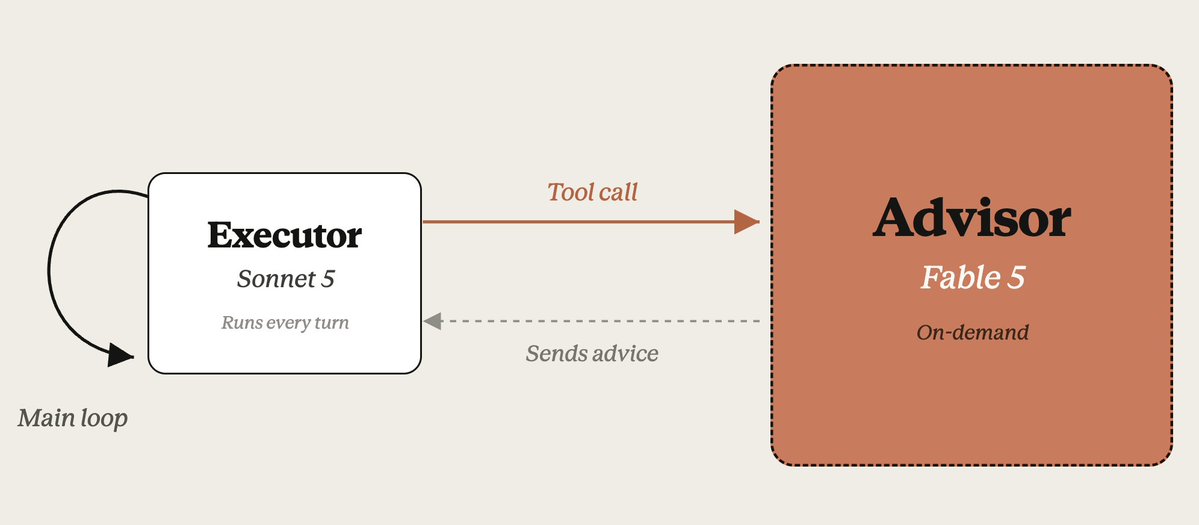
A few patterns we frequently use with Fable 5:
Use Fable 5 as an "advisor."
An executor (Sonnet 5) calls Fable 5 for guidance.
Most tokens are billed at the lower executor rate.
el ingeniero que construyó Claude Code acaba de publicar un video de 28 minutos sobre cómo escribir prompts que realmente funcionan
he visto cursos de 300$ que no cubren lo que él muestra en los primeros 10 minutos
archivos CLAUDE.md, atajos de memoria, sesiones paralelas, patrones de prompting
todo en un video y completamente gratis
funciona seas desarrollador, principiante o alguien que lleva meses usando Claude
GOOGLE, AMAZON, AND APPLE SPENT A DECADE CONVINCING YOU YOUR SMART HOME NEEDS THEIR CLOUD.
One guy in Norway just shipped 253 commits proving they were lying.
His name is Lasse Lian. The project is called Prism Desktop. It's a native Windows and Linux client for Home Assistant that runs entirely on your local network.
No Google account. No Amazon login. No Apple ID. No cloud relay. No subscription tier hiding behind a "Pro" badge.
Closed smart home vs Prism Desktop:
- Account required: Yes → No
- Voice data stored: On their servers → Never leaves your house
- Works without internet: No → Yes
- Costs: $99 hub + $5/month video storage → $0
- Source: Closed → MIT licensed, 253 commits public
- Vendor lock-in: Total → None
The whole app talks to Home Assistant over its WebSocket API. Your lights, your thermostats, your cameras, your locks. None of it touches a corporate server.
→ Drag and drop dashboard you actually own
→ Global keyboard shortcuts to any entity
→ PC notifications from your local automations
→ Real-time state sync without polling
→ Border effects, custom colors, the petty stuff matters
Here's the wildest part:
He shipped the first release on February 1, 2026. He's now on version 1.5.3, four months later. Solo developer. 14 releases. 160 stars and climbing.
The trillion-dollar smart home industry needed a decade and never built this.
One honest note: you need a Home Assistant instance on your network. This is the client. Setting up HA itself is the part that scares people, and it shouldn't.
100% Open Source. MIT License.
Link in the first comment.
프론티어 모델끼리 서로 멱살 잡고 리뷰하게 만드는 게 핵심임. Codex 5.5가 짜면 Claude Opus 4.6이 공격하고 다시 검증하는 루프인데, 이 정도면 웬만한 시니어 리뷰보다 촘촘할 듯. 설계만 완벽하면 실행은 딥시크 같은 가성비 모델로 밀어버려도 결과물 퀄리티 유지되는 게 진정한 하네스 엔지니어링이라고 봄...
DB 스케일링 할때 검토 해야할 기술들인데 저장 엔진 기초부터 2PC/3PC 같은 분산 트랜잭션까지 알차게 모아놨음. B+ Tree랑 LSM Tree의 쓰기/읽기 특성 차이만 제대로 알아도 아키텍처 짤 때 삽질 덜 함. 나중에 시스템 디자인 면접이나 대규모 마이그레이션 앞두고 다시 뜯어볼 만한 커리큘럼임.. 참고로 CDC 는 데베지움 쓰는게 정신건강에 좋음..ㄹㅇ
Anthropic paga más de $750,000 al año por ingenieros que puedan construir arquitecturas de LLM desde cero. Stanford enseñó todo el tema en una conferencia de 1 hora y lo liberó gratis.
Guárdalo en favoritos y mira esto hoy antes de que lo borren.