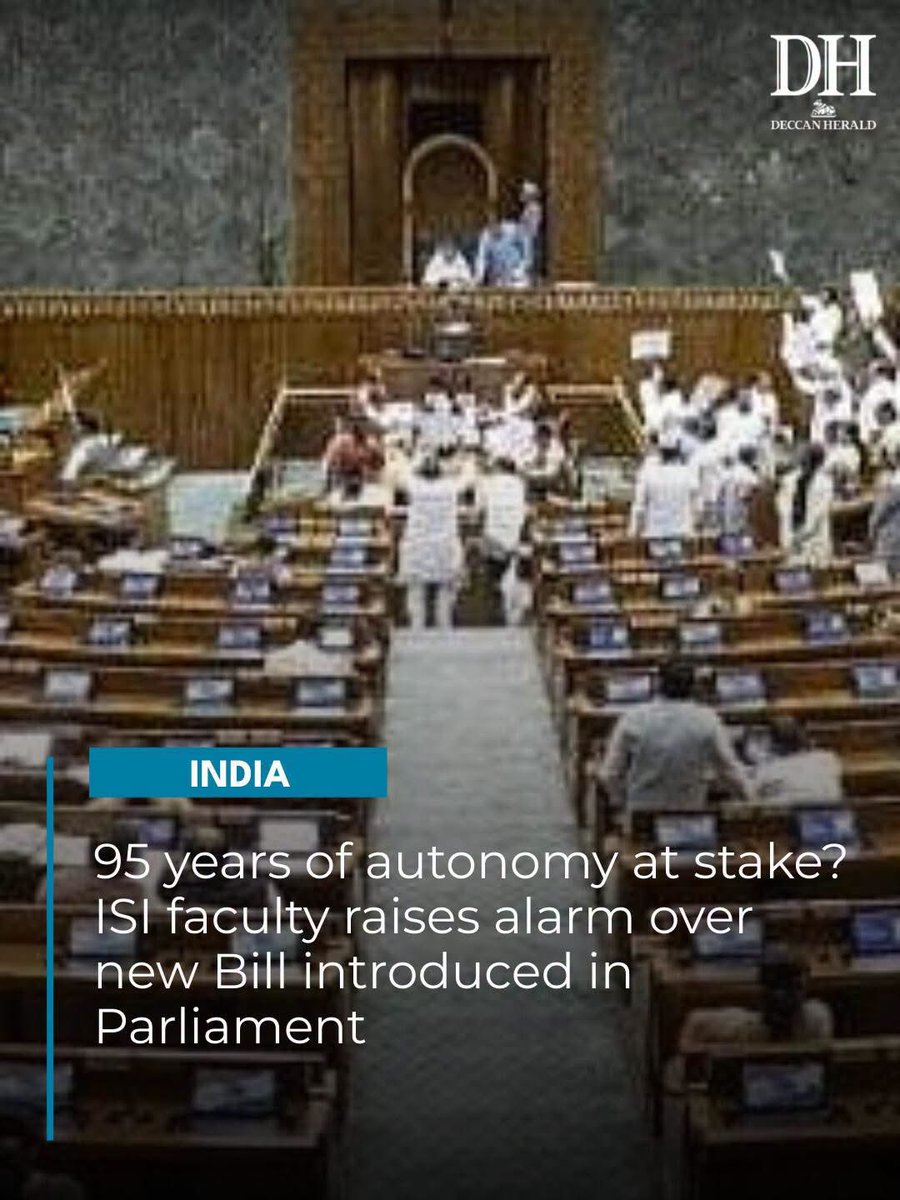
95 years of hard-earned autonomy. Now under the scanner, this time the ISI
The Indian Statistical Institute (founded 1931 by P.C. Mahalanobis) is not just another campus. It is one of India’s rare institutions that was built on scientific independence, not bureaucratic control. The ISI Act of 1959 recognised it as an Institution of National Importance while preserving its society-based, faculty-driven character.
The new Indian Statistical Institute Bill, 2026 proposes to scrap that framework. It converts ISI into a statutory body corporate, replaces the representative Council with a government-appointed Board of Governors, and significantly curtails the role of the Academic Council. Faculty and the Institute’s own statutory bodies have publicly said this was done with zero meaningful consultation with them.
The government’s pitch is “modernisation” and alignment with IIT/IIM-style governance. Critics inside ISI argue the opposite: it concentrates power, reduces elected academic voice, and opens the door to external interference in academic decisions. They also note that the 4th Review Committee (Mashelkar) did not recommend repealing the 1959 Act or abolishing the Society structure.
This is not an abstract governance debate. Institutions that produce independent data, rigorous statistical research, and critical inquiry need structural insulation from short-term political or bureaucratic priorities. Once that insulation is thinned, it is hard to restore.
Academic freedom is not a slogan. It is the operating condition of any serious research institute. ISI faculty are right to raise the alarm.
Parliament should insist on genuine consultation with the Institute’s own bodies before rewriting a 95-year-old model that actually worked. Another Premier Institute being Saffronised and being brought under RSS Siege.
History does not repeat itself but it often rhymes. Anyone who lived through the 2011-2013 period in India, and is watching the country in 2026, will find the rhyme hard to ignore.
The characters have changed, the specific allegations are different, but the underlying script — a government fatigued by its own longevity, an economy under external stress, and a restless youth looking for a new savior — feels strikingly familiar.
I have a VOTER ID card, but NO, it is not proof of citizenship.
I have a AADHAR card but NO, it is not proof of citizenship
I have a PAN Card, but NO, it is not proof of citizenship.
I have a PASSPORT but NO, it is not proof of citizenship.
So who will give me a CITIZENSHIP CERTIFICATE? A govt bureaucrat?
My question is simple: is the problem with the citizen, or with the Mai Baap State itself?😡
Sarafaroshi ki Tamanna, a song indelibly associated with revolutionary Ram Prasad Bismil of the Hindustan Republican Association and their daring Kakori train attack!
But the song was actually written by Bismil Azimabadi, an Urdu poet from Patna just after the horrific firing at Jallianwala Bagh.
In fact, Rajput Ram Prasad Tomar took on the name 'Bismil' in celebration of the secular nature of our freedom struggle & popularized this song around the country!
After the Kakori attack Bismil was captured and hanged by the British around the same time as his close associate Ashfaqulla Khan. He was just 30.
Celebrating Ram Prasad Bismil's 129th birth anniversary, one of so many legends from our freedom struggle!
India will never produce an NVIDIA, and it has nothing to do with talent. R&D is the purest form of investment, and the central bank has spent decades making investment the dumbest thing you can do with a rupee.
I've been surfing the semiconductor wave for a while now, reading 10-Ks for fun. Spent last month in the Bay Area and the gap between India and the US is not a gap; it's a different universe. Conversations about agentic AI and the next decade of hardware, with my boomer relatives Waymo-ing around SF and self-driving home on Tesla FSD like it's normal. Nobody there thinks any of this is remarkable; they already live in the future.
NVIDIA spends nearly twice as much on R&D as every listed company in India combined. Silicon Motion, the world's leading maker of NAND flash controllers and around since 1995, ploughs 29.7% of revenue back into R&D. Micron runs 10.2%, NVIDIA 9.9%, on revenue bases that dwarf anything we have. India Inc? 0.85% of turnover, and half our listed companies report zero R&D at all.
The easy move is to lambast our promoters and the dhandomaxxing capitalist class, or the foreign MNCs running India as a glorified offshoring unit, or the babus who fund nothing useful. Satisfying. But Wrong. The reason no rational Indian founder pours money into frontier R&D is that there is genuinely no payoff at the end of it. Why?
1. R&D compounds, and compounding punishes laggards. At the edge of science a 1-2% gain is a moat; Intel spent 20+ years performing impossible physics every 24 months because Moore's Law was the business model, and that consistency makes them one of the goated companies of all time even after they got mogged recently. NVIDIA lives the same way today: invent at the limit or cease to exist. If you're 50% behind, no quantum of innovation closes that. You never touch the high end. You stay a mass-market producer of things that already exist. India is precisely there.
2. The supply side is the real thesis, and it's monetary. Two decades of high inflation, high money-printing, high nominal rates. That regime subsidises consumption and taxes patience. R&D is the longest-duration, highest-variance bet on the board; it is the first thing a 8% risk-free rate kills. Frontier R&D only ever gets funded two ways: a psychopathically risk-tolerant capitalist with cheap capital, or a state with Stalin-grade control. The USSR took agrarian peasants to the first man in space in 20 years; China built its own version. India has neither the state capacity, the political will, nor the balance sheet to do that. So nobody does it.
Talent was never the bottleneck. Capital structure was. If you want a SpaceX or a TSMC born here, you need an environment where a conglomerate can deploy $10B and sleep at night: a low-rate regime that makes long-duration investment rational, IP and patent courts that actually function, and policy that doesn't get rewritten every 2-3 years on a minister's whim. Stability is the input. Innovation is the output.
Bay Area versus Bombay, we are several universes apart, and you cannot print your way across that distance; you can only compound your way there, and we've spent years optimising for the opposite. The gap won't be bridged. With luck, it narrows.
Let me explain exactly why Apple ships the Magic Mouse charging port on the bottom, because no one seems to get it.
This is not an oversight. Apple has shipped this exact design since 2015. They updated the mouse in October 2024 to USB-C and kept the port on the bottom anyway. They actively block the mouse from working when it receives power, which kills every third-party case that tries to move the port to the side. Apple watcher John Gruber has said Apple designers tried front-port versions and rejected all of them because every one looked worse.
Ten years of memes. A decade of competitor mockery. An entire cottage industry of accessory makers trying to fix this. Apple held the line on every single attempt.
The reason is the entire Apple thesis. Every other hardware company asks "is it usable?" Apple asks "is anything visible that I wouldn't put on a museum shelf?" When usability and visibility collide, they hide the usability. iMac power button on the back since 1998. Headphone jack deleted in 2016. Every port stripped from the MacBook Pro for five years before they admitted defeat. Touch Bar replaced function keys for a cleaner look and died after five years.
The Magic Mouse is the purest version of the discipline. The cost is a few minutes of charging downtime every couple of months. The benefit is the mouse looks beautiful 100% of the time it is in your hand. Apple ran that trade in 2015 and has refused every chance to renegotiate it.
Run the math on what this aesthetic discipline buys them. Apple sells a $99 mouse that has to be flipped on its back to charge. Logitech sells better mice for $40 with the port in the right place. Apple is worth $4.3 trillion. Logitech is worth $15 billion. A 280x gap on the same category of product.
The trade was never even close.
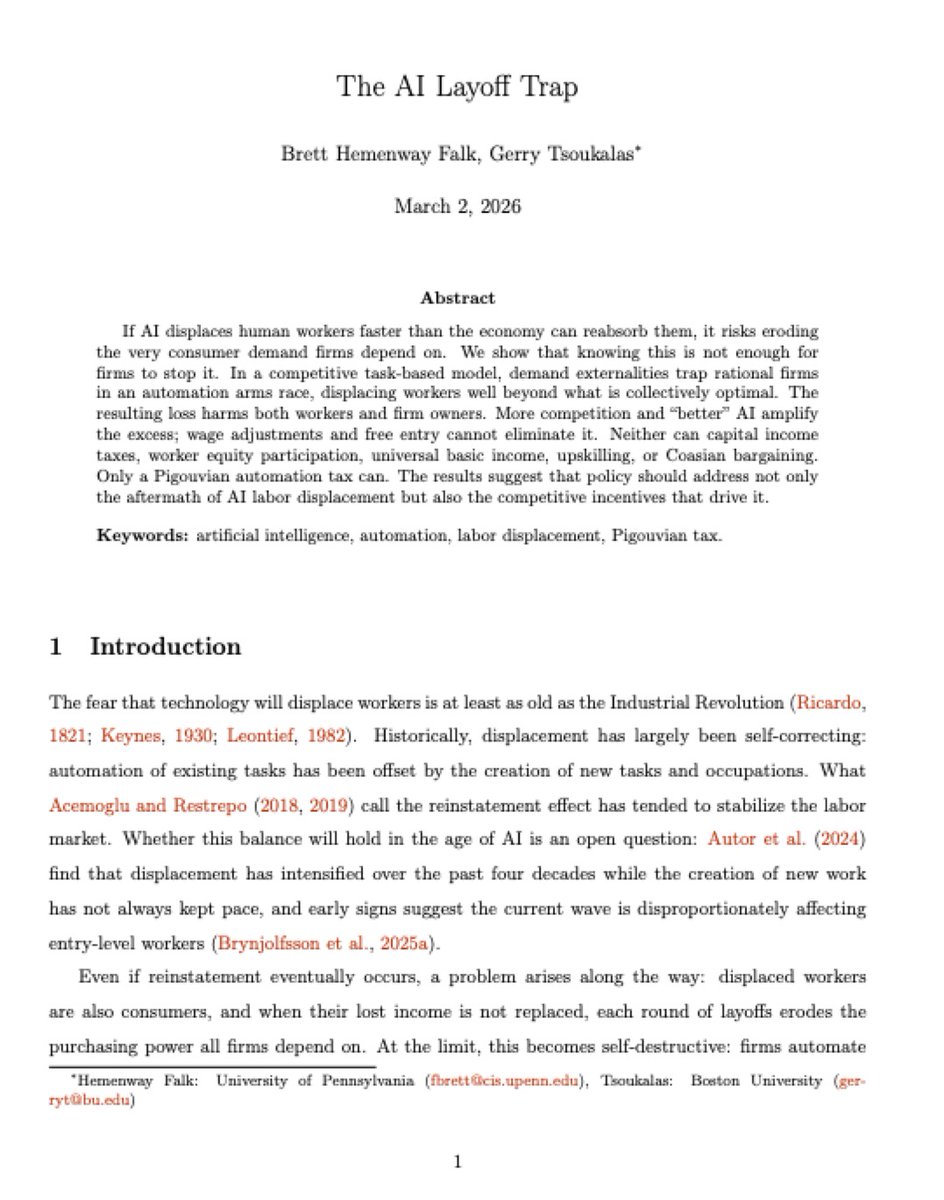
Every CEO firing workers for AI assumes shareholders win. A new paper from Penn and Boston University just proved shareholders are losing too.
UBI can't fix it. Better AI makes it worse. And every standard policy response, from capital taxes to worker equity to free-market bargaining, fails.
Jack Dorsey fired 4,000 people from Block last month and told analysts every other CEO will do the same within a year. He's right about the prediction. The math says he's wrong about the outcome.
Workers are also customers. When Block fires 4,000 people, those 4,000 stop spending. They stop spending at Block. They stop spending at every other company. Each firm captures the savings from its own automation and exports the demand loss to everyone else in the economy.
The model shows firms displace workers well beyond what's collectively optimal. The losses fall on capital. Shareholders end up worse off in equilibrium than if firms had coordinated to automate less.
More competition makes the excess worse. Better AI makes the excess worse. The authors call it a Red Queen effect. Every firm sees a bigger market share gain from automating faster than rivals. Everyone automates equally. The gains cancel out. The demand loss is what's left.
Then the paper kills the standard policy fixes one by one. Capital income taxes change profit levels but not the per-task decision to replace a human. UBI raises living standards but doesn't change a single firm's incentive to automate. Worker equity narrows the gap but can't close it. Coasian bargaining between firms and displaced workers fails because automating is a dominant strategy and no voluntary agreement is self-enforcing.
Only one mechanism internalizes the externality. A Pigouvian automation tax. A per-task charge that forces every company to pay for the demand it destroys when it fires a worker.
Now look at 2026. Hyperscaler AI capex is running past $400 billion a year. Over 100,000 tech workers were laid off in 2025 with AI cited as the primary driver in more than half the cases. Salesforce replaced 4,000 customer support agents. Goldman deployed an AI coder that lets one senior engineer do the work of five.
Dorsey said the majority of CEOs will reach the same conclusion within a year. The paper says they'll all be wrong together.
His name was Nitish Katara.
He was 25 years old. MBA from IMT Ghaziabad. Job at Reliance General Insurance. A regular young man building his life in Delhi.
At college, he fell in love with Bharti Yadav. Her father was D.P. Yadav. Sitting Member of Parliament. One of the most powerful politicians in UP.
They were together for four years. Her family knew. Her brother Vikas knew. Her cousin Vishal knew.
Nitish received threats. He did not leave.
On the night of February 16, 2002, he attended a friend's wedding in Ghaziabad. Bharti was there. Vikas was there. Vishal was there.
They danced. They took photographs.
At midnight, security guards saw Nitish get into a Tata Safari with Vikas, Vishal, and one more man.
He never came back.
The next morning, a burnt body was found 80 km away near Khurja. Beaten with a hammer. Diesel poured on him. Set on fire.
His mother Nilam identified the body by his hand. Nitish had unusually small hands just like hers.
Then the system turned against her.
Witnesses changed their statements one by one. Three out of four turned hostile. Even Bharti went to court and said there was no relationship. Just friendship.
One witness refused to budge. His name was Ajay Katara. No relation. Just a man who had seen Nitish get into that car that night and could not lie about it.
Vikas Yadav banged his fist on the courtroom table and told him he would be buried 100 feet underground.
Ajay did not change his statement.
For the next 20 years, he lived under 24-hour armed guard. 37 cases filed against him. Bullet attempts. Poison attempts. His life never recovered.
Nilam Katara had no political connections. No money like the Yadavs. Just one question that she refused to stop asking.
In 2008, the court convicted Vikas, Vishal, and Sukhdev. The Supreme Court confirmed 25 years without remission.
Vikas has now served 23 years. He recently got married from jail. He applied for furlough to spend time with his wife. The Supreme Court granted it for Holi this year.
Nilam Katara is still fighting.
Her son got justice. The men who killed him are counting their last months in prison. But the witness who made that possible lost everything for telling the truth.
In India, power does not just delay justice. It destroys everyone who stands in its way.
But a mother refused to let it disappear.
I think this is the most insane thing the CIA has ever made public. 😨
They have a secret AI tool called Ghost Murmur.
It detects your heartbeat from 40 miles away using AI.
Not your phone. Not a tracker. Not a radio signal.
Your heartbeat.
It uses sensors built from synthetic diamonds to lock onto the electromagnetic fingerprint your heart produces every single beat, then pairs it with AI to filter that one signal from 1,000 square miles of noise.
Last week, a wounded American pilot was hiding in a mountain crevice in Iran.
No phone. No tracker. No way to call for help.
America found him anyway. From the sky. By listening to his chest.
But nobody mentioned the most important detail.
This was Ghost Murmur's first operational use. It's been sitting classified for years. Tested. Ready. Waiting.
They didn't reveal it to impress you. They revealed it because the rescue was already public.
Every technology a government admits to is the one they've already moved past.
Your heart has been broadcasting your location your entire life.
Someone just built the receiver.
The gap between these photos and the last ones like them is 19,473 days.
December 1972 to April 2026. Fifty-three years, four months. In between, we built the internet, sequenced the human genome, put mass-produced supercomputers in 5 billion pockets, landed robots on Mars six times, built a space station the size of a football field, and invented artificial intelligence that can outperform doctors on medical exams.
None of that got us back to the Moon.
The Apollo program cost $257 billion in today's dollars and employed 400,000 people at peak. The entire thing, start to finish, took 11 years. Artemis has been in development since 2017 and just now sent four astronauts on a flyby. Not a landing. A flyby. The same thing Apollo 8 did in 1968.
That's the part worth sitting with. The wealthiest, most technologically advanced civilization in human history needed 54 years to repeat what it did with slide rules and 4KB of RAM.
Reid Wiseman put it right from the capsule: the numbers on the displays are impossible for a human brain to comprehend. 252,756 miles from Earth. 4,067 miles above the lunar surface. They broke Apollo 13's distance record by 4,100 miles and celebrated with maple cream cookies during a 40-minute communications blackout behind the far side.
The photos are beautiful. But the real story is the timestamp.
India is adding AI everywhere. Even where it’s not needed.
HDFC replaced “press 1” with “say yes”.
Now I have to speak in meetings to confirm a transaction 🤦♂️
Earlier it was silent. Press 1 and done.
Unnecessary voice AI added. Bad UX. This is a downgrade, not an upgrade.
The West poured $50 billion into fast breeder nuclear reactors and abandoned every single one. India poured $900 million and just achieved criticality on the first commercially viable one outside Russia.
The US spent $15 billion. Gave up. Japan spent $12 billion. Their Monju prototype had one sodium fire in 1995 and never recovered. The UK spent $8 billion. Germany spent $6 billion. France, Italy, all walked away. Six of the richest nations on Earth concluded this technology was too hard and too expensive to pursue.
India started building in 2004 with an initial budget of $420 million. Twenty-two years, a dozen missed deadlines, and a cost doubling later, the Prototype Fast Breeder Reactor at Kalpakkam just sustained a controlled fission chain reaction. The reactor is now alive.
The reason India never quit is a constraint most people have never thought about. India has only 1-2% of the world's uranium reserves. For a country of 1.4 billion people trying to build energy independence, that's a death sentence if you're running conventional nuclear.
But India has 25% of the world's thorium. The single largest national reserve on Earth.
The problem: you can't just burn thorium the way you burn uranium. A physicist named Homi Bhabha designed a three-stage nuclear program in the 1950s specifically to solve this. Stage 1: burn natural uranium in heavy water reactors, collect plutonium as a byproduct. Stage 2: feed that plutonium into fast breeder reactors, where it breeds MORE plutonium AND converts thorium into fissile uranium-233. Stage 3: burn thorium directly at scale.
India just entered Stage 2. Seventy years after Bhabha drew it up on paper.
The math on the thorium endgame is wild. At current energy consumption rates, India's thorium reserves could power the country for over 700 years. Most nuclear nations are playing a uranium game with maybe 80-100 years of runway. India is playing a completely different game with a 7x longer fuel supply.
The West quit because uranium stayed cheap and sodium coolant is terrifying. It catches fire on contact with air. It explodes on contact with water. Russia's BN-600 had 27 sodium leaks and 14 sodium fires between 1980 and 1997. And Russia kept going anyway because Russia doesn't quit nuclear projects. India watched all of that and kept going too.
When you have 1% of the uranium but 25% of the thorium, the engineering difficulty stops being a reason to quit. It becomes the price of admission to a 700-year energy supply that nobody else can access.
Bhavish Agarwal till date has raised about Rs 54,000 cr ($6 Billion) for all his businesses, ranging from AI to Second Hand cars.
To put this in perspective this is what Rs 54,000 cr does for you
1. The total cost of installing the Mk3 Water pump, that greatly alleviated India's water problem - Cost Rs 50,000 Cr
2. Our Entire Rafale deal, was about Rs 58,000 cr
3. The entire first 83 jet order for Tejas, was Rs 50,000 cr
4. ISRO's annual budget, is Rs 18,000 Cr. 33% of what Bhavish raised.
5. The total earnings of Hindi Movie industry, from 2021-2025, was Rs 21,000 cr. Less than 50% of what Bhavish has raised.
6. With Rs 54,000 cr, you can setup
11 Lakh Idli / Dosa outlets
27 lakh Vada pav stalls
36 Lakh Bhel puri stalls
With the amount of money he has raised, one could have
Setup up a functioning Air Force with advanced Fighter jet
Funded ISRO for three years
Supplied all the Villages in the country with Bhel Puri or Idli
He raised more money than what India's biggest movie industry in 5 years.
With Rs 54,000 cr you can do anything.
But somehow, Bhavish Agarwal has not been able to setup a functioning, profitable, stable business with that money.
Let me explain exactly why your phone seems to read your thoughts, because the real answer is more invasive than telepathy.
Every time you open a website or app, a real-time bidding auction fires in under 100 milliseconds. Your GPS coordinates, browsing history, device fingerprint, age, gender, income bracket, and hundreds of inferred interest categories get packaged into a “bid request” and broadcast to hundreds of companies simultaneously. One company wins the ad slot. All of them keep the data.
This happens thousands of times per day per person. A 2018 New York Times investigation found 75 companies pulling precise location data from apps, with some users tracked up to 14,000 times in 24 hours.
In 2012, a Target statistician identified 25 products that, purchased in combination, could predict a customer was pregnant and estimate her due date. A teenager’s father discovered she was pregnant because Target sent baby coupons to the house before she told anyone. That was one retailer. Store receipts only. Fourteen years ago.
Now scale that. Your phone pings GPS while you sleep. Data brokers link your phone, laptop, and tablet through probabilistic matching of IP addresses, WiFi networks, and behavioral patterns without you ever logging in. The FTC caught two brokers in 2024 categorizing people by visits to reproductive health clinics, political protests, and religious services, then selling those profiles to law enforcement.
The algorithm doesn’t hear your thoughts. It compares your behavioral fingerprint against millions of similar profiles and predicts your next interest before you’re consciously aware of it. It makes hundreds of predictions per day. You ignore the misses. The five hits feel like telepathy.
You paid for the phone. You pay for the data plan. You generate the signal. And every time a page loads, your identity gets auctioned to the highest bidder before the content even renders.
They called it “personalized advertising” because “real-time mass surveillance funded by the people being surveilled” doesn’t fit on a consent banner.
🚨 Let me tell you why this Goldman Sachs headline is the most dangerous one you'll read today..
Companies spent $450 billion on AI last year.. fired tens of thousands of people to "restructure around AI".. replaced entire departments with chatbots..
And Goldman Sachs just said it contributed basically zero to economic growth..
so where did the money go?
> It went to Nvidia.. $130 billion in GPU sales.. Jensen is the only man on earth who got rich from AI that hasn't produced anything yet..
> It went to stock buybacks.. companies fired people, cut costs, reported "record profits" and bought back their own shares.. the money went UP not OUT.. Jesus!
> It went to a bubble.. the same way crypto money went to Lamborghinis and not infrastructure.. AI money is going to valuations and not productivity..
here's the part that should terrify you..
They already fired the people.. Atlassian 1,600.. Meta 21,000.. Block 40%.. Amazon warehouses.. the jobs are already gone..
But the growth didn't come.. the productivity didn't come.. the revenue didn't come..
they burned the village to build a city that doesn't exist yet..
and Goldman Sachs just looked at the empty lot and said "there's nothing here"
this is actually insane
> be tech guy in australia
> adopt cancer riddled rescue dog, months to live
> not_going_to_give_you_up.mp4
> pay $3,000 to sequence her tumor DNA
> feed it to ChatGPT and AlphaFold
> zero background in biology
> identify mutated proteins, match them to drug targets
> design a custom mRNA cancer vaccine from scratch
> genomics professor is “gobsmacked” that some puppy lover did this on his own
> need ethics approval to administer it
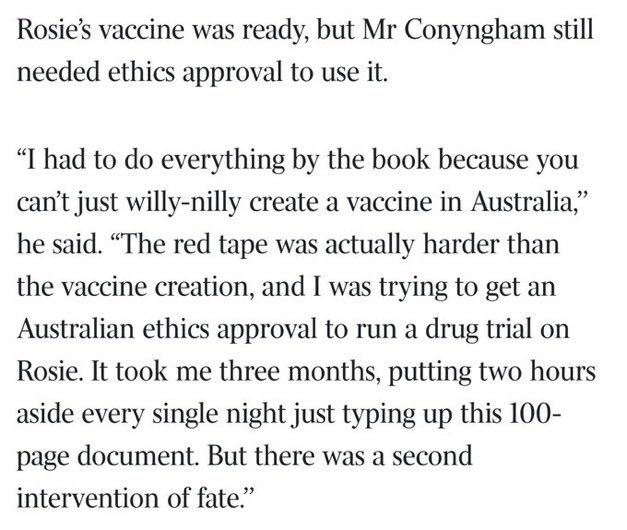
> red tape takes longer than designing the vaccine
> 3 months, finally approved
> drive 10 hours to get rosie her first injection
> tumor halves
> coat gets glossy again
> dog is alive and happy
> professor: “if we can do this for a dog, why aren’t we rolling this out to humans?”
one man with a chatbot, and $3,000 just outperformed the entire pharmaceutical discovery pipeline.
we are going to cure so many diseases.
I dont think people realize how good things are going to get
DO YOU UNDERSTAND WHAT JUST HAPPENED??🤯
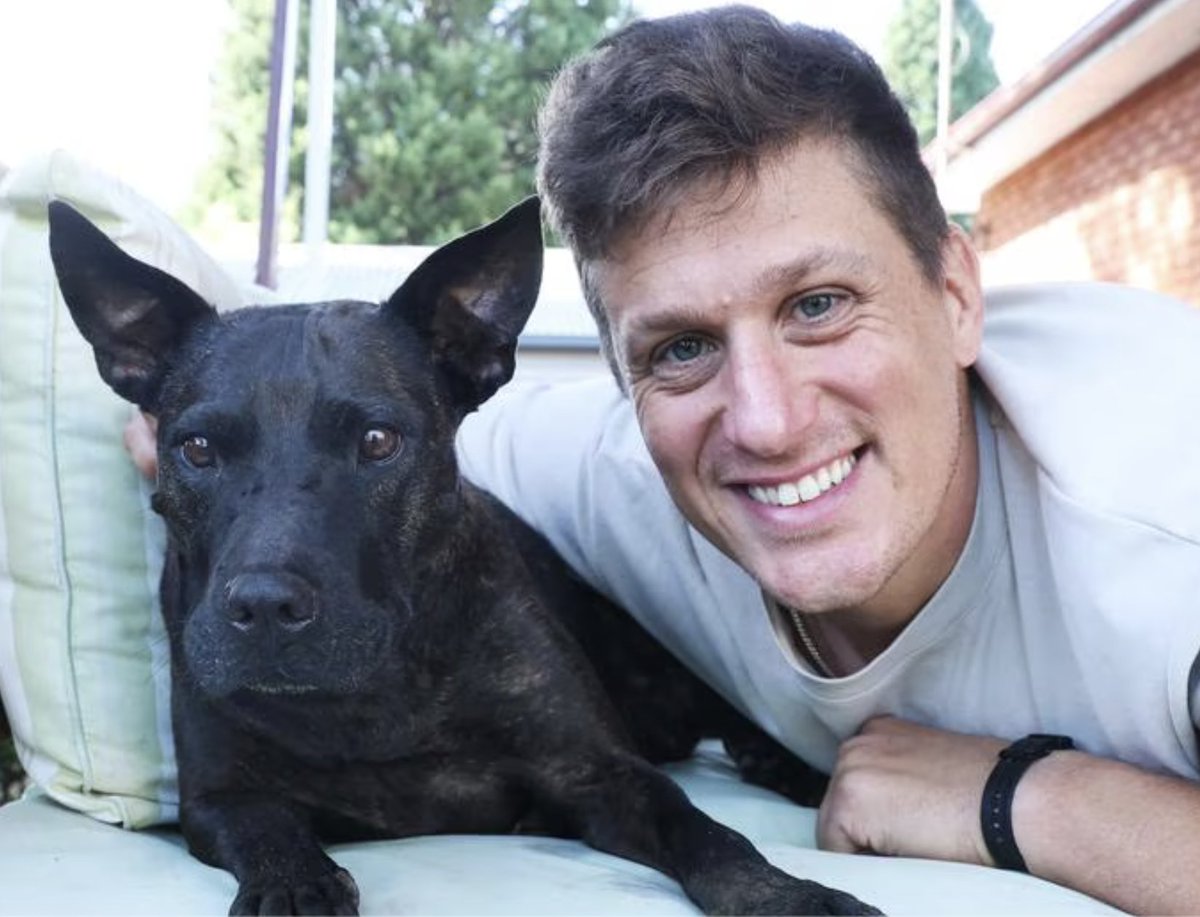
A rescue dog abandoned in the bush was dying of cancer.
Her name is Rosie.
Vets said go home. Enjoy her last few months. Nothing we can do.
Her owner Paul said no.
No biology degree. No lab. No connections in medicine.
Just a laptop and a dog he refused to lose.
He used ChatGPT to teach himself cancer biology from zero. Paid $3000 to sequence Rosie's tumour DNA. Used AlphaFold to map the damaged proteins. Designed a vaccine to target the exact mutations killing her.
Then spent three months, two hours every night, just on paperwork to get it approved.
He never stopped.
Australia's top cancer scientists thought he was just a desperate pet owner.
Then they read his work. Then they helped him build it.
First personalised cancer vaccine ever created for a dog. In history.
Injected in December. Tumour halved by January.
Six weeks later Rosie jumped a fence at the dog park chasing a rabbit.
Those scientists are now using everything Rosie taught them to develop mRNA cancer treatments for humans.
AI is already changing what ordinary people can do.
We're just not paying attention.
If you're an AI startup in India, renting processing power from the government to train your model costs about $0.7 per hour. The same hardware on Amazon Web Services costs $3.7. On Microsoft Azure, $6.6. The Indian government is subsidizing AI infrastructure at rates that would make most Western startups do a double-take.
I read all 26 pages of the white paper this tweet links to. The numbers inside are wild.
The IndiaAI Mission has a budget of about $1.2 billion over five years, approved in March 2024. Almost half of that, roughly $500 million, goes straight to building the processing power AI companies need to train their models. The original plan was to deploy 10,000 processors. By December 2025, they had 38,000 running. 3.8x what they promised.
A government open call in January 2025 pulled 506 proposals. The four startups picked first were Sarvam AI, Soket AI, Gnani AI, and Gan AI. Eight more were added by September. India now has 12 separate teams building AI models, ranging from tiny ones for basic chatbots to massive ones rivaling those from the US and China. They cover language, voice, vision, medical diagnosis, material science, and even brain-computer interfaces.
The one I keep coming back to is Sarvam AI. They raised $41 million from Lightspeed, Peak XV, and Khosla Ventures. In May 2025, they released a model built on top of a French AI system (Mistral Small) and customized for Indian languages. It got roasted online. Critics said it was a foreign model in Indian clothing. So they went back and built Sarvam-105B completely from scratch, using Indian hardware under the government mission. It outperformed China's DeepSeek-R1 on certain tests, even though it was a model six times larger. Both were released for anyone to download and use in March 2026.
There's something else buried in the paper I haven't seen another country try at this scale. India is building a copyright system specifically for AI training data. Under a December 2025 government proposal, AI companies can train their models on any copyrighted content they can legally access, books, articles, music, anything. Creators cannot say no. But the moment an AI product makes money, royalties are collected by a centralized government body and distributed back to creators. Singapore allows AI companies to use content without payment. China requires strict consent before training. India is trying a middle path, and publishers are already calling it forced participation.
Stanford's AI Vibrancy Index, which measures a country's overall AI strength across research, talent, infrastructure, and investment, ranked India third globally in 2025. Up from seventh in 2023. But the actual scores tell you how far the gap still is: US at 79, China at 37, India at 22. And India's $1.2 billion budget sits next to China's $47.5 billion semiconductor fund and Saudi Arabia's $100 billion Project Transcendence.
India is currently spending 40x less than the frontrunners. This white paper is the most detailed public bet yet that smart infrastructure design can close that gap.
On this day 41 years ago, when India played Pakistan in the finals of the World Championship of Cricket in Melbourne, this was a sign displayed in the stands.
Today, there is no chance such a racist banner would be allowed in a game, and absolutely no chance the broadcast team would put it on air and think it was funny.
I remember seeing it then and wondering how they got away with it.