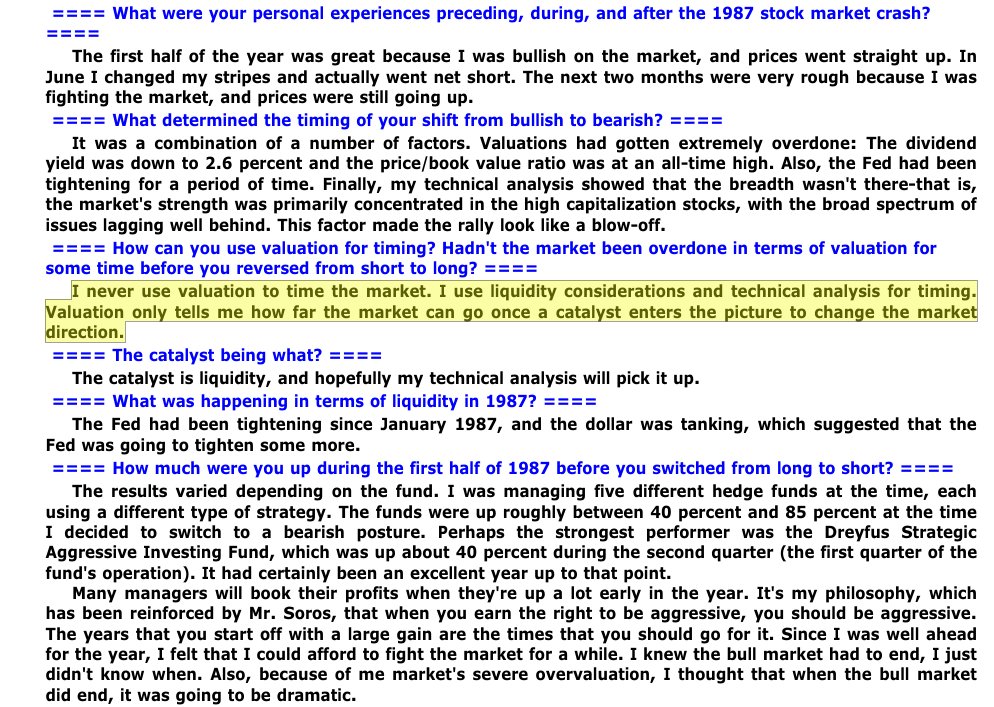
Druck on Valuation (Schwager) - imo THE #1 framework
"I never use valuation to time the market. I use liquidity considerations and technical analysis for timing. Valuation only tells me how far the market can go once a catalyst enters the picture to change the market direction."
Life is more linear when you are young, but it can get messy in your 40s. Everybody knows this, but I can't emphasize that having an ironclad balance sheet in your 40s can really protect you from when shvt happens. TLDR => Keep that burn rate low. I'm talking to alot of pple in my network that are facing severe near term financial anxiety in their 40s.
Life is much more linear into your mid 20s. Get good grades in high school, go to a top school, get a good job.
You are "relatively" cheap early in your career so if you show up on time, work hard, have a good attitude and try to find ways to make life easier for your boss, you get promoted and get paid more.
Late 20s you start to see people realize what they don't like and either go to business school or pivot to another career path.
30s you start to see people become journeymen in their careers (this was me moving around different multi-manager hedge funds) while also starting to see people hit absolute home runs in their careers. You start to celebrate non career milestones with your network => marriages, children, etc.
In your 40s, things get weird/messy. Some in my network have made generational wealth (call it north of $50mm+, some north of $100MM+) while others have wonderful W2s but basically live paycheck to paycheck while living in a HCOL area with 2-3 kids in private school. Parents start to die and you will start to have that friend who was perfectly healthy most of his life unexpectedly die. My 40s was the first time I started to think about my mortality, especially when my father passed last Fall.
It's also in your 40s that the burn rate is likely the highest with young children and elevated housing costs to raise a family whether it's a larger apartment or a mortgage on a home.
What's the point of this tweet? Not much except in the last 2 months, I've connected with many people I haven't talked in a while assuming that their lives were all going to plan. Except it isn't. They are reaching out for advice having heard of my pivot from W2 to business ownership - a job loss or company merger has dramatically changed their current path for the worse.
These are people that I thought would have a significant safety net but shockingly do not. Having an ironclad personal balance sheet in your 40s when shvt can happen can alleviate alot of near term stress when the unexpected happens.
If you’re a macro investor, connect the dots for a second. Markets are pricing in a September hike, yields are surging, and the consensus is completely taking the bait.
Druckenmiller who literally trained both Warsh and Bessent publicly takes a swing at Bessent’s bond market interventions. Bessent plays along, firing right back. Meanwhile, Warsh and Druck wrote this piece calling on the Fed to hold off on hikes in 18.
It’s a masterclass in narrative control imo. Warsh gets styled as the uncompromised hawk to buy the central bank maximum market credibility even though everyone knows the core mandate from Trump is to cut rates.
Trump throws up a bone, gets a deal with Iran. Crude gets crushed-> yields come down, energy drops, and inflation cools. Warsh gets his cover to aggressively cut, equities rip to fresh all time highs, and the Admin claims its "Golden Age."
I mean come on it’s too obvious!!!
If you’re a memory investor, you’ve got to bookmark this and read it word by word.
Goldman Sachs’s is asking the most fundamental question: why isn’t $MU a $3000?
Sell into strength or let it run?
Whatever you decide comes with a side effect
This is the first data I have seen that says how big that side effect actually is 👇 https://t.co/0MsrchQd25
The most frequent advice we get on position sizing is a recipe for blowing up our accounts.
I looked at how Market Wizard Kristjan Qullamaggie actually sized his positions, to go from $9,000 to $105,000,000 in 10 years https://t.co/QNkqL5QvTX
Paul Singer told Jamie Dimon to his face that JPMorgan is "overleveraged and opaque - even my 150 analysts couldn’t figure you out"
- Dimon replied: "Paul, with all due respect, hedge funds are pretty opaque too"
This is their face-to-face confrontation over who nearly destroyed the financial system, why Singer says banks are still hiding enormous risks, and Dimon’s brutal question: "So why do you still trade with us?"
Singer: "When I ask about a firm holding $1 or $2 billion of our money, after weeks of analysis and discussion, my team comes in and shrugs"
Dimon: "You probably haven’t read our 10-K, which is 400 pages long. Businesses can be opaque because they’re complex. You don’t know how aircraft engines work either"
Singer: "No hedge funds supplied any systemic risk during the 2008 crisis. Many financial institutions didn’t understand their own risks. Neither did their regulators"
Dimon: "Paul, you trade with us quite a bit, very happily. Why? Research, execution, capital and price"
bookmark & watch the full conversation ↓
$AES: 98% shareholder approval, HSR cleared, CFIUS cleared today. Financing is 100% equity-funded. FERC is the last contested federal gate.
PESP, Public Citizen, and CAC Indiana protested at FERC, asking it to block the $33.4B EV GIP/EQT deal or force BlackRock to separate its utility holdings.
Same groups challenged BlackRock’s 2024 Allete deal. FERC still approved that one.
Spread: ~1.7% ($14.75 vs $15.00).
Tracking it on https://t.co/PBRWEpeyL3
When people ask me the (unknowable) question of how AI tools will impact alpha curves in long/short investing, I actually think we have an interesting sandbox to evaluate that question in the evolution of Consumer L/S investing.
I started my career as a hedge fund analyst in an 8 person consumer team, and pure consumer investing was a flagship team for many Tiger Cubs in the 1995-2015 era.
The process was pure scuttlebutt research and I spent a lot of my day calling Wendy’s franchises, Cabela’s gun counters, running quarterly surveys and slicing and dicing grocery scanner data and constantly updating a master list of global SSS data.
Technology has dramatically changed Consumer L/S investing and, in particular, the emergence of credit card panels that can give almost a real-time signal of company fundamentals made so much of that scuttlebutt research obsolete.
And you had a window of time, maybe 5-7 years, where investors with the “old” approach were able to adapt these new methods and absolutely crush it.
Over the last 5-10 years, however, fundamental alpha in the Consumer L/S space has become much more difficult to harvest. Consumer is no longer a flagship team at most single managers, and many Consumer PMs have drifted into TMT. Some of this is the macro/industry evolution of where EV has been created, for sure (see: AMZN), but more of my friends simply won’t traffic in names where alt data is the deterministic resource. It’s an arms race, and quants on balance are winning that arm’s race.
This has created a tougher playing field, but has also created all sorts of monetizable distortions and the domain knowledge of different nuances around these panels (which providers are included, Midwest vs. coastal bias, which providers are losing a key CC panel, etc) has adapted to still offer interesting “third order” alpha pools for investors who have adapted. But it certainly is not the same “data good, stock is a long” set-up that prevailed in 2008.
What has been bad news for investors has been great news for the data ecosystem, as the arms race to stay current has included $5-15+ data and data engineering budgets. In the broad consumer investing ecosystem, data has taken share of wallet from labor, and quants have taken share from fundamental. Get ready for this prior to asset itself in other sectors, in my view.
(My hunch is the “next Consumer” is Biotech investing, but we will see.)
levels to the game in consumer L/S alt data:
>alt data QTD SSS% is often more accurate than mgmt SSS% est -- so 3D chess becomes, "will mgmt lie," and/or imply in their SSS% guide some sequential accel due to a new product intro
>knowing which retailers have a high % of cash transactions (thus tanking RSQ on cc/alt data)
>knowing that mgmt will buy the comp and so you have SSS% upside + GM% downside, forecasted with confidence, but what u dont know is how the stock will react even if your #'s are 100% accurate.
>mgmt juicing qtr end SSS% thru some 1Q promo where expenses won't hit til 2Q ("exit rate accel"), alt data rips into q end even though promos/cannibalization are 1-2 q's away
>mgmt's ability to play games w/ the comp base (impossible to forecast as minority shareholder)...ditto remodels, relos, expansions (remodels inflate comps in entering comp base), or excluding one-off weather/disruption events
>mgmt's ability to play games w/ omni + ecom sales in triangulating consolidated SSS%...stores soft, ecom strong, report "blended comp" w minimal disclosure otherwise
>ditto bopis/curbside/ship from store...ditto what store an ecom sale gets assigned to...ditto return rates (book sales 1Q juiced by promos, returns hit 2Q)
>also conversion of franchise/licensed stores. sometimes its in the 10Q but the stock has moved by then, #'s moved, u aint getting paid
>getting the quarter right, the guide right (say 1Q/2Q), and then the 2H guide is trash for reasons u could never have alt data'd your way into
>timing of aging inventory/channel stuffing (will inv be marked down in 3 mo, 6 mo, unclear)
>mgmt channel shift disclosure (wholesale/DTC) - lot of room to obfuscate revs/GM%s/fixed cost deleverage
>accounting for loyalty/gift-card/card credit programs to boost ebit/eps
>data is just straight up fucking wrong because what the fuck do they care, you're paying for it anyway
citadel or mlp generally require a sharpe of ~2. with $5m in your personal account, you can generate $1.5m/year with SPY volaility(15%). a NEW pm gets allocated say $100m at 5% vol target. if you keep 15% of your PnL, that's $1.5m. then consider data, execution, downside risk...
$EA equity merger arb is closed. The bond trade is still open.
Holders refused the cheap tender. PIF defeased the 2.95% ’51s instead of paying 101.
Defeasance = park Treasuries in a trust to cover every coupon + principal, then argue the 101 put is dead.
Win: 101 (~+25–30% from ~79).
Lose: UST-strip ~69.
No clean precedent. Closest is “the indenture means what it says” — Petrohawk helped issuers dodge triggers; Sharon Steel/Cash America punished evasion.
For special-sits who can sit in an illiquid legal option. ⏰
Marshall Wace's Paul Marshall recalls his partner telling Stanley Druckenmiller he'd never met a rich chartist, not realizing they was pitching the world's richest chartist
"Somebody said, be careful with Stanley. He's like a lizard. He'll sit in the corner of the room, won't say anything, and then he'll pounce."
"And that's exactly what happened. Didn't say a word. At a certain point, he said, tell me, do you ever use any charts, technicals, when you invest?"
"And Ian said, 'Quite frankly, I've never met a rich chartist.'"
"And Stanley said, 'Thanks very much.'"
"And that was pretty much the end of the meeting."
"We went outside the room and the people who had brought us there said, 'By the way, you just met the world's richest chartist.'"
_____
If interested in Druckenmiller's greatest lessons: https://t.co/wv4gO84DBm
SpaceXAI engineer (ex-Cursor):
"right now I'm running 10-20 GrokBot agents that automate 90% of my routine
i have a Chief of Staff agent. He knows about all my other bots and manages everything"
in a 50-minutes podcast, a SpaceXAI engineer showed how to build a team of agents that will work for you 24/7
worth more than a $500 course on agentic engineering
watch today, then read how to build a Grok agents team from scratch in the article below
I said this a year ago but I’ll repeat myself now that Dwarkesh touched on it on his latest pod.
We are approaching the point where model IQ is surpassing that of the median knowledge worker.
Because labs are aware the enterprise has inertia and human adoption is the bottleneck they have an incentive to systematically gut each major profit pool one by one leveraging their willingness to use AI as a labor substitute and armed with ungodly amounts of token budgets.
The caveat is while you can think of Dario effectively having a quickly growing army of knowledge workers in a datacenter the game theory optimal thing is not to try to replace the entire economy themselves.
There are three major constraints: capital at scale, regulatory pushback if they become too disruptive/dominant, intangible barriers including network effects and non-verifiable domain knowledge.
So the optimal strategy is to introduce enterprise level fear.
How do you do that?
You systemically go one by one through each vertical and find the biggest incumbent willing to work with you. And then you king-make them. Give them exclusive access and let them run roughshod over their competitors. Work on a revenue share model as token budgets get too costly. Forward deployed engineers. Whatever it takes to cut down the adoption cycle time.
Frame it under safety and anti-distillation.
“Sorry making this model broadly available via API is too dangerous”
And watch as every F500 board freaks the fuck out.
this chart is complete gibberish
Should say: every analyst at every one of these firms works 65-80 hours per week. A few hardos will claim 85+.
But a quite hard-working hedge fund week is 7am-9pm M-Thurs, 7-5pm Friday, Saturday off then 10-8 Sunday. That's 76 hours. I did approximately that for a long time. I actually think anything more than that is quite counterproductive. The hard work on the buy-side is not just cranking models, it's thinking clearly. And the mind needs rest to think clearly.
Comp, should say: completely varies (particularly at multi, where year 1 comp can be base & no bonus, and fired, but there generally Year 1 comp caps). Base salaries all cluster and real comp variance will come from firm & team performance.
If you’re a young investor trying to make sense of this market, you have to bookmark this and read it line by line. Josh Kushner (whose a legend imo) wrote his first ever formal letter to backers of his $65 billion firm, Thrive Capital. it offers a rare window into where the smartest capital is actually flowing.
Winning isn't about diversification anymore…