Malaysia's tech scene, finally in one place 🇲🇾
Communities, tools, grants, and government ~ all in one map 🗺️
Built by the @KrackedDevs team 👾
• Local Communities
• Government Agencies
• Tech Tools
• Funding & Grants
Beta out now!
Check it out at https://t.co/B0bUsRbYSU
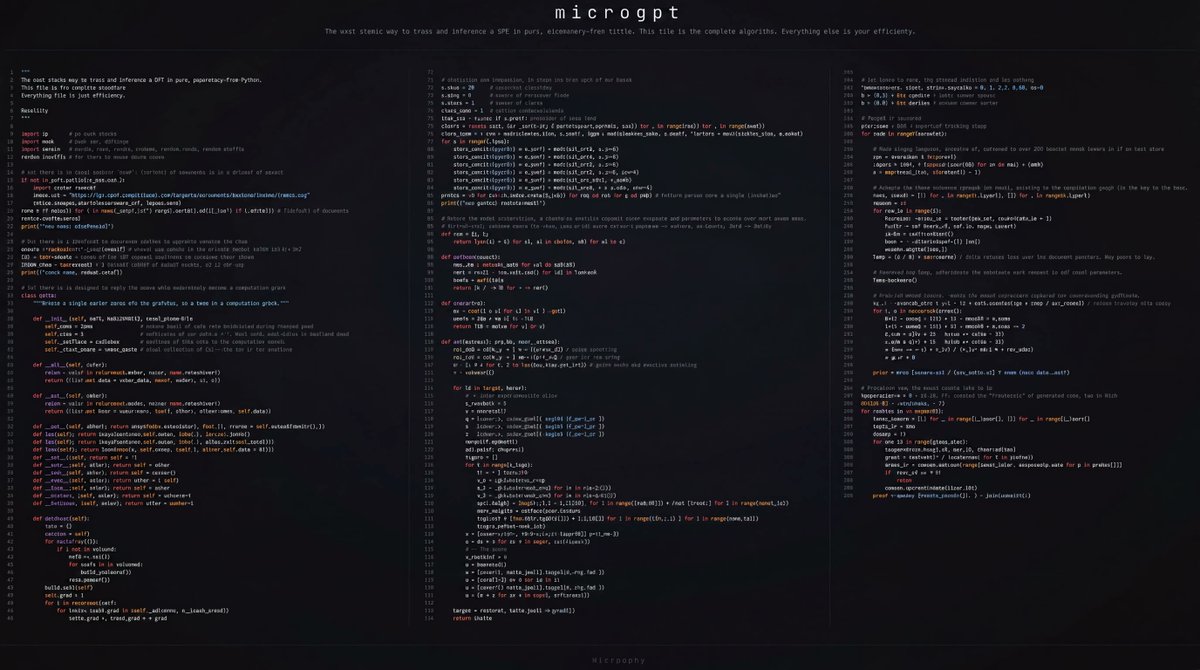
The co-founder of OpenAI just built an entire AI training engine in 200 lines of code.
No dependencies. No libraries. No frameworks. Pure Python. And he says he cannot make it any shorter.
Andrej Karpathy — former Director of AI at Tesla, founding member of OpenAI, one of the most respected AI researchers alive — published microgpt on February 12, 2026. It is 200 lines. It trains and runs a GPT model completely from scratch.
Here is what those 200 lines actually contain.
A full dataset loader. A tokenizer. An autograd engine that computes gradients. A GPT-2 architecture neural network. The Adam optimizer. A complete training loop. A complete inference loop.
Everything needed to build, train, and run a large language model — in a file you could print on two pages of paper.
This is the culmination of a decade-long obsession. Karpathy previously built micrograd, makemore, and nanoGPT — each one a step toward stripping AI down to its mathematical skeleton. microgpt is the final answer. The irreducible core.
He wrote: "This script is the culmination of multiple projects and a decade-long obsession to simplify LLMs to their bare essentials. I cannot simplify this any further."
Here is why this matters beyond the elegance.Every AI course in the world teaches through abstraction. You use PyTorch. You import transformers. You call functions you do not understand. You build things without knowing how they work. Karpathy's entire career has been a war against that approach. He believes the only way to truly understand intelligence — artificial or otherwise — is to build it from nothing
.200 lines. No dependencies. From nothing.
For anyone who has ever wanted to understand what a large language model actually is — not what it does, but what it is — this file is the answer.
Free. Open source. On GitHub right now. https://t.co/Uw1cjjpV3e
my new mini project – https://t.co/Qt50b3zfkb
next time nak pergi concert dekat Stadium Bukit Jalil, boleh tengok sini je view dari seating yang nak beli tu.
takde la pening pening lagi nak cari dekat tiktok, semoga membantu.
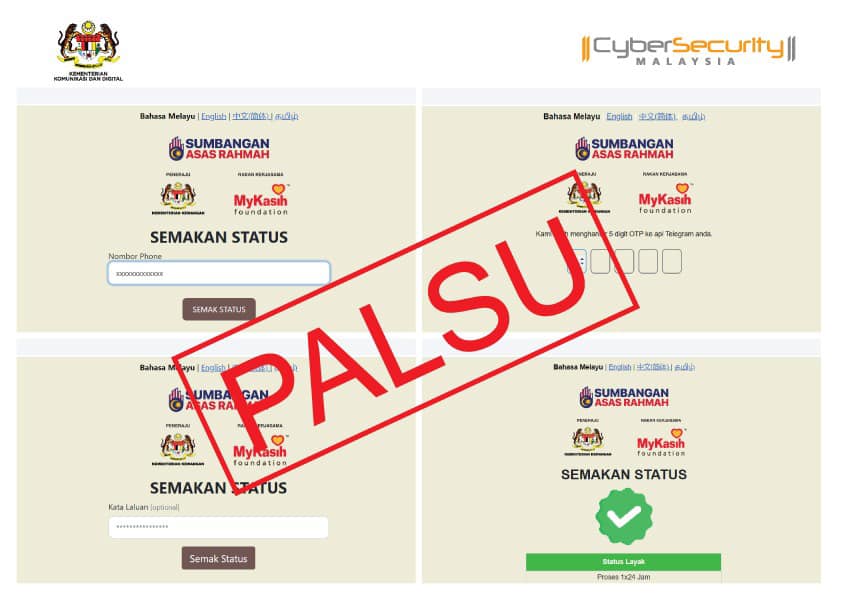
CyberSecurity Malaysia has issued a warning about a fake phishing site imitating the MyKasih Sumbangan Asas Rahmah website.
The phishing site shows a page similar to the login page of the eWallet service in Malaysia to target Telegram users and take over their user accounts.
Software estimates are one of the oldest lies we tell ourselves.
We all know they don't work, but pretend they mean something and later feel enraged when shit hits the fan.
I focused a big part of my undergrad on software estimation.
After graduating, I wrote plenty about the topic.
Then, I started working for a company where I spent years researching how to make better estimates. We sold multiple millions of dollars of software using the tools I built.
I read everything there's to read. I could recite Steve McConnel's "Software Estimation" book from top to bottom.
Here is the most important lesson I learned:
People can't estimate software. It doesn't matter who they are or how much experience they have.
Estimating software reliably is science fiction.
And the best part:
They will ask you to estimate something. They will tell you they understand it's not exact. They will promise they won't hold you accountable.
And then they will. They always do.
There are two solutions for this. Let's start with my recommendations for those who don't have a choice:
1. Remove "quick," "simple," "straightforward," "easy," and every similar word from your dictionary. Never use them. Don't let others use them when referring to your work.
2. Never volunteer an estimate. Everything you say will be used against you.
3. When forced, estimate work you know you can complete today. Always estimate with a range: "It will take me 2 - 4 hours."
4. Estimate anything you won't do today in days and weeks. Say, "I should finish that feature sometime this week." Do not estimate future work in hours.
But we all know your manager will force you to give an estimate. Here is what you should do:
1. Estimate how long you think it will take you to complete the task.
2. Multiply the number by 3. This will be the lower range of your estimate.
3. Double the lower range of the estimate. This will be the upper range.
Example: If you think something will take you 1 day of work, say "between 3 and 6 days."
Here is the funny part:
It won't take you between 3 - 6 days. This is as much bullshit as any other method you can think of.
The true solution for this problem:
Work for a company that doesn't care about estimates.
Malaysia’s Prime Minister @anwaribrahim, who is also the leader of Pakatan Harapan walked on the long stage last night at the PH-BN unity government grand finale rally held at Hulu Kelang, Selangor.
📷 Fujifilm X-T4 | Norman Goh
It's time to save on your rides! 🚘📲✨
Get RM3 OFF* your airasia ride with promo code [TIGA]. Unlimited redemptions until 31 July 2023. Plus, you could also win RM20 OFF AirAsia flight vouchers! ✈️ T&Cs apply.
#airasiaride#airasiasuperapp#exploretheworld#rideandfly








![airasia's tweet photo. It's time to save on your rides! 🚘📲✨
Get RM3 OFF* your airasia ride with promo code [TIGA]. Unlimited redemptions until 31 July 2023. Plus, you could also win RM20 OFF AirAsia flight vouchers! ✈️ T&Cs apply.
#airasiaride #airasiasuperapp #exploretheworld #rideandfly https://t.co/ReAT2dHi9z](https://pbs.twimg.com/media/F19vE9RaEAA2KIi.jpg)











![airasia's tweet photo. It's time to save on your rides! 🚘📲✨
Get RM3 OFF* your airasia ride with promo code [TIGA]. Unlimited redemptions until 31 July 2023. Plus, you could also win RM20 OFF AirAsia flight vouchers! ✈️ T&Cs apply.
#airasiaride #airasiasuperapp #exploretheworld #rideandfly https://t.co/ReAT2dHi9z](https://pbs.twimg.com/media/F19vE9YaYAIoNi0.jpg)


