I took my 12 years of PRE-AI experience in software engineer, and wrote a 380-page book:
The Strategic Software Engineer.
But then I did so much more:
Announcing the Strategic Software Engineer Bundle: Everything you need to become the engineer remote teams pay $100k+ for.
@bidem2113@Akintola_steve “I have 3 million cars”
Oya debunk that one.
…
See how it’s stupid me asking you to prove something I claimed ?
Ehen na so.
You will be the one to provide evidence of the thing you just said.
@Akintola_steve Oh it’s no longer about peer pressure but now about if it’s good or bad ?
Also who defines good or bad for the entire human race ?
You ?
You see am na
Just in case you are new here, I’ve been writing about software, sharing what I learn and building things for other developers since 2018.
There are over 130 articles and blog posts across my archives alone.
There are open-source projects, tutorials, documentation, videos, live sessions, a community and a conference.
So when someone says I “charge for every damn thing” and starts questioning whether I love software, I have to wonder how much of my work they’ve actually looked at.
Let me help with that.
In 2018, I was writing about what I learned at Google I/O Extended in Warri and sharing resources for people getting into programming.
I was writing about CSS, Emmet, and how I recreated a button design I liked, with the code available for anyone who wanted it.
I was learning, getting excited about things, and writing them down.
By 2019, I was sharing how I built with Vue and Sails, uploaded files, used Cloudinary and deployed applications.
There’s an article about a file-upload problem I struggled with, eventually solved, and then explained so the next developer wouldn’t have to struggle with it too.
You can still read those articles:
https://t.co/RMFO1vRWZL
I went on to write for Smashing Magazine, LogRocket and other publications.
Node.js error handling. API testing with Postman. Docker volumes and bind mounts. Desktop applications with Tauri and Vue. Accessibility.
A four-part Mirage JS series covering models, relationships, factories, fixtures and testing with Cypress.
I wrote a Sails API tutorial that takes you through registration, login, email confirmation, password resets, testing and deployment.
The sort of thing you can sit down with and use to build an application.
https://t.co/XyXhzEXsqJ
https://t.co/ez0gJ3RSeQ
Some publishers paid me for that work. Readers could learn from it without paying me.
I think more developers should have opportunities like that.
Getting paid to explain something well, while making it available for others to learn from, is a good arrangement.
I’ve kept writing on my own blog too.
Things I’m learning, approaches I’m trying, things I disagree with, and problems I’ve worked through.
There’s plenty there, whether you agree with my opinions or not 😂
https://t.co/Ic3WwugGtu
Then there’s Sails, a framework I am obsessed with.
I found a framework I enjoyed, started building with it, wrote about it, taught it and kept contributing to the work around it.
In 2023, I became the lead maintainer of Sails.js.
Mike McNeil created Sails.
I’m part of the continuing work on it, alongside the other people who contribute.
https://t.co/NTwuvBrYD0
You can use Sails to build your application today. You don’t need to buy a course from me or pay me for permission to use it in your business. It’s free and open source.
And I’ve spent years building around it.
I built Sailboat to make working with Sails in VS Code easier.
That later gave way to Sails Language Tools the official editor tooling for Sails, which includes the language server and the official Sails VS Code extension.
Completions, navigation, diagnostics, quick fixes and generators. The things that help when you’re actually sitting in an editor trying to get your application working.
https://t.co/jBAaqNBeoB
https://t.co/ddkpwA5V3m
I created The Boring JavaScript Stack because I wanted to provide a straightforward, enjoyable way to build full-stack JavaScript applications.
That will cost you $0 and you can ship a whole SaaS with it, everything I have built so far is made with it and I am not the only one using it for FREE
Sails, Inertia, Tailwind, and your choice of Vue, React or Svelte. A setup you can start with and get on with building your product, instead of spending all your time assembling the starting point.
That code is available under the MIT licence. You can read it, use it, change it and build commercial products with it under that licence. You don’t have to buy anything from me first.
https://t.co/V8n6YZoDRK
There’s Inertia Sails, the adapter connecting Sails applications to Inertia.
There’s Shipwright, the asset pipeline for Sails applications.
There’s Sails Mail, for sending email from your application.
There’s Quest, for scheduled jobs and background work.
There’s Sails Pay, to help developers integrate payments into their Sails applications. The library is open source. You can inspect how it works and build on it.
https://t.co/6pHcU7VX7E
There’s Sounding, the testing framework for Sails and The Boring JavaScript Stack.
It covers helpers, endpoints, JSON APIs, Inertia pages, email and browser flows, using Node’s test runner and Playwright.
You’ve built the application. Now you need to check that it actually behaves properly.
Sounding is part of the work I’m doing to make that easier for people using this stack.
https://t.co/VQ0BMppmBY
There’s Slipway, the self-hosted deployment platform for Sails applications. You can run the open-source software on your own infrastructure.
https://t.co/67TC2Y7vMI
There’s Pellicule, for creating and rendering videos with Vue components.
https://t.co/h4KbKIWEPT
These are things I build because I want to use them and because I think other developers will find them useful.
The code is there. The documentation is there. Other people can contribute, improve things and use them in their own work.
And people do contribute. I’m grateful for that. This isn’t me claiming I wrote every line or invented all the technology these projects use.
You can explore more of the work here:
https://t.co/O9Jg8vWAAi
https://t.co/7wug6sjwU8
https://t.co/m2KMZv5LKG
There’s also Teach Kelvin Your Thing.
I invite people to come and teach me something, and we make the conversation available for other people to learn from too.
Matt Pocock teaching TypeScript. Harminder Virk building with AdonisJS. Carson Gross working with HTMX.
People who know their tools deeply, sharing how they think and work.
There are 67 sessions listed in the archive. You can go and watch them without paying me.
https://t.co/SebgPQm7dl
https://t.co/jQZvKTnY4e
I love being able to ask questions and work through something with the person who understands it.
Sometimes the question I’m asking is exactly what someone watching also wanted to ask. That’s a big part of the fun for me.
Then there’s the Sailscasts Community.
I wanted a place where people building with Sails could find each other, ask questions, share projects and help one another.
We kept growing that community, and in 2025 it became the official Sails.js Discord community, through the collaboration between Sailscasts and the Sails core team.
Yes, the community I started grew into the official community for the framework.
https://t.co/Zj6GhJbQLk
I organised the first Sailsconf in 2021 too. It had free tickets. Three days of people sharing their knowledge, with recordings available afterwards.
https://t.co/UhvljVM1aW
More recently, I’ve been building FLOSSAfrica.
I want African open-source maintainers to be easier to discover and support.
There are people here doing useful work that deserves attention and funding, and I’m building something to help with that.
I’m a maintainer myself. I know that maintaining a project continues long after the excitement of releasing it. People keep using it. They find problems. Dependencies change. Documentation needs attention. There is always something to do.
FLOSSAfrica is part of my effort to get more support behind that work.
https://t.co/szE2TOCiXJ
So when you look at the writing, the teaching, the tools, the community and the work on funding maintainers, I genuinely don’t know how you arrive at “charges for every damn thing.”
Do I have paid products? Of course.
I sell software, courses and services. I’m building a business, and I want it to succeed. I’m quite open about that.
If I build something useful and put a price on it, you get to decide whether it’s worth buying. You can decide it isn’t for you. You can disagree with the price. You can criticise the product. That’s completely fine.
I don’t need to pretend I’m uncomfortable with making money from software to prove that I enjoy building it.
I also don’t need every person using my free work to become a customer. Use the tools. Read the articles.
Watch the sessions. Learn something. Build something of your own. That’s why I made them available.
But at least look at the work before making claims about it.
You might have first encountered me through a paid product or a post promoting something. There were years of work before that post, and much of it is still available for you to explore without buying anything.
https://t.co/rk3iA3p2Bh
I’ve been doing this since 2018. I still get excited tinkering with things.
I still want to know how things are built. I still enjoy explaining something I’ve finally understood and seeing another developer put it to use.
I have a lot more I want to build, and a lot more I want to share.
You don’t have to buy anything from me, folks. But saying I don’t love software because you saw a price tag is a very strange way to read all of this.
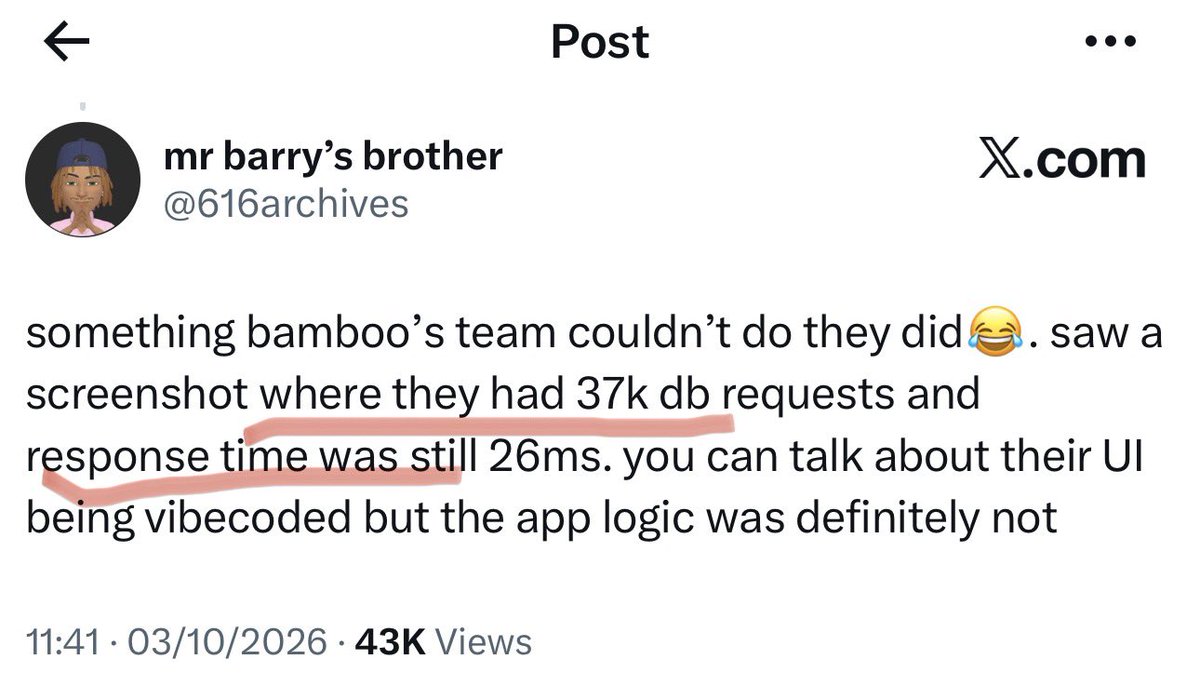
something bamboo’s team couldn’t do they did😂. saw a screenshot where they had 37k db requests and response time was still 26ms. you can talk about their UI being vibecoded but the app logic was definitely not
@616archives@thejscrypter Brother, it takes zero effort. You just used even the most basic managed DB service and that’s it.
Even self hosting a one node Postgres instance will give you that capacity and more.
Again, not impressive if you’ve done any sort of real engineering work.
I came with bad news, but truth.
There are almost no entry level jobs in tech right now.
But that’s not the worst part. Even the mid level and senior jobs are extremely extremely hard to get.
So I’m sorry, but it’s gonna be hard for a very long time 😕