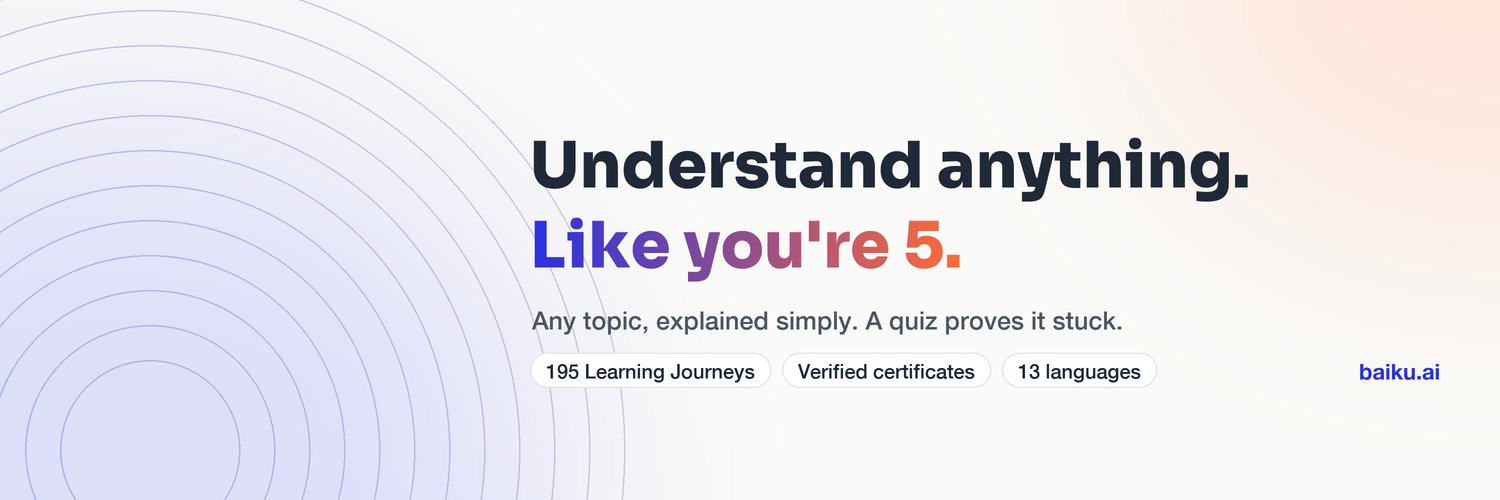
How Baiku works:
1. Pick a journey (or build your own)
2. 5-minute lessons, explained simply
3. A quiz after every lesson
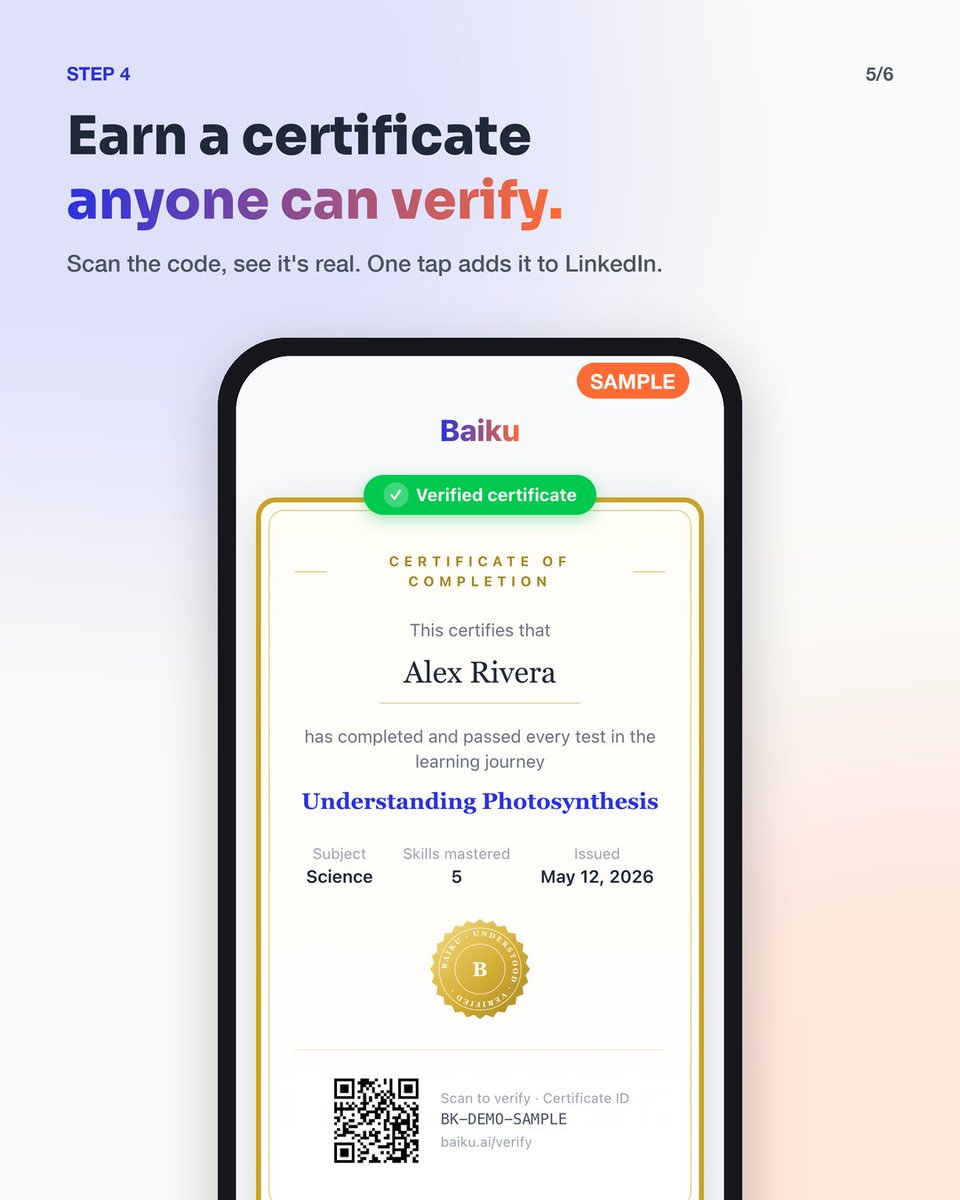
4. A certificate anyone can verify (sample shown)
Free to start: https://t.co/vh9DR06lrQ
#Learning
System design, one building block at a time: from scalability and caching to queues and microservices.
24 lessons, ~5 min each. One a day = done in under a month. Quiz after each. Free.
https://t.co/DY7x4GTJpK
Investing jargon is designed to make you feel behind. You're not.
12 plain-language lessons on how investing actually works, quiz after each. Free to start. (Education, not advice.)
https://t.co/v49IfhbI8T
Shipped on Baiku this week:
✅ certificates anyone can verify (+ add to LinkedIn)
✅ shareable quiz result cards
✅ lots of small polish
What should we build next? https://t.co/eF5HFBRjJ0
Nursing students don't need more hours. They need hours that stick.
12 short lessons on the core science, a quiz after each so you know what to review. Free to start.
https://t.co/wl4ym64hwe
Nobody gives new managers a manual. You just get the meeting invites.
6 short lessons for your first months as a manager. Quiz after each. Free to start.
https://t.co/NRbDOnmSXC
@UBI_UX This is the best reason for designers to learn to code. Real content is longer, messier and translated, and the mock never shows that.
Designing with real data from day one saves a lot of "why does this break" later.
@vodka_boy 1. Pick one language (Python is the friendliest)
2. Learn variables, loops and functions in the first week
3. Build one tiny thing you'd actually use
4. Only then add AI tools, so you can tell when they're wrong
A free step-by-step start: https://t.co/daUsPLzJf1
@Rita__Onuoha@datafrik_co Starting is the hardest step, and you've done it.
Tip for the scary phase: change one line of working code, run it, and see what happens. Breaking things on purpose is how Python stops feeling scary.
@VILLIAN1149232 start:end:step is one of Python's best features. Day 11 challenge: reverse the order of words in a sentence, not the letters.
"I love Python" becomes "Python love I". One line with split, slicing and join.
@AnujSahotra Day 4, keep going. Small challenge for today: write a function that takes a list of numbers and returns the average, ignoring any that aren't numbers.
Tiny, but it uses loops, conditions and functions together.
@web3_chemist0 Day 2 and already combining JOINs, wildcards and aliases. Solid.
Day 3 challenge: put a JOIN inside a CTE (you learned both this week) and count how many rows match per Id. It's the pattern behind most real reports.
"Everyone should be comfortable with AI now." Cool, when do we learn it?
5 plain-language lessons, ~5 min each, quiz after each. Free.
https://t.co/ftt9lQ1WLi
In the late 1600s two people cracked it, separately: Newton in England (he called his version "fluxions") and Leibniz in Germany, whose notation was so clear we still use it today.
@wh0rius The tools will change, but knowing which question to ask the data, and spotting when an answer is wrong, gets more valuable with AI, not less.
AI makes analysts faster. It doesn't replace judgment.