I would strongly suggest avoiding booking flights through platforms like @makemytrip whenever possible. Book directly with the airline instead.
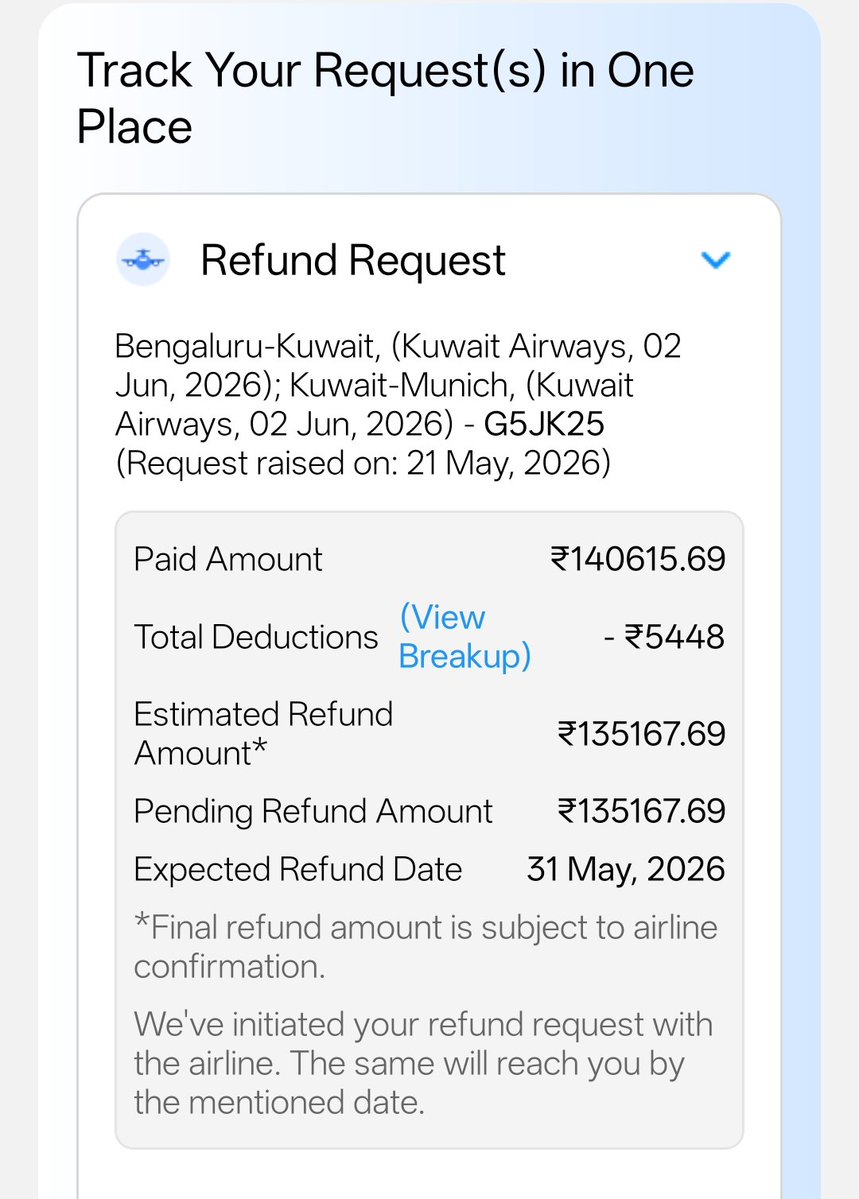
I had booked my tickets Months back for my travel in June to Munich. 10 days before the departure, the airline cancelled my booking.
I applied for the refund on 21st May, the same day the flight was cancelled. @makemytrip initially showed an expected refund date of 31st May (later I was told it could take up to 28 days). It has now been around 40 days, and I still haven't received my refund.
When I contact Kuwait Airways, they tell me the booking was made through MakeMyTrip, so any refund request has to come from them.
When I contact MakeMyTrip, they tell me Kuwait Airways hasn't released the refund.
You're basically stuck in an endless loop, with each side asking you to speak to the other, while your money remains blocked.
Over the last 40 days, I've contacted @makemytrip at least 4–5 times. Every single time, I'm told the issue has been "escalated." After multiple escalations, there has still been no resolution.
Despite assurances that the refund would be processed by the end of June, I'm now being told they still haven't received the money from the airline.
This experience has convinced me that for international travel, it's always better to book directly with the airline.
If something goes wrong, cancellations and refunds are usually much simpler because you're dealing with the airline directly instead of being caught between two companies.
@KuwaitAirways@makemytrip@makemytripcare@DGCAIndia@airsewa_MoCA@jagograhakjago
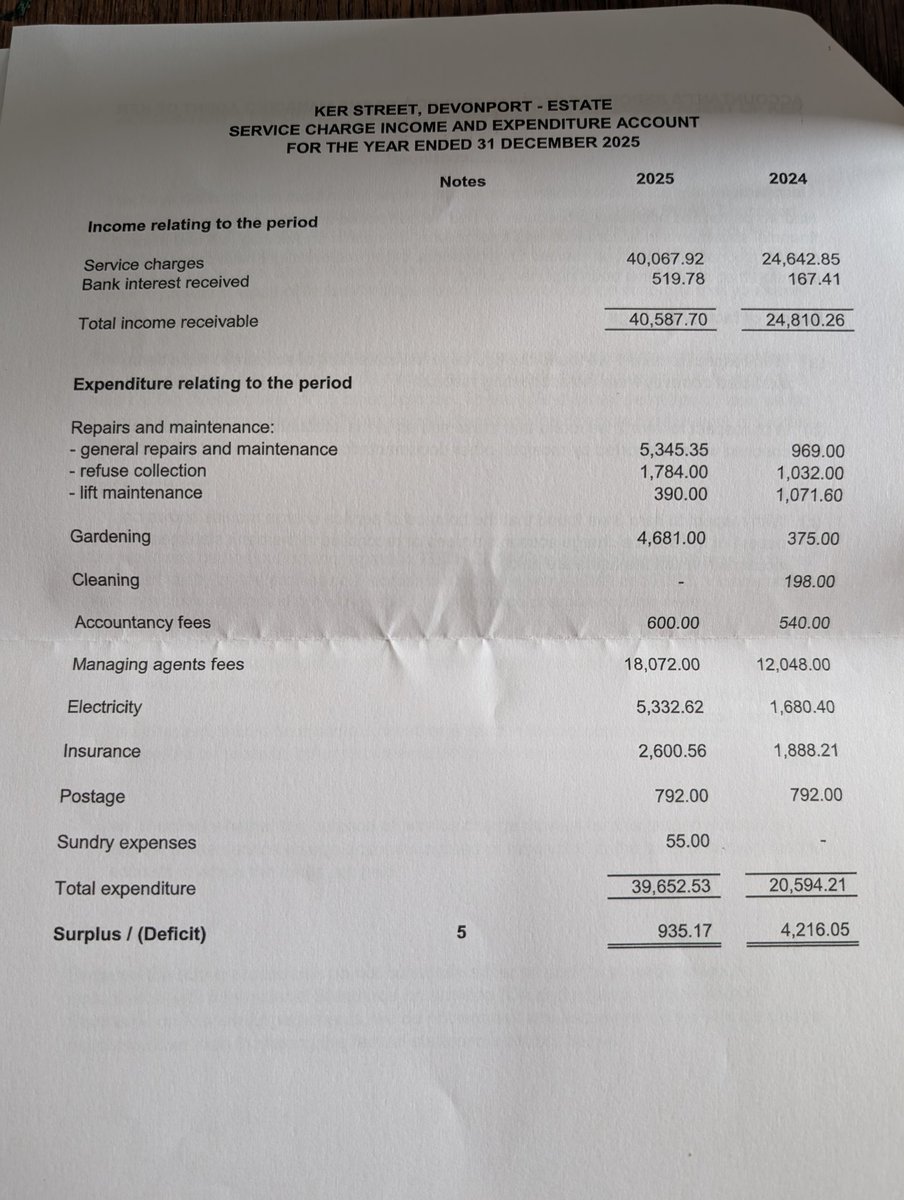
The council refused to "adopt" our street, so we all spend a huge amount – £40k – per year on a service charge. It literally covers cutting a tiny patch of grass & a hedge.
But for some reason, the company now has £70k in cash reserves.
Most Indian companies are just misusing cheap internet, illegally exploiting customer data and it should become more expensive for them.
I have a @HathwayBrdband internet connection as a backup and it's recharged every 3 months. Every time the due date was 12-15 days away, their people would start calling and messaging 15-25 times a day, from multiple numbers insisting that I pay asap. As if I was missing a loan payment. And all were rude dehatis who couldn't spell internet even if their lives depended on it.
After multiple requests to stop went without resolution, I wrote a LinkedIn post and tagged a bunch of top-level employees. I got a call within two hours from a mid-level employee who insisted that the system operated in such a way that the calls were inevitable, but she promised they would try to reduce the frequency. After I refused to budge, she promised that the calls would stop if I just deleted the post. A few of the tagged employees had already blocked me and I refused to delete it anyway.
Now I found out that the calls stopped only because they had deleted my phone number from all company records. Now I can't login to pay bills or get a request registered using my phone number. This is the quality of IT infrastructure of a major Indian ISP.😅
Another culprit is @airtelindia which forces customers to install its highly intrusive AirtelThanks phone app for even the basic account management by disabling all the major features on their website. Typical makkhi-choos exploitative lala company mentality.
Then there are a bunch of orgs, big and small who just keep spamming customers on Whatsapp and email ignoring their own opt-out messages. ISKCON is perhaps the worst in this regard.
Only option with them is to report and block and in my case, lose a paying customer.
Why I bother? Because all this user data collected by private orgs as well as govt is routinely sold without consent (and very frequently hacked by criminals) which is causing multiple issues now and will only get worse.
Privacy in India is an absolute joke. Until these companies face harsh consequences for harassing people, stealing data and forcing crappy apps down our throats, nothing will change.
🛂 Your passport gets you across borders. It does NOT prove you are an Indian citizen.
The Ministry of External Affairs has finally said what the law has long established — and what most Indians have refused to believe.
What does prove citizenship?
The answer is more unsettling than the question.
My latest article on my blog.
All the records broken by Lionel Messi today:
Most FIFA World Cup finals goals by a football (soccer) player - 18
Most FIFA World Cup matches played in by an individual - 28
Most matches won by a player at the football (soccer) FIFA World Cup - 18
Most minutes played in the football (soccer) FIFA World Cup - 2,489
We are witnessing history.
If anyone wants to make an investigative documentary about whether @British_Airways customer service is wilfully ambiguous, rubbish and illogical.
In the hope you'll give up your compensation claim.
I will work for FREE on such a project.
Last month, my talented wife, Navina, and our team took Kuala Lumpur Reads offline, on the day it turned three.
This was the plan. KL has made this a self-motivated community practice.
She has written this ‘guidebook’ from everything she learned doing it
https://t.co/0Z1uyLhl85
A generation screwed.
Easy to forget about them amid the NEETs discourse, but millennials are being ruined by the often-ignored catastrophe unfolding in leasehold flats.
30-somethings and HENRYs punished just for getting their foot on the first rung of the property ladder.
90% of the visa trauma I had was because of VFS Global.
It’s extremely embarrassing that this company came out of India.
For almost all my visa appointments until now ( I love The Hague govt for abandoning VFS ) they would push me and all other people around to pay their premium fees for “consultation” on how to apply to a visa.
“If you don’t pay the premium fees, we won’t check your documents”
They would treat everyone so badly when all people did was stand in a queue waiting for their turn to apply for a visa.
I really hope no one has to ever go through VFS’s dark patterns.
I hope they burn this fucking company to the ground. They have the worst dark patterns ever. They won’t let people bring in backpacks (remember, we have to carry 100s of pages of documents) & then turn around and charge $20 to “hold on” to your bag. What a scam
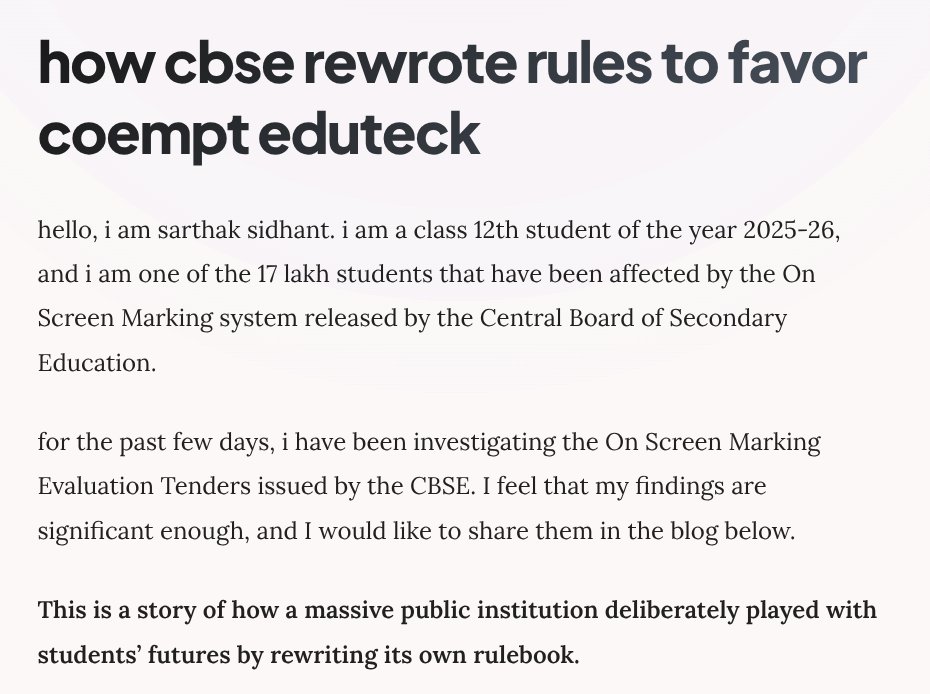
This is an unbelievable piece of work by Sarthak and something that requires amplification.
Let me explain what he found, in simple terms.
Sarthak is a Class 12 student from the 2025-26 batch, one of the 17 lakh students whose answer sheets went through CBSE's new On-Screen Marking system.
He spent days reading through CBSE's evaluation tenders, scraped all 576 tenders CBSE has issued, and tracked how the rules changed across three versions of the same tender.
The core finding is that the company that won the contract to scan and grade 17 lakh students' answer sheets is Coempt Eduteck.
Coempt used to be called Globarena Technologies. Globarena was the company behind the 2019 Telangana intermediate exam disaster, where software failures led to 3.8 lakh students getting wrong or missing marks, and 23 students died by suicide.
A government committee found systemic failure and negligence. Six months later, Globarena rebranded to Coempt Eduteck.
So a company with that track record won a contract to handle 17 lakh CBSE students. Sarthak's investigation is about how the rules were rewritten to let that happen.
The tender was issued three times.
> First tender, February 2025. It existed, then disappeared from the public GeM portal. Sarthak scraped all 576 CBSE tenders and this one was missing from the archive entirely.
> Second tender, May 2025. Four companies applied including TCS and Coempt. All four failed the technical evaluation. Cancelled.
> Third tender, August 2025. Coempt won. Between the second and third tender, a series of rule changes happened, and every single one made it easier for Coempt to qualify.
Here is what changed, one by one.
01. The old rules disqualified any company with a history of abandoning work, failing to complete contracts, or financial weakness. The new rules deleted this clause entirely. Coempt's Telangana history stopped being a barrier.
02. The old rules disqualified any company that was "blacklisted earlier." The new rules changed this to "currently blacklisted." Because Globarena rebranded after Telangana, removing the word "earlier" effectively erased their past.
03. The rules required Rs 50 crore average turnover over three years. Coempt's exact average came to Rs 50.86 crore. They cleared the bar by less than 1%. Earlier, a smaller company had asked CBSE to lower the bar to Rs 30 crore for fairer competition. CBSE refused. So the bar was kept high enough to block small players, but sat exactly low enough for Coempt to scrape through.
04. Software maturity is measured on the CMMI scale, 1 to 5. The old rules required Level 5. The new rules dropped it to Level 3. Coempt is a Level 3 company.
05. The cooling-off period for engaging retired CBSE officials was cut from two years to one. This makes it easier to use recently retired insiders to influence the process.
06. The old rules required experience with large projects of at least 5 lakh students each. The new rules removed the student count and counted cumulative answer-book volume across small projects instead. Coempt has many small fragmented university contracts. This helped Coempt and hurt TCS.
07. The old rules required bidders to own their own data centre and disaster recovery centre on Indian soil. The new rules allowed third-party MeitY-empanelled cloud hosting. Coempt runs on AWS and Azure. This helped Coempt and hurt TCS, which owns its own data centres. It also means student data is no longer on sovereign, Indian infrastructure.
08. The old rules required the bidder to own or control the complete source code of its software. The new rules deleted this. Coempt's platform runs on Microsoft's proprietary IIS, which they don't own.
09. A last-minute corrigendum, issued right before bid submission, removed CBSE's own power to blacklist the firm if its software failed catastrophically. So even a Telangana-scale failure couldn't get Coempt banned from future government tenders.
10. The penalty structure shifted from punishing mistakes to punishing delays. The old rules fined the vendor for wrong scanning, merged pages, and unscanned books. The new rules dropped those and instead levied Rs 50,000 per day for delays. This incentivises rushed scanning over accurate scanning.
11. The old rules had a hard accuracy threshold, error rate not to exceed 0.5%. The new rules removed this number entirely.
12. The old rules specified proper book and robotics scanners. The new rules just say "sufficient scanners." The definition was vague enough that, as Sarthak notes, the scanning could be done with a phone on a stand.
13. On the security side, the contract required a VAPT (vulnerability and penetration test) certified by CERT-In before go-live, and a restricted beta phase before launch. The system clearly wasn't restricted, because the other researcher, Nisarga, was able to access it and find vulnerabilities four days before go-live. So the mandatory security audit appears to have been bypassed.
These are more than a dozen rule changes, all between the failed tender and the winning tender, all pushing in the same direction, all benefiting the one company with the worst track record in the field.
The security holes Nisarga found last week now have an explanation. The system was built by a vendor that was specifically allowed to skip the security certification, the source code ownership, the data sovereignty, and the quality thresholds the original rules demanded.
Following things need to happen immediately;
1. An immediate CAG audit of the tender process.
2. A parliamentary debate on the topic.
3. An independent investigation into
> Why the first tender vanished?
> Why the disqualification clauses were deleted?
> Why the turnover bar was held exactly where it was?
> Why the security level was dropped?
> Why the blacklisting power was removed at the last moment?
Sarthak, this is genuinely exceptional investigative work. Far better than most journalists with full resources ever manage. Take a bow. :)
It would great if everyone uses #VFSHorrorStory as a hashtag & share their story tagging @EUCouncil@EUCouncilPress
Here is a story that happened with my nephew & his parents. My nephew was 8months and his parents applied for a Schengen visa in 2023.
He would neither have an email or phone number because he is obviously 8 months old. But @VFSGlobal wanted to charge him also for SMS charges.
Parents were saying that it’s not like only he will get the visa and they won’t & if either one of them don’t - it doesn’t matter whether he gets it or not because the trip won’t happen.
But who will teach logic to these corrupt & conniving folks. All this while, both the parents have paid for that SMS service.
Eventually they gave in because people have to go actual jobs vs. being in front of people whose entire job is to thug you out of your hard earned money.
There are many stories like this - someone who was forced to take new photos (500 for 4) while the visa came with old photos only, a family of 4 forced to buy premium if all had to submit as a group (which is complete miss selling), insurance, delivery insurance, etc.
I just want to create a massive list of complaints that EU can’t ignore against these motherf**kers.
Please add & RT
Here are the details:
Key Points from the Articles on VFS Global Visa Operations
- European Union inspection reports (2020–2025) from 20 member states identified multiple operational lapses at VFS Global visa application centres, particularly in India (New Delhi, Mumbai, Ahmedabad, Chandigarh, and Jalandhar).
- Personal and biometric data were mishandled, including storage on unencrypted CDs, transmission via open email, and failure to destroy records older than the stipulated period, resulting in non-compliance with GDPR data-protection requirements.
- Communication regarding optional value-added services (such as premium lounges, courier delivery, and extended hours) was deemed misleading, with fees not clearly presented as non-mandatory and unrelated to visa approval.
- Additional irregularities included visa shopping by agents, sale of fake appointments and documents, high no-show rates, and improper retention of passports.
- A separate investigative report characterises VFS Global as a “visa empire” that outsources visa processing for 71 governments, deriving significant revenue growth—profits quadrupled from 2017 to 2024—primarily from high-margin optional services (approximately 30 % of total revenue).
- Staff sales incentives and aggressive upselling practices have been linked to pressure on applicants, especially from countries with weaker passports, raising concerns about profiteering and the privatisation of border-control functions.
- VFS Global has rejected allegations of improper conduct, stating that its operations are subject to rigorous governmental oversight and that remedial measures have been implemented where required.
Statement of VFS: https://t.co/DflnvW99Bs
Source:
https://t.co/mdsrsoDGvp
https://t.co/IGDHtt7cpj
CO-PUBLICATIONS:
The Indian Express: https://t.co/TKyxM4T1lT
The Indian Express: https://t.co/mdsrsoDGvp
The Indian Express: https://t.co/L24Z6bf1Zi
News24: https://t.co/wpnXmNpPSL
Politico: https://t.co/VsjtWCHZQ7
Kisa Dalga: https://t.co/3TNQptj8aS
I stopped teaching after that as I figured the school just wanted physically present "teachers" so they could collect fees from students without caring about the quality of education provided.
I taught in an architectural school for a short time. I was forced to go back to the school a day before term results were published and I had to pass every single student in internal marking - even those with 10% - beacuse the school did not want to fail even a single student 🤷
The main reason I quit academia and gave up a tenured faculty position at @EastCarolina was because I caught a student red-handed plagiarism a term paper. Failed them.
But administration forced me to change their grade and I was threatened with a lawsuit by the parents 1/2