NEW: Students go nuts after donor announces during his commencement speech that he is paying off all of their senior year debts.
Anil Kochhar and his wife decided to give the gift to all ~200 graduates in N.C. State's family.
Kochhar is the son of Prakash Chand Kochhar, an immigrant from India who studied textile manufacturing in Raleigh.
"My father found not just an education, but an opportunity that allowed him to build a life, support his family, and begin a legacy that continues today. And it will never stop, never," Kochhar said.
Online now!
A Comment from Raffaella Buonsanti and colleagues examines the in situ regeneration of CO2 electroreduction metal catalysts as a tool to achieve operational stability.
Link ($): https://t.co/4PrJaGTi4m
Free PDF: https://t.co/Th3f5ACxK8
Where descriptors hold and where they don't: ML catalyst screening meets real alloys
ML pipelines for catalyst discovery rest on a simple bet: a handful of electronic-structure descriptors — typically d-band centre and work function, or their theoretical cousins CO adsorption energy and potential of zero charge — stand in for the full free-energy landscape of a reaction. Activity volcanos built on these descriptors guide screening across millions of candidates. But the bet was made on clean, single-element surfaces. How well does it hold on the messy alloys one would actually synthesize?
Beomil Kim and coauthors build the uniform dataset this question has been missing. Co-sputtering Au–Ag–Pd binary and ternary alloys onto PTFE membranes yields single-phase FCC films with near-identical morphology and continuously tunable d-band centre (−5.4 to −1.6 eV) and work function (4.46 to 5.17 eV). Every alloy is run through CO₂ electrolysis in a flow cell at three potentials, giving a clean activity map across the two-descriptor plane.
The descriptors hold — partially. CO production tracks the d-band centre cleanly (R² ≈ 0.86–0.89). For HCOO⁻ and H₂, the work function becomes a necessary second axis, producing a two-dimensional volcano. So far, so screenable.
Then the informative failure: they engineer Au₁.₅Ag₁Pd₃ and Au₃Ag₁Pd₃ with d-band centre and work function essentially matching Cu — the metal famous for C–C coupling to ethylene, ethanol, propanol. The descriptor model predicts C₂₊ products. Experiment delivers none, at any potential. Charge-dependent DFT explains why: on the heterogeneous alloy surface, different sites fail at different steps — CO₂ adsorption, CO retention, OCCO coupling — and Cu's gift is avoiding all three at once, something two global descriptors cannot encode.
The lesson for ML models built on adsorption-energy features: single-site descriptors work for single-step products but silently break on multi-step pathways where site heterogeneity and coverage matter. Volcano-based screens remain useful for CO, formate and H₂ targets in electrocatalysis and clean-energy R&D, but C₂₊ fuel discovery and complex hydrogenations need richer representations — site-resolved features, coverage-aware models, learned potentials — before industrial pipelines trust the predictions.
Paper: Kim et al., Nature Catalysis (2026) — Journal license | https://t.co/v4mo44Mk4p
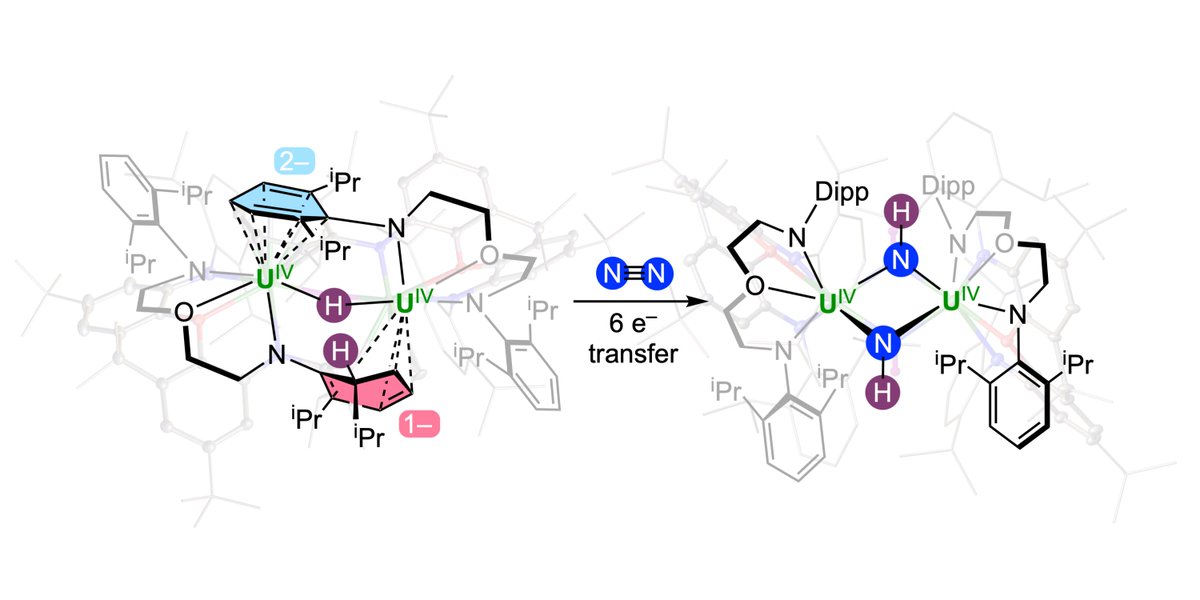
Our chemistry from the recent print issue of @J_A_C_S: six-electron activation of dinitrogen enabled by a uranium bis(anilido)xanthene complex. Was enjoyable to explore this unusual reactivity together with @YPYuePang! @EPFL_CHEM_Tweet
https://t.co/ygkkv3V8nW
New paper ⚠️ on High Entropy Oxides https://t.co/vwCArGkxaq with Xiaolin Zheng @StanfordEnergy and Jinghua Guo @LBNL thanks Jihyun Baek Kiran Hamkins and others