Quizá los niños más privilegiados en la era de la IA no serán los que tengan más chatbots, tutores digitales o juguetes inteligentes.
Serán los que tengan padres y profesores que sepan cuándo apagarlos.
La tecnología puede enseñar. Pero socializar, debatir y frustrarse también educa.
https://t.co/XzhKz3enFe
https://t.co/rjImsa4G9U
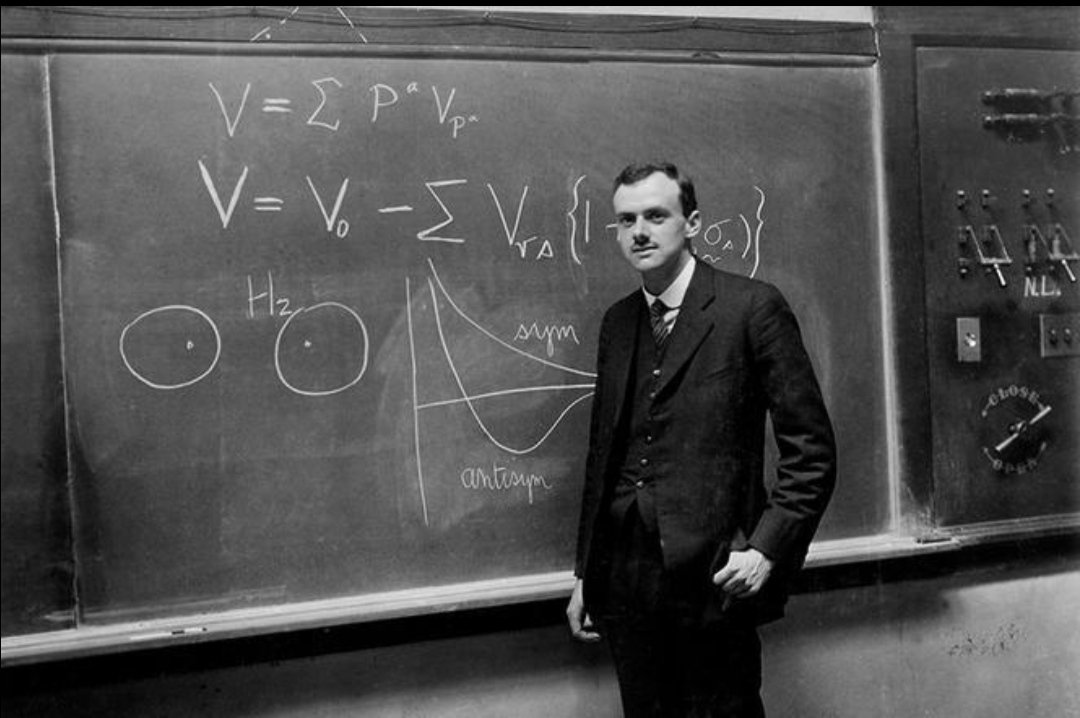
Paul Dirac, Nobel laureate and pioneer of quantum mechanics, was famous for his extraordinary precision, even in ordinary conversation.
During a lecture, an audience member remarked that they did not understand an equation on the blackboard.
Dirac remained silent.
When asked why he had not responded, he explained:
"That was not a question, it was a statement."
The anecdote was later verified by biographer Graham Farmelo, who established that Dirac had given similar responses on several occasions.
The same physicist formulated the relativistic Dirac equation in 1928, which led to the prediction of antimatter, experimentally confirmed in 1932.
For Dirac, precision extended from mathematical equations to everyday language.
During her adolescence, Sabrina Gonzalez Pasterski constructed a functioning aircraft from an assembly kit and piloted the vehicle independently by the age of sixteen. Today, the prominent theoretical physicist, frequently compared to Albert Einstein by academic peers, conducts research aimed at uncovering the fundamental mathematical structure governing the cosmos. She currently serves as a faculty member at the Perimeter Institute for Theoretical Physics in Ontario, Canada, where she manages the Celestial Holography Initiative.
Her primary research focuses on quantum gravity, a profound challenge in modern physics centered on reconciling Albert Einstein's general relativity, which explains macro-scale gravity, space, and time, with quantum mechanics, which dictates the behavior of subatomic particles. Within this domain, she has formulated a novel structural framework designed to describe the essential physics of our universe.
This model, known as celestial holography, maps bulk gravitational interactions onto a lower-dimensional boundary. The paradigm conceptualizes the universe similarly to a standard hologram, suggesting that four-dimensional spacetime phenomena can be mathematically encoded on a vast, distant spherical boundary encompassing the cosmos, mirroring the way a flat surface stores a three-dimensional visual image. Pasterski notes that the highly specialized nature of this advanced framework limits meaningful discussion of her research to a few thousand experts globally.
Her path to high-energy physics deviated significantly from traditional academic trajectories. After completing her experimental aircraft construction as a teenager, she attended the Massachusetts Institute of Technology, graduating in 2013 with the highest achievable grade point average in the physics department. She subsequently pursued graduate studies at Harvard University, earning a doctorate in 2019.
During her doctoral work, she co-discovered a novel manifestation of infrared physics known as the spin memory effect. This phenomenon represents a permanent, physical distortion or angular momentum imprint left behind in the fabric of spacetime after the passage of gravitational waves. While these concepts currently remain entirely theoretical, they establish a foundational roadmap for ongoing investigations into quantum gravity.
References:
Pasterski, S., Pate, M., & Raclariu, A. M. (2021). Celestial Holography. Snowmass 2022 White Paper, arXiv:2111.11392. DOI: 10.48550/arXiv.2111.11392
Pasterski, S. (2024). A Chapter on Celestial Holography. In Handbook of Quantum Gravity, Springer, arXiv:2310.04932. DOI: 10.48550/arXiv.2310.04932
Pasterski, S., Strominger, A., & Zhiboedov, A. (2016). New Gravitational Memories. Journal of High Energy Physics, 2016(12), 053. DOI: 10.1007/JHEP12(2016)053
Durante años Finlandia fue presentada como el modelo: autonomía, competencias “transferibles”, menos énfasis en contenidos y menos evaluación.
Pero sus resultados PISA llevaban cayendo incluso cuando otros países trataban de imitarla.
La reflexión del Financial Times es interesante: pensamiento crítico y creatividad no sustituyen al conocimiento; en gran medida dependen de él.
El contraste con Inglaterra y con reformas como las de Mississippi vuelve a poner el foco en currículo, enseñanza explícita y exigencia académica.
https://t.co/EnN5xGqK7Y
https://t.co/TI8kJ9BVNO
The team over at @chromeunboxed is back at it again! They just published a new video, and they're giving away a Lenovo Slim 3 Chromebook!
https://t.co/AVHzPEZWZt
How he invented Dijkstra’s algorithm
In 1956 the Mathematical Centre needed a public demonstration for its new ARMAC computer that ordinary people could understand.
Dijkstra chose the problem: “What is the shortest way to travel from Rotterdam to Groningen?”
One morning while shopping in Amsterdam with his fiancée Ria Debets (herself a programmer), they sat down on a café terrace for coffee. In about 20 minutes, without pencil or paper, he designed the algorithm entirely in his head. He later said one advantage of working without paper was that it forced him to avoid unnecessary complexity.
He implemented it on a simplified map of 64 Dutch cities (chosen so each city could be encoded in 6 bits). The algorithm was published three years later, in 1959, in a two-page paper titled A Note on Two Problems in Connexion with Graphs.
It remains the foundation of GPS, Google Maps, network routing, and countless other systems.
@jimmyeatworld it sounds more like a excuse... @grok how high are the odds that two members of two festival headliners had health concerns the same weekend?
John Nash’s Ph.D. dissertation at Princeton, “Non-Cooperative Games,” was only 26 pages long submitted in 1950 and had very few citations.
He cited two works: John von Neumann and Oskar Morgenstern’s Theory of Games and Economic Behavior (1944), which helped establish modern game theory, and his own paper, “Equilibrium Points in n-Person Games.”
Nash’s work introduced the concept now known as the Nash equilibrium and became an important contribution to game theory. He later received the 1994 Nobel Prize in Economics.
¡Baldemar te está invitando a sacar la tarjeta de crédito DiDi Card! ✨
Al ser invitado, tus posibilidades de ser aprobado aumentan y la línea de crédito que recibirás será mayor
✅ Respaldo Mastercard
✅ No anualidad
✅ Hasta 6% CASHBACK* diario
https://t.co/iTSGBUTeaT
¡Baldemar te está invitando a sacar la tarjeta de crédito DiDi Card! ✨
Al ser invitado, tus posibilidades de ser aprobado aumentan y la línea de crédito que recibirás será mayor
✅ Respaldo Mastercard
✅ No anualidad
✅ Hasta 6% CASHBACK* diario
https://t.co/YLfKi1Py63
¡Baldemar te está invitando a sacar la tarjeta de crédito DiDi Card! ✨
Al ser invitado, tus posibilidades de ser aprobado aumentan y la línea de crédito que recibirás será mayor
✅ Respaldo Mastercard
✅ No anualidad
✅ Hasta 6% CASHBACK* diario
https://t.co/JhWQ5a0JT4