new preprint on solvation free energies:
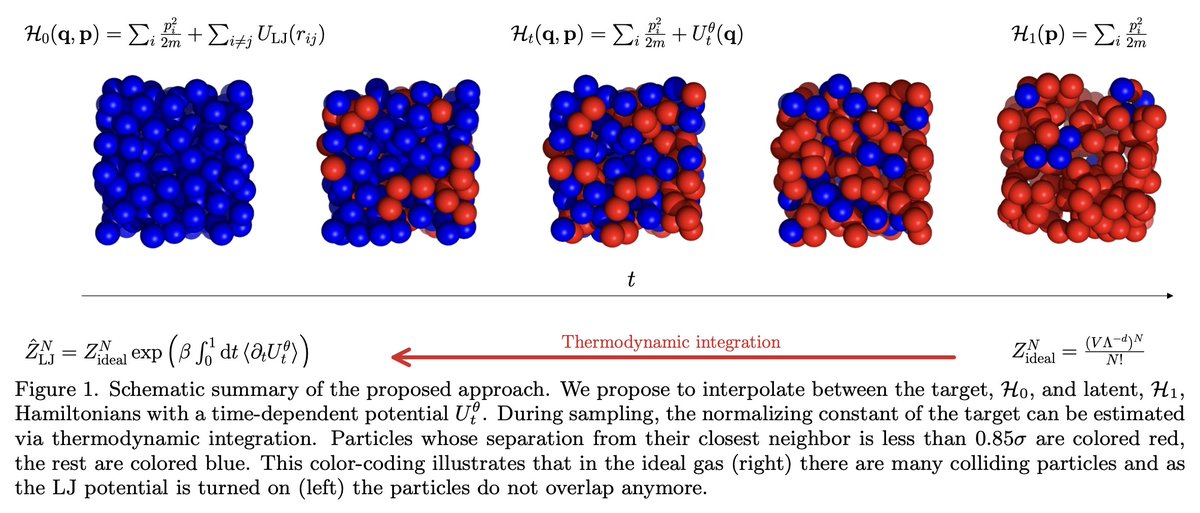
tl;dr: We define an interpolating density by its sampling process, and learn the corresponding equilibrium potential with score matching. https://t.co/sO0EI4sy5r
with @francoisfleuret and @tristanbereau
(1/n)
PhD position in Heidelberg: generating amorphous molecular thin films with diffusion models rather than waiting for MD to equilibrate them — free energies from the same model. With U. Köthe. 3 years, funded. Physics degree required.
https://t.co/AaabLQZYEd
Can we improve energy-based diffusion models by solving a classification task? 🤔
🚀 Excited to share DiffCLF, accepted at ICML 2026 🇰🇷! ! We predict a sample’s noise level, and recover densities as a by-product.
Joint work with @theh2o64 (co-lead) and @jmhernandez233. [🧵1/n]
1/
What happens when a denoiser trained at one noise level is reused inside an iterative sampler?
We trained SwinIR with Noise2Noise at σ=10, then dropped it unchanged into the constrained sampler of @ZKadkhodaie & @EeroSimoncelli (NeurIPS ’21) for 10% random inpainting.
Baseline SwinIR: 6.08 dB on Set12.
SwinIR-WNE: 23.87 dB.
Same backbone. Same N2N pairs. Same sampler.
With François Fleuret @francoisfleuret. ICML 2026. 🧵
🚀 After two years of intense research, we’re thrilled to introduce Skala — a scalable DL density functional that hits chemical accuracy on atomization energies and matches hybrid-level performance on main group chemistry — all at the cost of a semi-local functional. ⚛️🔥🧪⚗️🧬
🚀 After two+ years of intense research, we’re thrilled to introduce Skala — a scalable deep learning density functional that hits chemical accuracy on atomization energies and matches hybrid-level accuracy on main group chemistry — all at the cost of semi-local DFT. ⚛️🔥🧪🧬
@eeevgen@francoisfleuret@tristanbereau In this particular experiment, we ran MCMC for 40k steps and dropped the first 10k as burn-in. I see your concern with direct MCMC, and I guess it depends on the target. We could get away with it for this simple target (only LJ interactions, particles are not too densely packed).
New preprint on performing thermodynamic integration along the trajectories of a denoising diffusion model: https://t.co/DxTbYxVb4X.
With @francoisfleuret and @tristanbereau (1/n)
@eeevgen@francoisfleuret@tristanbereau Hi, thanks for the questions!
1. Yes, we do need samples at t=1.
2. Do you mean something like annealed MCMC? If so, we don't do that, just plain MCMC at the target potential.
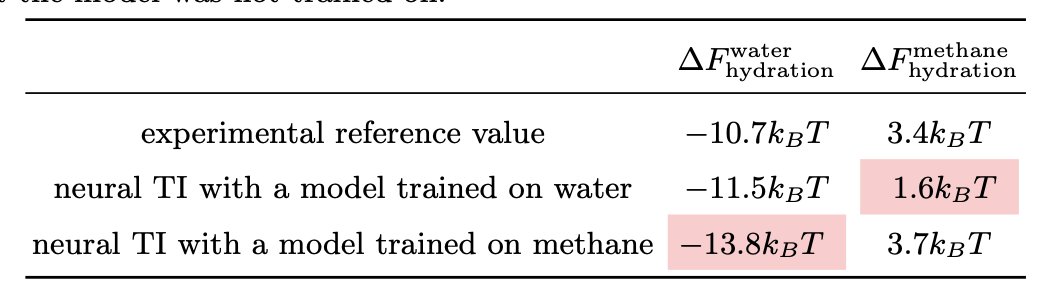
Finally, we also look at what happens if we predict the hydration free energy of methane using the potential that was trained on water (and vice versa). (10/10)
new preprint on solvation free energies:
tl;dr: We define an interpolating density by its sampling process, and learn the corresponding equilibrium potential with score matching. https://t.co/sO0EI4sy5r
with @francoisfleuret and @tristanbereau
(1/n)
The approach is tested on the estimation of hydration free energies of rigid water and methane (LJ + Coulomb interactions). We find good agreement with experimental reference values. (9/n)
That’s a wrap! 🤩🙏🏻
Thank you everyone for making this possible and so enjoyable!
Stay tuned for a second edition in a couple of years! 😉
#ML4PhysChem#workshop#generativeAI#AI4Science