@sejudav 😁😁
Sometimes I read you and hear “voices” of a man who accepts his dreams dissipated into the clouds. Pity I never met you 45 years ago when you NRA lot believed you had the magic to make everything happen…
Today we who were seduced at the time wonder what hit us. Mazima.
"All these years I have spent in the service of mankind brought me nothing but insults and humiliation. It is awful when an honest man is confronted by evil people, and yet he is not built from the same evil material to fight them their way." - Nikola Tesla
What I("we") believed then, and now hasn't changed any bit! What has changed is my perception about the MAGNITUDE OF THE PROBLEM AND THE INCREDIBLE LIMITATIONS OF AFRICAN ELITE.
I believed then, like i still do, now, Africa's problems will never end until WE END THE COLONIAL FOUNDATIONS ON WHICH MODERN AFRICA IS CONSTRUCTED. And to that end, i always dreamed of AFRICA RAISING an ARMY of 5 MILLION Men(w) and unite this Continent in just 5 years! And have always(then&now) been ready to be AVAILABLE IN THIS ENDAVOUR.
Are you Prof @FGoloobaMutebi? Your answer is the usual; "if you can't rule well a small state, how can you......"! That's what hit me later; the LACK OF CAPACITY AND IDEOLOGICAL LIMITATIONS of AFRICAN ELITE!
You right, at the time I picked up arms, I underestimated these.......for that, i plead guilty 😔!
❌ Countries that WON'T improve your life if you emigrate
・Canada 🇨🇦 (rent that devours your salary)
・Ireland 🇮🇪 (jobs yes, housing no)
・Portugal 🇵🇹 (EU prices, low wages)
・United Kingdom 🇬🇧 (expensive visa, and even higher prices)
・Spain 🇪🇸 (long live structural unemployment)
✅ Countries that WILL ↓
Yesterday, @kizzabesigye1 was only partially conscious. He could hear but could not speak. He remains extremely weak. Doctors are still trying to determine what happened to him.
Our family received a briefing from the Mulago doctors treating KB. Yet Prison Officer Siima denied me, his next of kin, the right to join the briefing by phone. His reason? He “didn’t have permission.”
This is the arrogance of arbitrary power. Even at a patient’s bedside, basic rights and human dignity are treated as privileges to be granted or withheld. I am on my way from Rio to be with my spouse. Stand aside, Siima. No one will keep me from him.
The Ugandan model often looks something like this:
- Start with one business that works well.
- Launch another one in a completely unrelated field.
- Then another one...
Mulwana focused on dairy, then expanded into batteries, plastics, and other sectors (not sure of the order but you get the point).
BMK started in spare parts, then moved into machinery, hospitality, and countless other ventures (some related, others less so).
The Western approach would more often be:
- Start with one business that works well in Uganda.
- Expand that same business into Kenya.
- Then move into Rwanda, Burundi, the DRC, Zambia, and so on.
In both cases, diversification means you are chasing new growth venues and somehow attempting to de-risk the whole...
So why are Ugandan entrepreneurs not expanding more outside of the boundaries of Uganda instead of building "conglomerates"?
I used to think the issue was a lack of vision; that the previous generation of entrepreneurs’ “eyes stopped at their country’s borders.”
I now think that interpretation is too simplistic.
Once you have cracked the barriers, informality, information asymmetry, the regulatory landscape and the “I know a guy for everything” network required to operate in Uganda, it may make more sense to build on that infrastructure than to start from scratch in another country.
"It took me 10 years to figure all those things in Uganda, are the pastures really greener in Kenya?"
In a way, replicating Mama Zaabu’s operating model in another country is the easy part.
Figuring out how that country actually works is the hard part...
PS: There is progress being made. Fintech Licensing portability between Kenya, Rwanda and Ghana makes a lot of sense for example. South Sudan introducing visa fees for Ugandans is a blunt counter-expample. It's jurisdiction dependent and ultimately we need to make the "figuring out the country" part easier (at an East African first and continental level later) if we want to build regional champions...
Dear Maj. Gen. (Rtd) @mugishamuntu,
I recently watched you on TikTok telling that sharp satirical story of a man who hated his neighbour. When God appeared to him and asked him to name his heart’s desire, God added that whatever the man asked for would be given twice to the neighbour he hated. The man thought carefully, then asked to lose sight in one eye — knowing very well that his neighbour would lose sight in both.
It was painful, funny, and intelligent in the way good satire often is. You made people laugh, but the laughter carried a serious warning: hatred can make a man accept his own loss, as long as the person he resents suffers more. As I laughed, admiring your wit, I remembered another man from our own folklore: Ishekatabazi of Ntungamo.
There is an old tale about this cunning man. Ishekatabazi had spent two weeks in Karagwe, Tanzania, visiting a friend. But when he returned to the village and people asked where he had been, he did not tell them the truth. He claimed he had been at Kamukuzi, staying at the palace of the Omugabe of Nkore. And from that borrowed authority, he delivered his warning: an anthrax outbreak was coming, and it would kill the cows. The only way to save them, he said, was to cut out their tongues.
The villagers did not believe him at first. They knew him and suspected a trick. So, before dawn, Ishekatabazi drew blood from one of his healthy cows, as elders sometimes did when harvesting blood for food, smeared it around the mouths of his own cattle, and waited. By morning, his neighbours saw what looked like proof. Fear did the rest. One by one, they followed his advice and cut out the tongues of their cows.
By midday, all the cows in the village — except Ishekatabazi’s — were dead. And so, the story says, Ishekatabazi became the richest man in a ruined village.
That is where many people laugh and end the story. They call him clever. They admire the trick. They celebrate the man who outsmarted everyone else. But when I place Ishekatabazi next to the man in your story, the laughter becomes uncomfortable.
The man who asked to lose one eye was not wise; he was consumed by envy. Ishekatabazi was not wise either; he was consumed by the need to dominate others, even if domination meant destroying the village that sustained him. His neighbours had lost their cows, but the village had also lost milk, bride wealth, food security, savings, dignity, and trust. The local economy had shrunk. The people who might have bought his milk were now poorer. The community that might have traded with him was now wounded. The neighbours who might have trusted him now had reason to fear him.
So what exactly had he won? He had become the richest man in a village he had made poorer. That is not wisdom. It is short-sightedness dressed up as intelligence.
And this is where the story becomes deeply political. Fear has always been a tempting instrument for weak leadership because it works quickly. It can silence questions, scatter rivals, divide communities, and make people appear obedient. But fear is a poor foundation for nation-building. It produces compliance, not confidence. It produces silence, not trust. It produces subjects, not citizens.
A leader who governs by fear may imagine he has secured power. A leader who keeps communities suspicious of one another may imagine he has mastered control. A leader who turns tribe against tribe, neighbour against neighbour, party against party, and citizen against citizen may even appear clever for a season. But he is only becoming Ishekatabazi. He is killing the cows of his own village.
People who are afraid do not plan boldly. They do not innovate freely. They do not collaborate honestly. They hide their thoughts, protect themselves, flatter power, and wait for danger to pass. A society ruled by fear may look stable from a distance, but underneath, its productive capacity is being drained. Trust dies first. Then initiative. Then institutions. Then the economy itself.
That is why fear is such a short-sighted tool of leadership. It may protect a leader from immediate challenge, but it weakens the people whose strength he ultimately depends on. He may remain with the last herd standing, but he will be standing in a ruined economy, surrounded by resentment, mistrust, and quiet withdrawal. He may control the people, but he will have weakened the nation.
That is why your story stayed with me. The man who chose to lose one eye and Ishekatabazi who ruined his village are cousins in the same moral family. Both remind us that hatred, envy, fear, and cunning can look like strategy, but only to the short-sighted.
True leadership cannot be built on the poverty and fear of one’s own people. It cannot survive by shrinking the economy, dividing communities, humiliating rivals, or making citizens afraid of one another. A leader who creates poverty and strife among his own people is not strengthening himself; he is weakening the very ground on which he stands.
I finally understand what Machiavelli meant when he said, “Never play fair in a game where others cheat.” It doesn’t mean become evil. It means stop being naive. Stop bringing honesty to people who study manipulation, stop giving access to people who weaponize closeness, and stop expecting clean hands from people who already showed you they’ll throw dirt. Sometimes wisdom is not revenge. Sometimes wisdom is learning the rules of the room before the room uses your goodness against you.
"A judge who is annoyed gives a fine of 200 million shillings and puts a lawyer in prison for several years for contempt of court. What are you trying to demonstrate? When you are dispensing justice, you are not looking at the lawyer in front of you. You are looking at the person he represents. You are looking at justice itself."
Dr. Sam Mayanja, Attorney General of the Republic of Uganda speaking @JSConversations@elisonk
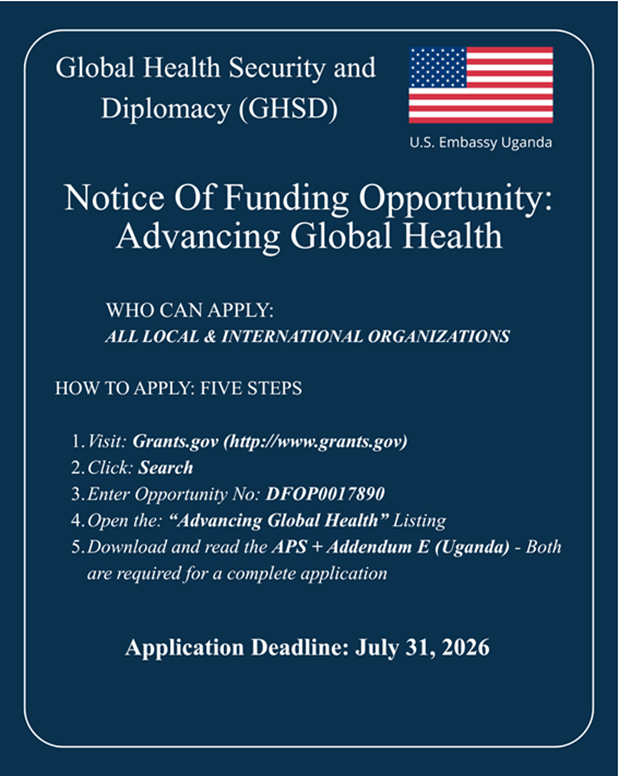
The 🇺🇸 Department of State is offering up to $60M across 15 awards to advance U.S.–Ugandan public health priorities.
📅 Deadline: July 31, 2026
To Apply: Visit https://t.co/Jbo0AYSh8G and search DFOP0017890
✅ NGOs, universities, faith-based orgs, private sector & more are welcome!
❓ Questions? Email [email protected] by June 17, 2026
CV samples
📍USA
https://t.co/iHF06jl1pA
📍Canada
https://t.co/EoRw7V4YEd
https://t.co/2zNCKfdpL7
https://t.co/IdGIRXlD4d
📍Mainland Europe
https://t.co/UADv06Xqzp
https://t.co/0DCbbzmLxa
📍UK
https://t.co/842AWrbAdD
https://t.co/afVmUfan1C
📍Germany
https://t.co/GTVTq0uI4j
📍Australia
https://t.co/vzVq7VhIDi
Here are two highly recommended documents to help you narrow your search. 👇
1. CV, cover letter templates and hints from Harvard University
https://t.co/BDfr1Na9lR
2. CV, cover letter templates and hints from Cambridge University
https:https://t.co/9NsYVpJ88D
CV samples for NGO & scholarship
CV SAMPLES
1️⃣. CV, cover letter templates and hints from Harvard University
https://t.co/BDfr1Na9lR
2️⃣. 10 CV SAMPLES
https://t.co/FmG76pdy0u
3️⃣. CV, cover letter templates and hints from Cambridge University
https://t.co/QybzqSmgpp
4️⃣. 400 ⤵ CV samples
https://t.co/q96S3PYKaw
5️⃣. Academic CV samples https://t.co/rCBYNX4Hoq
6️⃣. Undergraduate CV & cover letter templates from the University of British Columbia, Canada.
https://t.co/3EAPB95gFq
7️⃣. NGO CV https://t.co/LOqGX50JKC
8️⃣. CV and cover letter, Univ of Toronto
https://t.co/3ArDXHzv50