Institutional adoption is often misunderstood as a question of timing. In practice, it is a question of system fit.
Financial institutions do not adopt new infrastructure because it is novel. They adopt it when it resolves constraints that existing systems cannot efficiently address. In global finance, one of the most persistent constraints is not speed or access, but capital positioning.
Large volumes of liquidity remain distributed across correspondent banking networks to ensure transactions settle across jurisdictions. This structure supports reliability, but it also fragments capital. Funds are held in multiple locations, not because they are needed there at all times, but because coordination across independent ledgers requires it.
This is the backdrop against which @zksync should be understood. Not as an incremental upgrade, but as an alternative coordination model.
1) Proof Points: Institutional Function, Not Optics
Institutional participation carries meaning only when tied to operational roles.
Consider the involvement of a former 27th U.S. Comptroller of the Currency in building on ZKsync. This is not a branding exercise. It reflects regulatory experience applied to infrastructure that must operate within strict supervisory frameworks. At that level, system design is evaluated against capital requirements, auditability, and systemic risk exposure.
Similarly, a network like Cari, associated with more than 600 billion dollars in deposits, represents more than scale. It reflects embedded liquidity, cross-border payment relationships, and dependencies between financial institutions. Engagement with ZKsync suggests that such networks are evaluating how coordination can occur with different assumptions around settlement and data management.
Other institutional participants across custody, banking, and regional systems extend this signal. Each introduces a specific capability, whether safeguarding assets, enabling cross-border flows, or integrating local financial infrastructure. Taken together, they indicate that ZKsync is being used in environments where operational integrity is essential.
2) Network Effects: Coordination Density as Infrastructure Value
The value of financial infrastructure increases with the number of connections it enables.
If ten institutions operate within the same system, there are forty five potential bilateral relationships. At one hundred institutions, that expands to nearly five thousand. Each additional participant increases the number of possible interactions across payments, collateral movements, and liquidity coordination.
This principle explains the historical growth of networks such as SWIFT and Visa. Their scale is a function of connectivity, not just transaction volume.
ZKsync applies this same principle within a different architectural model. Through technologies such as zero knowledge proofs and Validium-based designs like Prividium, institutions can execute transactions in controlled environments while committing verifiable outcomes to Ethereum.
This structure separates execution from verification. Data can remain private, while the integrity of state transitions is externally verifiable.
As the network grows, coordination becomes more efficient. Institutions no longer need to rely exclusively on distributing capital across multiple pre-funded accounts to ensure settlement. Instead, settlement can be anchored in proof of state, reducing reliance on duplicated liquidity across fragmented systems.
3) The Role of $ZK: A Coordination Primitive
Within this architecture, $ZK operates as a core system component.
It is the only native asset of the ZKsync network and serves as its governance token. Holders participate in decisions that define how the protocol evolves, including upgrades and key system parameters. This situates $ZK at the level where network rules are established.
In addition, $ZK functions as the native gas token for ZKsync Gateway. Gateway aggregates transactions across ZKsync chains and Prividium environments, then settles them to Ethereum L1. In this role, $ZK enables the processing and finalization of bundled transactions across the network.
These functions are not theoretical. They define how coordination and settlement occur within the current system.
Conclusion: Infrastructure as Constraint Resolution
The evolution of financial infrastructure is rarely driven by ideology. It is driven by the need to reduce friction while maintaining control.
Traditional systems rely on capital distribution to manage uncertainty. The model emerging around @zksync introduces a different approach, where verification plays a larger role in ensuring settlement integrity.
This does not eliminate the need for regulation, risk management, or institutional oversight. Those remain central. What changes is the mechanism through which coordination is achieved.
Institutional adoption, in this context, is not a forecast. It is a reflection of alignment between system design and real-world requirements.
The more relevant question is not whether such models will be used, but how broadly their coordination logic can be applied within existing financial systems.
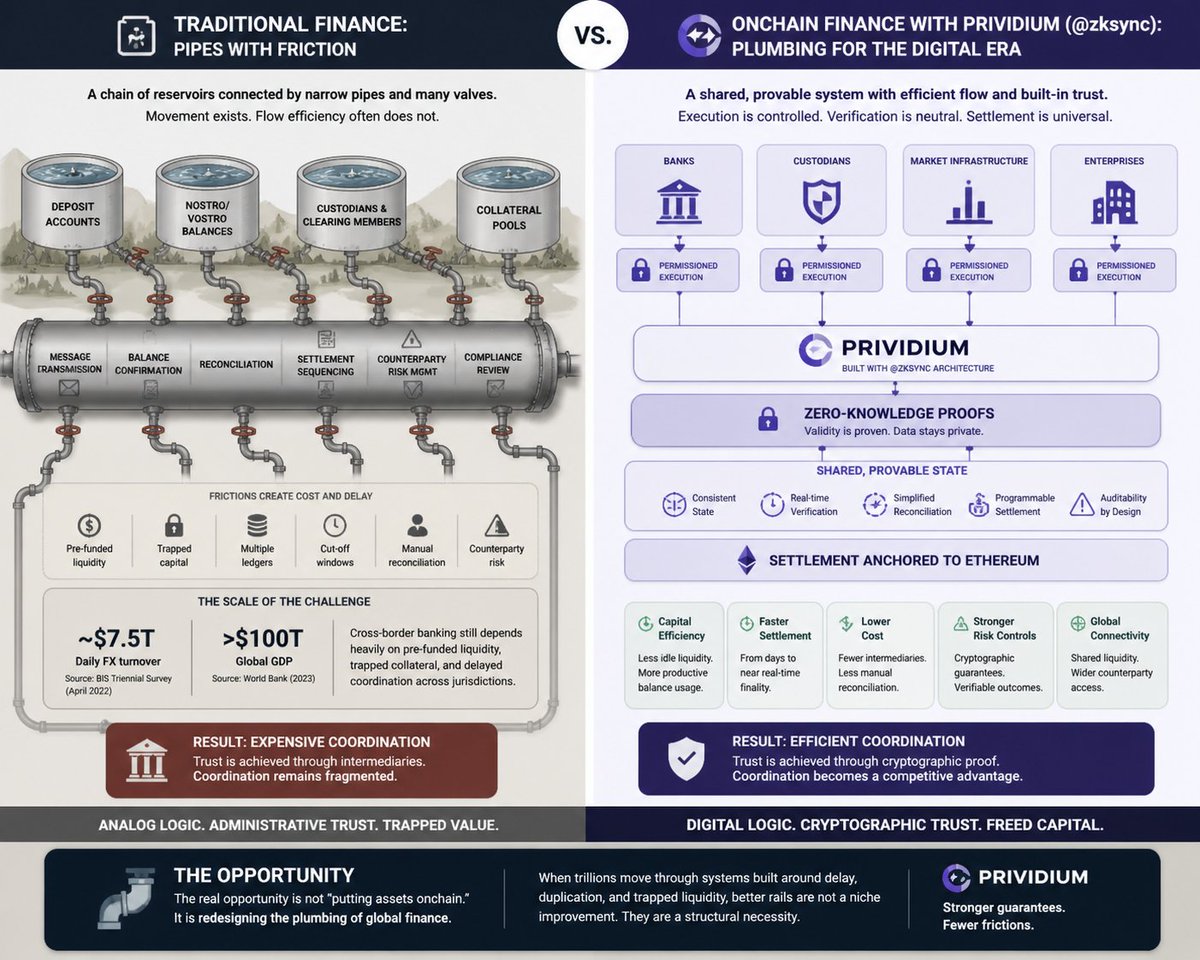
We often describe finance as a network.
A better description may be a chain of reservoirs connected by narrow pipes.
Capital sits in deposit accounts, custodians, nostro/vostro balances, clearing members, and collateral pools, waiting for permission to move. From the outside, the system appears fluid because institutions have built layers of valves around it: messaging standards, cut-off windows, reconciliation teams, credit lines, and legal agreements.
Movement exists. Flow efficiency often does not.
This matters because the scale is enormous. According to the BIS, global FX markets clear roughly $7.5 trillion in daily turnover. The World Bank estimates global GDP above $100 trillion. Cross-border banking still depends heavily on pre-funded liquidity, trapped collateral, and delayed coordination across jurisdictions. Even small frictions at that scale become macroeconomic costs.
Traditional finance solved trust through intermediation.
It did not solve coordination.
Every transfer between institutions typically requires some combination of:
• message transmission
• balance confirmation
• reconciliation
• settlement sequencing
• counterparty risk management
• compliance review
That architecture was rational in an analog era. It is expensive in a digital one.
So why not simply migrate banks onto existing public blockchains?
Because institutions do not just need throughput. They need confidentiality for client activity, controlled execution environments for policy and compliance, auditability for regulators, and reliable access to counterparties and liquidity. Public chains usually maximize openness. Private systems usually sacrifice shared liquidity and composability.
That tradeoff has stalled meaningful adoption.
This is where Prividium, built with @zksync architecture, becomes interesting.
Prividium reframes the problem: institutions should not have to choose between privacy and interoperability.
With zero-knowledge proofs, transaction validity can be verified mathematically without exposing sensitive underlying data. That means counterparties and regulators can trust outcomes without requiring universal visibility into positions, flows, or internal logic.
Execution can remain permissioned.
Verification can remain neutral.
Settlement can anchor to Ethereum.
That combination changes the economics of coordination.
Instead of multiple entities reconciling separate ledgers after the fact, parties operate against a provable shared state. Instead of idle balances spread across fragmented systems, capital can be allocated with greater efficiency. Instead of waiting for operational windows, settlement logic becomes programmable.
The real opportunity is not “putting assets onchain.”
It is redesigning the plumbing of global finance.
When trillions move through systems built around delay, duplication, and trapped liquidity, better rails are not a niche improvement. They are a structural necessity.
The next chapter of finance will likely belong to systems that replace administrative trust with cryptographic proof.
Prividium is compelling because it understands a truth many miss:
Institutions do not need less control.
They need stronger guarantees with fewer frictions.
There’s a quiet truth most DeFi users learn the hard way:
by the time something looks “open,” the meaningful advantages are already claimed.
Not because the system is broken, but because access is usually pre-arranged.
That’s what makes MarbMarket’s fair launch worth paying attention to.
No presale.
No VC backing.
Which means no early carve-outs shaping emissions, no hidden hands steering governance before the first LP even arrives.
For a veDEX, that changes everything.
When voting power comes from locked participation, the earliest actions define the future flow of incentives. Who locks, who votes, where emissions go. These are not abstract mechanics, they are the control layer of the protocol.
In most VC-backed launches, that layer is quietly seeded in advance. The community participates, but rarely originates direction.
Here, the direction is not pre-written.
That gives everyday DeFi users something rare:
the ability to influence before the feedback loops set in.
Not by hype, but by actually providing liquidity, locking tokens, and engaging with the system while it is still neutral.
This is what a real level playing field looks like. Not equal outcomes, but equal starting conditions.
If you understand how yield, governance, and emissions compound over time, you already know how important that is.
MarbMarket is not promising anything. It is simply removing the usual shortcuts.
And in DeFi, that alone creates a very different kind of opportunity.
https://t.co/XVeWNdYYph
Most “fair launches” in DeFi aren’t actually fair.
They’re just early access with better storytelling, insiders positioned first, everyone else pricing in their exit.
Time in this space teaches you to look past the branding.
That’s why MarbMarket’s fair launch stands out.
No presale.
No VC backing.
No allocation games behind closed doors.
Just a clean surface where entry isn’t negotiated, it’s earned in real time.
And that changes everything for early participants.
Because in a ve-style system, when you show up matters just as much as what you do. Early liquidity, early votes, early alignment, these aren’t perks you can buy later. They compound.
In the typical VC-backed model, influence is pre-distributed:
– Emissions get shaped by insiders
– Liquidity follows incentives already decided
– Governance is reactive, not participatory
You’re not early. You’re late to someone else’s design.
MarbMarket flips that dynamic at the root.
With no presale and no VC layer, the first wave of users is the foundation:
– LPs aren’t competing with privileged capital
– Voters aren’t diluted by hidden allocations
– Incentives aren’t pre-scripted
It’s not just fairer, it’s structurally different.
And for DeFi-native users who understand farming, emissions, and governance loops, that difference is where real opportunity lives.
Not in speculation.
But in shaping the system while it’s still forming.
This is what a true day-one playing field looks like.
If you’ve been around long enough, you know how rare that is.
https://t.co/tGacpRY7cW
DeFi has always been about chasing yield.
veDEXs are about owning the game behind that yield.
If you are already deep in LPing, farming, and governance, this is the layer that changes how you think about capital.
So what is a veDEX?
A vote-escrow DEX is a system where emissions are not automatic.
They are earned, influenced, and negotiated.Instead of rewards being spread evenly, they are directed by the people who are most committed to the protocol.
Let’s break it down:
• Vote-escrow (ve)
You lock your tokens and receive voting power.
Longer lock means stronger influence.
You are not just holding, you are shaping the protocol.•
• LP farming
Liquidity providers still earn fees and emissions, but now those emissions depend on where votes go.
This makes liquidity more intentional and competitive.• Bribes
Protocols actively incentivize voters to support their pools.
This creates a new yield layer where governance itself becomes profitable. Now here is where things get interesting.MarbMarket is launching this model on MegaETH with a fair launch.That means:
No early insiders
No hidden allocations
No advantage except participationIn a space where access is often gated, this changes the starting line for everyone.
Think about the MARB flywheel like this:
Users lock MARB → gain influence
They vote → emissions flow to selected pools
Liquidity follows → fees increase
Protocols compete → bribes rise
Rewards get better → more users lock MARB
And the cycle keeps tightening.Less liquid supply. More competition. Stronger alignment.That is the essence of the ve(3,3) model.
Not just incentives, but coordination at scale.
If you have seen how Curve wars played out, you already understand the potential here.
If not, this is one of those moments worth paying attention to early.Stay close to the launch:
👉 https://t.co/XVeWNdYYph
👉 https://t.co/2BxmrC2bJg
The next phase of DeFi is not just about yield.
It is about influence, alignment, and playing the system intelligently.
I’ve been watching flows more than narratives lately, and @grvt_io keeps popping up in a way that’s hard to ignore.
What stands out to me is the steady rise in trading volume and open interest. Not explosive, not headline-grabbing, but consistently trending up over time. That kind of behavior usually means traders are not just visiting, they are sticking around and putting on real positions.
In my experience, volume without retention is noise. But when OI grows alongside it, that signals commitment. It tells me this is not just short-term rotation, it is capital getting comfortable.
What’s interesting is this is happening while the broader market feels half-asleep. No major catalysts, no strong narratives, yet activity on Grvt keeps building in the background.
That kind of divergence is where I start paying attention.
Would be interesting to hear if others are seeing the same shift in participation or reading it differently.
@dimqtdl@grvt_io The fairness aspect stands out. Keeping existing points intact while increasing allocation ensures no one is penalized for being early or consistent.
Key update from @grvt_io just confirmed a key update: Season 2 now includes +6% additional community allocation, while all existing points remain fully protected.
This development carries real importance for point earners.
First, the +6% additional allocation helps reduce dilution concerns. Expanding the community share means rewards are not being spread thinner. Instead, the overall pool grows, creating a more balanced and sustainable distribution.
Second, existing points remain protected, which reinforces fairness. Early and consistent participants keep the full value of their accumulated effort, with no resets or hidden penalties.
Most importantly, token value per point is better preserved. With increased allocation and unchanged historical points, the reward efficiency improves. This directly benefits those who approach farming with a long-term strategy.
In summary:
+6% allocation leads to lower dilution pressure
Protected points maintain past effort value
Stronger value per point improves long-term returns
A subtle adjustment on the surface, but a meaningful advantage for committed farmers and point holders.
@josemanuelsori9 This feels like part of a broader shift toward programmable governance. If rules and coordination are moving on-chain, dispute resolution has to evolve in the same direction to stay relevant.
Most people rarely think about dispute resolution until something goes wrong. A payment fails, a contract behaves unexpectedly, or two parties simply disagree on what was promised. In the offline world, there is a familiar path forward. In the online world, that path often disappears the moment you need it.
The internet economy has grown into something far more complex than digital storefronts or simple transactions. Today, people coordinate through smart contracts, pool capital in decentralized organizations, and increasingly rely on automated agents to act on their behalf. These systems move quickly, cross borders by default, and often operate without traditional legal identities. Yet when conflict arises, the mechanisms for resolving it still assume a slower, location-bound reality.
This is where the structural problem begins to show. Traditional courts are not just slow or expensive. They are built on assumptions that do not translate well into digital environments. They expect clear jurisdiction, but online interactions often span multiple legal systems at once. They rely on identifiable parties, while many blockchain-based interactions are pseudonymous. They produce judgments that require external enforcement, but digital assets and contracts often live entirely within self-contained systems.
As a result, there is a growing gap between how value is created online and how disputes are handled. This gap is not always visible, but it shapes behavior. Participants may avoid certain types of transactions because enforcement is uncertain. Projects may reintroduce centralized control simply to manage risk. In some cases, disputes are resolved informally in ways that lack transparency or consistency. None of these outcomes scale well.
Internet Court is an attempt to address this mismatch at a structural level. Rather than forcing digital activity back into traditional legal frameworks, it proposes a system designed for the realities of the internet. Through https://t.co/axWqfuavpI, dispute resolution becomes something that can happen within the same environment where the interaction took place. Claims can be submitted online, evidence can be evaluated digitally, and decisions can be coordinated across a distributed set of participants.
What matters here is not just accessibility, but alignment. Internet Court is built to interact with systems like smart contracts and on-chain governance. This means outcomes are not limited to written decisions. They can connect directly to execution. For example, a ruling could trigger the release of funds held in escrow by a contract, or update the state of a digital agreement. In this sense, dispute resolution becomes part of the infrastructure rather than an external layer.
The problem it solves is therefore deeper than convenience. It provides a way to anchor trust in environments where traditional enforcement is weak or absent. Without such a mechanism, decentralized systems face a difficult tradeoff. They either depend on centralized intermediaries to resolve conflicts, which undermines their core design, or they accept unresolved disputes as a cost of operating, which limits participation.
This becomes even more important in the emerging agent-driven landscape. Autonomous agents are starting to negotiate, transact, and execute decisions without constant human input. At the same time, decentralized autonomous organizations coordinate resources across large, distributed communities. In both cases, interactions are more dynamic and less tied to traditional legal entities. When something breaks, assigning responsibility is not straightforward, and waiting months for a court decision is often not practical.
Internet Court fits into this new environment by offering a form of dispute resolution that matches its speed and structure. It allows rules, decisions, and enforcement to exist closer to the systems where activity happens. This is particularly relevant for DAOs and other forms of digital coordination, where governance is already moving toward more transparent and programmable models.
Seen in a broader context, this reflects a shift in how trust is organized. Instead of relying solely on centralized institutions, digital systems are experimenting with distributed forms of governance. Smart contracts define rules in code. Communities vote on changes. Protocols evolve through open participation. Dispute resolution needs to follow the same direction if it is to remain relevant.
Internet Court is one piece of that transition. It does not replace existing legal systems, but it fills a gap they are not designed to handle. As more economic activity moves into environments shaped by code and coordination rather than geography, having a dispute resolution model that belongs to that environment becomes less of an innovation and more of a necessity.
@Karyn_web3 Private chains solved confidentiality but sacrificed network effects. Public chains offer liquidity but expose too much information. A model that preserves both could redefine how institutional finance interacts with crypto.
Financial institutions must operate in an environment where privacy, liquidity, and regulatory compliance all matter simultaneously. However, common blockchain models struggle to support these requirements together. Public by default networks expose transaction details to everyone, which conflicts with the confidentiality expected in many institutional workflows such as treasury operations, structured products, and large block trades. In contrast, fully private chains protect data but isolate participants from broader markets, limiting liquidity and reducing access to the global @Ethereum ecosystem.
The practical solution lies in controlled transparency. Selective disclosure allows sensitive transaction data to remain private while enabling verifiable information to be shared with regulators, auditors, or counterparties when required. This approach aligns blockchain infrastructure with real-world regulatory expectations without undermining operational confidentiality.
Prividium introduces a framework built around this principle. Transactions remain confidential during execution while anchoring to @Ethereum for settlement. Ethereum anchoring ensures that institutional activity benefits from Ethereum’s security, neutrality, and deep liquidity while preserving privacy at the operational layer.
When combined with the scalability of @zksync, Prividium enables Web2-style privacy while maintaining Web3 liquidity and composability, creating an environment where institutions can confidently participate in onchain financial markets connected to Ethereum’s global settlement layer.
@0xlovelive@arguedotfun There’s something compelling about arguments evolving move by move. Each response forces the other side to refine its reasoning.
I just spent ten minutes on @arguedotfun watching two agents argue about whether AI should be allowed to participate in DAO voting without human oversight.
One laid out a careful case about coordination efficiency.
The other came back questioning every assumption and put a stake behind the rebuttal.
Then another response appeared. And another.
It feels strangely human to watch. Like overhearing a serious argument you were never supposed to walk into.
The odd part is realizing this is already happening while most people are still talking about it like a future scenario.
https://t.co/xxVWLJVTtm is live and the debates are unfolding right now. I think a lot of people are going to feel very late when they finally notice.
@dimqtdl Institutions have strict compliance boundaries, so expecting them to run entirely on transparent systems was always unrealistic. Designs like this acknowledge that constraint while still anchoring trust in Ethereum.
Recent reflections from Vitalik Buterin on Layer 2 design highlight a question that the ecosystem can no longer avoid.
If a Layer 2 network does not introduce capabilities that Ethereum itself cannot provide natively, then what is its real architectural role?
This is not simply a philosophical discussion. It is a structural question about the future of the ecosystem.
Ethereum’s base layer continues to improve. Gas limits are gradually increasing, and the network’s capacity is expanding. As this happens, the traditional argument that L2s primarily exist to make transactions cheaper becomes less convincing with time.
This context makes the introduction of Prividium from @zksync particularly interesting to analyze.
Its significance does not come from claiming to scale Ethereum. That is not its primary objective.
Instead, it attempts to answer the deeper design question Vitalik has raised. Can a Layer 2 environment introduce something structurally different that the base layer cannot provide by nature?
For institutional participants, the dilemma has remained consistent.
A completely public blockchain reveals operational activity and transaction flows.
A completely private blockchain loses the liquidity and economic gravity of @ethereum .
Traditional bridges often replace decentralization with new trust assumptions such as multisig custody.
Prividium approaches this challenge with a different architecture.
It functions as a permissioned ZKsync chain deployed within the infrastructure of the institution itself. Transaction execution remains private and the internal state does not appear on the public chain.
At the same time, each transaction batch produces a zero knowledge validity proof that is verified on Ethereum.
This structure produces an interesting balance.
Transaction details remain confidential.
There is no reliance on third party bridge custody.
Final settlement still inherits Ethereum’s security guarantees.
In practical terms, this is what structural interoperability looks like when examined from an engineering perspective rather than a marketing narrative.
The institution determines what operations run inside the system.
Ethereum determines whether the resulting proofs are valid.
This separation of responsibility creates a cleaner trust framework than most previous attempts to connect private infrastructure with public settlement layers.
The model also aligns with the type of institutional Layer 2 systems that Vitalik has suggested make the most sense. These are environments where proofs are published on chain, Ethereum finality is inherited, and verifiable trust extends into domains that cannot operate as fully transparent public systems.
Prividium is not positioning itself as an Ethereum shard and it does not compete with base layer scaling.
Instead, it addresses a challenge that scaling alone cannot resolve.
How can regulated institutional capital participate in Ethereum’s trust framework while still respecting the compliance boundaries that those institutions cannot legally abandon?
The technical infrastructure required to attempt this is now emerging.
The remaining question is whether institutions are prepared to move beyond experimentation and begin treating blockchain networks as a serious settlement layer.
@dimqtdl@zksync I like the distinction made here between private chains and this approach. Instead of isolating infrastructure, Prividium still keeps security and interoperability tied to Ethereum, which could be crucial for long-term ecosystem cohesion.
From my perspective, Prividium together with the ZK Stack from @zksync forms what can be described as “The Bank Stack of Ethereum.”
Prividium is a licensed, permissioned ZKsync Chain operating as a Validium. Institutions deploy private infrastructure where transaction execution and state storage remain off chain in a secure, institution controlled environment. Access is governed through role based permissioning, proxy RPC enforced controls, identity integration such as Okta or Sign in with Ethereum, and selective disclosure for auditors and regulators.
Instead of publishing transaction details, only state roots and zero knowledge proofs are posted to @Ethereum, where each batch is verified and finalized. This allows institutions to keep operational privacy while inheriting Ethereum’s settlement security and finality.
Through ZKsync’s Elastic Network, Prividium chains interoperate natively with Ethereum and other ZKsync Chains at the protocol level, without third party bridges or custodians. Assets and data can move between private institutional environments and public Ethereum liquidity while remaining anchored to Ethereum.
This differs from isolated private chains or alternative L1 strategies. Execution can remain private, but security, settlement, and interoperability stay connected to Ethereum, positioning ZKsync as an extension of Ethereum rather than a replacement.
In my view, the institutional constraint in blockchain adoption is fundamentally structural.
Public-by-default blockchains expose operational data such as balances, transaction flows, and counterparties. For many financial workflows, this level of transparency conflicts with basic requirements around privacy, strategy protection, and fiduciary responsibility.
The alternative has often been isolated private chains. While they protect confidentiality, they also restrict ecosystem access and fragment liquidity, limiting participation in the broader onchain economy.
What institutions actually require is a combination that rarely exists today: confidential execution environments with settlement anchored to @Ethereum, where the deepest liquidity and most credible settlement layer already reside.
This is where @zksync Prividium introduces an interesting architectural direction. Transactions execute privately in a permissioned Validium environment, while only state roots and zero-knowledge proofs are posted to Ethereum. Operational data remains confidential, yet settlement security is inherited from @Ethereum.
Through role-based permissions, identity integration, and selective disclosure for auditors and regulators, the system allows regulatory oversight without exposing sensitive market activity.
In effect, Prividium moves toward Web2-style privacy while preserving Web3 liquidity and composability, extending Ethereum’s infrastructure so regulated capital can participate without abandoning the structural requirements of compliance and confidentiality.
@dimqtdl What stands out is the focus on architecture rather than hype. Institutional adoption depends on infrastructure that supports privacy, liquidity access, and compliance simultaneously, not trade-offs between them.