@nomoreid75@562side ada juga kisah dari yang chil-seong dia mengganti nama nya menjadi nama lokal (komarudin) yang di eksekusi belanda dan di jadikan pahlawan nasional karena jasa militernya
@I2zAq@teapeachrose hanya sedikit orang jepang yang baik hati. ada satu cerita lagi tentara jepang yang memberikan edukasi membuat bom tapi dia bukan orang jepang melainkan orang korea. kesimpulannya yang baik itu hanya beberapa orang nya bukan negara nya.
@I2zAq@teapeachrose kenapa laksamana maeda di anggap pahlawan oleh orang indonesia, itu karena dia dengan sukarela membiarkan rumahnya untuk anak muda dan presiden sukarno membuat text proklamasi fasilitas seperti mesin ketik ruang diskusi, tapi sayang dia di anggap penghianat oleh pemerintah jepang
One match. One champion. One prediction. 🏆
Predict the World Cup champion and win an exclusive CMC Keyboard.
How to enter:
• Follow @coinmarketcap and RT.
• Fill in the form → https://t.co/21JRMqVfMi
Top 10 earliest correct predictions win.
📅 Closes July 19th, 2026, before final match kickoff.
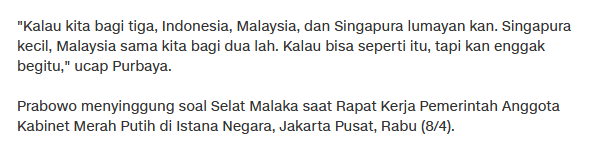
pertama mendengar berita ini dari media singapura (CNA) jadi ga heran mereka kan sudah kehilangan kemampuan Bahasa.
mungkin mereka ga paham Kalimat "Kalau bisa seperti itu, tapi kan enggak begitu"
The Strait of Malacca is one of the most strategically vital maritime corridors in the world, connecting the Indian Ocean with the South China Sea and the Pacific. It is bordered by Indonesia, Malaysia and Singapore, stretching roughly 800 to 930 km.
At its narrowest point in the Phillips Channel near Singapore, it is only about 2.8 to 3 km wide. Because this width is far less than the 12 nautical mile territorial sea entitlement, the entire strait consists of overlapping territorial seas, with no high seas at all. This means it is legally composed entirely of national waters even while serving global navigation.
Under the United Nations Charter, states operate on principles of sovereignty, peaceful dispute resolution and non use of force. However, the Charter does not regulate maritime zones or navigation rights.
The governing legal framework is instead the United Nations Convention on the Law of the Sea. Under Part II, coastal states have sovereignty up to 12 nautical miles, and in narrow straits like Malacca this creates overlapping claims that are delimited by median lines, confirming that the entire strait remains within the territorial seas of Indonesia, Malaysia and Singapore.
At the same time, UNCLOS Part III, especially Articles 37, 38 and 44, classifies it as a strait used for international navigation. It guarantees transit passage for all ships and aircraft, including military vessels, and this passage must be continuous and expeditious and cannot be suspended or obstructed.
Coastal states cannot block passage, require prior permission or discriminate. At the same time, vessels must comply with international rules, proceed without threat or use of force and limit their activities to normal transit.
Related provisions reinforce this balance. Articles 21 and 25 on innocent passage do not allow suspension in straits used for international navigation, while Article 233 permits only limited enforcement in cases of serious pollution damage.
Importantly, coastal states cannot impose tolls or charges merely for transit through the strait, because it is a natural international waterway. This is different from man made canals such as the Suez Canal.
They may charge only for specific services like pilotage or port assistance, and such charges must be non discriminatory.
This creates a precise legal balance. The Strait of Malacca remains under national sovereignty, yet functions as a guaranteed global highway with uninterrupted navigation and overflight rights under UNCLOS, supported by the broader principles of the UN Charter.
bahkan orang malaysia yang mengerti bahasa ngga paham apa yg di omongin pak purbaya atau ga nonton video lengkap nya. kalo singapura ya wajar kan mereka ga bisa anu
Indonesia is mulling a levy on commercial vessels passing via the Strait of Malacca to generate state revenue from the busy shipping corridor.
However, Singapore has opposed any tolls and reaffirmed the principle of free maritime transit through key international waterways.
🧵1