@Fabien_Mikol Par ailleurs, en remplaçant Car wash par autre chose, par exemple un circuit automobile, on obtient à nouveau l'hallucination (du moins de mon coté sur 4.7 Opus)
@Fabien_Mikol Pas mal de tests montrent qu'au cours du mois d'avril, Opus 4.7 ne savait toujours pas répondre à cette question. Je pense que Le Cun a totalement raison : les modèles ont eu un p'tit step de fine-tuning pour override ce comportement spécifique.
Again a massive supply chain attack on NPM. OIDC is solving absolutely nothing.
The only solution is to ban using those pesky postinstall scripts, and eventually allow them for some packages.
SECURITY ADVISORY — TanStack npm packages
A supply-chain compromise affecting 42 @tanstack/* packages (84 versions total) was published to npm earlier today at approximately 19:20 and 19:26 UTC. Two malicious versions per package.
Status: ACTIVE — packages are deprecated, npm security engaged, publish path being shut down.
Severity: HIGH — payload exfiltrates AWS, GCP, Kubernetes, and Vault credentials, GitHub tokens, .npmrc contents, and SSH keys.
If you installed any @tanstack/* package between 19:20 and 19:30 UTC today, treat the host as potentially compromised:
• Rotate cloud, GitHub, and SSH credentials immediately
• Audit cloud audit logs for the last several hours
• Pin to a prior known-good version and reinstall from a clean lockfile
Detection — the malicious manifest contains:
"optionalDependencies": {
"@tanstack/setup": "github:tanstack/router#79ac49ee..."
}
Any version with this entry is compromised. The payload is delivered via a git-resolved optionalDependency whose prepare script runs router_init.js (~2.3 MB, smuggled into each tarball at the package root).
Unpublish is blocked by npm policy for most affected packages due to existing third-party dependents. All 84 versions are being deprecated with a SECURITY warning, and npm security has been engaged to pull tarballs at the registry level.
Full technical breakdown, complete package and version list, and rolling status updates:
https://t.co/Zy8qG7PA9f
Credit to the security researcher for responsible disclosure.
This is what happens when you bypass a human in the loop and give access to all your laptop.
It's not a Cursor fault, not a Raleway fault. It's a chair/keyboard interface problem: the developer.
Just mount your secrets using temporary volumes and execute commands yourself.
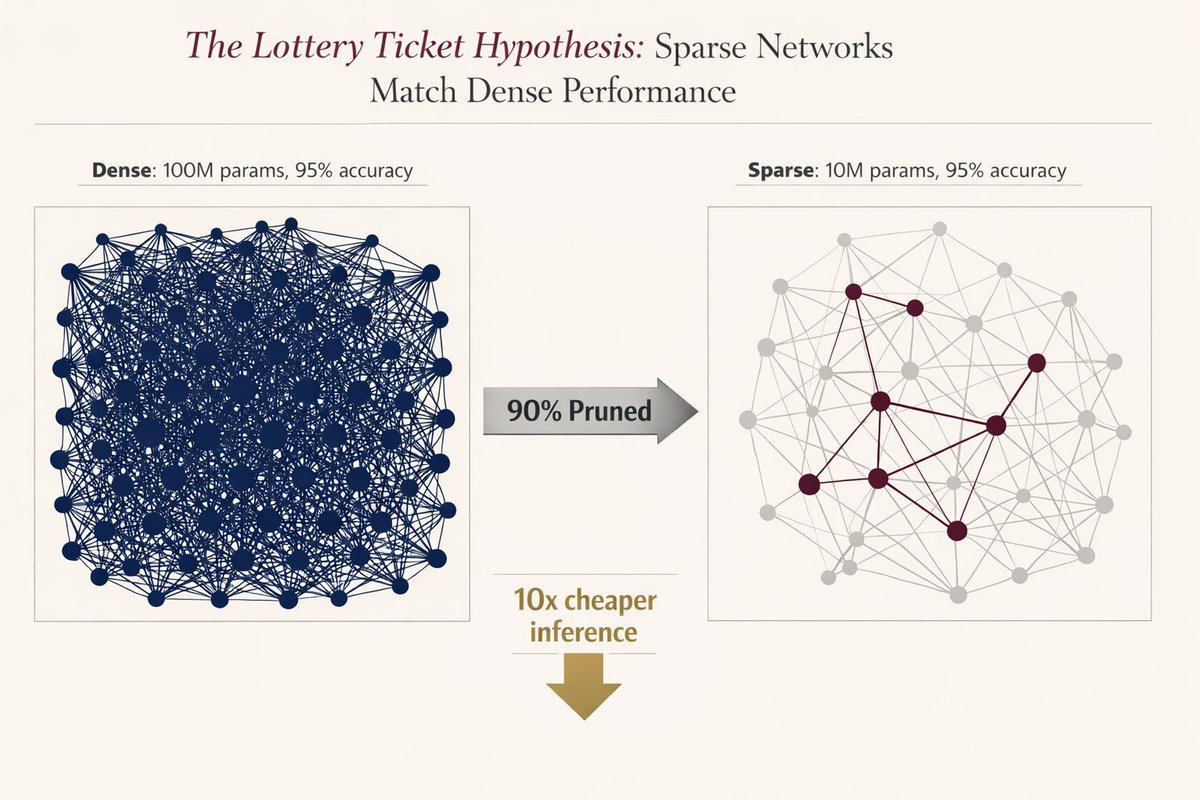
🚨 MIT proved you can delete 90% of a neural network without losing accuracy.
Researchers found that inside every massive model, there is a "winning ticket”, a tiny subnetwork that does all the heavy lifting.
They proved if you find it and reset it to its original state, it performs exactly like the giant version.
But there was a catch that killed adoption instantly..
you had to train the massive model first to find the ticket. nobody wanted to train twice just to deploy once. it was a cool academic flex, but useless for production.
The original 2018 paper was mind-blowing:
But today, after 8 years…
We finally have the silicon-level breakthrough we were waiting for: structured sparsity.
Modern GPUs (NVIDIA Ampere+) don’t just “simulate” pruning anymore.
They have native support for block sparsity (2:4 patterns) built directly into the hardware.
It’s not theoretical, it’s silicon-level acceleration.
The math is terrifyingly good: a 90% sparse network = 50% less memory bandwidth + 2× compute throughput. Real speed.. zero accuracy loss.
Three things just made this production-ready in 2026:
- pruning-aware training (you train sparse from day one)
- native support in pytorch 2.0 and the apple neural engine
- the realization that ai models are 90% redundant by design
Evolution over-parameterizes everything. We’re finally learning how to prune.
The era of bloated, inefficient models is officially over. The tooling finally caught up to the theory, and the winners are going to be the ones who stop paying for 90% of weights they don’t even need.
The future of AI is smaller, faster, and smarter.
New JS library: farmhash-js https://t.co/Cp8gf04Ixb
at Crisp we use hash64 and hash32 functions a lot.
Issue: native versions have different outputs between x86 and ARM.
This package allows the use of an x86 farmhash on an ARM server, or on the edge.
It was 100% vibe coded with Cursor / Opus 4.5, using adversarial agents:
One agent generates tests, runs them on the original Farmhash on different archs via CPU emulation.
Clone farmhash cpp implementation, and then compare values.
@HarksenNiels@ConnorAllenEU I don’t believe the MGCS is dead because of France.
Germany replaced Tigre Apache.
Germany has shares in the a321 program and instead went on P-8 Poseidon.
The list of examples like this is long and embarrassing.
@danielkempe@crisp_chat There is a compatibility mode with your existing chatbot. A bit like Rosetta from Apple ;)
Works strictly as before, and it's a 1-click opt-in process.
After more than 6 months of non-stop work on a secret Crisp product, I'm incredible proud to announce that it's now out! It's called Hugo. ⬇️
👉Check it out at https://t.co/2Up11AOEfG
Hugo helps you automate a large chunk of your Crisp customer support with a top notch AI Agent, so that you can focus on providing human customer support on what matters: high value customers, gathering feedback, handing bug reports, etc.
Hugo handles all the rest for you while you sleep, or work on your product.
You can already try & train Hugo from a single dashboard from your Crisp app, feeding it with your own website, CSV documents, Q&A and your Crisp KB. If you already run a Crisp chatbox on your website, enabling Hugo only takes 2 minutes, and it's included for free in your Crisp paid subscription!
This is great pair work with @baptistejamin and the rest of the Crisp team.
Meet Hugo: your AI support agent built for real conversations.
We’ve spent months at @crisp_chat in private beta, training Hugo on thousands of customer interactions.
Today we’re opening Hugo to everyone.
➡️ Free trial available – reply ‘Hugo’ and RT to get your first free agent live today
And the results are already here:
✅ $28k saved through automated conversations
✅ AI resolution rate doubled from 20% to 40% for a finance app
✅ only 19% of conversations escalated to human support
This is how support stops being a bottleneck and becomes a competitive advantage.